Archive for April, 2010

Still seeking Susan Sontag …

Friday, April 30th, 2010
Share

sontag3Czesław Miłosz told me in 2000:  “It seems to me every poet after death goes through a purgatory, so to say.  …  So he must go through that revision after death…”

He was referring to T.S. Eliot — but he might as well also have been referring to prose writers, too, such as essayist and novelist Susan Sontag. We recently participated in the cyberspace roasting with Terry Castle here — but reading an interview with Sontag by my friend James Marcus (of House of Mirth blog fame) reminded me of how inspiring and impressive she was in the first place — a figure so relentless and towering that you craved her approval and patronage.  You can read the Marcus interview here.   An excerpt that reminds me why I’ve spent a lifetime with my nose in a book:

“Reading should be an education of the heart,” she says, correcting and amplifying her initial statement. “Of course a novel can still have plenty of ideas. We need to discard that romantic cliché about the head versus the heart, which is an absurdity. In real life, intellect and passion are never separated that way, so why shouldn’t you be moved by a book? Why shouldn’t you cry, and be haunted by the characters? Literature is what keeps us from shriveling into something completely superficial. And it takes us out of ourselves, too.”

“Perhaps some people don’t want to be taken out of themselves,” I suggest.

“Well, reading must seem to some people like an escape,” she allows. “But I really do think it’s necessary if you want to have a full life. It keeps you–well, I don’t want to say honest, but something that’s almost the equivalent. It reminds you of standards: standards of elegance, of feeling, of seriousness, of sarcasm, or whatever. It reminds you that there is more than you, better than you.”

Hal Holbrook: “We’re the clergymen of the world in disguise!”

Wednesday, April 28th, 2010
Share
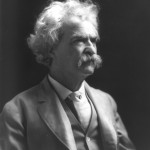
twain2

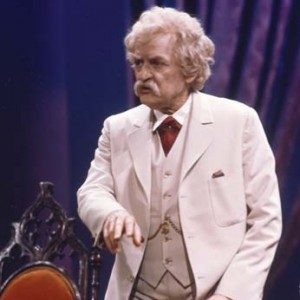
Hal Holbrooke, inevitably, as Mark Twain

I walked into the Piggott Theater only a few minutes late, but Hal Holbrook was already going at full gale force:  “They interrupt each other!” he exploded. He was talking about the downfall of television news, and I had entered the tirade at mid-point.  “Ninety percent of the American people don’t have an opinion worth putting on television!”

Even without the makeup, the famous white moustache, and the costume, Hal Holbrooke will always be Mark Twain.  There’s nothing I know quite like it in the history of theater: Holbrook first performed his one-man show at the Lock Haven State Teachers College in Pennsylvania over half-a-century ago, in 1954 — and his most recent enactment of Mark Twain Tonight! took place  Tuesday night in Memorial Auditorium.  This was a follow-up session with Stanford students and a few hangers-on, like myself, at a Q&A session in Piggott Theater.

Holbrook is an astonishing 85 years old, and by now it’s impossible to know where Holbrook leaves off and Twain begins.  It’s an miraculous meshing between the subject and his impersonator, between art and reality — to the benefit and ennoblement of both.

“The beauty of Mark Twain is that he lays a thought on your lap and walks away, and lets you handle it,” said Holbrook.  So here are a few thoughts from Holbrook, or Twain, for you to handle:

On American leadership:  “We take our opinions to the public trough, and follow the leader who makes the most noise.”

On Democrats and Republicans: He — or Twain? — disparaged the two-party system, which “turns voters into slaves and rabbits,” and praised the independent voter.

On the New York Times: “I know it leans to the liberal side, but so do I — so I have to watch out!” he said.  Hence, he confessed that he listened to Glenn Beck — then, with his hand, put a mock pistol to his head and jokingly fired it.  “It’s my job!” he said.  “We’re not supposed to all think alike — but we are all supposed to listen to each other.”

On the intelligentsia: “I admire it, it’s important … but now that we’re done for,” he shrugged.  “If the intelligentsia is not married to morality…”  Then Holbrooke launched into a jeremiad about the downfall of America, which Twain (or Holbrook?) had compared a great machine whose belt has slipped, but still goes on.

On morality: While many blame homeowners for taking on mortgages they couldn’t afford, Holbrook said that people have always been  suckers for things they can’t afford and morality enters with “your responsibility not to incite people to buy something they cannot afford” — an opinion that, taken alone and enacted into law, would cause major economic reform in America.

On performing villains: “You understand that people who are corrupt don’t get it — that’s the point.  They don’t know they’re corrupt,” he said.

Holbrook keeps detailed accounts of all his Twain engagements — his last at Stanford was in 2000, and he was surprised when he checked his records and found his subject had been “Money is God.”

“You see, I was thinking ahead of the bubble!” he said.  Looking around Silicon Valley, he felt “a lot that was happening here was chancy.  What causes  chanciness?  Greed.”

“He wrote this!  Great republics do not last.”  Money causes corruption, which “excites dangerous ambitions and brings the republic down.”

Holbrook reminisced about playing another larger-than-life American from the 19th century, Abraham Lincoln.  With corked shoes, Holbrook boosted his 6′ height a few inches to rival Lincoln’s 6′-3/4″ — but the size 14 shoes were beyond his reach.  He urged young actors to do their research. In his own reading on Lincoln, he noted that contemporary news reports of Lincoln’s debates described his voice most frequently as “high,” “shrill,” “flat,” “nasal,” and “unpleasant.”  A colleague described his speaking style: Lincoln planted his feet together, pointed forward, when he spoke, and didn’t move them while gesticulating wildly.  It’s not, Holbrook said, the picture one forms from the statue in Washington D.C.

And it sounded like he was going to conclude with a hymn to thespians:  “I think the acting profession is a noble profession. It’s been given a bad name by people who don’t know how to behave properly.”

“You have to believe in something beyond fame and money,” he said.  “We are the clergymen of the world in disguise.”

When I left a few minutes early he was still talking — “like a waterfall,” as he warned.

Twain and the barbaric yawp

Sunday, April 25th, 2010
Share

mark-twainWe’ve written about the centenary of Mark Twain’s death this week here and here, but for sheer liveliness, it’s hard to top Tom Wolfe’s take in the New York Times today here.
An excerpt:

“The rest of the world regarded Americans as a mob of barbarians who happened to live on top of a mother lode of precious minerals, fertile land, inexhaustible woodlands and waterways galore … but were as uncouth as they were rich … and spoke in barbaric yawps. This improbable yobbo, Mark Twain, had risen up from the buried life of the mines and the boiler rooms and done an amazing thing. He had turned the local yokel’s yawping yodels into … literature!

England gawked. Europe gawked. The whole globe gawked, even India. It has been recorded that Twain once returned from India and said to a friend, eyes wide, mandibles agape, soul in a state of utterly sincere self-awe: “In India, they know only three things about America … Wall Street … the Statue of Liberty …and Mark Twain!”

HOLB_LPostscript: Hal Holbrook in Mark Twain Tonight! on Tuesday, April 27, at 8 p.m., in Memorial Auditorium.  Sold out, I’m afraid, but there’s always a chance of returns… More info here.

“The right word may be effective, but no word was ever as effective as a rightly timed pause.” Mark Twain

Tomorrow: meet the authors — lots of them

Friday, April 23rd, 2010
Share

The seventh annual spring book salon, “A0804763615 Company of Authors,”  happens tomorrow (Saturday, April 24th) beginning at 1 p.m. and cbedeontinuing through the afternoon at the Humanities Center at 424 Santa Teresa Street.

The broad-minded book salon covers all genres from fiction to biography and  international politics to religion — rather like the Book Haven itself.  Unlike the Book Haven, however, the event gives the community a chance to meet the authors — lots of them.

This year’s authors will include, among others: Scotty McLennan on Jesus; Steven Zipperstein on Isaac Rosenfeld; John Felstiner, Robert Conquest, Terry Castle, and Patrick Hunt on poetry; Bert Patenaude on Trotsky; Kathryn Ma on prizewinning short stories; Tom Killion on Mount Tamalpais in art and poetry; Gail Lapidus and Alexander Dallin on Russia; Mark Lewis on China; Stan Yogi on civil rights; George Brown on the Venerable Bede; Denise Gigante on Romanticism; Herant Katchadourian on tintinguilt; Jean-Marie Apostolidès on Tintin; Jack Rakove on America; James Fishkin on democracy; and Sean Hanretta on Africa and Islam.

A Company of Authors is hosted by Peter Stansky and co-sponsored by the Palo Alto Weekly, the Stanford Humanities Center, and the Stanford Bookstore. Full schedule is available here.

In addition to refreshments, expect a 10 percent discount on featured books — with author signatures.

Happy Earth Day, Mother Earth!

Wednesday, April 21st, 2010
Share

atlasIt’s Earth Day, and the Nature Conservancy decided to celebrate with the release of The Atlas of Global Conservation, a lavishly illustrated new book that goes beyond the traditional atlas, providing an in-depth picture of the Earth’s animals, plants, and habitats. The story is largely told through maps — you can get a preview of the maps  here.

antelopes

Antelopes in the Botswana's Okavango Delta

“This is not about extrapolating trends toward some distant doom-and-gloom scenario.  This is about a complicated system of interacting species, changing climates, altered biogeochemical processes, and rapidly evolving human cultures shifting towards an entirely different global reality,” writes Paul Ehrlich in the book’s foreword.  “It is now widely accepted that our species could be entraining an extinction event as severe as the one 65 million years ago that wiped out all of the dinosaurs except for the birds.”

Sounds like a fancy way of saying what we’ve known for years — that we’re running out of time.  Gretchen Daily, Marilyn Cornelius, Charles Katz, and Brian Shillinglaw, however, write in the new volume that it has always been so:

buffalo

Cape buffaloes could not survive without seasonal floods

“However measured — in dollars raised or hectares saved — conservation has always been a race to buy time.  Now it needs to be about more, addressing head-on the root problem: that conservation too often is seen as being in conflict with human development.  How do we practice effective, enduring conservation in a world of growing numbers and aspirations of people?  We need to change our approaches quickly if we are to do anything more than temporarily slow the pace of biodiversity loss in a few places.”

waterbirds

Virginia salt marshes offer a smorgasbord for these whimbrels

The maps in this atlas represent “an unfailing faith in facts,” building from the best available data, writes Jon Christensen.  Every shape and color in this atlas has a database behind it.  He continues:

“Maps can inspire and inform. They can also limit and deceive. The more maps try to tell us, the more questions we should ask.  If these maps do not start some arguments, they will have failed.  These arguments matter.  Many of them are about priorities and actions. They are about life and death on Earth.”

We’ve decided to celebrate with a few of the book’s pictures, since nature’s story is best told that way — with apologies to Henry David Thoreau.

(All photos from The Atlas of Global Conservation, University of California Press, 2010.)

waterway

Brazil's Pantanal harbors jaguars, giant otters, the lesser anteater, and 650 species of birds

“Mark Twain threw it up in the air and I grabbed it”

Wednesday, April 21st, 2010
Share

nigger Shelley Fisher Fishkin‘s new book, The Mark Twain Anthology: Great Writers on His Life and Works, is surprisingly addictive, as noted below.  Though the essays are uneven (George Orwell’s essay is at once prescient and dated in its historical and cultural assessments, and I could have done without Erica Jong’s still-stuck-in-the-60s piece on “deliberate lewdness”), a quick perusal showed that Dick Gregory‘s short essay, taken from his 2000 “updated” memoir, Callus on My Soul, is still compelling and powerful.  Ironically, it’s one of the handful of essays written by someone who is not primarily a writer; though it lacks the timeless elegance of T.S. Eliot or Jorge Luis Borges, it has the immediacy of a punch. An excerpt:

“There have only been three geniuses in comedy: Mark Twain, Lenny Bruce, and Richard Pryor.  Mark Twain was the only one of the three who came out of the madness unscathed.  Of course writing is different from standing flat-footed onstage.  But he was so far ahead of his time that he shouldn’t even be talked about on the same day as other people.  Look what he did with his brilliant satire.  For the first time in the history of literature a White man talked about a relationship between a Black man and a White boy.  Black men didn’t even have names; they were referred to as ‘nigger.’  Then he wrote about The Adventures of Huckleberry Finn in 1884 and talked about ‘Nigger Jim.’  Today some people are outraged by that book and they have banned it from many school districts.  That’s really a shame, because the truth is that Twain was the first writer to refer to us as someone other than a nigger.  He attached a name to nigger and made Jim human. …callus

When asked why he called his earlier, best-selling autobiography Nigger, Gregory answered in his foreword, “Whenever you hear the word Nigger, you’ll know they’re advertising my book” — relevant to the rest of the essay in Fishkin’s book, which continues:

“People were afraid to ask for my book, and bookstore owners were afraid to put it in their stores.  Some Black folks would go into a bookstore and say, ‘I want one of Dick Gregory’s what-you-call-it.’  They just couldn’t say the word. And White folks would say, ‘You named that book a title I just can’t say.’ Or they would complain, saying, ‘I just can’t stand the name of your new book.’ I didn’t hear White folks complaining about the word nigger when I was growing up.  I only heard them using it.  If they had complained about the word nigger in the past, there would not have been a need to name my book Nigger. Titling my book Nigger meant I was taking it back from White folks.  Mark Twain threw it up in the air and I grabbed it.”

An interesting postscript from Editor Shelley:  Dick Gregory’s essay is one of my favorites in the book. I only wish he hadn’t made the same mistake that Hemingway & Leslie Fiedler & Norman Mailer and others made of referring to Jim as “Nigger Jim.” Twain never did — and he never would have. Twain’s first biographer, Albert Bigelow Paine, was the first to refer to Jim this way, and others followed suit. But any reader can see for herself that in the novel, Twain never refers to Jim by that name. — Shelley Fisher Fishkin