Archive for November, 2013

She never sniveled: Natalia Gorbanevskaya (1936-2013)

Friday, November 29th, 2013

Share
gorbanevskaya

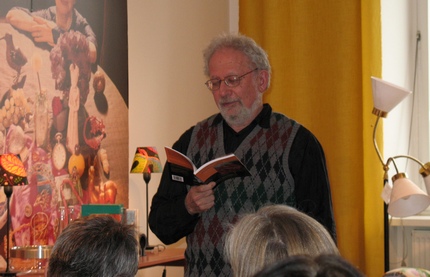
Free. (Photo: Dmitry Kuzmin)

The Russian poet Natalia Gorbanevskaya declared unequivocally that, for a poet, living in an alien land is “a source of new potency.”

It’s lucky that she thought so, because she really had no choice.  The dissident writer fled the Soviet Union for Paris in the 1970s. And that’s where she died, last night, at 77.  In one of those odd synchronicities, I had been excerpting a poem she wrote for something I was writing – perhaps the first time ever that I had done so. As soon as I finished typing, I clicked to my Facebook page, and the director of the Summer Literary Seminars in Vilnius, Mikhail Iossel, mentioned  her death in the very top post on my screen.

According to her first translator and champion, Daniel Weissbort, writing in 1974, “Gorbanyevskaya has been a leading civil rights activist, one of the seven to demonstrate in Red Square on 5 August 1968 against the Soviet invasion of Czechoslovakia. Because of her infant child, she was not tried along with the other demonstrators, and she continued to agitate on their behalf, compiling an account of their trial, Noon (published in England as Red Square at Noon). In December 1969 Gorbanyevskaya was herself finally arrested, and in April 1970 was declared to be suffering from schizophrenia and placed in a psychiatric prison hospital, first in Moscow, then in Kazan, where a course of drug treatment was administered. There has recently been a good deal of agitation in the West about the misuse of psychiatry in the Soviet Union as a means of dealing with dissenters, and whether for this reason or for some other, Gorbanyevskaya was released in February 1972.” Red Square at Noon included not only Weissbort’s translations of her poems, but a transcript of her trial, papers relating to her hospital detention, and an assessment by a British psychiatrist of her mental condition, based on evidence then available.

“One might suppose that Gorbanyevskaya verse would reflect her political activity,” Weissbort continued. “It is, on the contrary, intensely personal and non-public. It transcends politics, not accusing, but describing the psychic reality of her situation. One generation, has had the capacity of transmute her suffering into a universal image. The staccato pulse of her work, the near-hysterical shrillness, recall the poetry of that other poet of suffering, the great Marina Tsvetaeva. In Gorbanyevskaya’s love lyrics, the old Russian mystique of regeneration through suffering is evoked (this appears, less intensely, in Yuli Daniel’s poetry too). Physical love becomes an ordeal like Christ’s on the Cross. Gorbanyevskaya has had the immense courage to remain vulnerable. Hers is the poetry of pain, of separation, of isolation, of despair, of threatening disaster, of disaster present.”

In Gorbanevskaya’s 1991 interview, the poet had an upbeat outlook on her flight for survival:  “I think that we poets are in general enriched by the experience of emigration or exile. Well, if we don’t snivel … that is if we don’t just start to describe the exotica or just start getting nostalgic – in so far as we are submissive to the language, we bring to it everything that we can beg, borrow or steal from other languages. And the language, in so far as it is grateful to us, has yet more to give us in return.”

She never sniveled.  I met Gorbanevskaya in Kraków in 2011. As I wrote here:  “The poet, by then in her midseventies, was short and unfashionably dressed, with short, grizzled hair and thick stockings. She held the small stub of a cigarette like a defiant wand, its end glowing in the dying day on a sidestreet in Kazimierz. When she spoke to me, in French (Paris has been her home since 1976), her voice was probing and intelligent, her eye contact unflinching. She seemed tough-​minded, durable, and utterly lacking in self-​pity.”

I didn’t know her well, but Daniel Weissbort, who died a few days ago (I wrote about that here), did.  So I’ll let him speak. From his book, From Russian with Love:  “While I appreciated the opportunity of working with a poetry so different from my own and indeed from the Russian poetry to which I had previously been drawn, I also suspected that I did not have the language adequately to express the agony, even if as a reader I was responsive.” At that time, Joseph Brodsky had just arrived in the West, and Weissbort didn’t realize that he was a friend of the Moscow poet:
gorbanevskaya2

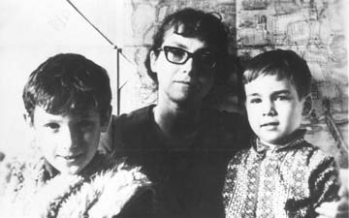
After her release from prison.

“Anyway, as far as I can remember, we were lingering at the front of the Queen Elizabeth Hall auditorium, just below the stage, perhaps during an interval at the end of that day’s readings, when Brodsky said to me, apropos of the Gorbanevskaya versions (it surprised me that he was aware of them: ‘If you were to die tomorrow, would you want to be judged by these translations?’

It seemed unlikely that this was a simple inquiry! I must have been somewhat shocked. Not only because we had just met, but also because his remark echoed, if more forcefully than I would have put it myself, my own doubts and anxieties about the whole business of poetry translation, as well as about the whole business of poetry translation, as well as about my Gorbanevskaya versions. Although I had read the account of her trial and, in addition to translating her poetry, had also written about her ‘ordeal’, I doubt whether I had much grasp of its significance. I imagine that Joseph was trying to get across the gravity of a situation when art, in a way, was all you had; that is, he was not merely suggesting that my translations left much to be desired. Though I took what he said as a comment on the translations, I may have received the other message too, since I did not respond as defensively as might have been expected. …. my translations were largely the product of a kind of optimism. That they had their moments was perhaps the best that could be said of them. Still, I realized that, though possibly wrong-headed, Joseph was not being unkind or malicious. Certainly he was not mealy-mouthed, but this helped me begin to see that the context was larger than one simply of translation, the translation of words. My first exchange with Brodsky, thus, took the form of a kind of summons to greater personal commitment. What such a commitment might entail, in his view, was not immediately clear to me, although I already suspected that, prosodically at least, it had to do with formal imitation, the point being that this had a moral dimension.”

Here’s my favorite poem from Red Square at Noon, which I bought in the 1970s.  The 1961 poem has remained my favorite ever since.  In fact, it was the poem I was transcribing when I heard that she had died. In English and Russian:

redsquareIn my own twentieth century
where there are more dead than graves
to put them in, my miserable
forever unshared love

among those Goya images
is nervous, faint, absurd,
as, after the screaming of jets,
the trump of Jericho.

В моем родном двадцатом веке,
где мертвых больше, чем гробов,
моя несчастная, навеки
неразделенная любовь

средь этих гойевских картинок
смешна, тревожна и слаба,
как после свиста реактивных
иерихонская труба.

Update on 12/3:  Obituary from Agence France-Presse/The Raw Story here.  New York Times obituary here.

Happy 256th birthday, William Blake!

Thursday, November 28th, 2013
Share

William_BlakeIt’s Thanksgiving, and Hannukah… but who remembers that on this day 256 years ago, William Blake (1757-1827) was born on Broadwick Street in Soho?

A few of us do, and we thought it would be fun to celebrate with a few lesser known images, since he was recognized as an artist and engraver long before he was known as a poet.  We’ll begin with the 1820 portrait at left, by his friend John Linnell.

We continue below with Blake’s illustration for Canto I of Dante‘s Inferno.  Why?  Because we like Dante (see here and here, for starters) and, well, we also like lions.  We also include his illustration of “David Delivered out of Many Waters,” because it’s fantastic, in the literal sense of the word, and also because we like seraphims, with two of their six wings crossed underneath them like they’re waiting on a street corner for a bus.  (Blake seems to think they are cherubim, but we know better.)

Meanwhile, Time Out in London hasn’t forgotten the anniversary. Volunteers of Southbank Mosaics artisan studio have created 28 mosaics in tribute to the poet, which visitors can see on Centaur Street in Lambeth. The mosaics, under the tunnels near Waterloo station, show ten years’ worth of Blake’s output, created while he lived on nearby Hercules Road.  Check it out here.

Now go back to your Thanksgiving drinking and eating and belching – but spare a few thoughts, anyway, for the ur-poet of the Industrial Revolution, who, through words and images, showed us the new horrors and timeless possibilities for man in a bold new era.

blake-inferno

David Delivered out of Many Waters circa 1805 by William Blake 1757-1827

Joseph Brodsky’s reading list “to have a basic conversation” – plus the shorter one he gave to me

Tuesday, November 26th, 2013
Share
Josef_Brodsky

Reading lots in Ann Arbor, 1972

We had the W.H. Auden reading list here, so now – ta DUM! – we present the Joseph Brodsky list, thanks to Monica Partridge, a Los Angeles writer and a former Brodsky student from Mt. Holyoke, where the Nobel poet taught for years.  With her blog, called The Brodsky Reading Group, she seems to have formed something of a cultus around the list, and with her acolytes she is attempting to work through the whole slog of books. More power to her. I’d heard rumors of such a list before, but never saw the actual artifact.  I include the list below, having spent some time correcting the references and the spellings (always a dangerous thing to do, someone is sure to find a mistake in my rendering). The list he gave her class was handwritten – perhaps he just scribbled it out, errors and all.

weilAt any rate, eventually the list was typed out, errors still intact.  Open Culture has already printed the list here, so you can see for yourself.  On the site, author Jennifer K. Dick‘s contributed her own memories in the comment section:

When I was a student of Joseph Brodsky’s at MHC between 1989 and 1993 for course on Russian Lit and Lyric Poetry, we were distributed a similar list. However, it was not given as a basis for “conversation” at that time, but rather he said that anyone who had not already completed the reading of that list by 18 would certainly never be able to become a great poet, because the list was a basis for that. This, of course, meant that all of us who might have been aspiring authors were already doomed. So, like everything else with him, you had to take it with a grain of salt. He asked us to write poems based on works by Auden and Frost on occasion. He also made us memorize many poems, as Partridge mentions, including many by Auden, Frost, A.E. Housman and most memorably (no pun intended) all of Lycidas by Milton. In his Russian Lit courses, he provided the texts in Russian and retranslated them as he went through and gave close readings of the poems, focusing on work by Tsvetaeva, Mandelstam, Pasternak, Lermontov, Dershavin, and Akhmatova. One key thing we were told to read were Gumilyev‘s essays, the one on translation is a particular gem.

either_orThough a half-tyrant autodidact prof, he was an invaluable teacher opening up our minds and exposing us to a vast array of authors not traditionally taught in English Lit departments. Yes, I read Milosz too thanks to him – and met him twice before he passed away, and I read Zbigniew Herbert which, during class, brought me almost to tears. But I was also asked by Brodsky to write a paper on a little known poet of the time, Wislawa Szymborska, and her “The Sea-Cucumber” because, as Brodsky said, this was an author worth paying attention to. I suppose he may well have been right (that is meant as humor) given her subsequent Nobel Prize. I feel lucky to have had someone like Brodsky push me to read read read, and this list, a lifetime of reading in the version of it that I have, is certainly a great conversation piece if not the start of some great adventure. It is, as some are, only inviting people to add to it, as he did, until he left this earth.

(It’s worth noting that he couldn’t have read the reading list before he was eighteen anyway, because most of these books weren’t available in the old U.S.S.R., and he became a poet anyway – so take heart.)

shestovI speak with some authority about his reading lists.  Long before the Nobel, he scribbled down a personalized reading list for me, which I kept in my wallet ever afterward.  I’ve pretty much committed to memory, though may be something I’ve forgotten.

And now, for the first time ever in my whole life: I share it with all of you, in no particular order:

Simone Weil, The Need for Roots

Lev Shestov, Athens and Jerusalem

Hannah Arendt, The Origins of Totalitarianism

Andrey Platonov, The Foundation Pit

santayanaGeorge Santayana, Soliloquies in England and Later Soliloquies 

E.M. CioranThe Temptation to Exist

Søren Kierkegaard, Either/Or

Why don’t I produce a photo of this list, as I did with Auden?  Here’s why:  the wallet was stolen from my home in Islington.  It was all the robbers could grab from my flat in the middle of the night because they woke me up and I called out downstairs and scared them off. Probably no more than 12 quid in my wallet. But ohhhh… it’s the reading list I’d rather have back.

Here’s the list – with a few surprises for you on the breakover page, because this is getting loooonnnnggg…

Joseph Brodsky’s Reading List

1.   Bhagavad Gita
2.   Mahabharata
3.   Gilgamesh
4.   The Old Testament
5.   Homer: Iliad, Odyssey
6.   Herodotus: Histories
7.   Sophocles: Plays
8.   Aeschylus: Plays
9.   Euripides: Plays (Hippolytus, The Bachantes, Electra, The Phoenician Women)
10. Thucydides: The Peloponnesian War
11. Plato: Dialogues
12. Aristotle: Poetics, Physics, Ethics, De Anima
13. Alexandrian Poetry: The Greek Anthology
14. Lucretius: On the Nature of Things
15. Plutarch: Lives [presumably Parallel Lives]
16. Virgil: Aeneid, Bucolics, Georgics
17. Tacitus: Annals

THERE’S MORE!

(more…)

Defending the humanities: “Show, don’t tell.”

Saturday, November 23rd, 2013
Share
bauerlein

Take the “no-brainer option.” And hurry.

Earlier today, a friend brought my attention to Mark Bauerlein‘s defense of the humanities over at the New Criterion.  Like me, he is frustrated by the misguided arguments advanced to defend the humanities (I wrote about that recently, here and here and here).

His diagnosis of the disease:

In a word, the defenders rely on what the humanities do, not what they are. If you take humanities courses, they assure, you will become a good person, a critical thinker, a skilled worker, a cosmopolitan citizen. What matters is how grads today think and act, not what Swift wrote, Kant thought, or O’Keeffe painted. No doubt, all of the defenders love particular novels and films, symphonies and paintings, but those objects play no role in their best defense. Ironically, the approach resembles the very utilitarianism the defenders despise, the conversion of liberal education into a set of instruments for producing selected mentalities and capabilities.

pericles

Shakespeare Theatre Company’s “Pericles” in Washington D.C., supported by NEA

What an odd angle, and an ineffectual one. Think of it from the perspective of two individuals whose decisions directly affect the humanities, one of them a twenty-year-old sophomore picking classes for spring term, the other a sixty-year-old state legislator on a committee setting the year’s higher education budget. If the sophomore avoids humanities courses, she hurts enrollment numbers for the fields, a factor in how a dean allocates resources across departments. If the politician discerns no palpable gain from humanities instruction, he will steer funds to technical colleges and vocational programs. What will change their minds? …

The advantages they promise are too vague and deferred (“to know something of other civilizations,” “opportunities for integrative thinking,” “act adroitly,” “we’re human”), especially in contrast to other options (“major in speech therapy and become a speech therapist—there’s a shortage!”). Besides, social science fields claim the same insights, such as the anthropologist who rejoins, “And we don’t study what it means to be human?!” Hard scientists, too, might add, “You want critical thinking? Learn the scientific method!”

Tepid and half-credible, these fuzzy encouragements sound ever more vain and dispirited the more they circulate. They exhort the public to appreciate the humanities, but, with the grounds so abstract and promissory, the appeal falls flat. The failure comes down to bad marketing. The defenders misconstrue their audience. They think that support for the humanities will stand on the anticipation of a job skill, a civic sense, or moral self-improvement, but these future benefits are insufficient to youths worried about debt, politicians about revenue, and employers about workplace needs. No, students enroll and politicians fund and donors donate for a different reason, because they care about the humanities themselves, and they care about them because they’ve had a compelling exposure to a specific work. …

Then he brings up an interesting point.  Most of us were taught, somewhere in our zillion years of education, to “show, don’t tell” when writing. Have the folks in the humanities, of all places, forgotten that fundamental lesson? 

othello

Hudson Valley Shakespeare Festival’s “Othello,” supported by NEA

My former boss Dana Gioia understood it well. As Chairman of the National Endowment for the Arts (2003–09), he was obligated to use the bully pulpit and summon local and national, public and private support for museums, orchestras, and after-school arts programs. It was a delicate task partly because of the suspicion conservatives retained for this agency at the center of the Culture Wars ten years earlier, and partly because saying the wrong thing could jeopardize the annual request for funding from Congress.

In the early 2000s, as No Child Left Behind pressed schools to cut arts, theater, dance, and music programs, organizations such as Americans for the Arts offered standard reasons for arts education including the commercial value of arts investments, better reading and math scores by kids in schools with music instruction, and behavioral improvements for kids in theater programs. Gioia recited them dutifully, but relied at critical times on another one: direct exposure. When he conceived a national initiative called Shakespeare in American Communities with a large in-school component, he might have presented it to Members of Congress in testimony backed by the usual moral and economic corollaries. But instead, he hosted an event on Capitol Hill for Members and invited 5th-graders from Rafe Esquith’s legendary Shakespeare program in Los Angeles to show up in Elizabethan garb and perform scenes and soliloquies for them.

midsummer

Shakespeare & Co.’s “Midsummer Night’s Dream”

The event proved the point. The kids acted splendidly, and a few Members themselves grabbed a costume and declaimed lines, reenacting their own school days and drama club. The politicians had heard every rationale for cultural programs before, but the call of “We few, we happy few, we band of brothers” they could not withstand. Gioia got the funding—and heaps of good will, too.

Exposure works better than explanation, participation better than entreaty. The humanities defenders, mistakenly, try to persuade and coerce when they should intrigue, excite, fascinate, and inspire. Why humanities defenders neglect this no-brainer option, why they lay down their strongest weapons, is a mystery only if we forget the turn from primary texts decades earlier.

Read the whole thing here.

“Feeling the love” in Croatia: Adam Johnson and The Orphan Master’s Son

Thursday, November 21st, 2013
Share

adamjohn

Pulitzer prizewinning Adam Johnson (The Orphan Master’s Son) is “feeling the love in Croatia.” This photo, with his kidlets, was taken by his wife Stephanie Harrell. Clearly, there’s a lot of talent for photography in the family – we’ve already posted daughter Jupiter‘s photo here.  Earlier this month, Adam was fiction winner of the Dayton Literary Peace Prize, a celebration that awarded author Tim O’Brien as well. Adam is currently on an around-the-world gig  promoting his surreal novel about the twisted lives in today’s North Korea – we’ve written about it here and here and here.  Today’s photo and Adam’s book are timely in a more chilling way: we’ve just learned that Merrill Newman of Palo Alto, the 85-year-old Stanford alum and Korea vet, has been arrested and detained while visiting North Korea as a tourist. According to his Newman’s son, “The basic fact of the matter is that this gentleman is 84-85 yrs old, an elderly man, presumably not a threat in any way to North Korea, so this is, even by North Korean standards, an extraordinary thing.”

R.I.P. Daniel Weissbort, champion of translation everywhere

Tuesday, November 19th, 2013
Share
Weissbort2

Reading at the Ars Interpres Poetry Festival, 2006

Daniel Weissbort is dead. I heard this yesterday from Neil Astley of Bloodaxe Books in the U.K., but hadn’t been able to confirm it till I found it posted here, on the website of the influential journal he founded with Ted Hughes in 1965, Modern Poetry in Translation. He continued to edit the magazine until 2003.

Perhaps the major obituaries are yet to come out, but it’s surprising how little a splash major figures in translation make in today’s world, although Weissbort was also a poet of note. I never met him face-to-face, but I know him from once remove; his wife, the Russian scholar Valentina Polukhina, is a colleague, friend and regular correspondent. He would have been 78 this year, and I know he has been ill for some years.

According to the website (which has a page for tributes here):

He was associated with MPT for nearly forty years, and he saw it through its birth as a “scrappy-looking thing – just to keep their spirits up…” (from a letter by Ted Hughes to Daniel Weissbort in 1965) to becoming a periodical of international importance and renown, which published some of the best international poets in the best translations. He was also a translator of poetry and a poet in his own right, and he made it his cause to get Russian poetry better known and better read in the English-speaking world, editing and translating Russian poetry tirelessly, and hosting and leading translation workshops. His most recent translations of the Russian poet Inna Lisnianskaya Far from Sodom were published to great acclaim by Arc Publications in 2005.

mpt3Nicholas Wroe, whose 2001 Guardian interview with Czesław Miłosz was included my volume Czesław Miłosz: Conversations, interviewed Weissbort in the same year.  It was posted on a few Facebook pages:

“Poetry happens everywhere,” writes Daniel Weissbort in the introduction to Mother Tongues, “but sometimes, often, it happens in languages that do not attract attention. We are the poorer for not experiencing it, at least to the extent it can be experienced in translation.”

Although he wasn’t conscious of it at the time, translation had been a part of this poet, editor and translator’s life from the outset. “My parents were Polish Jews who came to London from Belgium in the early 1930s,” Weissbort explains. “They spoke French at home because that was the language they met in, but I was so determined to be English that I’d always answer them in English.” …

It was Hughes’s idea to get as many literal translations of work as possible. “We didn’t want carefully worked, minute things that took forever to produce,” explains Weissbort. “It sounds a bit insensitive now, but we wanted quantity even if it was in quite rough-and-ready translation.” He says that at the moment one of the big debates in translation is between so called foreignisation and domestication. “Domestication looks like something that was first written in English,” explains Weissbort. “Post-colonial theory is very much in favour of foreignisation, seeing domestication as an imperialistic strategy that is opposed to allowing the foreignness to come into the language. I suppose we were foreignisers before it was invented.”‘

Weissbort3Weissbort is also due to publish his own, 11th collection of poems, Letters to Ted, written after Hughes’s death, as well as a memoir of Nobel prizewinner Joseph Brodsky.  (Read the rest here.)

I reviewed the latter volume, From Russian with Love, in a Kenyon Review article called “Uncle Grisha Was Right” – it’s here.  Being a Brodsky translator was a crushing, ego-deflating experience for many, and Weissbort was one of the earliest translators, before he could have taken courage from the tales of other casualties. Weissbort agonizes over the experience, analyzing and doubting himself – something the Russian Nobel laureate never did.  As I wrote: “He [Brodsky] came from a culture that had bypassed Freud and his heirs, where an enemy was an enemy and not just a projection of an inner landscape. He was not, to put it mildly, a man crippled with a sense of his own contradictions. Hence, his attacks could be unambiguous and fierce. As sycophants multiplied exponentially, it became hard, some of his friends say, to tell him the truth—for example, the truth about his abilities to write English verse and translate into it.”

Yet in the end, Weissbort seemed to be unexpectedly buoyed by the experience, and came to a startling conclusion that says as much about the master translator as it does about the poet:

Weissbort__From_Russian“At a commencement address years later, he [Brodsky] spoke of ‘those who will try to make life miserable for you,’ and added: ‘Above all, try to avoid telling stories about the unjust treatment you received at their hands; avoid it no matter how receptive your audience may be. Tales of this sort extend the existence of your antagonists. . . .’

That’s the legacy of the man. But the poetry? Weissbort seesaws and perseverates for pages and pages, and there is much repetition and confusing back-and-forth in time … Yet despite the waffling and self-deprecation, he makes a central, remarkable contention: Weissbort argues that Brodsky ‘was trying to Russianize English, not respecting the genius of the English language, … he wanted the transfer between the languages to take place without drastic changes, this being achievable only if English itself was changed.’

In short, Weissbort invites us to listen to Brodsky’s poetry on its own terms. As he tells a workshop: ‘It’s like a new kind of music. You may not like it, may find it absurd, outrageous even, but admit, if only for the sake of argument, that this may be due to its unfamiliarity. Give it a chance, listen!’”

Update on 12/3:  Guardian obituary by Sasha Dugdale is here.