Archive for April, 2014

Henry Wallis’s “The Room in Which Shakespeare Was Born.” On the floor, apparently.

Wednesday, April 30th, 2014
Share

The English Pre-Raphaelite artist Henry Wallis (1830-1916) painted “The Room in Which Shakespeare Was Born” in 1853. It now hangs at London’s Tate Gallery.  The Shakespeare home on Henley Street was described in an 1843 biography by Charles Knight (1842), who commented on “the mean room, with its massive joists and plastered walls, firm with ribs of oak.” Wallis also took to heart Knight’s passage describing “hundreds amongst the hundreds of thousands by whom that name is honoured have inscribed their names on the walls of the room.”  Apparently, however, the bard must have been born on the floor. Motherhood was hard in those days.

wallis

Why does everyone hate this man?

Tuesday, April 29th, 2014
Share
morris

Tribalist monkey?

Why does everyone hate poor Ian Morris, all of a sudden? They did nothing but crow and give awards to the Stanford archaeologist and historian’s last book, Why The West Rules – for Now. His newest book, War! What is it Good For? Conflict and the Progress of Civilization from Primates to Robotsseems to be making all sorts of unpleasant hoopla.

He wrote a short explanation of his thesis in the Washington Post over the weekend, in an article titled “In the Long Run, Wars Make Us Safer and Richer.” An excerpt:

“Take the long view. The world of the Stone Age, for instance, was a rough place; 10,000 years ago, if someone used force to settle an argument, he or she faced few constraints. Killing was normally on a small scale, in homicides, vendettas and raids, but because populations were tiny, the steady drip of low-level killing took an appalling toll. By many estimates, 10 to 20 percent of all Stone Age humans died at the hands of other people.

“This puts the past 100 years in perspective. Since 1914, we have endured world wars, genocides and government-sponsored famines, not to mention civil strife, riots and murders. Altogether, we have killed a staggering 100 million to 200 million of our own kind. But over the century, about 10 billion lives were lived — which means that just 1 to 2 percent of the world’s population died violently. Those lucky enough to be born in the 20th century were on average 10 times less likely to come to a grisly end than those born in the Stone Age. And since 2000, the United Nations tells us, the risk of violent death has fallen even further, to 0.7 percent.

“As this process unfolded, humanity prospered. Ten thousand years ago, when the planet’s population was 6 million or so, people lived about 30 years on average and supported themselves on the equivalent income of about $2 per day. Now, more than 7 billion people are on Earth, living more than twice as long (an average of 67 years), and with an average income of $25 per day.

war

His new book.

“This happened because about 10,000 years ago, the winners of wars began incorporating the losers into larger societies. The victors found that the only way to make these larger societies work was by developing stronger governments; and one of the first things these governments had to do, if they wanted to stay in power, was suppress violence among their subjects.

“The men who ran these governments were no saints. They cracked down on killing not out of the goodness of their hearts but because well-behaved subjects were easier to govern and tax than angry, murderous ones. The unintended consequence, though, was that they kick-started the process through which rates of violent death plummeted between the Stone Age and the 20th century.

“This process was brutal. Whether it was the Romans in Britain or the British in India, pacification could be just as bloody as the savagery it stamped out. Yet despite the Hitlers, Stalins and Maos, over 10,000 years, war made states, and states made peace.”

Now, on Tuesday, the article is still the Number #1 Heavy-Hitter at the Washington Post. Typical of the comments:  Jose Benitez writes:  “No doubt, you are Republican and love to watch Patriot Games with Harrison Ford. You also probably supported George W. Bush when cheating the Americans about the weapons of mass destruction supposedly had Iraq and sent thousand young fellows to die. You are an Iceman.”  I very much doubt Ian knows Harrison Ford at all, let alone watches DVDs with him.  Cheryl Ann writes: “what is that? joke of the day for societal disconnects? Ian Morris, you are an unevolved, tribalist monkey.”  Joel R. Stegner wrote: “This is undoubtedly the most insane idea I have ever seen in any newspaper, ever. Only a person who doesn’t value life can advocate this perspective. What next? A column from a serial killer on how to achieve notoriety? Let us hope that no aspiring Hitler buys into this quality of thinking.”

Reussere obviously thought a moment, and wrote:

morris

The old book.

I am one of those that hate war in every possible way. War in my mind is the epitome of evil.

To say I was put off by the title is putting it mildly. In fact, the first time I saw it, I refused to even read it.

Having read it however, and having the overall facts presented in the proper historical light, it is clear that the author has a very valid point. No matter how evil wars and their brutal aftermath is, the truth is that what emerges afterword are often larger, more cohesive and peaceful societies with lower homicide rates. This is certainly not always true, but it is the growth of large societies and the protections that afford their citizens has grown inexorably since the stone ages and the result has been a reasonably steady decline in one on one or few on few homicides.

Please read the article and analyze what the author is actually saying instead of reacting childishly and walk away with an entirely false distortion of what is being said.

Read the whole thing here. And don’t forget the comments section.
.
.

George Szirtes on Tadeusz Różewicz: “There is, in his harsh clarity, something beyond…”

Friday, April 25th, 2014
Share
Różewicz

The late, great poet…

We wrote yesterday about Tadeusz Różewicz, who died at 92. Today, poet and translator (and friend) George Szirtes writes about him in The Guardian. He says the Polish poet “was one of the great European ‘witness’ poets whose own lives were directly affected by the seismic events of the 20th century.”

“‘My decimated generation is now departed and dying, duped and disillusioned,’ he said soon after the fall of the Berlin Wall. He saw the forgetting of history as a disaster, ‘the falling of tears on the stock exchange’ as he wrote in a poem of 1994.”

More:

“That generation, born just after the first world war, amid the great chaotic redrawing of maps, saw the rise of fascism, the terrors of the second world war (both Różewicz and his brother Janusz – also a poet – served in the Polish Underground, Janusz being killed by the Gestapo in 1944), then watched the Iron Curtain descend across Europe and survived, if they did, Stalinism without being jailed or killed to see the clock tick towards 1989 and what they sometimes considered the false reinterpretation of their own pasts.

szirtes

… and his admirer.

“Różewicz’s own recounting of his life, Mother Departs – a work part memoir, part diary, part recorded conversation, part poetry – presents us with the picture of a childhood that begins with an intensely religious mother who was born Jewish but then became part of the Catholic community. By the time Tadeusz was born the family was living in a small town, but she had spent years in a small backward village and her vivid descriptions of village life, which he recalls in Mother Departs, made a strong impression on the poet in his understanding of human potential.

“Różewicz’s first poems were religious and he never quite lost sight of the idea of good and evil. He did after all see plenty of the latter. After studying the history of art at university in Kraków he began to publish both poetry and plays and made his reputation in both, developing a collage style in plays like The Card Index.”

He concludes: “Różewicz was a major figure in modernist poetry but his modernism has little to do with theory and formal experiment as such. There is, in his harsh clarity, something beyond, a touch of early Chagall perhaps, as though life were sacred after all.”

Read the whole thing here.

The end of a world: Poet Tadeusz Różewicz died today at 92

Thursday, April 24th, 2014
Share

RóżewiczTadeusz Różewicz died today at 92 years old. It hasn’t made the Western press yet. He was one of Poland’s greatest poets, of the generation after Czesław Miłosz and Zbigniew Herbert.  Miłosz described him as “the most talented among those who began to publish immediately after 1945.”

“By contrasting the scenes of war that he had witnessed with the entire heritage of European culture, he arrived at a negation of literature because it seemed to be no more than a lie covering up the horror of man’s brutality to his fellow man,” Miłosz wrote. Różewicz served in the Poland’s Home Army, loyal to the government-in-exile in London. His older brother Janusz, also a poet, was shot by the Gestapo. I learned this today. Back in 2008, much less was known about this poet.

I tried to arrange a meeting with him during my first trip to Poland that year, but his home was in a remote rural area nearest to Wrocław, and I was far away in Kraków. The attempted meeting was arranged through Maria Debicz. As I recall, he didn’t speak English well, or perhaps at all … that added an extra layer of difficulty to any potential tête-à-tête. I seem to remember that an illness put the meeting out of the picture altogether. Of course I regret now what wasn’t possible then.  It will have to be another time. Au revoir, though there wasn’t a “voir” in the first place.

I posted a few Polish articles on my Facebook page, then scoured to find the small, award-winning Archipelago Books volume of his poems, translated by Bill Johnston. I failed, but I found on a dusty shelf on top of a wardrobe, Polish Writers on Writing, edited by Adam Zagajewski, who encouraged the meeting. His nervous, sometimes comically irritable essay is called “Preparation for a Poetry Reading.” It’s a reading the maestro didn’t want to give. One paragraph:

polish_comp_selected_10_5_10Poetry has to consummate a given place and time. If it does, it is perfect. How easy it was to create poetry and describe poetry, while it existed. Poets still use this kind of phrase: ‘As long as poetry hasn’t died in me, I can’t be unhappy.’ As if they didn’t understand that there is no ‘poetry.’ They are like children. Worse: They are merely childish. Poetry! If they’re not comparing a fist to an eye, they don’t feel like poets. What empty gibberish: ‘As long as poetry hasn’t died in me, I can’t be unhappy.’ What confidence in oneself and in ‘poetry.’ What if ‘poetry’ died in you a long time ago and you feel happy? Is poetry in you as a kind of foreign body? Poetry? The happy knew where poetry began and ended. Critics could pinpoint the place in a poem where there was poetry. They feel unhappy if they’re not describing poetry. Until you feel unhappy, ‘poetry’ won’t be born in you! That’s better. But there are even poorer poets. They say: ‘Poetry is like a bell’ or ‘Poetry is a moonlit night.’ They make comparisons. They clutch comparisons as a drowning clutches driftwood. They already know what poetry is. So they can create poetry, have poetry in them. They can feel happy. But there is no poetry. They sense this, but they don’t want to touch on the truth. They’re afraid. The old and the young.”

Then a friend, Erdağ Göknar, posted this poem on Facebook, “on the way consciousness gropes to order the world after catastrophe.” Can’t do better than this, at least not today. The fifth stanza alone is worth the price of admission:

In the Middle of Life

new-poems-coverAfter the end of the world
after my death
I found myself in the middle of life
I created myself
constructed life
people animals landscapes

this is a table I was saying
this is a table
on the table are lying bread a knife
the knife serves to cut the bread
people nourish themselves with bread

one should love man
I was learning by night and day
what one should love
I answered man

this is a window I was saying
this is a window
beyond the window is a garden
in the garden I see an apple tree
the apple tree blossoms
the blossoms fall off
the fruits take form
they ripen my father is picking up an apple
that man who is picking up an apple
is my father
I was sitting on the threshold of the house

that old woman who
is pulling a goat on a rope
is more necessary
and more precious
than the seven wonders of the world
whoever thinks and feels
that she is not necessary
he is guilty of genocide

this is a man
this is a tree this is bread

people nourish themselves in order to live
I was repeating to myself
human life is important
human life has great importance
the value of life
surpasses the value of all the objects
which man has made
man is a great treasure
I was repeating stubbornly

this water I was saying
I was stroking the waves with my hand
and conversing with the river
water I said
good water
this is I

the man talked to the water
talked to the moon
to the flowers to the rain
he talked to the earth
to the birds
to the sky
the sky was silent
the earth was silent
if he heard a voice
which flowed
from the earth from the water from the sky
it was the voice of another man

.                                 –  translated by Czesław Miłosz

Stanford’s “Another Look” spotlights Marguerite Duras’ The Lover

Wednesday, April 23rd, 2014
Share

Stanford’s book club honors the famous French writer’s centenary with a May 12 discussion of The Lover, her autobiographical tale of her scandalous teenage affair with an older Chinese millionaire, set in her native Saigon. Read more below.

.

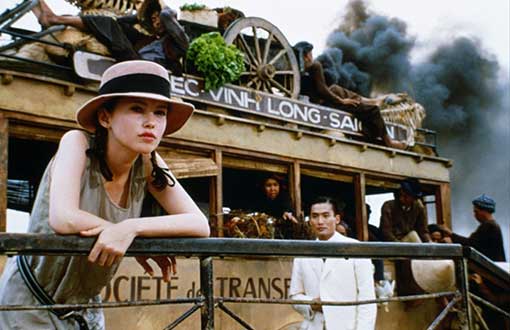
pantheon-coverLong before most Americans could find Vietnam on a map, the French ruled Indochina, and its Chinese, French, and native Annamese denizens lived in an unequal colonial stew. So when a 15-year-old French schoolgirl had a passionate affair with a wealthy 27-year-old Chinese lover in Saigon, it created a scandal. The affair eventually became a book, and the book became a masterpiece.

The writer, Marguerite Duras, would tell the story again and again, throughout her lifetime, but never more compellingly than in The Lover, which received a prestigious Prix Goncourt when it was published in 1984, and sold two million copies.

Now, in Marguerite Duras’s centenary year, the “Another Look” book club is celebrating the author and her book at 7:30 p.m., Monday, May 12, at the Stanford Humanities Center’s Levinthal Hall. The panel will be moderated by Blakey Vermeule, professor of English, with her colleague Paula Moya, professor of English, and Stephen Seligman, a psychiatrist and professor at the University of California, San Francisco. The event is free and open to the public.

Vermeule had read the short novel as a high school student, but on rereading it, “I was gobsmacked,” she said. “It’s one of these masterpieces that gets rediscovered again and again. It’s a very intense book, so powerful it had slipped my mind what a truly great and subtle work of art it is.” With the centenary, she thought it was an excellent moment to revisit the book the New York Times Book Review had called “powerful, authentic, completely successful … perfect.”

Duras’ simple, terse writing style reads “as if language itself were merely a vehicle for conveying passion and desire, pain and despair,” wrote British author and journalist Alan Riding. “The mysteries of love and sex consumed her, but she had no room for sentimentality in her works, or indeed, in her life.”

“I write about love, yes, but not about tenderness,” she had told him in a 1990 New York Times interview. “I don’t like tender people. I myself am very harsh. When I love someone, I desire them. But tenderness supposes the exclusion of desire.”

Mitterrand

A presidential pal

Duras was born in Gia Dinh, near Saigon. Her father fell ill and returned to France, where he died. Her widowed mother, a teacher, was bankrupted in a shady land deal. The family struggled as impoverished colonials in a small tight-knit, gossiping community. Duras recalls an abusive mother who had severe bouts with depression, a drug-addicted brother who beat his sister fiercely and stole from the family (and even its servants), and a beloved younger brother who died young. When she met a Chinese millionaire on the ferry crossing the Mekong River, the teenager saw a doorway to a different world. The affair continued until Duras returned to France to finish her education at 18.

In France, she worked in the French Résistance in a team under the direction future French President François Mitterand, who remained a lifelong friend. After the war, she became a member of the French Communist Party. Duras is often categorized with the writers of the postwar “nouveau roman,” a movement that loosened the grip of plot- and character-driven narrative, blurring the boundaries of time and space, but Duras resists easy categorization. She experimented with novels, plays, films, essays, journalism, and memoir. She was fascinated, in particular, by the possibilities of film, most notably writing the screenplay for Alain Resnais‘s 1960 classic, Hiroshima, Mon Amour.

She wrote The Lover at 70, when she had become a tiny old woman, her body wracked by alcoholism and cigarettes, giving interviews often read like a parody of what a French avant-garde writer is expected to sound like. She told the story in different ways with widely divergent details, so much so that until the discovery of an unpublished diary, there could be doubts that the affair had happened at all.

“She had an intensive, almost anti-social capacity to tell the story the way she wanted to tell it, in all its violence and ugliness,” said Vermeule. “The need to be utterly solitary, and socially antipathetic – very rarely does one see it in women writers. It’s not a pose they claim,” she said.

“This book is so very psychoanalytic. She’s clearly under that spell. Look at the nonlinearity of the story. As narrrator, she is almost dissociated from herself, moving from first to third person and back.”

The_lover

The 1992 film that irked her…

Duras quarreled with film director Jean-Jacques Annaud as they collaborated on the 1992 film of the book, and retaliated with 1991’s The North China Lover, as a way of reclaiming her story. But no version before or since had the luster of The Lover. According to Stanford scholar Marilyn Yalom writing in How the French Invented Love, “She could transform a somewhat sordid affair into a mutually passionate romance and project into posterity her vision of love as an irresistable force that penetrates through the skin, regardless of its color.”

That vision continues to transfix readers, and The Lover continues to draw fans, decades after its first publication. In The Independent, South African playright and novelist Deborah Levy wrote in 2011, “The Lover does not just portray a forbidden sexual encounter of mind-blowing passion and intensity; it is also an essay on memory, death, desire and how colonialism messes up everyone.”

“Marguerite Duras was a reckless thinker, an egomaniac, a bit preposterous really. I believe she had to be. When she walks her bold but ‘puny’ female subject in her gold lamé shoes into the arms of her Chinese millionaire, Duras never covertly apologises for the moral or psychological way that she exists.”

***

The “Another Look” book club focuses on short masterpieces that have been forgotten, neglected or overlooked – or may simply not have gotten the attention they merit. The selected works are short to encourage the involvement of the Bay Area readers whose time may be limited. Registration at the website anotherlook.stanford.edu is encouraged for regular updates and details on the selected books and events.


 

“It hurts, but you won’t die.” Stanford poet Rodney Koeneke on Dante and omelettes

Sunday, April 20th, 2014
Share
purgatorio

Purgatorio’s Canto 27: Botticelli’s version

Yesterday’s “Company of Authors” event exceeded expectations – and we can expect a lot. Peter Stansky‘s annual recap of Stanford books was an intellectual shake-up – as he put it afterwards, “I think it is pretty exhilarating to hear what is going on at Stanford in terms of splendid writing.”

koeneke

Not jangly at all.

And what of my little panel on “The Power of Poetry,” which I described a few days ago? I must confess that I had a little trepidation about Rodney Koeneke‘s Etruria (Wave Books, 2014). He is an early member of the Flarf Collective, “a group of poets working in loose collaboration on an email listserve, mining the internet for their work, producing jangly, cut-up textures, speediness, and bizarre trajectories,” as I explained at the event. We at the Book Haven try to be avant-garde, really, but still… so imagine my surprise when out of his mouth rolled this lovely meditation about a subject dear to our hearts, Dante Alighieri – echoing Robert Harrison‘s insistence of movement as a theme of the Divine Comedy in general, and of the Purgatorio, in particular, since it’s the only one of the three realms in which time exists – we wrote about that here

The affinity is not happenstance: Rodney said that reading Stanford’s John Freccero and teaching Purgatorio Stanford students years ago were “two sparks for the poem” – then he added, “so it’s nice to have it come home, as it were, to the Haven.”  Our pleasure. Poem below.

As for the panel itself?  Said Rodney: “Only Peter Stanksy could put a scramble of authors together like that and make it an omelette.”

.

La Chevy Nova

Etruria_final_for_website_1024x1024

One of the great pivots in Christian history
occurs near the end of canto 27 of Dante’s Purgatorio, a
canto that opens with the pilgrim comparing the dying sky
to Christ’s vermillion wounds (note the “sun”
deftly figured here as “son”) and the Ebro
and the Ganges, which are rivers,
are empurpled—made royal—by noon
and a glad angel shows up to sing gladly
about the flame that will burn but also purifies,
which our pilgrim by the end of the canto will have to go through
like the muscles behind or just on top of the knee can burn
at the end of a long run, or perhaps (and here’s the pivot)
like the burning some do when they go from a car
at night’s end in a remote parking lot
where nothing is unseemly or sordid
but does in a fashion burn, but also does it purify
as history considered in its Christian dimension must also purify?

Dante, you’ll remember, has spent the preceding cantiche
skillfully working his personal crotchets
into a gargantuan cosmic structure — “I vividly recalled
the human bodies I had once seen burned” —
with his obduracy not once being softened;
yet he manages to nest this ugly effort
in the larger project of turning his passion for the dead Beatrice
into a redemptive program for himself, for time, the reeling stars,
the fishes, the beestes, the air and everything in it
itself and finally, one might point out, for movement itself
which is seen at the end from its center and revealed as an aspect of love.

Structure is on fire, and tercets are on fire, and process
is on fire, and motion is on fire; while the poem has learned
to preen and turn, pivot on, and no longer hurts, or points
at a world, or even at its status as an internally consistent
verbal object, only at the most tiresome conditions
of its own production.
.  .                                   . But I gaze at you and I burn
with a new vernacular; I see you, and I see vermillion,
your color—vermillion in the stoplights
and the stoplights ranged as stars
like the stars could spell out ‘B-E-A-T-R-I-C-E’
and would if they weren’t so dim and talky, stuck
in their orbits where it’s safe to promise love — “it
hurts, but you won’t die”—and you stew in a tepid
amor amicitiae, Socrates spooning
with Alicibiades, warm under sheets
against philosophy’s cold stars:
“It hurts, but you won’t die.”

That even a wound, even now, could make things pure
is enough to count me bitten
returned to the pivoting folds of this world:
count me hurt, count me bitten
Gulls distribute themselves over Oakland’s industrial center
like I leave you, come back to be near you
where I hear their glad song, or watch them scatter gladly
over the beautiful chords of this world;
and beautiful are the chords of this world
with you and everything in it;
Beautiful the Ebro above the phone lines
emitting its fine vermillion into morning
so pleasing to mine and to everybody’s eyes.
So do I live to look at you and so
does everyone: It hurts, but I won’t die —
a little sun, a little wound
“but through that little space I saw the stars.”