Archive for November, 2014

Why the world needs proofreaders

Friday, November 28th, 2014
Share

An unusually candid assessment appeared in the journal Ethology recently:

.
.

Gabor-paper

.

Read more about how this particular gaffe happened (along with a few other doozies) over at Slate here. The author got 4,247 retweets with this goof – probably more attention than the original article received.

.

.

“I can’t stop while there are lives to be saved”: the women of World War I

Wednesday, November 26th, 2014
Share

Postcard front for web_Women and the Great War

It’s the hundredth anniversary of the beginning of World War I, and we’ve heard much about the men who went to war … but comparatively little about the women. They weren’t always left behind, reading letters from the front. They took an active role in nearly every aspect of the war – as soldiers, nurses, spies, relief workers, ambulance drivers, and yes, sometimes scribbling letters to the soldiers far away. A new exhibition at Hoover Institution, which continues through March 21, 2015, tells the stories of individual women whose acts of selflessness, courage, and integrity captured the public imagination.

Poster Collection, AT 45, Hoover Institution ArchivesPerhaps the most famous heroine of the Great War is Edith Cavell – or rather was, since her name has been largely forgotten today. Before the war, she was considered a pioneer of modern nursing: she was head of  L’École Belge d’Infirmières Diplômées, launched Belgium’s first professional nursing journal, L’infirmière, and eventually trained nurses for three hospitals, 24 schools, and 13 kindergartens in Belgium.  With the war, she redoubled her efforts: “I can’t stop while there are lives to be saved,” she said. Cavell, a British nurse in Belgium, saved lives on both sides of the war, but in particular she helped about 200 Allied soldiers escape from German-occupied Belgium.

She did more than bandage wounds: Cavell was part of a much larger operation to help wounded British and French soldiers and Belgian and French civilians of military age get out of the country, providing them with false papers, money, and guides to reach the Dutch frontier.  She had sheltered most of them in her house.

2006c7_rolston_box05_album02_001When arrested and charged with treason under German military law, she refused to defend herself or hide what she was doing. The world appealed for mercy for the 49-year-old nurse, but Sir Horace Rowland of the British Foreign Office  said, “I am afraid that it is likely to go hard with Miss Cavell; I am afraid we are powerless.”

The Americans, at that point a neutral party in the war, urged clemency, one diplomat writing a personal letter from his sickbed. However, Germany’s Count Harrach said his only regret was that he did not have “three or four old English women to shoot,” managing to combine ageism and sexism in one go (although neither concept existed in 1915). German civil governor Baron von der Lancken pleaded with his government on her behalf –  not only because of her honesty, but because her tireless work had saved many lives on both sides. He was overruled.

poster_us_01238The night before she died, she told a priest, “Patriotism is not enough. I must have no hatred or bitterness towards anyone.” She was shot by a firing squad on October 12, 1915.

The new exhibit Women and the Great War illuminates the varied roles women—and images of women—played in the four-year conflict. The exhibit features posters, photographs, letters, diaries, postcards, handbills, pamphlets, medals, and memoirs drawn from the rich holdings of the Hoover Institution Library & Archives, founded in 1919 to collect, preserve, and make available the records of that war.

And it comes in the nick of time – it’s only one month more before the centenary ends. But cheer up. Edith Cavell’s centenary is coming up next year, and it looks like the British are determined to make a splash of it.

The exhibition in the Hoover Memorial Exhibit Pavilion is open from Tuesday to Saturday, 11 a.m. to 4 p.m. – except for this week. The pavilion will be closed on Thanksgiving, November 27, and Friday, November 28. But otherwise, it’s a way to fill out the holiday weekend, beginning Saturday.

All photos courtesy Hoover Institution Library and Archives.

Winifred V. Ramplee-Smith Collection, Box 1, Envelope 1

Commander Botchkareva, at left, and her Women’s Battalion for the Allied Cause in Russia. (Photo: courtesy Hoover Institution Library and Archives).

Poster Collection, US 484, Hoover Institution Archives.

World War I Pictorial, Box 33

Nasty bookplates

Saturday, November 22nd, 2014
Share

thiefbookplate

Halt! Mein Buch! (Stop! My Book!) How is that for a subtle bookplate warning to potential thieves, a.k.a. your friends? See 1895 bookplate above for an illustration of the hand of God reaching from a cloud to pluck the purloined book from your greedy arms. Bookplates were a tremendous innovation as private libraries developed. After all, in the olden days, people had to write unpleasant little poems warning people from stealing their books, and there is a limit to most people’s literary innovation. For instance, note the flyleaf threat at right-below, dated 1829, featured on a special collections blog from the library of my alma mater, the University of Michigan, here.  (We’ve also written about bookplates before, here and here and here and here and here and here.)

flyleaf_rhymes_005Some flyleaf poems threatened judgment day, but this book-lover thought it might be more effective to threaten punishment in this world. How’s this for a passive-aggressive warning to your “honest” friend?

Steal not this Book my honest friend,
for fear the gallows will be your end
Be very careful of this Book
and very often often in it look
for in it we may only find
food aplenty for the mind.

hitlerbookplateEven aside from literary quality, you can see why bookplates quickly evolved as an improvement to poetic creativity. It is easier to see than to imagine. For example, while the flyleaf poem merely threatened the gallows, the book owner whose undated bookplate is featured below thought you would need to have a visual reminder of your potential fate. However, the warning is oblique and mysterious: “Fert in omnia rutubam et tristitiam terribilis amor” or, in English, “In all things terrible love brings trouble and sadness.” A handy reminder for a book of love poems? Hardly the best consolation for the recently divorced … or the newly married, for that matter. Or is it the love of books that brings one to such a terrible end? Can you imagine the book owner gazing fondly at this image of a hanged man? What possesses people?

Or how about this Halloween special below, for the kiddies? Tuck them into bed with the book, see what happens when you tell them to go to sleep. Actually, artist Bernie Wrightson designed it for his graphic novel adaptation of Creepshow. As for Adolf Hitler‘s bookplate from the Library of Congress, it speaks for itself.

Read more here and here and here. (Be warned, however, not all the bookplates are nasty; most are rather lovely). And a hat tip to the ubiquitous Dave Lull, friend to bloggers everywhere, for the inspiration.

.

nastybookplate


grimbookplate2

Were the 1950s really that bad?

Friday, November 21st, 2014
Share

eisenhowerThe 1950s have taken a bum rap for years. You remember the 1950s: women were locked in their houses and forced to bake apple crumble and change diapers while men took their hats and briefcases to the office. Everyone was repressed, and unable to express their Innermost Selves. No one had any fun at all.

People forget how close the West came to losing it all. Had Hitler avoided a few military blunders, we might all be speaking German right now. Believe it or not, many men and women were happy to beat their swords into ploughshares and devote themselves to the virtues of peace. Being a riveter, though doubtless empowering, was not that much of a career enhancer. For kids, especially, it wasn’t a half-bad era. You had a pretty good chance of growing up in an intact home with the same parents, and children could walk to school safely and attend classes without gunfire. W.H. Auden, T.S. Eliot, Elizabeth Bishop, and Robert Frost were still alive and writing poems, and the Partisan Review was in its prime. Was it that much worse than the 1930s, the 1910s?

Two recent reviews over at Books Inq seem to reinforce my sense that the era has been much maligned. The book at hand is Paul Johnson‘s Eisenhower: A Life  – a biography that’s 134 pages long, including the index. The Times Literary Supplement review said of Johnson: “His zesty, irreverent narratives teach more history to more people than all the post-modernist theorists, highbrow critics, and dons put together.”

My colleague Frank Wilson reviewed the book here, in the Philadelphia Inquirer:

“As recounted in Eisenhower: A Life, a new brief biography by the British writer Paul Johnson, the life of Dwight David Eisenhower was one of steady, uninterrupted success – five-star general, supreme commander of Allied Forces in Europe during World War II, 34th president of the United States, elected twice, both times by landslides, and still popular when he left office. Heck, just a year before he died, he hit a hole-in-one on the golf course.

“Yet one feels sad when one finishes Johnson’s book. Not for Eisenhower, but for the country he served so well.

“A joke making the rounds as his presidency neared its end told of the Eisenhower doll: You wound it up and it did nothing for eight years. But we could use plenty of that nothing these days. As Johnson points out, Eisenhower gave America nearly ‘a decade of unexampled prosperity and calm. The country had emerged from the Korean War and the excesses of McCarthyism. Inflation was low. Budgets were in balance or with manageable deficits. The military-industrial complex was kept under control. . . . Thanks to Ike’s fiscal restraint, prices remained stable and unemployment only a little more than 4 percent. …’

General Eisenhower Behind the Wheel of a Jeep

Maybe not such a loser, after all.

“Had he heard the joke about the doll, Eisenhower probably would have laughed, at least to himself. ‘He seems to have found it convenient and useful,’ Johnson writes, ‘for people to get him wrong. He chuckled within himself.’

“So, at the time, the all-too-conventional wisdom had it that he was inarticulate, not too bright, lacking in cunning, and lazy, preferring to hit the links and leave the business of government to subordinates. His critics, Johnson writes, got things exactly wrong: ‘Ike was highly intelligent, knew exactly how to use the English language, was extremely hardworking, and very crafty. In practice, he made all the key decisions, and everyone had to report to him on what they were doing and why.’ Like any genuine leader, Eisenhower did not insinuate. He issued commands. He led from above. … One in particular might find it interesting to learn that during six of Eisenhower’s eight years in office, both houses of Congress were controlled by the opposition party.”

Another one here by reviewer John Derbyshire, who seems to have suffered a sort of crush on the biographer once:

“In his 1983 book Modern Times, Paul Johnson made a point of talking up U.S. presidents then regarded by orthodox historians as second-rate or worse: Harding, Coolidge, Eisenhower. He wrote:

Eisenhower was the most successful of America’s twentieth-century presidents, and the decade when he ruled (1953-61) the most prosperous in American, and indeed world, history.

bruce-cole

The real Bruce Cole

“The goal of political leadership is to secure for one’s country, so far as circumstances will allow, the things that most ordinary citizens wish for: prosperity and peace.

“On that score, Ike did superbly well. America’s 1950s prosperity glows golden in the memory of us who witnessed it, if only from afar. Peace? Paul Johnson draws a withering comparison between Ike’s masterly 1958 deployment to Lebanon—’the only American military operation abroad that Ike initiated in the whole of his eight years at the White House’—and the Bay of Pigs misadventure of the vain, shallow John F. Kennedy in the following administration.

“Discounting as best I can my partiality to P.J.’s prose, I’m convinced:  This was our best modern President.”

Postscript on 11/24:  Another country heard from! Not everyone agrees with the resurrection of Ike – below, Nevada blogger Bruce Cole elaborates on the comments he made Saturday. (Coincidentally, a Bruce Cole is a member of the Eisenhower Memorial Commission – this is not the same guy.) Colleague Bruce, who blogs over at A Citizen Paying Attention, disagrees with the reviews about Ike – but he concurs about the silliness of lumping cultural trends into decades – and don’t get me going on how much of the 1960s happened in the 1970s. Here’s the important part: he tells me he shares my enthusiasm for Czesław Miłosz.

Cynthia has been kind enough to ask me to elaborate a little on my hasty early Saturday morning comments about Eisenhower and the 1950s (two subjects, though they overlap).
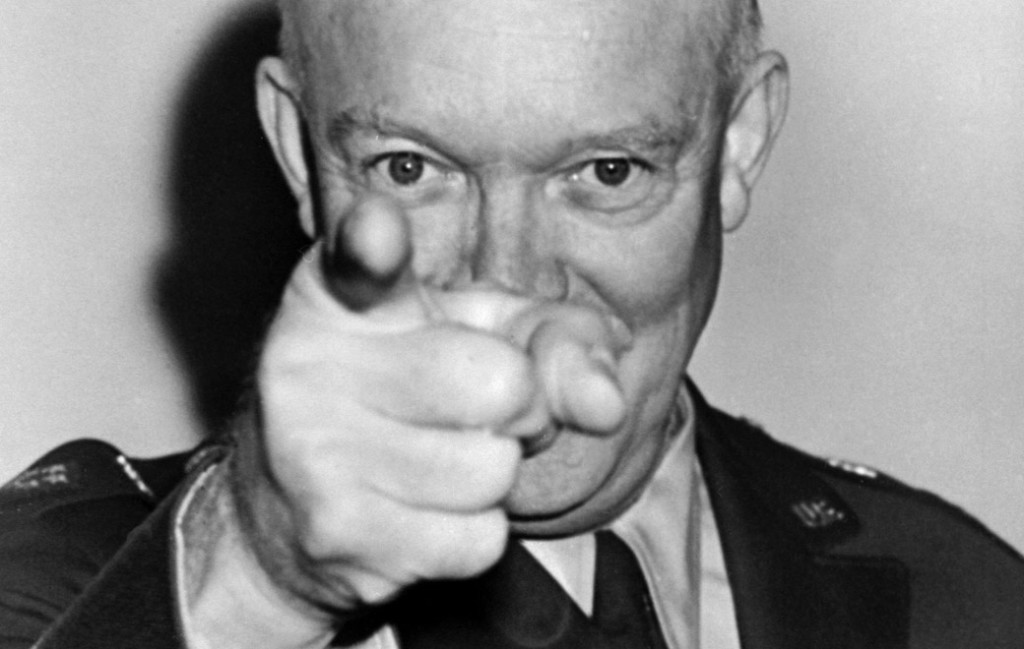
dwight-eisenhower

Maybe not so hot after all.

First, I mentioned John Lukacs‘ review of several books about Ike. The review ran in Harper’s in 2002 and was collected in the anthology of his writings, which I cited. He makes several points about the (again, two) subjects of Cynthia’s original post. Many of the characteristics of the 1960s (or things we associate so easily with that decade, or things we bemoan as happening since the Good Old Days) began in the 50s: the decline in our manufacturing and our savings, the deterioration of our cities, the net outflow of gold from the United States, the increasing problems of our public education system, the demotion of jazz as our most popular music, the “sexual revolution,” etc. The point is not that these were the fruits of Eisenhower’s presidency. Rather, they remind us not to indulge in a false nostalgia about an arbitrary set of years (a nostalgia whose mirror image is, of course, the 50s as staid, awful, and repressive).

Now, about Ike. Eisenhower (who, as a general in 1945, telegraphed Marshall Zhukov assuring him that the Americans wouldn’t reach Berlin before the Russians) came into office with talk about rolling back Communism, as opposed to the “cowardly containment” (Nixon’s words) of Truman. I am hard put to see where this ever happened. We did watch as Hungary (having been covertly encouraged by us) got tromped on in 1956. Lukacs has written often, and persuasively, about the chances in the years just prior to this when the West could have taken advantage of relative Soviet weakness to negotiate some kind of genuine rolling back of Soviet dominance in Eastern Europe (Churchill, no softy, kept urging this course on Eisenhower). Even then, they removed themselves from Austria, forsook a naval base in Finland, recognized West Germany, etc.

All of that is as may be. Ike did not keep the “military-industrial complex under control.” The defense budget tripled throughout the fifties. Our military presence expanded all over the globe, including places where there was little or no Soviet threat. He fortunately did not intervene in Indo-China in 1954, but then there was little chance the US would. The Lebanon incursion in 1958 was an absurdity. The Korean truce of 1953 established what had been the status quo for about two years (nothing wrong with that, but it was no great accomplishment). Finally, there is that Bay of Pigs thing – all pre-packaged by Ike and the CIA for his successor, complete with “intelligence” assurances that a popular uprising against Castro would take place. So, “vain, shallow” JFK followed suit. Hmm, is there any reason to believe Richard Nixon would have fared better? No.

Eisenhower5

He’s happy with the reviews, anyway.

Then there is McCarthy. Ike did not work McCarthy’s destruction, but kept silent while various Senators in both parties prepared censure in the Senate. It also should never be forgotten how Ike kept silent while McCarthy repeatedly slandered Ike’s patron, General Marshall.

Much of the above I owe to Lukacs’ analysis (which I again urge everyone to read) with a few embellishments of my own and no apologies from me at that score! Let me add something, though, on our two, inter-related subjects.

The origins of Eisenhower’s rehabilitation go back, in no small measure, to an article Murray Kempton wrote in the 1960s (!) for Esquire with a title something like “The Underestimation of Dwight D. Eisenhower.” (Kempton was a great journalist, but when he went off the beam, look out!) The arguments were repeated by Garry Wills a few years later in an otherwise perceptive book, Nixon Agonistes. I think this was, in part, the reaction to “Camelot,” which spawned, of course, a multitude of anti-Camelots. We have a difficult time taking our presidents plain, anyway, and the contrast of the two in terms of age and “glamour” with LBJ following them, and Vietnam thrown into the mix, made it well-nigh impossible.

That leads me to the other subject (which actually I am more interested in). I, too, despise, “decade-talk.” Of course, the 50s were not simply the Age of Conformity and Repression. But notice how the nostalgia some people express for that time merely turns that idea inside out. I think this is the nub of the matter. So many of our debates occur between people who agree on terms and wouldn’t know a tertium quid if it hit them full in the face. That is why our “culture wars” have such staying power. Beyond the real issues, it is easy to sign up for a Line, a set of attitudes, a collection of loves and hates. Which, finally, is why the “bad” 50s will never go away as a cliché – but it is hardly alone in that.


“Learning is as natural as walking.” The world loses a terrific educator: Robert Calfee, 1933-2014

Thursday, November 20th, 2014
Share
calfee3

“Why teach them to march, when they can learn to fly?” Bob reading to an Escondido Elementary kindergarten class in 1985 (Photos: Ed Souza)

I traveled with Robert Calfee to schools in New York City, Pittsburgh, and around the Bay Area, when we were conducting research for the 1995 book we co-authored, Teach Our Children Well (Portable Stanford Series). The second chapter of the text was published as a Washington Post op-ed, and won a national award.

That was back in my days as the news director for Stanford’s School of Education – and before that, I had worked with a project called “Stanford and the Schools.” Bob was my first boss at Stanford, and I coauthored (with Stanford University President Donald Kennedy and Education Dean Myron Atkin) the book that came out of the project, Inside Schools. Then Bob and I tackled this second book together.  He was an amazing educator and an easygoing travel chum. I was greatly saddened to hear of his death by cancer on October 24 – I hadn’t even known he was ill.  You can read more about it here and at the UC-Riverside website, where he was dean, here.

Bob was a passionate champion for ‘the rhetoric,’ the formal use of language to reason, persuade, and argue – whether its getting kids to talk the administration into getting new lockers for the school, or whether they think the novel they’re reading is a good one. He believed in writing. He said students can read a book without comprehending it, but it’s hard to compose an essay passively.

calfee1He emphasized “critical literacy” – that is, learning to use all forms of language for thinking, for problem-solving, and for communications. He said it was the way he had been taught in Kentucky, during a rather hardscrabble childhood, partly spent in an orphanage.

To that end, Bob created Project REA/Inquiring School, an educational endeavor that emphasized making schools “communities of inquiry.” As I recall, Project READ was for the classroom, Inquiring School was for the school as a whole. Rather than focusing on students who were branded as ‘defective,’ he focused on professional development for teachers. He wanted to steer instructors away from teachers’ guides that, he said, read like the IRS tax manuals. He tried to wean them away from follow-the-recipe teaching. He was undaunted by low-achieving, multilingual classrooms in poor neighborhoods with histories of low achievement. Those were the ones he was looking for.

This is from our book together: “We have repeatedly found that most students, including those identified as low-achieving, have sharper academic value and pedagogical potential, but they don’t know what they know. They cannot recognize and use their background experience until someone – a teacher – offers the cognitive tools for expressing themselves and participating in group problem-solving.” Our conclusion? “Children walking into their first classrooms vary widely in experience and temperament; but for virtually each one of them, learning is as natural as walking. Why teach them to march, when they can learn to fly?”

calfee2It wasn’t just talk; I watched him to it. For example, he walked into a boisterous classroom of elementary students within minutes – coming in cold, with no preparation, he’d have them in his hand within minutes. He’d start with a question – how would they explain where they lived to a man from Mars? – and follow up their suggestions with ‘Tell me more’ or ‘Why?’ And from that he would teach. Not only did he learn a great deal about the students that way, but he engaged them where they were right then, right there, instead of beginning with abstractions far away from their daily lives.

I recall him talking about a student whose difficult family background was such that he had a better working knowledge of how government works than many adults do – but that knowledge didn’t get tapped in the classroom.

He wanted to see classrooms brimming with life, and walls covered with students’ writing, webs and weaves and story graphs. Silent classrooms bothered him more than noisy ones.

We were often on a tight schedule, and after visiting one school, a teacher said she wanted to discuss matters with him as we waited for our taxi. It was a frigid winter morning – I think it was in the Bronx. He turned up his collar against the wind, and said gently, “Let’s talk here.” And they did. That was sooooo Bob.

***

FROM TEACH OUR CHILDREN WELL: Robert Calfee was a guest teacher for a lunch-hour economics class in Yerba Buena High School east of San Jose, in a poor neighborhood and a port of entry for new arrivals from around the world. Here’s his impromptu instruction:

calfee

In recent years (Photo: Smart Ants, Inc.)

Calfee: What do you guys think economics is all about? What words come to your mind when I say ‘economics’?

Students: Money. Scarcity. Products. Profit. Services.

Calfee: Why do you think we need to know about economics? What’s the value? [Silence. Teachers frown.] Have you got an economic system at home? Is your family an economic system? [More silence.]

Brendan: Yeah, I think so.

Calfee: Say more. [Silence.] How do you handle money? Do you guys have anything do with money at home? [Someone mumbles about money and “decision-makers.”]

Calfee: Who decides?

Ngo: Parents.

Calfee: Do you have a job?

Ngo: No.

Calfee: Ever had a job?

Ngo: No.

Calfee: You get an allowance?

Ngo: No. I just ask.

Calfee: Tell me a little more about how that happens.

(more…)

Oxford does it right: The Merton Record arrives on our doorstep

Monday, November 17th, 2014
Share

IMG_20141111_145704We shouldn’t have been surprised. When we were contacted by the Merton College at Oxford about republishing our obituary on the late great Milton scholar, Martin Evans in The Merton Record, we offered our enthusiastic  support. The Welshman was an amazing man and an amazing Miltonist, and it was a privilege to study Paradise Lost with him.

We made Editor Helen Morley promise to send the finished product.

When the envelope arrived from Oxford, we were pleased to find a model of this kind of academic publishing: 200 perfect-bound pages with writing that matches high production values  – and it was delightful to be a small part of it. (Also noted: it has a review of Stuart D. Lee‘s A Companion to J.R.R. Tolkien, who was a professor at Merton for many years.)

From my republished piece on Martin:

Evans coined the phrase “Miltonic moment” to describe the point of crisis just before the action changes dramatically, looking at once backward to a past that is about to be transcended or repudiated, and forward to a future that immediately begins to unfold.

His first reading of Milton marked a Miltonic moment of his own: “I fell hopelessly in love with the poetry. It was the most exciting thing I’d ever read,” Evans said.

Yet Evans is remembered for being a powerful mentor as well as a revered scholar.

IMG_20141111_145734The poet and scholar Linda Gregerson of the University of Michigan, his student in the late 1970s, recalled, “He was immensely generous, both personally and intellectually, able to convey deep learning with extraordinary clarity. He always took a deep delight in ideas, and was just opinionated enough to make things fun.” She recalled him as “impish, with a brilliant, irreverent sense of humor.”

“He converted many of us to a lifelong inhabitation in the world of Milton studies. It’s a formidable world in many respects, not nearly so genial as the world of Shakespeare studies, for example. But Martin imbued it, and us, with a durable sense of joy.”

You can read an earlier Book Haven post on Martin here – or about his 400th birthday party for Milton here. Or here’s a treat: go here and you can listen the the Milton scholar himself, at Milton’s birthday party (which was also a celebration of his own anniversary at Stanford). Hearing him read the last words of Paradise Lost is absolutely delicious.

(See? “Lycidas” is evidently still on my mind after my post yesterday about Derek Walcott.)

lovesongsPostscript on 9/19: Martin Evans’s influence was wide indeed. I just received this note from music scholar and author Ted Gioia: “I spent a lot of time with Martin Evans, both inside and outside the classroom, and learned a tremendous amount from him. My next book (on the history of love songs) is a better book because of what Martin taught me about Petrarch, Dante, Boccaccio, Castiglione, etc. Because of him, I read The Art of Courtly Love by Andreas Capellanus, The Allegory of Love by C.S. Lewis and a number of other books that prepared me (in ways I never could have anticipated at the time) to write a study of the evolution of the love song.”

evans1

“It was the most exciting thing I’d ever read.” (Photo: L.A. Cicero)