Archive for October, 2015

Blogger Raif Badawi wins the Sakharov Prize – but the floggings will continue in Saudi Arabia.

Thursday, October 29th, 2015

Share
Badawi

“An exemplary good man” gets a prize. (Photo: Amnesty International)

It’s a new day, and what delightful news to wake up to: Raif Badawi has been awarded the Sakharov Prize for Freedom of Thought. The prestigious award, offered each year by the European Parliament, honors individuals and organizations defending human rights and fundamental freedoms.

Badawi is a blogger who has been jailed, fined, and publicly flogged in Saudi Arabia. He has been sentenced to 1,000 lashes, and is currently serving a 10-year prison sentence for insulting Islam on his website promoting social, political and religious debate.

European Parliament president Martin Schulz announcing the 2015 award at the European Parliament, said: “This man, who is an extremely good man and an exemplary good man, has had imposed on him one of the most gruesome penalties that exist in this country which can only be described as brutal torture.” Schulz added: “I call on King of Saudi Arabia to stop the execution of this sentence, to release Mr. Badawi, to allow him to back to his wife and to allow him to travel here for the December session to receive this prize.”

badawi2

Badawi in 2010 (Photo courtesy PEN International)

What kind of stuff has he written? Well this, for example, in 2010: “As soon as a thinker starts to reveal his ideas, you will find hundreds of fatwas that accused him of being an infidel just because he had the courage to discuss some sacred topics. I’m really worried that Arab thinkers will migrate in search of fresh air and to escape the sword of the religious authorities.” (You can read more at The Guardian here.)

The authorities also jailed Badawi’s lawyer, Waleed Abulkhair, founder of the group Monitor of Human Rights in Saudi Arabia. He was sentenced last year to 15 years in prison for undermining the government, inciting public opinion, and insulting the judiciary.

According to an article in the New York Times:

“Reached by telephone, an official at the Saudi Mission to the European Union in Brussels said the kingdom did not have a response to the announcement. He pointed to a past statement in which the Saudi authorities stated that their judicial system was independent and that it was not the place of outsiders to criticize it.” …

The prize, established in 1988, is named for the nuclear physicist Andrei Sakharov (1921-89), who led the Soviet Union’s development of the hydrogen bomb and then became a tireless crusader for human rights. Past winners include Nelson Mandela and Kofi Annan. In 2013, the prize went to Malala Yousafzai, a teenage Pakistani activist for women’s rights who went on to win the Nobel Peace Prize. In 2014, it was awarded to Denis Mukwege, a gynecologic surgeon in the Democratic Republic of Congo who has devoted himself to victims of sexual violence during wartime.

badawi3News in recent days has been that the next round of floggings are imminent – they had been discontinued because of Badawi’s fragile health, and they wanted, after all, to make sure that he survived long enough for the full sentence. According to a European Parliament announcement, worldwide dismay had a role to play in the postponement as well:

He was administered the first set of 50 lashes in public in January 2015. The remainder were postponed following international protests. Earlier this week the wife of Raif Badawi, Ensaf Haidar, who is currently living in Canada with their three children, announced that the Saudi authorities have given the green light for the flogging to resume.

In February this year MEPs [members of the European Parliament] adopted a resolution strongly condemning the flogging of Badawi as “a cruel and shocking act” and calling on the Saudi Arabian authorities “to release him immediately and unconditionally as he is considered a prisoner of conscience, detained and sentenced solely for exercising his right to freedom of expression”.

This month also, he was the co-recipient (with British journalism James Fenton) of the PEN Pinter Prize, a free-speech award established in 2009 in honor of the British playwright Harold Pinter. The Sakharov award ceremony will be held in Strasbourg on December 16.

On the announcement of the Sakharov Prize, Badawi’s wife said: “Raif would be very happy to see the extent to which his fight is shared by so many people in the world, and this award is further evidence of that.” We’re with you on that, Ms. Haidar.

badawi-oslo

The protests have helped. (Photo: Dan-Raoul Miranda)

Happy 112th birthday, Evelyn Waugh!

Wednesday, October 28th, 2015
Share

Evelyn-Waugh

“The trouble with modern education is you never know how ignorant people are. With anyone over fifty you can be fairly confident what’s been taught and what’s been left out. But these young people have such an intelligent, knowledgeable surface, and then the crust suddenly breaks and you look down into depths of confusion you didn’t know existed.”

Evelyn Waugh (1903-1966)

.


Shaman and poet Stanisław Barańczak (1946-2014) – “a fantastic genius, indeed.”

Sunday, October 25th, 2015
Share
baranczak4

Barańczak and friends.

“There is a Polish poet, Stanisław Barańczak, a professor at Harvard. He was a virtuoso of translation – he translated practically all of Shakespeare, the metaphysical English poets, Emily Dickinson also, and so on. But his own poetry, also, is … equalibristics. He writes rhymed poetry, because his inventiveness in this respect is fantastic.”

So Czesław Miłosz told me fifteen years ago, at his home on Grizzly Peak in Berkeley, as he was musing about his colleague’s “shaman” qualities.

The twentieth century brought untold literary genius to the West. When I say “untold,” I mean it. How many Americans have heard the name Stanisław Barańczak, despite the wealth of poems, translations, and essays he left behind on this side of the Atlantic?

baranczak

Farewell to a shaman.

After a decades-long fight with Parkinson’s Disease – writing as much as he could, for as long as he could – the Polish genius finally died last year on December 26. He was 68.

A few weeks ago, I received a special edition of the preeminent Polish literary journal, Zeszyty Literackie in my email inbox from its co-founder Barbara Toruńczyk (Barańczak was the other co-founder). The issue is devoted to Barańczak, and includes the eulogies at his January 3, 2015, funeral in Cambridge, along with some of his poems in Polish and English. It is something of a primer for those who don’t know his name. It’s available online here.

Polish journalist, essayist, historian, and former dissident Adam Michnik recounted Barańczak’s history with Solidarity, and his struggle to free his country from the Communist yoke: “He was also a wonderful, brave, and irreverent spirit of his time; he was among the first to get involved in Poland’s democratic opposition movement. He paid for it by getting a publishing ban issued against him, by getting thrown out of the university, and suffering all kinds of repressions. But even his open enemies dared not question his brilliance.” The peril was not from his overlords, but from within: “It was but a narrow escape,” Barańczak said years later. “I could have simply raised my hand as other people did, and simply let it down, as other people did.”

michnik2

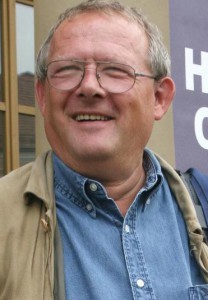
Adam Michnik

Michnik recalled, “He related to people with understanding, but he was steadfast when it came to principles. He had no tolerance for cowardice in the face of dictatorship. This is clear in his poems and essays—any one of them could have landed him in prison.”

“The game is bad because we stand, from the beginning, at a disadvantage; but it would be even worse, if we were to admit that—as a result of the certainty of failure—the game is not only bad, but completely senseless. Acting with dignity in this stupid situation, putting on a brave face, depends on finding some sense within it. We will not defeat our opponent in this way; but we will, at least, throw a stumbling block in his path. Nothingness is keenly interested in propagating the feeling of meaninglessness, which paves the way for its progress and eases its task. Until the very end, Staszek kept erecting stumbling blocks before nothingness.”

“In an essay about Auden, Staszek wrote that poetry ‘is not able to eradicate evil from us. But it allows us, at least, to bring this evil to consciousness. Precisely because we are condemned to the presence of evil within ourselves, we need, all the more, to become conscious of it.’”

zagajewski

Adam Zagajewski

So how did he wind up in Cambridge, Massachusetts? Barańczak spent years applying, unsuccessfully, for a visa, before he finally got one: he accepted the chair in the Slavic Languages and Literature Department at Harvard.

Irena Grudzińska Gross remembers visiting him there: “Although Staszek’s talents, intelligence and industry were somewhat intimidating, those who were lucky enough to know him more intimately were enchanted by his pronouncements on literature, his wit, his modesty and kindness, which he would abandon only when (and these moments were terrible) he encountered a bad translation or a very stupid book. He was a great companion (when one was able to drag him away from his work) on the excursions, organized by [his wife] Ania, to the Massachusetts beaches, historical landmarks, and great open air restaurants. Indoors, it was a great pleasure to listen to the music he loved, to watch over and over the cult movies he and Ania knew by heart: The Godfather, White Sheik or Some Like it Hot.

From Adam Zagajewski:

Stanisław Barańczak with wife Anna (Photo: Mariusz Kubik)

Stanisław Barańczak with wife Anna (Photo: Mariusz Kubik)

Death deprived us not of a theoretician, nor even of an author—but, above all, of an exceptional human being. Yes, a human being and a poet. On that day, when Stanisław’s funeral was being held in the American Cambridge, the Kraków Opera reopened its production of Winter Journey by Schubert and Barańczak (I like to look at the juxtaposition of these two names). Those, who could not fly to Boston, gathered together in the red chamber hall of the opera and listened to the songs of Franz Schubert, to which Stanisław had written poems—poems that were exquisite, simultaneously mystical and cabaret-esque, tragic and funny. The baritone Andrzej Biegun sang beautifully. It seems to me that I was not the only one for whom this was an extraordinary experience, and not only because I knew, we knew, that in the same moment, at the Mount Auburn cemetery in Cambridge, a crowd of Stanisław’s friends had gathered to farewell him.

It was as if two completely different generations, one hundred and fifty years apart, embedded in different countries, in different eon and languages, condemned never to meet—Franz Schubert, an artist of the era of tailcoats and candles, of cannons and diplomatic lies, a witness to the Congress of Vienna, and Stanisław, living in the shadow of Yalta and Potsdam, in the shadow of lies even more monstrous, systematic and triumphant, in the shadow of an incurable illness—united themselves that afternoon in an ideal artistic form. They met in the great, sweet melancholy of art, in a sadness made mild by perfection of form and expression, by the bitter joy granted to us by wonder, however brief. A tragic wonder, which for a moment allows us, almost, to accept joyfully something which cannot be accepted—the fact that everything perishes in the cold fire of time, the most patient of killers.

President of Poland, Bronisław Komorowski said at the memorial that “choosing to remain abroad, he ceased to be a refugee from Poland, emerging instead as the country’s untiring ambassador.”

miloszYou still think genius is overstating the case? Here’s what Nobelist Joseph Brodsky said to fellow Nobelist Miłosz on the subject, in the interview between the two included in Czesław Miłosz: Conversations:

Brodsky: The boy is a genius, Stasiek, ya?

Miłosz: Fantastic.

Brodsky: A fantastic genius, indeed.

 Can’t quarrel with that. Read the whole thing here.

Congratulations to Dubravka Ugrešić, winner of the Neustadt Prize!

Friday, October 23rd, 2015
Share
(Photo: Zeljko Koprolcec/Wikimedia Commons)

(Photo: Zeljko Koprolcec/Wikimedia Commons)

In May we announced that Croatian writer Dubravka Ugrešić was a finalist for the Neustadt International Prize for Literature. Tonight we are thrilled to announce that she’s a winner!

The Neustadt Prize, offered by the University of Oklahoma’s World Literature Today, is considered the “American Nobel,” and is often a harbinger of the Swedish award.

Ugrešić is the author of several works of fiction and essay collections. She went into exile from Croatia after being labeled a “witch” for her anti-nationalistic stance during the Yugoslav war. She now resides in the Netherlands.

Here’s what she had to say about that:

Ten years ago I held a Yugoslav passport, with its soft, pliable, dark red cover. I was a Yugoslav writer. Then the war came, and the Croats, without so much as a by your leave, shoved a blue Croatian passport at me. The Croatian government expected a prompt transformation from its citizens, as if the passport itself was some sort of magic pill. Since this didn’t go down easily in my case, they excluded me from their literary and other ranks. Croatian passport in hand, I abandoned both my newly acquired and formerly demolished homeland and set out into the world. With impassioned, Eurosong-like glee, the rest of the world identified me as a Croatian writer. I became a literary representative of a place that no longer wanted me. I, too, no longer wanted the place that no longer wanted me. I am no fan of unrequited love. Even today, I still, however, haven’t shaken free of the labels.

Again I hold a passport with a soft, pliable, dark red cover, a Dutch passport. Will this new passport make me a Dutch writer? It may but I doubt it. Now that I have a Dutch passport, will I ever be able to “reintegrate” into the ranks of Croatian writers? Possibly, but I doubt it. What is my real problem? Am I ashamed of the label of Croatian writer that still trails after me? No. Would I feel any better with a label like Gucci or Armani? Undoubtedly I would, but that’s not the point. Then what is it that I want? And why am I, for God’s sake so edgy about labels?

ministryWhy? Because the reception of literary texts has shown that the luggage of identification bogs down a literary text. Because it has further been shown that labels actually alter the substance of a literary text and its meaning.

Not surprisingly, then, she considers herself a “post-Yugoslavian writer.” Clive James wrote of her: “For her, Yugoslavia lingers in the mind and heart as the dreamed reality, whereas Croatia is the living nightmare. Tito’s iron hand at least kept the ethnic minorities from each other’s throats. … She comes from one of what Kundera memorably called the Kidnapped Countries, and she has given it its voice, which is the voice of a woman. The woman carries plastic bags full of the bad food and the thin supplies she has queued for by the hour while the men sit around in the square scratching their crotches and dreaming up their next war.”

As he points out, there is much to discomfit Western readers. For example, when she writes: “Proudly waving its own unification, Europe supported disintegration in foreign territory. Emphasizing the principles of multiculturality in its own territory, it abetted ethnic cleansing elsewhere. Swearing by European norms of honour, it negotiated with democratically elected war criminals. Fiercely defending the rights of minorities, it omitted to notice the disappearance of the most numerous Yugoslav minority, the population of a national, ‘nationally undetermined’ people, or the disappearance of minorities altogether.”

You can read an excerpt from her excellent interview with Daniel Medin in Music & Literature here.

Nobel peace laureate Liu Xiaobo still imprisoned. Wife under house arrest. What does the West have to say? Crickets.

Tuesday, October 20th, 2015
Share
NOBEL-PEACE/LIU

She’s been silenced. He’s in prison.

Liu Xiaobo. Remember him? The writer, critic, and former professor was awarded the 2010 Nobel Peace Prize “for his long and non-violent struggle for fundamental human rights in China.” The Chinese dissident has been imprisoned since 2008 after helping to draft Charter 08, a manifesto calling for sweeping changes in China’s government that was signed by thousands of supporters.

So what does the West have to say about it? Crickets.

From Radio Free Asia:

Five years after being awarded the 2010 Nobel Peace Prize, jailed Chinese dissident Liu Xiaobo, activists are calling on the ruling Chinese Communist Party to release his wife Liu Xia, who has been under house arrest at the couple’s Beijing apartment since her husband’s award was announced.

Beijing rights activist Hu Jia, a close friend of the Lius, said the Nobel award has had huge repercussions for the activist’s entire extended family.

“[Liu Xia’s] brother was sentenced to 11 years in jail, which was entirely because of his connection to the Lius,” Hu told RFA.

“But the worst persecution has been the way they have cut off Liu Xia’s communication with the outside world, and silenced her,” he said.

While Liu Hui has since been released from prison, he remains under bail conditions, and is an important form of leverage over Liu Xia, Hu said.

liuxiaobo“Basically, they are effectively saying to Liu Xia that if she has any contact with the outside world, people like me, foreign diplomats or journalists, then they can put her brother back in jail again,” he said.
“So she has no way to speak out either on her husband’s behalf, or her own.”

As for Nobel laureate Liu Xiaobo himself:

In June 2014, the authorities turned down an application for parole from Liu’s lawyers, who said he can’t make a fresh request for another three years from that date.

In the application, Liu, 60, criticized the prison authorities for denying him the right to be in contact with friends and family, which is against China’s Constitution.

However, he is unlikely to qualify for parole, because he has never admitted to committing any crime.

His lawyers say Liu still follows political developments in China, where the administration of President Xi Jinping launched a nationwide police operation that has detained nearly 300 rights attorneys, paralegals, and legal activists since early July.

Read the rest here. Read here for Liu Xia’s 2011 desperate internet message: “I’m crying. Nobody can help me.”

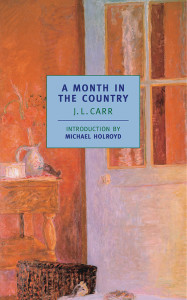
J.L. Carr’s A Month in the Country on October 19! Here’s 10 things you didn’t know about the book and the author.

Saturday, October 17th, 2015
Share
JLC n quince tree 2 09_1969 small (2)

Carr by a quince tree, 1969 (Photo courtesy Bob Carr)

Stanford’s Another Look book club spotlights masterpieces that have been forgotten, overlooked, or otherwise just haven’t received the audience they merit. J.L. Carr‘s A Month in the Country fits the bill perfectly. Other than an excellent biography by Byron Rogers, The Last Englishman, you’ll find little on the pitch-perfect book or its idiosyncratic, stubborn, and deeply private author.

That’s another reason to come to the Another Look discussion of A Month in the Country will take place at 7:30 p.m. on Monday, October 19, at the Bechtel Conference Center at Encina Hall on Serra Street on the Stanford campus. The conversation will be moderated by Robert Pogue Harrison, Another Look’s new director, along with acclaimed author Tobias Wolff, professor emeritus of English, and Jane Shaw, dean of religious life at Stanford and author of several books.

Parking is readily available around Encina Hall’s Bechtel Conference Center – a map is here. The nearby Knight parking structure, underneath the nearby Graduate School of Business, has plenty of room for free parking (see here for a map). In addition, parking is available on Serra Street and in front of Encina Hall itself. Humble Moi will be at the front door by 6 p.m. for early arrivals, just to make sure you get in and save a seat.

Meanwhile, here’s ten things you probably didn’t know about the book or its author:

1. Carr’s book was born of a frustrating, decade-long endeavor to save a dilapidated 14th century Northamptonshire church. Read about it here.

2. “Splendid in their day – but not now.” Old English churches today are a staid affair, compared with their previous lives in the medieval centuries, where they were a riot of texture and color. Plus a short BBC film clip about how the stunning restoration of a Welsh church changed a village – which sheds some background on Tom Birkin’s labor to uncover a 14th century painting. Read about it here.

carrbook3. “He was my Dad, he wasn’t exceptional to me.'” J.L. Carr’s son doesn’t quite understand the fuss. “Carr was not an open man, neither was Bob, so theirs had been a perfectly friendly relationship with few confidences exchanged but no confrontations either,” wrote Carr’s biographer. “The result is that when you ask Bob Carr questions about his father, you sometimes feel you might just as well as be asking them of the lodger.” Read about it here.

4. “Thoo’s ga-ing ti git rare an’ soaaked reet doon ti thi skin, maister.” The Yorkshire accent was as mystifying to Tom Birkin as it is to Americans. Where did it come from? A short explanation, with a video clip on how the wrangling between the Vikings and the Anglo-Saxons can still be heard on the Yorkish tongue today. It’s here.

5. “This was the book nobody rejected, because they did not get the chance,” wrote Byron Rogers of A Month in the Country. But here are a few of the few words that have been said about this 1980 classic.

6. “’It was a sort of stage-magic’ : the Yorkshire countryside.” If you’ve never been to Yorkshire, here‘s your chance. A short video about the dales, rivers, and ethos of England’s enchanting county, a backdrop for Carr’s novel.

jlc wales head&shoulders

The author in Wales. (Photo courtesy Bob Carr)

7. “Hell? Passchendaele had been hell.” In the terrible history of the 20th century, the horrors of World War I were quickly overwhelmed by a greater war, but Passchendaele was unforgettable for those who remember the fear and the mud. It also marked the Germans’ introduction of mustard gas. Read about it here.

8. Penelope Fitzgerald, J.L. Carr, and the “death of the spirit we must fear.” The Booker award-winning author discusses Carr’s “nostalgia for something we have never had.” Read it here.

9. “Apples are the only exam I could ever hope to pass.” Carr would have been aware of the invasion of commercial apples, which was beginning about the time he wrote A Month in the Country. Have English apple-eaters have been seduced by the shiny red skins of foreign rivals? Read about it here.

10. Why Sara van Fleet and Wensleydale? Why did Carr pluck the Sara van Fleet rose for Alice Keach? And what’s so special about Wensleydale? Find out here.