
Archive for April, 2016

Economist Myra Strober and the “gentlemanly smile”

Friday, April 29th, 2016


Share
strober

Still smiling … Myra today.

At the time she began her career in economics, the Myra Strober was one of the very few women in the field. “I had no idea it was so male. None,” the Stanford labor economist told a crowded audience at the Bechtel Conference Center on April 19. She went on to become the founding director of the Clayman Institute for Gender Research (then the Center for Research on Women, or CROW) and first chair of the National Council for Research on Women, a consortium of about 65 U.S. centers for research on women.

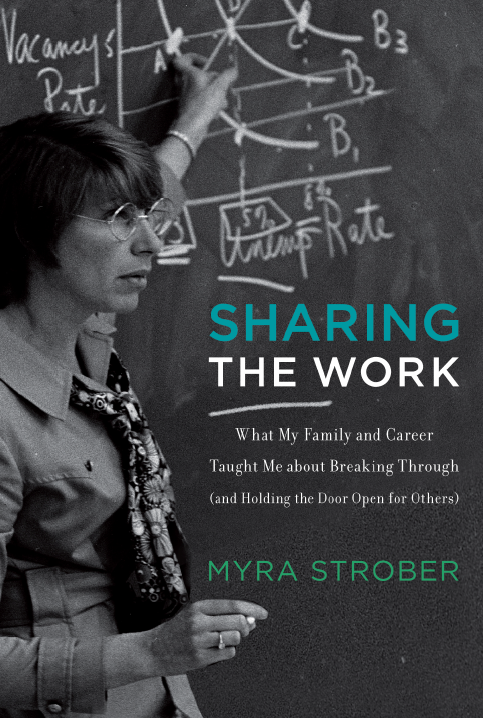
The subject of her April talk was her new book, Sharing The Work: What My Career And Family Taught Me About Breaking Through (And Holding The Door Open For Others). Myra told me about her writing her memoir some time ago, so in a sense I’ve known this book since it was a baby – little more than a thought in Myra’s mind.

Her story is inspiring, but the tale I remembered best is the one that takes place in 1979, when she returned to CROW as director, and had a new boss, the vice provost for research, Jerry Lieberman. It shows us that maybe we have indeed come a long way.

From her book:

From the start, it’s clear that Jerry is extremely supportive of CROW and wants to serve as my mentor. Jerry and I are both from New York, and he says he needs to explain to me why he had to change his New York style to be successful at Stanford, and why I will have to change mine. In New York, he tells me, people can just argue outright, and the loudest screamer wins. Not so at Stanford, he counsels, with a smile. He had to learn to argue “like a gentleman,” softly, and I have to learn that, too.
strober-book

“Everything at Stanford is understated,” he says. “Tough, but gentlemanly and understated.”

I understand what he’s saying. I’ve also noticed a big difference between the New York and Stanford styles. I appreciate this conversation with Jerry, and it becomes a source of humor throughout our relationship. Whenever either of us bargains hard and loudly, we admonish the other to “put away” the New York style and become more Stanford-like.

***

In 1972, Jerry Lieberman, my former boss at CROW and now the university’s provost, asks me to chair a new ad hoc committee he is forming on the recruitment and retention of women faculty. Women now make up 16 percent of the Stanford faculty, twice the percentage they were when I first arrived, but still low compared with our peer institutions. Jerry wants me to lead the committee in figuring out what Stanford can do to raise that percentage and keep it growing.

The committee’s charge is broad, and its male and female members, prominent faculty from all over the university, have quite varied opinions. After several meetings, we decide to focus our efforts on junior faculty. We break up into groups of two or three, with at least one woman and one man in each, and conduct focus groups with both men and women assistant professors.

What we hear is disturbing. Junior faculty tell us that they feel the absence of what committee members begin to term a “culture of support.” Although Stanford departments make heroic efforts to recruit the very best junior faculty they can, including young scholars from other countries, once those faculty arrive and take up their posts, senior faculty in their departments often pay them little mind, perhaps not even reading their work. Both junior women and junior men tell this tale. On the other hand, there are several problems unique to women: encountering the extra scrutiny given to people in the minority, fending off sexual harassment, and being underpaid.

The committee feels that the charges of underpayment are serious, and I bring up the matter in a meeting with Jerry, remembering his counsel years earlier that I negotiate “like a gentleman,” not like a former New Yorker.

“In our focus groups, a lot of the women faculty we talked to said they feel they’re underpaid, but we can’t verify that the university pays women less than men at the same stage of their career unless we have salary data by gender for each school.”

Serra House

The Clayman Center at Serra House.

No way,” he says. “Salary information is confidential.”

Well, that may be,” I say in my most gentle way, “but you appointed this committee to make suggestions about improving the hiring and retention of women faculty, and it looks like one reason women may be leaving Stanford is that they feel underpaid.”

OK, I’ll take a look at the data and see.”

Jerry, you can look at the data anytime. But you appointed a committee to help you with this. We need to look at the data.”

Silence.

We don’t need names, you know, just numbers.”

I smile my most “gentlemanly” smile.

After several go-rounds, we compromise. Jerry agrees to provide a series of scatter plots of full professors’ salaries, by years of experience, in five fields: humanities, social sciences and education, science, clinical medicine, and nonclinical medicine. In each scatter plot, any dot that represents a woman is circled in black. That way, we can see the overall distribution of salaries in a particular field as well as the distribution of women’s salaries. No such plots have ever been prepared, but Jerry asks members of his staff to create them.

He allows only three members of our committee to look at the data with him, and he won’t permit any of us to take the plots out of his office. What we see is crystal clear, and we don’t need much time or analysis to understand the pattern. At all levels of experience, women are overrepresented in the lowest quintile of the salary distribution and underrepresented in the highest. I’m not at all surprised, but Jerry is, and so are many of the deans to whom he shows the plots. Indeed, the creation of those simple quintile plots becomes the first step in Stanford’s emerging efforts to redress salary discrimination. Jerry creates a fund that deans can draw on for salary equity raises, and over the next few years, many women faculty, including me, find that our paychecks are substantially increased.

“Death is so plain!” Remembering Thom Gunn on the anniversary of his death.

Monday, April 25th, 2016
Share

gunn1

tim120I’ve been thinking about San Francisco poet Thom Gunn in the last few days, for reasons I won’t get into. But perhaps a subliminal one is worth mentioning: he died on this day, twelve years ago. I was, to my best knowledge, the last person to interview him at his flat in the City, in a Q&A published in The Georgia Review – not online, alas. 

He was apparently on L.A. poet’s Tim Steele’s mind, too. Both poets are alums of Stanford’s English Department and its Creative Writing Program. Gunn studied with the legendary Yvor Winters while at Stanford; Tim was a Jones Lecturer. 

Tim remembers one of Thom Gunn’s many fine poems on this sad anniversary:

gunn3Thom Gunn died on April 25, 2004. A wonderful elegist, he also wrote with memorable affection about domestic animals, and these gifts come together in “Her Pet.” As he indicates in a video clip (below), he composed the poem when, during the AIDS crisis, he was reading Michael Levey’s “High Renaissance” and came across a reproduction of Germain Pilon’s sarcophagus for Valentine Balbiani (1518-1572) that resonated with own experiences of seeing friends die in the epidemic.

The Balbiani sarcophagus is an example what Erwin Panofsky calls “the double-decker tomb.” On the top of the tomb, Pilon depicts the reclining figure of Valentine as she was in life. Below, on the side of the tomb, he renders her as she was after she died.

Contracts concerning the sarcophagus survive, and they call not only for this double depiction of Valentine, but also for her being accompanied by “a little dog of marble, made as naturally as possible.” Dogs often appear on tombs, but generally at the feet of the deceased and chiefly as symbols of fidelity. In this case, however, the dog was an effigy of a real companion of the subject, and according to contemporary accounts, it died of sorrow three days after its mistress did.

gunn2Writing about the sarcophagus, Gunn imitates its appearance by devising a double sonnet. The first sonnet—the upper one—describes the portion of the tomb that shows Valentine alive. The second sonnet describes the side-relief of her in death. Below is the text of “Her Pet,” along with the two images of the tomb reproduced in Levey’s book. The video clip of Gunn’s reading of the poem is from a 1994 appearance at the Lannan Foundation in Los Angeles.
“Her Pet”

I walk the floor, read, watch a cop-show, drink,
Hear buses heave uphill through drizzling fog,
Then turn back to the pictured book to think
Of Valentine Balbiani and her dog:
She is reclining, reading, on her tomb;
But pounced, it tries to intercept her look,
Its front paws on her lap, as in this room
The cat attempts to nose beneath my book. …

[Well, copyright laws forbid us to do more. Listen to the rest below…]

Postscript on 4/26 from Tim Steele: “I well remember your Georgia Review interview with Thom. It brought many characteristic flashes of his insight. I also recall his comparing, in his conversation with you, Yvor Winters’s influence on him to his mother’s influence on him. (This appeared in your Stanford Magazine piece on Thom, I believe.) That’s an incredibly revealing and touching comment. People often think of Winters as a formidable father figure, and he may have been that for Thom to some extent. But Thom also saw Winters as a nurturing, supportive, literature-loving figure, just as his mother had been.”

The Stanford book club that rocks the news

Friday, April 22nd, 2016
Share
camus5

Toby Wolff’s Another Look send-off last spring. (Photo: David Schwartz)

Author Peter Stansky‘s “A Company of Authors,” the annual event where Stanford authors present their books, had its best day ever last Saturday. As I told Stanford Report“The author presentations were eloquent and excellent, without exception, and the audience questions ensured the discussion was spirited and intelligent.” And longtime Hoover fellow Paul Caringella even gave an impromptu pitch for my forthcoming René Girard biography. What’s not to like?

“I always find these occasions extremely exhilarating,” Peter said. “The heart of the university is the life of the mind and you could not have a better example of that than in the books that their authors presented here today.”

Well, you can read the whole thing here. Nearly everyone stayed through all the presentations, and the excited and audible buzz in the lobby afterwards told the story.

And I told a story, too, during my ten-minute solo for “The Wonderful World of Books at Stanford.” Peter introduced me as “the leading figure at Stanford in keeping us involved in so many exciting ways in the world of books.” So I took up the cause of the Another Look book club it has been my privilege to manage for four years. Here’s what I said:

I’m here to tell you the Another Look story. It’s a good story, and I’ve been proud to be part of it. I think you’ll like it because it’s a story about books finding their people.

camus-8

Founder Tobias Wolff. (Photo: David Schwartz)

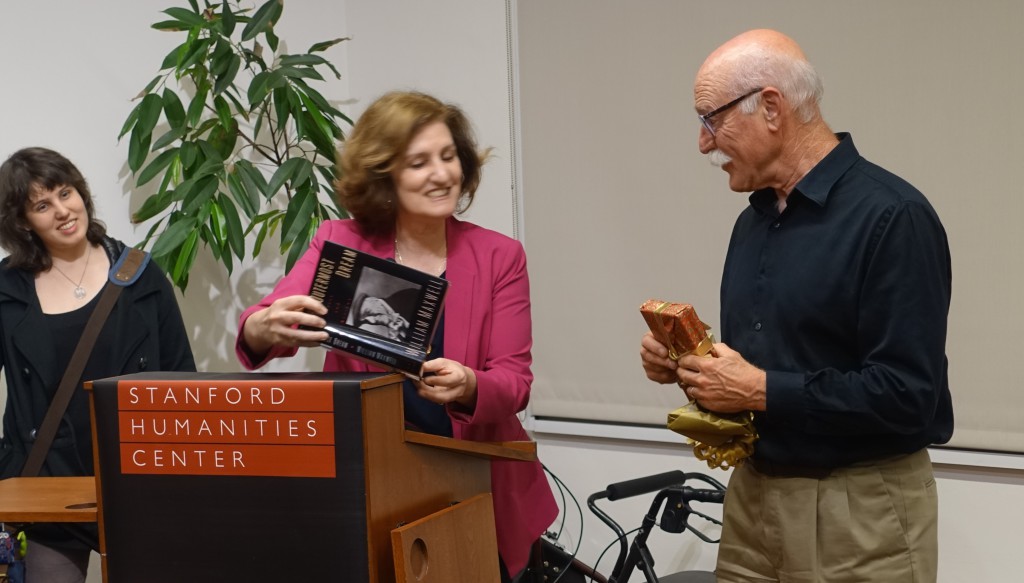
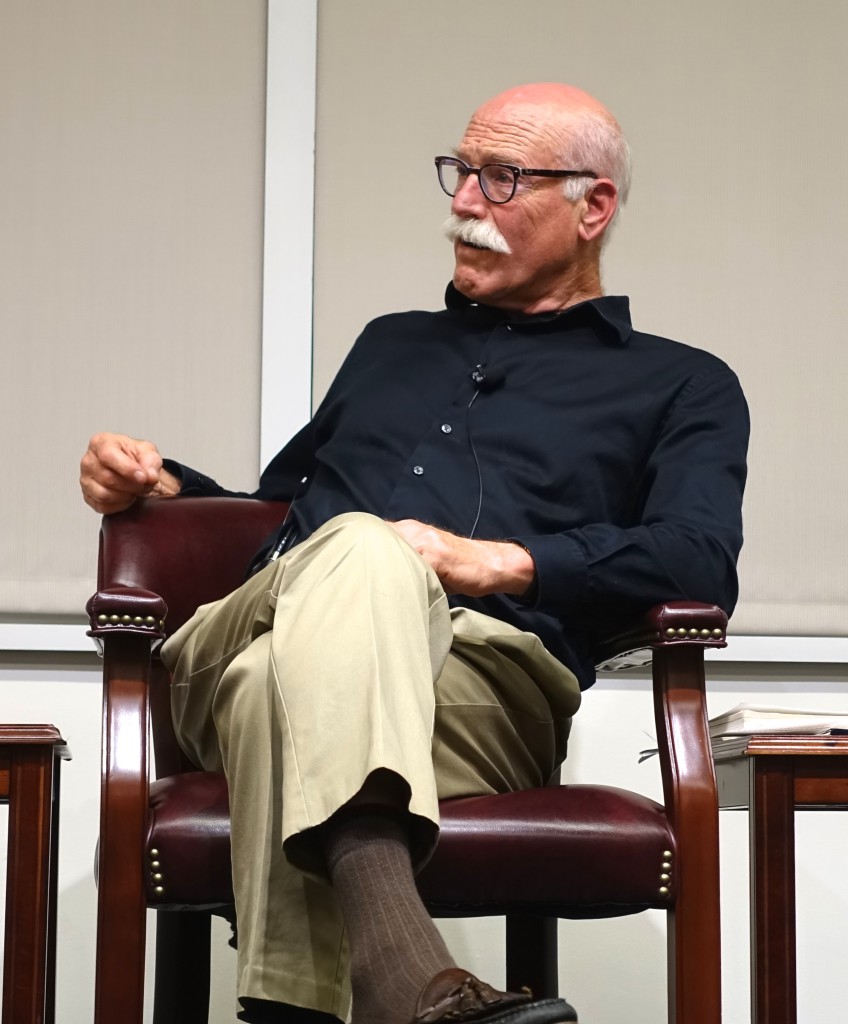
Four years ago, the distinguished author Tobias Wolff – who was recently named a recipient of the National Medal of the Arts – approached me with an idea: he wanted to create a forum where members of the community would interact with Stanford writers, scholars, and literary figures in the world beyond, to talk about the books they love. He wanted the first book to be a beloved favorite, William Maxwells So Long See You Tomorrow. He asked me if I could make all this happen. Frankly, I have to say, I was doubtful. The term “book club” did not have good associations for me. But as we hashed it out, I realized my issues were two-fold: first, I figured most people, like me, didn’t have the hours and hours to read long books of other people’s choosing; and second, the books tended to be mainstream, middlebrow, middle-of-the-road “safe” choices.

Inspired by Maxwell’s novel, we decided that we would focus on short books – short enough for Bay Area professionals who are pressed for time, and who may spend their days going through legal briefs or medical documents. Also, we would focus on books that were forgotten, overlooked, or simply haven’t received the audience they merit. We would call it “Another Look.” It would be for people who wanted to be part of the world of books and literature – a world they may have lost touch with once they left university. They would be connoisseurs’ choices for books you must read – discussed and even championed by the people who love them.

Not delusional. (Photo: Nancy Crampton)

Nobless oblige. (Photo: Nancy Crampton)

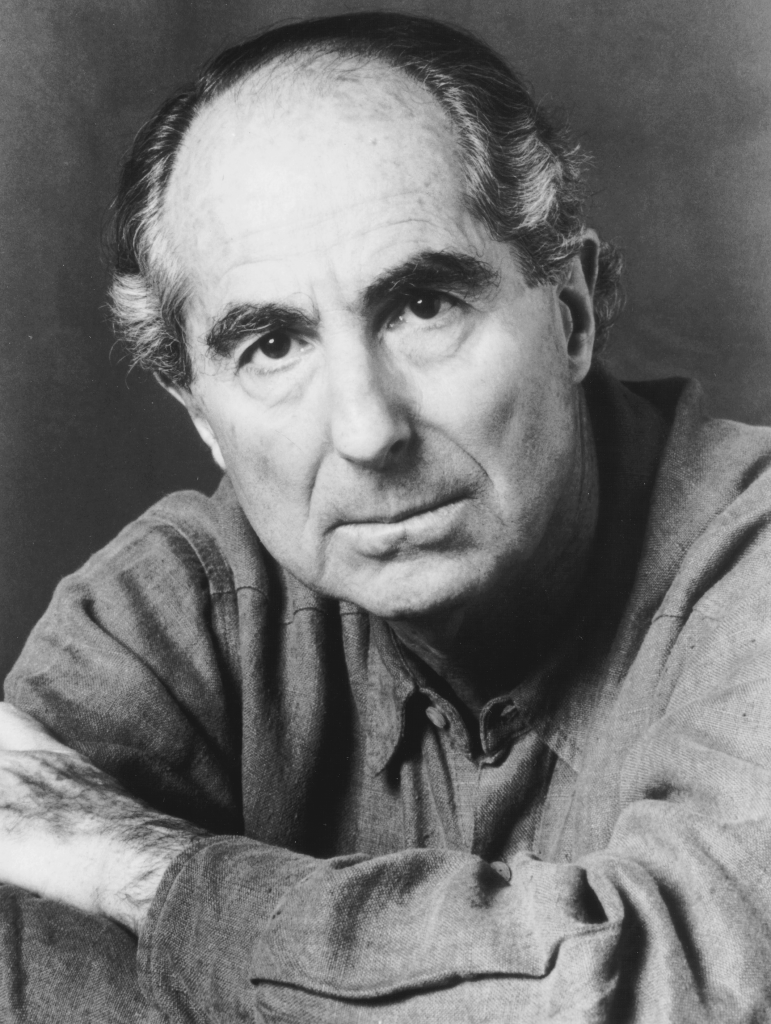
We had a full house the first night, and our audiences have been steadily climbing upward ever since. One highpoint: for Philip Roth‘s The Ghost Writer, we were joined by Michael Chabon and Ayelet Waldman. It was the only time to date we have had a living author. And although he had become something of a recluse, I decided to see if I could interview him. The subsequent Q&A was published on The Book Haven and republished in La Repubblica, Le Monde, and Die Welt. It made the international press, and the high-profile Another Look was featured in The Guardian.

Toby retired … or said he was going to retire … last year (he was recalled for another year, but that’s another story). When we announced that Another Look was going to close shop a year ago, we got record numbers of people attending our event for Albert Camus‘s The Stranger – a book, Toby claimed, that was more honored than read. One member in the audience, the acclaimed author Robert Pogue Harrison, stepped forward that night to offer to assume the directorship of the program. We’ve developed subscribers’ list pushing up to 1,400. Our February’s event with Werner Herzog at Dinkelspiel Auditorium, discussing J.A. Baker‘s The Peregrine, is now on youtube, in both highlights and full-length version. (The event was covered by San Francisco Chronicle columnist Caille Millner here.) The repercussions of that powerful book event will continue to unfold in the months to come.

Legendary film director Werner Herzog discusses J.A. Baker's book The Peregrine at the Feb. 2 Another Look book club event.

Legendary film director Werner Herzog discusses J.A. Baker’s book The Peregrine at the Feb. 2 Another Look book club event. (Photo: L.A. Cicero)

It’s been enormously gratifying for me personally to be the point of contact with all of you in our book-loving Bay Area community – and sometimes around the nation and world, too. We have one aficionado driving in from Carmel – others write from far-flung places to tell me they’re reading along with us. And Toby has talked about this program, during his speaking engagements around the country. He’s proud of his brainchild, too.

Why am I so keen on this program? Because it’s rocked my world. Those who know me as a literary journalist know that I’ve sunk my time into the world of Eastern European poets, particularly Nobel laureate Czesław Miłosz, and more recently, into the French theorist René Girard, a longtime Stanford faculty member, a dear friend, and the subject of my biography. Hence, there are huge holes in my knowledge of modern fiction, and particularly American fiction. Without too much investment of time, I’ve caught up with a lot of writers I’d somehow missed. No membership fees, no meetings with minutes, no commitments – just show up, please!

So please join us next month, on Tuesday, May 10, at the Bechtel Conference Center, when we discuss Joseph Conrads novella The Shadow-Line. The story will run in Stanford Report Monday and be on the Stanford news website – we have books in the lobby. Meanwhile, take some freshly minted bookmarks – and take a few for your friends who might be interested, too.

“Karski & the Lords of Humanity”: The story of the man who tried to stop the Holocaust

Thursday, April 21st, 2016
Share
jan_karski

He tried to tell us.

I had a lot of work to plough through tonight, but duty and interest called me for a brief foray out to the Stanford campus – specifically, to the new McMurtry Building to see the 2015 film, Karski & the Lords of Humanity, sponsored by the Hoover Institution Archives and the Center for Russian, East European & Eurasian Studies. It was showing for free. The theater was only a third full – and it’s a shame. The name Jan Karski (1914-2000) should be a household word, and it’s not.

This short movie isn’t perfect (the drawings are overused to portray action, and it begin to grate), but the film serves as a good introduction to a man still too little known.

The brief New York Times review last fall only begins to describe it:

One of the many interviewees in “Shoah,Claude Lanzmann’s definitive nine-and-a-half-hour 1985 documentary about the Holocaust, was Jan Karski, a Pole whose undercover missions in World War II gave early information to the Allies about the extermination of Polish Jews. Slawomir Grunberg’s stately documentary “Karski & the Lords of Humanity” focuses exclusively on Karski’s courageous adventures in intrigue and espionage.

The handsome, dapper, erudite and multilingual Karski (1914-2000), who was blessed with a photographic memory and educated as a diplomat before serving in the military, was an ideal candidate for the Resistance. Often working for the Polish government in exile in London, he conducted many missions, among them a trip incognito to the Warsaw Ghetto, illustrated here with utterly harrowing photographs. Karski presented his eyewitness account in person to officials in Britain and, eventually, President Franklin D. Roosevelt. His exploits — surviving brutal torture by the Gestapo; a daring hospital escape; smuggling microfilm; using medical mean to disguise his accent — are fleshed out with vivid animated sequences, while experts offer testimony.

My Hoover Archives friends recall meeting the tall, distinguished Pole from Georgetown University during his visits. Little known fact: the Karski papers are at the Hoover Archives. Anyone can see them, with a request.

Another Look book club spotlights Joseph Conrad’s Shadow-Line on May 10

Wednesday, April 20th, 2016
Share
conrad-ship

Joseph Conrad (foreground) on board the special service ship Ready in 1916. He wrote The Shadow-Line on his return from the voyage. (Image credit: Beinecke Rare Book and Manuscript Library, Yale University)

The author Joseph Conrad insisted his work The Shadow-Line: A Confession was not a book about the supernatural. But sometimes the real can be spookier than the imagined, and what we observe outpaces our worst nightmares. So it is with Conrad’s late novella.

“The belief in a supernatural source of evil is not necessary; men alone are quite capable of every wickedness,” Conrad said a few years before World War I. Certainly the rest of the century bore out his conclusions.

The Another Look book club will discuss Conrad’s 1917 novella and the Polish author at 7:30 p.m. Tuesday, May 10, in the Bechtel Conference Room of Encina Hall. The Shadow-Line is available at Stanford Bookstore, Kepler’s in Menlo Park and Bell’s Books in Palo Alto.

The panel will be moderated by Another Look director Robert Pogue Harrison, an acclaimed author and professor of Italian literature. Harrison is a regular contributor to the New York Review of Booksand the host for the popular radio talk show Entitled Opinions. He will be joined by drama Professor Rush Rehm, artistic director of the Stanford Repertory Theater, and Monika Greenleaf, associate professor of Slavic languages and literatures and of comparative literature.

The event is free and open to the public.

“I chose this short novel because of its exquisite prose and quintessentially Conradian drama,” Harrison said. “It probes the enigma of fate by putting circumstance, landscape and depth psychology into play all at the same time.”

He added, “Conrad is a master when it comes to putting his characters through trials. The Shadow-Line is one of the most intense of Conradian trials of character. It is not one of his best known novels and is certainly deserving of another look.”

Conrad’s short masterpiece describes the “green sickness” of late youth, when a young man desires to “flee from the menace of emptiness.” The unnamed narrator’s flight ends when he is captain of a merchant ship in Southeast Asia; the terrors of sickness and the sea bring him to grief, maturity and wisdom.

In a two-page author’s note, Conrad denies the supernatural has anything to do with his story. We are meant, then, not to draw a line between the mate’s superstitious and feverish fear of his former captain, buried at sea, and the destruction of the ship to weather, wind and contagious fever. The mate says the ship will not have luck until it passes the spot where the reckless and demented captain was put overboard.

conrad2

(Courtesy Beinecke Rare Book and Manuscript Library)

The Shadow-Line can also be read as a psychological study of the disintegration of an entire ship’s crew. That would be in keeping with Conrad’s worldview; he once called life a “mysterious arrangement of merciless logic for a futile purpose. The most you can hope from it is some knowledge of yourself – that comes too late – a crop of inextinguishable regrets.”

The year The Shadow-Line was published, The Argus praised the novel: “It holds the reader under a spell so strong that the book must be finished at one sitting, and even when it is laid aside it keeps its grip on the memory, and the impression left remains with a curious persistence.”

The Sunday Times wrote, in 1917, “Mr. Conrad is an expert in the business of suggesting mystery and the action of malevolent agencies and the endurance of a man under the buffets of fate. Not even Coleridge has held passers-by more spellbound under a tale of horrors on the ocean than does Mr. Conrad in this work.”

Józef Teodor Konrad Korzeniowski – Joseph Conrad – was born in 1857 in a largely Jewish village in territory that is now Ukraine; it had been part of the Polish-Lithuanian Respublica before partition, and at the time of his birth was part of the Russian Empire. His father was a Polish patriot and man of letters, and the family had a migratory existence. Conrad began a seafaring career as a teenager, and eventually joined the British merchant marine and became an English citizen.

He was one of the very few writers to establish his literary reputation in a foreign tongue. (Vladimir Nabokov comes to mind as well, but the author of Pale Fire and Lolita was reared in an aristocratic Russian family; however, he later claimed English was the first language he learned in his trilingual household.)

World War I was much on Conrad’s mind as he wrote Shadow-Land, and the book is dedicated to his son Borys, a soldier. By the time it was published, Borys had returned from the front, shell-shocked and gassed in the new technology of warfare. The war’s end would change forever the face of the Europe Conrad remembered.

Shortly after the war, a visitor to the Conrad household observed: “Conrad spoke fluently, but his accent, his manner of expression were such as I observed among the inhabitants of the south-eastern Polish borderlands. One felt clearly that when he thought of Poland, it was of a Poland of half-a-century ago. When I listened to him, I could not evade the impression that I am being carried back in time and talk to one of the people of long ago.”

 Another Look is a seasonal book club that draws together Stanford’s top writers and scholars with distinguished figures from the Bay Area and beyond. The books selected are short masterpieces you may not have read before. This article is republished from my Stanford Report piece here.

Happy 109th birthday, Thornton Wilder! Two great quotes for his day.

Sunday, April 17th, 2016
Share
Thornton_Wilder

Wilder in “Skin of Our Teeth,” 1948 (Photo: Carl Van Vechten)

I was looking for a half-remembered quote today, and found it: “There’s nothing like eavesdropping to show you that the world outside your head is different from the world inside your head.” So true.

The quote-sayer was playwright and novelist Thornton Wilder. Then I happened to remember that today is his 109th birthday.

Here’s the quote that Joseph Peschel chose for his own Facebook celebration. It’s also a good one: “I’ve never forgotten for long at a time that living is struggle. I know that every good and excellent thing in the world stands moment by moment on the razor-edge of danger and must be fought for — whether it’s a field, or a home, or a country.”

That’s from The Skin of Our Teeth. So is Carl Van Vechten‘s 1948 photo of Wilder, playing Mr. Antrobus in the production.

Happy birthday, Thornton Niven Wilder (Apr. 17, 1897 – Dec. 7, 1975)!