Archive for May, 2016

Dana Gioia’s 99 Poems: plaudits, readings, an award, and an evening at Stanford

Saturday, May 28th, 2016

Share
dana-humanities

Dana Gioia at Stanford’s Humanities House on May 5.

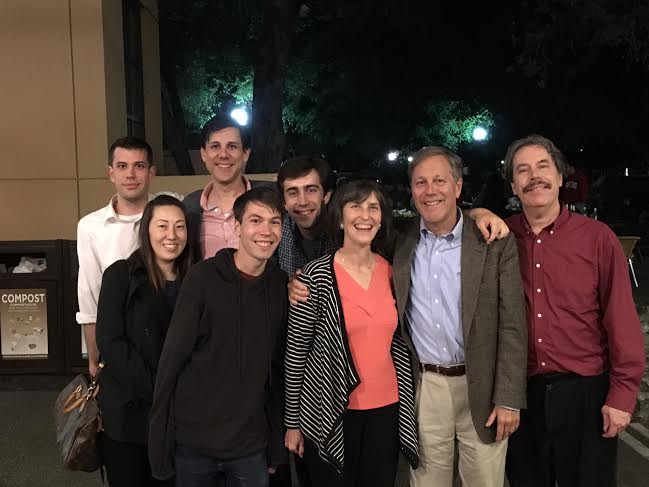
Dana Gioia and his 99 Poems: New and Selected (Graywolf Press) have been getting a lot of attention. California’s current poet laureate had a reading from his new collection at Stanford’s new Humanities House on May 5 (an occasion that also doubled as a family reunion afterwards), and the following week he received the Denise Levertov Award in Seattle on May 11. This week, a reading at Kepler’s in Menlo Park on the 26th.

There’s more: A.M. Juster (we’ve written about his work on Petrarch here) has an article, “The Case for Dana Gioia,” in the current Claremont Review of Books here. An excerpt on Dana’s career:
99PoemsThough Gioia continued to publish poems, essays, reviews, and libretti, he came to devote more time to public service. He received broad praise, after some initial grumbling, for his tenure as Chairman of the National Endowment for the Arts from 2003 to 2009. His Poetry Out Loud program, a poetry recitation competition for high school students, has become a blowout success, particularly among recent immigrants. He also initiated programs that promoted community discussions of poetry, brought Shakespeare to mainstream audiences, and helped returning veterans relate and cope with their war experiences.

Now 65, Gioia’s new collection of brief essays, Poetry As Enchantment, is a quieter and more reflective expansion of the themes in Can Poetry Matter? He defends poetry as a spiritual need, partially resistant to the tools of New Criticism and later schools of literary theory. His populist argument is rhetorically brilliant. Gioia undercuts a likely objection by including the songlike chants of Ezra Pound’s verse as evidence for his proposition, even though Pound was instrumental in transforming modern poetry into obscurities academics pored over and everyone else ignored. Enchantment also cites the work of Rainer Maria Rilke, William Blake, and the surrealists to bolster its point.

Though Gioia’s role as a cultural warrior and arts leader would be sufficient to make him a minor figure in American literary history, his time in public service damaged his literary productivity. Thankfully, he is back on a mission with 99 Poems, a “new and selected” collection likely to be a future candidate for inclusion in the canon.

Dana is one of the few poets in the world to have an MBA – from Stanford, no less. He worked at General Foods in New York, eventually rising to vice-president. The story is retold by a former colleague, Rochelle Newman-Carrasco, in  “A Poet Laureate, Jell-O, and Me” over at the Lunch Ticket:
gioia-reunion

The Gioia clan at Stanford, May 5.

I attended Dana Gioia’s poetry workshop on The Poetic Line and listened to him read Gwendolyn Brooks’ poem, “We Real Cool” twice—once to accentuate the rhymes and once the way it was written. As he discussed strategies of syntax and stops, I could clearly see Gioia, the client, the man I knew more than two decades prior—the one who seemed different from other corporate executives even then.

When we had worked together, I was in my early twenties, he was in his thirties, and aside from a client crush sparked by his unchanged good looks and resonant voice, I was particularly enamored with his ability to simplify complex marketing ideas, communicating only what was essential. He was also one of the few clients who not only got the idea of culturally-specific marketing, but also seemed to embrace it. All too often, the average white male (or even female) marketing execs struggled with this new way of looking at the world. Nothing about Gioia was average. The son of a Mexican-American mother and an Italian-American father, Gioia was no stranger to cultural nuances, but there was more to his distinct style than that.  He wasn’t as literal as many of his corporate MBA-trained colleagues, and he approached problem solving with an open mindedness and imagination that was more often associated with liberal arts types. At the time, I had no clue that he was a poet and neither did anyone else at General Foods or the Agency. Likewise, he didn’t know that I was an actress-writer in a costume, playing a role. There was a time when such things were better left unsaid.

…What we conceal
Is always more than what we dare confide….
From Unsaid, by Dana Gioia

jelloOne day in 1992, I was informed that Gioia had left General Foods. The news came as a surprise to everyone. He had turned the Jell-O brand around. We had even worked on Jell-O Jigglers together, a product innovation that helped grow sales. I heard something about his leaving to become a writer, but it wasn’t anything too specific. I remember thinking, That makes sense. He was sensitive and soulful in an industry where souls were sold, not protected.

In his essay, “Being Outed,” Gioia writes about the Esquire  article that stripped him of his literary anonymity. “When I entered corporate life, I resolved to keep my writing secret,” writes Gioia. “There was no advantage in being known as the company poet. For nearly a decade I succeeded in keeping my double life hidden from my co-workers.”

Oh, and listen to Garrison Keillor read Dana’s “Places to Return” last month (April 24) on the Writer’s Almanac – it’s here.
A powerful antidote to the current election cycle

Wednesday, May 25th, 2016
Share

grossmanLike so many Americans, I am disheartened by the current election cycle and its dispiriting daily news. Here’s one antidote: instead of the political blogs, try reading Vasily Grossman‘s Love and FateIt has been sitting on my bookshelves for about a year, awaiting the right moment. Try the battle of Stalingrad, the Soviet gulags, and the Nazi death camps, to give you a sense of scale.

Here’s Grossman take on the times being out of joint, a bracing reminder that we all can’t roll with it, all the time. Who, after all, would want to be the man of the hour in the U.S.S.R. of Joseph Stalin?

“There is nothing more difficult than to be a stepson of the time; there is no heavier fate than to live in an age that is not your own. Stepsons of the time are easily recognized: in personnel departments, Party district committees, army political sections, editorial offices, on the street … Time loves only those it has given birth to itself: its own children, its own heroes, its own labourers. Never can it come to love the children of a past age, any more than a woman can love the heroes of a past age, or a stepmother love the children of another woman.

“Such is time: everything passes, it alone remains; everything remains, it alone passes. And how swiftly and noiselessly it passes. Only yesterday you were sure of yourself, strong and cheerful, a son of the time. But now another time has come – and you don’t even know it.”

Anyway, I’ve already voted by mail in the primaries. Wake me up in November. Meanwhile… back to my book.

Robert Conquest remembers Solzhenitsyn: “How should one judge him?”

Saturday, May 21st, 2016
Share
Conquest at work (Photo: L.A. Cicero)

Conquest at work in 2010 (Photo: L.A. Cicero)

Next month, I’ll be giving a talk about Robert Conquest – the legendary historian of Russia’s Stalinist period, and also a very fine poet. The occasion will be the West Chester Poetry Conference outside Philadelphia. Tonight, I’m working and thinking about Bob, who died last year at 98. While checking dates on the internet, I found this article from him about his collaboration with the larger-than-life Russian writer Alexander Solzhenitsyn.

You can read it in its entirety in the Wall Street Journal here. Or settle for a couple excerpts below:

solzhenitsyn4

He’s working too, at Hoover Institution Archives.

Those of us who had long been concerned to expose and resist Stalinism, in the West as in the USSR, learned much from Alexander Solzhenitsyn. I met him in Zurich, Switzerland, in 1974, soon after he was expelled from the Soviet Union – the result of … The Gulag Archipelago, being published in Paris. He was personally pleasant; I have a photograph of the two of us, he holding a Russian edition of my book, The Great Terror, with evident approbation. He asked if I would translate a “little” poem of his. Of course I agreed.

The little poem, Prussian Nights, turned out to be 2,000 lines! Thankfully, he and his circle helped. It was an arresting composition, increasing our knowledge of him and his times – something worth reading, and rereading, for its stunning historical background.

Solzhenitsyn was one of the most striking public figures of our time. How should one judge him? As a writer, up there with Pasternak? As a moralist, up there with Czeslaw Milosz? But he should also be judged as one who might have won two Nobel prizes – not just for Literature, but also for Peace.

In his public capacity, he felt bound to stand forward as the conscience of his people. He said, in a July 2007 interview in Der Spiegel, “My views developed in the course of time. But I have always believed in what I did and never acted against it.” Yet above all, he saw himself as a writer – a Russian writer.
 .
For most of us, Russian literature is like a triangle around Pushkin, Dostoevsky, and ChekhovTolstoy is in his own class. Solzhenitsyn, on the strength of August 1914 alone, competes in the Tolstoy lane.
.

***

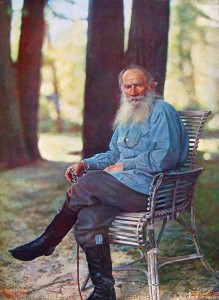
L.N.Tolstoy

“Class of his own.”

Some giants of Russian literature appear more preachy than is common in the West, a trait that brings us to what many see as weaknesses in the Russian tradition. First is the feeling, without basis, that one is somehow being cheated – as in Gogol; second is a tendency to exaggerate or invent. Yet along with these weaknesses there is also painful honesty.

I did not sense the weaknesses when I met him. He was religious and Russian, but without exhibition – though it became clear he embodied Fyodor Tyutchev‘s famous dictum that “Russia can neither be grasped by the mind, nor measured by any common yardstick – no attitude to her other than one of blind faith is admissible.”

He remained staunchly anticommunist, noting in the July 2007 interview in Der Spiegel that the October Revolution “broke Russia’s back. The Red Terror unleashed by its leaders, their willingness to drown Russia in blood, is the first and foremost proof of it.” He also hoped that “the bitter Russian experience, which I have been studying and describing all my life, will be for us a lesson that keeps us from new disastrous breakdowns.”

Incidentally, I would never call Milosz “a moralist” – he certainly would not have considered himself as such, and was far too aware of his fallibility. Nevertheless, read the whole thing here.

Photographer Lena Herzog: “I fall into breathing with the world…”

Thursday, May 19th, 2016
Share
Lena_Herzog

Herself. (Photo: Wikimedia)

Russian American photographer Lena Herzog is a phenomenon – well beyond the books she has published and her international exhibitions. She’s witty, incisive, profound, and thoroughly original. You can read for yourself in my Q&A with her at the Music & Literature website – here

I caught her during a recent trip to San Francisco, while she was visiting on break for her tours with her newly published Strandbeests: The Dream Machines of Theo Jansen. Lena Herzog spent seven years tracking the evolution of a new kinetic species, intricate as insects but dwarfing its creator, a scientist-artist, in size as they roam the beaches of Holland. 

But this particular visit to the City wasn’t a solo visit: her husband Werner Herzog was in town for Stanford’s Another Look book club event, in which Herzog joined author Robert Pogue Harrison for an onstage conversation (we wrote about that here and here). Robert met the Herzogs a few years earlier, when he interviewed Lena for his Entitled Opinions radio show.

But I consider it a privilege to have had a short squished hour with Lena alone, before the Herzogs headed back to their Los Angeles home.

Here’s an excerpt:

strandbeestsHaven: So how do you capture a moment that is movement? With the Strandbeests, you’re trying to take a still photograph of something that is essentially motion, by definition.

Herzog: By definition, yes. That’s the whole point of it. One of my first two books was about dance—Flamenco: Dance Class in 2004. By the way, it was dedicated to a great Flamenco dancer Yaelisa of Spanish decent, the daughter of the great Flamenco singer Isa Mura. Yaelisa lives and works in the Bay Area. I had a similar challenge with her and her troupe, how do you photograph something that is all about motion? Or anything that’s alive, really? A dancer is not a breathing, living being in my photographs, but, I hope, you get a sense of her, of her dance. A photograph is not a calcification. For me, it’s capturing the spirit of something, a tree, a person, an object, a moment. At its best, a good shot is the opposite of clarification—it is a mystery.

I normally photograph at a regular speed, 125 fractions of one second. So it’s one second divided by 125 times. That’s the slice of the time I use to capture something. I click when I feel something—when my heart sinks for a brief moment. Everything that constitutes me, coalesces, dances with that moment.

flamencoThat connection is what matters, what makes me take a picture. That’s why, for example, I don’t use tripods. I have them, I just haven’t used them. I realized that even when I’m photographing a tree or a mummified human specimen in the Cabinet of Wonders I need to be one with my camera. The lost souls are not moving, but I am moving. My soul is moving. It’s breathing. It feels like I fall into breathing with the world. And then I click.
I need that last breath, that sense of becoming the thing I’m photographing—as if my soul jumped out of me and into that person. I need that brief second, that possession, and so that last breath is crucial. When I am responding to motion, to a dance or to Strandbeests, that’s what I’m reflecting—something that’s in me. It’s not technically photographing something and making sure the viewer understands this motion. It’s this after-image effect, the moment when your heart sank because you saw that. And it translates. It’s a mystical moment. I don’t know why it translates, but I know that it does.

Well, you can read the whole thing online here

Has entertainment turned our minds into jello and our politicians into clowns? Vargas Llosa thinks so.

Monday, May 16th, 2016
Share
MVL_©_zygmunt_malinowski

Mario Vargas Llosa in NYC with interlocutor John King at right. (Photo: Zygmunt Malinowski)

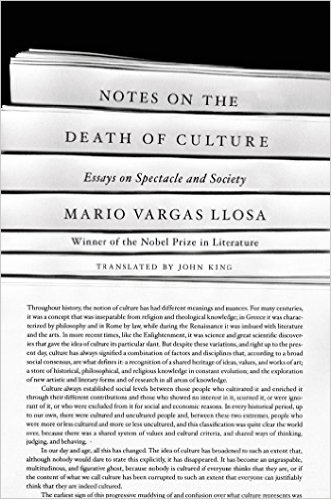
We’ve written about Peruvian Nobelist Mario Vargas Llosa before (here and here and here). Now it’s The Guardian‘s turn. Vargas Llosa has just come out with a new collection of essays, Notes on the Death of Culture. (This isn’t a new article, but perhaps you also missed it when the book was published last year.)

From The Guardian:

llosa-bookVargas Llosa has long been known as a public intellectual as well as a novelist in the Spanish-speaking world – and indeed in the UK, where he lived in the 1980s. One-time contender for his country’s presidency, a cultural liberal who wants value in the arts, ideas and literature to rule over easy relativism, the register of price and the “civilisation of spectacle”, he worries over the dangers to democracy the latter group poses. He’s at home with the giants of French theory, from Guy Debord, inventor of situationism, to Jacques Derrida and his archival fever. Their impact, he notes, has hardly been salutary. Meanwhile, neither artists nor critics, journalists nor politicians value judgment or intelligence.

By succumbing to what Marshall McLuhan called an “image bath”, he writes, the 21st-century west has ushered in a time of “docile submission to emotions and sensations triggered by an unusual and at times very brilliant bombardment of images that capture our attention, though they dull our sensibilities and intelligence due to their primary and transitory nature”. A shallow levity has taken over. The ethics of Hello!, which he reminds us was originally a Spanish magazine, rule. Entertainment is all. Translated into the political sphere, this means our politicians increasingly become clowns, prepared to do anything to capture media attention. The press, whose freedom is crucial, is more symptom than outright cause of this regrettable phenomenon.

Read the whole thing here.

Editor extraordinaire Daniel Medin: he’s “raise-your-eyebrows smart”

Friday, May 13th, 2016
Share
medin-krasnahorkai

Man Booker award-winner László Krasznahorkai’s with Daniel Medin at last year’s ceremony. (Photo: Hans Balmes)

One of our favorite people is international literary tastemaker and editor extraordinaire Daniel Medin of the American University in Paris. We’ve written about him here and here and here, among other places. It’s been a pleasure to watch his rise as a truly great editor and homme de lettres, fostering literary excellence wherever in the world he finds it.

Fortunately, our good taste is contagious. An article on the Washington University of St. Louis’ The Source called him “an evangelist for outstanding contemporary foreign-language writers.”

Case in point: Medin is a judge for the 2016 Man Booker International Prize. The annual award honors a fictional book translated into English and published in the United Kingdom. The winning title earns a lofty £50,000 ($75,800), split equally between author and translator.

...and his admirer

Literary evangelist

Medin and the four other jurists pored over 160 novels and met several times throughout the winter and early spring to create the prize’s longlist and then select the winner. “What I’m doing doesn’t feel like work,” he says. “It’s a privilege.”

Warm, self-effacing and raise-your-eyebrows smart, Medin works in three languages — German, French and English — allowing him to read fiction by authors famous in their own countries but underrepresented or completely unknown by Anglophones.

When a novelist or poet impresses him, Medin gracefully labors to expose that person’s prose to English-language readers. He publishes translated selections of their work in Music & ­Literature, The White Review and The Cahiers Series, the three literary ­magazines that he helps edit. He also sends copies to publishers, critics and writers all over the world.

“Reading these books is a pleasure,” Medin says. “It’s similar to having something delectable to eat; the delight is enhanced by sharing it with others.”

Read the whole thing here. The only thing I’d fault it for is that it doesn’t mention Daniel’s long stint at Stanford, which is where our paths finally crossed.