Archive for August, 2016

Danish poet Ulrikka Gernes: bringing light to darkness

Tuesday, August 30th, 2016
Share
ulrikka

(Photo: Christoffer Regild)

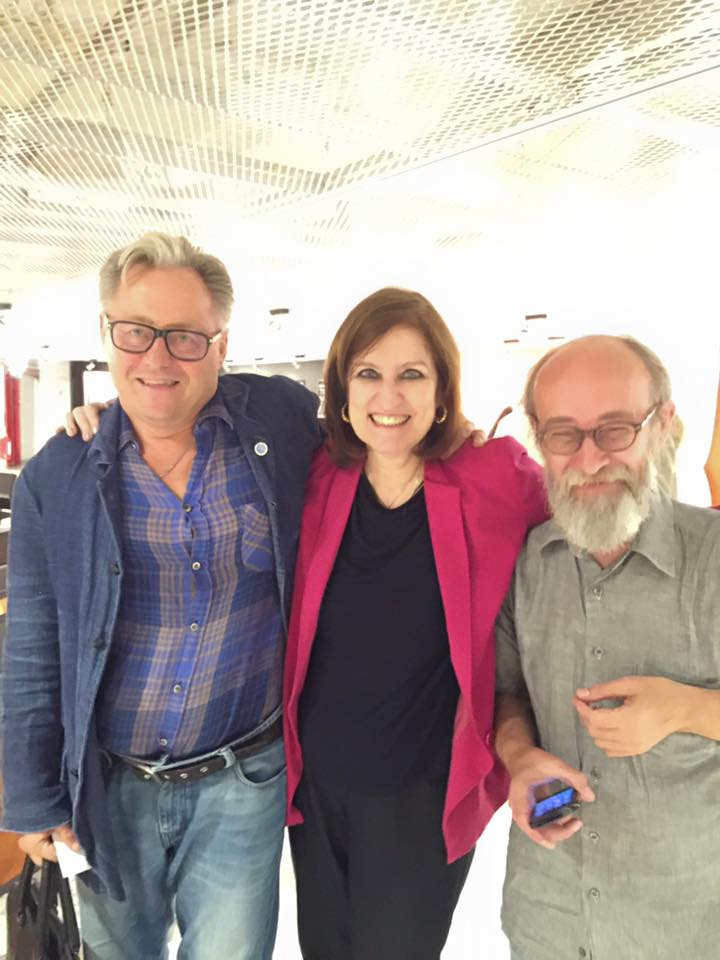
One of the more radiant presences at this year’s Sigtuna Literary Festival in Sweden was Ulrikka Gernes, one of Denmark’s leading poets. Ulrikka, daughter of the international artist Poul Gernes, published her first collection at eighteen, and has followed with ten more collections in the years since since. As far as radiance goes, you can judge for yourself by the photo at right. (She was wearing the same trademark pearls last week.)

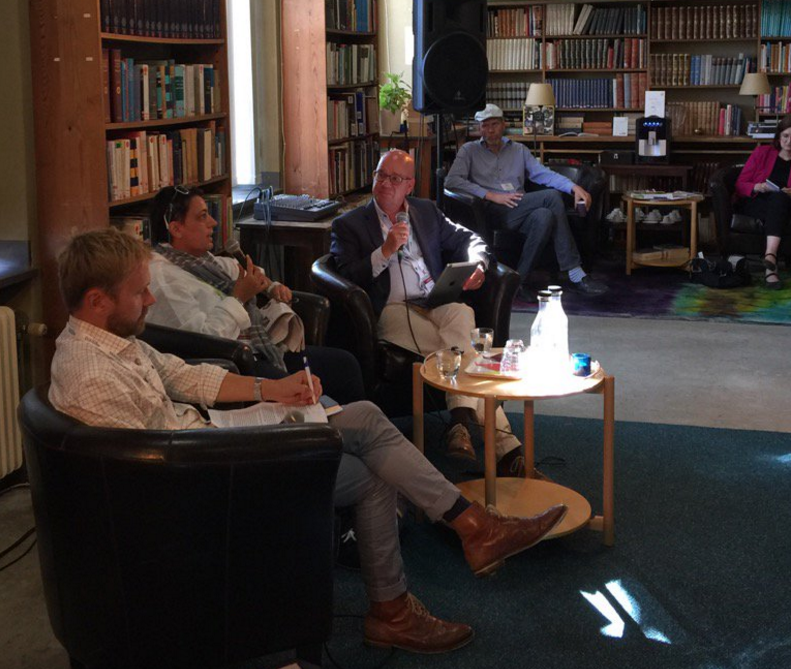
The Copenhagen poet is also generous. I attended the Sunday morning panel on “Border Crossings in Language.” She shared the conversation with Oslo poet Håkan Sandell; it was moderated by Swedish writer and journalist Maria Küchen. I didn’t understand a word, of course – it was all in Swedish. Ulrikka ended the session with a shout-out to Humble Moi, and read the poem below – mercifully, in English.

It’s from her most recent collection Frayed Opus for Strings & Wind Instruments (Brick Books, 2015), translated from the Danish by Per Brask and Patrick Friesen:

.

On the table in the room in the dark

On the table in the room in the dark
house lies the book you didn’t know
you were looking for, opened to the page
with the poem about solace you didn’t know
you needed; at first the letters
then the words, little by little
the lines disappear as you read them
in the light of the faint dawn that trickles in
between the venetians’ dusty
slats and unites you with someone
you didn’t know you are.

Syrian author Iman Al Ghafari: “I did not want to leave my country forever!”

Sunday, August 28th, 2016
Share
iman

Larsmo, Ghafari, and Linderman at the Sigtuna Literary Festival. (Photo courtesy Sigtuna)

“I did not want to leave my country forever,” said Syrian author Iman Al Ghafari. When she left her homeland in 2012, she had hoped to recharge her batteries and return to fight for gender issues. Now she knows she cannot go back. Most recently, she worked at the Amsterdam Research Centre for Gender and Sexuality, as well as a stint as a guest writer in Utrecht.

Now Ghafari is the Sigtuna literary center’s newest sanctuary writer, a guest in Sweden for the next two years. Sigtuna itself is one of nearly sixty International Cities of Refuge (ICORN), an independent organization of cities and regions offering shelter to writers and artists at risk, advancing freedom of expression, defending democratic values, and promoting international solidarity.

Ghafari spoke at a Sigtuna Literary Festival event yesterday about the plight of feminist and lesbian writers who wish to discuss the issues that concern them in the public sphere. She was joined by author Ola Larsmo, president of the Swedish PEN, and Sigtuna Foundation director Alf Linderman in a conversation about the freedoms we so often take for granted in the West.

iman3

Sigtuna’s newest guest writer

She has a doctorate in English literature from Cairo University; her dissertation was on the poet Sylvia Plath. “There was a feeling of anxiety in Syria, a feeling of being excluded in my own country,” she said. “I was not able to appear in public or express my opinion.”

“Then the situation became unsafe in general – every day explosions and bombs,” she recalled. She left the Syria and has been an exile ever since.

The authorities gave other reasons for her marginalization – she said that to admit the truth “would have been a confession.” Or rather, they gave no reason at all. She insisted she had not resigned from her faculty post, but her university said it no longer wanted her. “Before I left, I was involved in a personal war in Syria. I was not allowed to get an income or leave.” She felt like she was a hostage in her own country and an exile even while living in it.

PEN’s Larsmo said that writers and journalists have a special position within society. When waves of people are fleeing a dangerous situation, they are heading in the opposite direction: “Journalists, truth-finders, those are the people who are trying to tell us what is happening there. They are heading in that direction as others flee,” he said.

He noted that the 1989 fatwa against Salman Rushdie provided a model for the way these people are denigrated and held in suspicion by the very people who should be protecting them. He cited four commonplace accusations they face: 1) The threatened artist is “artistically bad,” he said. Hence, Rushdie’s novel Satanic Verses is condemned for being a “lousy novel.”  2) The threatened artist was deliberately provocative to get fame and money. 3) The threatened artist is putting other, innocent people in danger – for example, publishers, illustrators, or bookstore personnel. 4) The threatened writer or journalist is fundamentally “a bad person,” or unhinged and unstable. In keeping with the blaming-the-victim mentality, Ghafari recalled fellow Syrians blaming her, asking her, “Why do you put yourself at risk? Stay on safe subjects. Keep quiet. Don’t create problems for yourself.”

Larsmo recalled an incident where asylum was denied to a Bangladeshi blogger for fear he might overstay his welcome in his potential host country. Instead, he was murdered in his own. “I get furious still when I think about this,” said Larsmo. “In spite of the world situation, you have to keep your decency.”

In the absence of free speech, governments exploit divisions among people and persecute writers. “Turkey is now literally a prison for writers and journalists,” said Larsmo. “Erdogan wants to emphasize polarization. Who knows where Turkey will be in five years?”

Linderman asked Ghafari to look in her to make a few near-term predictions. “I’m not optimistic,” she said. “I see more restrictions on freedom of speech moving to the Western world.”


The Book Haven goes to Sweden’s Sigtuna Literary Festival!

Friday, August 26th, 2016
Share
sigtuna

Sweden’s oldest city…

Sweden has about 10 million people –about half the size of the New York metropolitan area. It’s language has about the same number of native speakers as the Czech language has. Compare that, however, to the plight of a noble language like Lithuanian, which has a mere 3 million native speakers. It’s something to think about in a world where the big languages are swallowing up the small – English has 340 million native speakers, by comparison, and half a billion when you include those who have it as a second (or third or fourth) language. It’s roughly the same for Hindi, though no one talks about Hindi being the universal Latin of the modern world. Both English and Hindi are dwarfed by Mandarin Chinese, with about 873 million, with more than a billion including second language.

stockholm2

Ingemar Åkesson, Alexander Deriev, and Humble Moi

I ponder this as I sip my morning Gevalia (“Intensivo”) coffee and sample some Präst and Västerbotten cheese in the home of Alexander Deriev in Märsta, outside Stockholm. These smaller language groups are wise to choose to celebrate their own literary glory in the splashiest way they can. In the case of Sweden, that’s a significant literary legacy.

I’m a guest of the Sigtuna Literary Festival, based in Sweden’s oldest city (established in 970). The festival is one of Scandinavia’s largest literary festivals.  This year is its fifth consecutive year – but they don’t just celebrate their own literature; they celebrate everyone’s.

“To arrange and host a literary festival feels completely natural to us in Sigtuna. As Sweden’s first city, we have a unique history as a multicultural place with a long narrative tradition,” according to the festival’s website. “Sigtuna was an important meeting place where people from near and far gathered to network and exchange thoughts and ideas, as far back as a thousand years ago. We want to build on that. ‘Word power’ is simply in the Sigtuna soul.

“In today’s society, characterized by a fast, steady stream of information and opinions, we feel that there is a need for context to slow the tempo –  to provide scope for further thinking and not least of all, time for reflection. We need to discuss and reflect on important issues. In Sigtuna, we lean on more than a thousand years of history, so we prefer take a longer perspective. We want to continue to build on our history as a place of public debate for another thousand years.”

Sweden has a lot to celebrate: I flew in on Norwegian Airlines, which features leading Scandinavian figures on its tailfins. The nation has seven Nobelists (being the home of Alfred Nobel helps, for sure), including Selma Lagerlöf, Pär Lagerkvist, and Tomas Tranströmer – and the tailfins include writers from neighboring Scandinavians as well, such as Denmark’s Søren Kierkegaard and Norway’s Nobelist, Sigrid Undset. (I didn’t see playwrights Henrik Ibsen and August Strindberg listed for the tailfin honor in my quick scan of the list – curious omissions if so.)

Clearly they have to catch up, given for the current rage for Swedish noir, the international popularity of Swedish crime fiction. Will Stieg Larsson be featured on an airplane anytime soon?

More from the festival in days to come… Previous guests include Lithuania’s Tomas Venclova and Sweden’s Bengt Jangfeldt, so I’m in good company.

“Tell them that we are dying.” The West wasn’t ready to listen: Jan Karski and the Holocaust

Monday, August 22nd, 2016
Share
jan_karski

The young Karski: they didn’t believe him.

“I have met many people who are considered heroes. Karski was the real deal,” said journalist Andrew Nagorski of Jan Karski, the man who tried to stop the Holocaust. Andrew was writing on Facebook – but he has more to say than that. He has just published a powerful article in the Daily Beast recalling his 1998 interview with Karski, who died in 2000. Karski was a courier for the Polish underground, and he was determined to bring evidence of Nazi inhumanity—but the West wasn’t ready to listen.

During his interview with Nagorski, Karski came straight to the point, adding new details not published in his 1944 book, The Story of A Secret State. Karski had met with Jewish leaders in Poland, and recalled the details:

“Hitler has decided to murder all the Jews in Europe,” one of them told him. The other leader started to cry. “We cannot hope that the Poles will help us. Poles can save individuals but they cannot stop the destruction of the Jews. Approach as many people as possible—the English, the Americans, whoever. Tell them that we are dying.”

The other message: The Allies need to scatter leaflets across Germany holding the entire population responsible for this mass murder, telling them they would face wholesale reprisals. They should also publicly execute Germans, “any they can get hold of” anywhere in the world.

Karski replied that such retribution was impossible to imagine, and the demand would horrify everyone. One of the leaders conceded: “We do not dream of it being fulfilled, but nevertheless we demand it,” since this would demonstrate “how helpless we are, how desperate our plight is, how little we stand to gain from an Allied victory as things are now.”

nagorski.karski

Nagorski and Karski in 1998.

Finally, they told Karski that he should convey their demand that Jewish leaders in the West should go to government offices and start hunger strikes there, not relenting “until they have obtained guarantees that a way has been decided upon to save the Jews.” They should refuse all food and water, dying “a slow death while the world is looking on… This may shake the conscience of the world.”

Karski understood that these Jewish leaders were all too aware of “the complete hopelessness” of their situation, which is why they had cast all practical considerations aside. “For them, for the suffering Polish Jews, this was the end of the world.”

Read the whole thing, in all its disturbing glory, here. An excerpt of an interview is also included in the video below, for the film Karski and the Lords of Humanity (I wrote about it here.)

More than eulogies: new book considers the dead – famous and infamous

Saturday, August 20th, 2016
Share

deadpeople“Why should we celebrate these dead men more than the dying?” T.S. Eliot asks in “Little Gidding.” And we’re all dying, hour by hour. One new book shares Eliot’s fascination with the dead.

We’ve been following the successes of the New Yorker‘s Morgan Meis (here and here, for example) – now here’s another one. He’s teamed up with Stefany Anne Goldberg to write a book Dead People (Zero Books), that’s getting critical acclaim. It is about what the title says it is, including studies of Susan Sontag, Christopher Hitchens and Eric Hobsbawn; musicians like Sun Ra, MCA (Beastie Boys) and Kurt Cobain; writers like David Foster Wallace, John Updike and Tom Clancy; artists like Thomas Kinkade and Robert Rauschenberg; and controversial political figures like Osama bin Laden and Mikhail Kalashnikov.

The two conduct a self-interview over at The Nervous BreakdownAn excerpt:

Morgan Meis: Well, when I started writing about Christopher Hitchens he had literally just died. I became very emotional as I wrote. The whole thing was written while crying, to be honest. I realized two things. One, that I had a lot of anger and resentment toward the man and two, that I actually loved him, in the non-romantic sense of the term. I realized that this love was generated by something other than the usual regard for his writing and argumentative skill. In fact, upon reflection, I realized that his writing and argumentative skill were, to my mind, overrated. That made my deep feeling of connection to the man all the more mysterious, a fact that pleased the hell out of me the more I thought about it. I tried to capture some of that in the essay, which, if it has any virtue at all, has the virtue of mostly refraining from restating the well-worn Hitchens clichés. The more I wrote about Hitch, the more I realized that I have no idea why he was such a powerful person.

morganandstefany

Teamwork: authors Morgan Meis and Stefany Anne Goldberg

Stefany Anne Goldberg: I had an overall negative feeling about Mikhail Kalashnikov when I first heard that he died. I considered it one of those mild, everyday ironies that the man who invented one of the killing machines of the 20th century, the AK-47, was now, himself, dead. But when I started to read more about the man, and read the letter he had written to a priest near the end of his life, something changed. I started to see him as a tragic figure. That would be an interesting enough change in perception and might make for a good eulogistic essay. But then a third thing happened. I started thinking about Mary Shelley, which is something I do more often than not. I started to see Kalashnikov as involved in the struggle that faces all inventors, which is the struggle, as I see it, between nature and culture. I started to see Kalashnikov as a Dr. Frankenstein figure. This made Kalashnikov scary again, but in a better way. Now, he was no longer, for me, simply the guy who mechanized killing or the tragic figure caught up in historical events that were over his head. Instead, I started to see Kalashnikov as a monster and in being a monster of sorts, to see his specific humanity. Because the gun he invented was, after all, supposed to solve problems. It is in trying to solve problems that the trouble starts, for all of us. And yet, who would ever suggest that we should stop trying to solve problems? The are infinite knots you can get tied up in trying to resolve all the conflicting thoughts and emotions around a figure like Kalashnikov. My little essay was an attempt to get the ball rolling on that.

Read the whole thing here. And go here for Image Journal’s excerpt from the book on Leszek Kołakowski.

A villanelle on self-pity and a few words hurled at heaven

Wednesday, August 17th, 2016
Share

heynA villanelle, for those of you who don’t know the lovely form with its remarkable incantatory power, is a 19-line poem with a rhyme-and-refrain scheme that runs as follows: A1bA2 abA1 abA2 abA1 abA2 abA1A2 where letters (“a” and “b”) indicate the two rhyme sounds, upper case indicates a refrain (“A”), and superscript numerals (1 and 2) indicate Refrain 1 and Refrain 2.

Got that? Think Elizabeth Bishop‘s “One Art” or Theodore Roethke‘s “The Waking.”

The history of the villanelle, from the Italian villanella, a rustic song, goes back to the 16th century. The French poet Théodore de Banville compared the interweaving refrain lines to “a braid of silver and gold threads, crossed with a third thread the color of a rose.” The complex form was fixed with Jean Passerat‘s “J’ay perdu ma Tourterelle” in 1606.

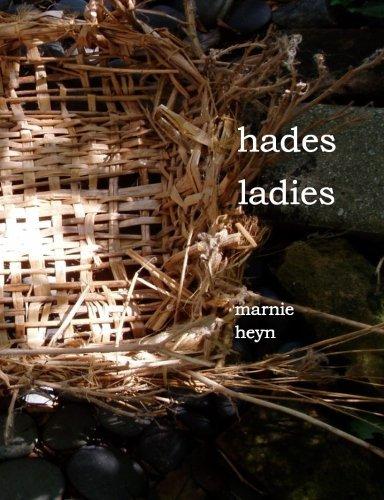
Here’s one more to add to the repertoire: “Self-pity” by a poet from the calm shores of Lake Michigan, Marnie Heynwho has just published a collection of poems, Hades Lades, with The Writers’ Bloc Press. (She takes liberties, as many poets do – clearly Passerat didn’t have the last word. Though she keeps to 19 lines and interwoven refrains, she combines terza rima with the villanelle.)

And below that, a more recent poem Marnie has written, about five years ago, dedicated to Humble Moi. I ran another dedicated to myself, titled “Gravitas,” by Patrick Hunt last March. As I noted then, it’s one of the pleasant byproducts of having poets for friends.

What both Marnie’s poems have in common, oddly, are the inclusion of buses. I wonder why … though I expect Marnie is a longtime fan of public transit.

Self-pity

I’m rigid on the bus at all the halts.
I set my jaw against sincere persuasion,
And that is not the gravest of my faults.

I overdress at any provocation.
My smile will never soothe a single sting.
I set my jaw against sincere persuasion.

I can’t subtract. Above all things,
I dearly love to win an argument.
My smile will never soothe a single sting.

My correspondents don’t get what I’ve sent.
I’m validated by the times I pine.
I dearly love to win an argument.

I decline my rightful turn in line
And trample on some hapless stranger’s feet.
I’m validated by the times I pine.

I lead in polka dancing, miss the beat,
And trample on some hapless stranger’s feet.
I’m rigid on the bus at all the halts,
And that is not the gravest of my faults.


hurling words at heaven

for Cynthia

you know I feel the creator’s presence the way I feel
the lateral coziness of that odd woman’s thigh, there
on the Trailways bus between one city in a state where
I know no one, and a city in another state where I know
no one, but I will manage well enough, and I am in
no danger, and going somewhere I want to be, there
beyond loneliness,
…….and so I know you will understand
that this bright, windy day I will not mirror Moses or
echo Jeremiah, rather that I will toss easy catches,
underhand, with flourishes, telegraphing every move,
soft, slow lobs right at the sweet spot where the stroke
can’t miss,
…….and ask, please, shine a light on the monster,
toss a banana peel under the heel of that stalker, whisper
a homecoming recall into every throbbing ear, and just
let Sinai be, let it be, while you show your countenance
to the gentle, the patient, the weary, this year, even in
Jerusalem


Postscript on 8/20: We have some nice pick-up from our friends at one of our favorite blogs, 3QuarksDaily, here.