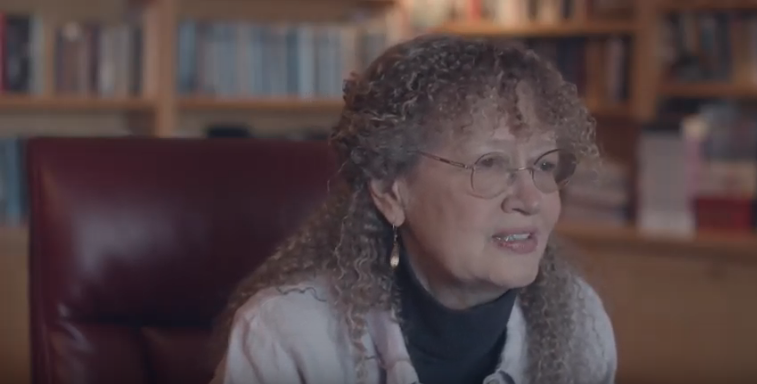
A new video from a powerful advocate for reading. We’ve written about the children’s author, Mary Pope Osborne, before here. She is the author of the Magic Tree House series, which has sold more than 100 million copies and been translated into 30 languages – success by any standards. The series has been awarded by the National Council of Teachers of English, the American Booksellers Association, and she also received the Ludington Memorial Award from the Educational Paperback Association and a Lifetime Achievement Award from the Random House Sales Force.
In the video, she’s discusses the first books that form a bridge into the rest of your life. “I feel like the first books are some of the most important things that fall into your lap in your life. And you have to treasure them for what they did for you. …They were eye-opening and stayed with me. To this day, I can recreate the thrill I had when I first heard them, when I was just three or four years old. In high school, I wouldn’t have survived without reading.”
Full video “The Magic of Reading” here. It’s short. Three minutes. (Hat tip to Paul Caringella)
At Waverley and Forest: “We were simply amazed to see so many parrots on one true, and more flying in the sky. The tree was full of them and they were eating berries,” says Melonie Chang Brophy, who took the photo.
One of my favorite memories in São Paulo was how the trees in the neighborhood were filled with brilliantly colored chattering parakeets. I didn’t think I’d see them this in North America, even on the warmer side of the continent. But here we are. You’ve heard of San Francisco’s The Wild Parrots of Telegraph Hill? Welcome to the parrots of Palo Alto!
There were several sightings this month. From NextDoor:
• “They were on a tree on Middlefield and Channing this past Wednesday. My daughter was in awe in her walk to school! So fun to see!”
• “They must have a thing about Waverley Street. I’ve seen (but mostly heard) them in Johnson Park, in a tree at the corner of Waverley and Everett. Persimmon tree.”
• “We saw a flock of them in midtown a couple of weeks ago. They used to hang around the church on Colorado. It was great to see them back!”
San Francisco species (Photo: Dan_H/Flickr)
• “I just saw a bunch at 4 p.m. today the corner of Lytton and Middlefield. It was pretty awesome to see it in person.”
• “I see (and hear) them on Cowper between Lytton and Everett at least once a week. They showed up around here about 2 years ago. They are so beautiful!”
• “Thank you for the parrot report! For many years, up until maybe 2016, we had a huge green parrot flock living in the trees next to the Church at Colorado and Cowper. And then they disappeared. So glad to learn they have migrated.”
• “That’s so beautiful. I wish I had my phone with me last year when I saw them at El dorado and Waverley going from tree to tree a whole flock. It was so beautiful!!! I had never seen anything like that before. I had never seen a wild parrot before, I thought maybe I was wrong about it. But I guess I was right about what I saw.”
• “They come to my backyard all the time. I have not paid attention this year though. They are really noisy (but so pretty) and they like the plum tree in my backyard.”
(Photo: Melonie Chang Brophy)
Sunnyvale apparently has some birds just like these, too. … But parrots? Not so fast. According to one comment, “These are mitred parakeets [i.e., Psittacara mitratus – ED] a different species from the ones in San Francisco. Probably spread up the peninsula from Sunnyvale. Very cool!”
But … but… but… the mitred parakeets look just like the mitred conures to me. And both, apparently, are famous for screeching. Could these birds be both? Could we be developing whole North American subspecies?
Here’s what KQED has to say about San Francisco’s birds: “The wild parrots in and around San Francisco are called cherry-headed conures. At one point, a mitred conure joined the flock and bred with the cherry heads. Now the flock is dotted with hybrids. There are a couple ways to differentiate the breeds. Cherry heads have slightly smaller bodies and a red helmet pattern on their heads, whereas mitred conures have a more blotchy pattern of red and feet that are a slightly darker hue.”
Where Are They From?
The cherry-headed conures come from a small territory spanning Ecuador and Peru. The mitred conures originated from a large territory ranging from Peru through Bolivia down to northern Argentina.
Wild for Palo Alto persimmons. (Photo: Maureen Bard)
How Did They Get Here? They were brought here to be sold as pets in the exotic pet trade. The U.S. was the largest importer of birds in the world before the government banned the trade of wild exotic birds in 1992.
How Did They Get Out?
The founders of the wild flock of conures either escaped or were released.
***
So what about the Palo Alto birds? They are said to be escapees from Monette’s Pet Shop on California Avenue. I remember it well from years ago. According to one post, a few took shelter in trees just on the south side of Oregon Expressway. Could these be these rugged birds?
Beware! Beware! They are not as innocuous as they might seem:
“Years ago there was a flock of about a dozen who were all over the place in our city. Two local churches had to have work done on their roofs to evict the parrot flock from carving out little caves in the eaves.”
And this: “Many years ago we heard the sound of ripping wood in our attic. I thought it was some aggressive rodent, but when I took a look a saw… a conure I guess making a nest !?!?”
Photographer David Schwartz preserved the a terrific night for us – with four panelists, including David Thomson, the film critic and author who wrote the introduction to the NYRB Classics edition we were reading.
We had another surprise guest that evening, the author’s daughter, Josephine Hayes Dean, flew out to join us for the evening. David took a photo of that, too.
From left to right above: Another Look director Robert Harrison; the author’s daughter, Josephine Dean; novelist Terry Gamble; National Medal of Arts winner Tobias Wolff, and film critic David Thomson.
If you missed the stellar event, you can join us after-the-fact with the podcast here. It really was a lively and incisive discussion about a world where talent is chewed up and discarded, where thousands come to follow a dream that so rarely and randomly gets fulfilled.
Panelists in discussion below, from left to right: Robert Harrison, Tobias Wolff, Terry Gamble, and David Thomson.
Tobias Wolff is one of Stanford’s treasures. The National Medal of Arts winner and professor emeritus of English is one of the nation’s leading writers. He didn’t have it easy, though, and recounts the story inThis Boy’s Life. His mother was was the daughter of a naval officer who lost all of his money in the 1929 crash when she was 13. When Wolff was 4, she left her husband and drove with her two sons to Sarasota, Florida. After the divorce, his father married money and took his older brother Geoffrey, while Tobias stayed with his mom. “He sent my mother nothing, not even the small amount a judge had ordered,” he recalls.
He also tells the story in “Tobias Wolff’s Rough Ride,” in the Wall Street Journal here. (And thanks toLiddie Conquest for the heads-up!) Two excerpts:
My mother didn’t scare easily. She had been through a lot after we left my father in 1950. When she remarried in 1957, we lived in Newhalem, Wash., a hamlet of 200.
My stepfather was a drinker. He liked to stop at a tavern 15 miles downriver. He often returned to the car drunk and sped home with my mother, stepsister and me. He took pleasure in frightening us.
The road to Newhalem climbed high above the river on the right. Despite Mom’s pleas to slow down, he took hairpin turns too fast, nearly sending us tumbling down to the river.
My mother’s face would be frozen in terror, but she never said another word. She probably just added the near-death experiences to a long list of reasons to leave him, which eventually she did.
Mother, son, and dog, Sheppy, in Florida, 1950. (Wolff family)
I was born in Birmingham, Ala., where my father, Arthur, was a project manager at Bechtel Corp. He converted civilian planes into military aircraft. My family moved to Atlanta and then to Old Lyme, Conn. My father didn’t belittle my mother, Rosemary, or lay a hand on her. His abuse was extreme irresponsibility and infidelity.
***
In Sarasota, my mother met a man, and we lived with him for a couple of years. He was a good-looking guy, a former cop, who had been living in a trailer off his disability checks. He was physically abusive.
When she left him, my mother drove us to Utah. She was convinced we could become rich by prospecting for uranium deposits there. I was going into the fifth grade.
I loved the drive, staying in motels and crossing the Rockies. I imagined myself a character in a Western. In Salt Lake City, we lived in a one-bedroom apartment in a Victorian house.
Then the man we’d left in Sarasota tracked us down. We took a bus to Seattle in the middle of the night. We lived in a boardinghouse in West Seattle for a year.
Over at The Spectator, a lifelong liberal mourns a cheerfully pessimistic conservative. (We’ve written about Stanford’s (and Oxford’s) Timothy Garton Ashhere and here and here.) His remarks are one of a dozen recollections of the late Roger Scruton, who died last week:
“There’s this very interesting Hungarian called, er, I think, Soros,” said Roger, sitting in the bohemian book- and music-strewn thicket of his Notting Hill flat. This was sometime in the mid-1980s, and our shared desire to support dissidents in Czechoslovakia, Poland and Hungary had brought us together. Incredible though it may sound, no one had then heard of George Soros.
Cheerful pessimist
Our conspiratorial missions behind the Iron Curtain were, let’s be honest, also huge fun, but what needs to be remembered is the amount of hard, thankless charitable administration that Roger undertook, between writing his 50 or so books. Yet the boring agenda of those charitable trusts would be enlivened by Roger’s outrageous overstatements about the western intellectual and political establishment, slipping from his lips with a kind of silent chuckle.
The last time we sat down together at any length was when he invited me to talk about free speech at the Inner Temple, an ur-Burkean institution he visibly adored. Afterwards he wrote an email commenting on how one rather forceful, blind Iraqi refugee questioner “had mastered the snobbery of disadvantage so effectively and so much to his own advantage” — characteristically provocative, probably unfair, and yet what a thought-provoking phrase “the snobbery of disadvantage” is. He went on “we are beginning to learn, what of course we should have known from our experience with totalitarian communism, just how malleable human nature is, and how unlikely it is that truth will prevail. But after discussions such as yesterday’s one always feels a little more cheerful.” As a lifelong liberal I shall miss this cheerfully pessimistic conservative.
Keep your eye on him–you’ll get a chance on Wednesday
Robert Hass has a new collection out, a rare cause for celebration (his last was in 2010). “Hass personalizes everything, warms everything up. He’s an open book; but he’s also someone whom readers should, in every sense of the phrase, keep their eye on,” writes Dan Chiasson in “Robert Hass’s Inner History of the Decade,”in the current issue of The New Yorker.
He writes:
Hass’s work is a fifty-year standoff between concentration and dispersal: part haiku, part road trip. Hass, who served as the U.S. Poet Laureate in the nineties, and for decades has taught English at the University of California, Berkeley, has published his volumes rather slowly, beginning in 1973. When his new poems turn up, they often embed, almost as an alibi, behind-the-scenes footage of how and where they were written, including outtakes and bloopers. They are shapes made in time, over time, like the mellow hikes and meandering conversations that they sometimes describe. Summer Snow, with its patient count of tanagers, warblers, aspens, and gentian, its year-after-year audit of the dead, its tallies of everything from our country’s drone strikes to his friends’ strokes, is Hass’s inner history of the decade. It arrives right on time.
“Nature Notes in the Morning,” an early poem in “Summer Snow,” distills Hass’s method: first, some short, almost neutral captions (“East sides of the trees / Are limned with light”), followed by jotted ideas and judgments (“Just distribution theory: / Light”), along with memories and associations (“What do I know from yesterday?”). The effort is precise, not random, like a chef adjusting his seasonings. The word “notes” has a double meaning, and, as often happens in a Hass poem, a tune starts to form out of scattered impressions. To render “the way light looked on plums,” Hass tells us, the eighteenth-century Japanese artist Itō Jakuchū “smuggled Prussian blues from Europe.” The poem starts to conflate its own colors with the names of painters’ dyes (“Last streaks of sunset: alizarin”) and crests with an anecdote about “the old art historian” who told Hass to pick up a brush and paint “small rectangular daubs so that they shimmer”—or else to “shut up about Cézanne.” Accuracy in painting, which may depend on whether your country has an embargo on the source of the perfect blue, seems to chasten Hass’s comparatively too easy art.
Now here’s a cool thing: You have a chance to meet and talk with the poet himself, should you happen to be, by chance or design, in Berkeley next Wednesday for a lunchtime talk at Heyday Books. The talk begins at noon, and, like all Heyday talks, takes place at 1808 San Pablo Avenue in Berkeley. The catch: you must RSVP by Monday, Jan. 20 – drop a note to: “emmerich (at) heydaybooks (dot) com.” Tell him I sent you. (Bonus prize: you get to meet my humble self! I wouldn’t miss it for the world.)