Archive for November, 2021

“One of the most brazenly intellectual shows on the digital airwaves” is in the news

Monday, November 22nd, 2021

Share
His 2016 discussion with legendary film director Werner Herzog discusses J.A. Baker’s “The Peregrine,” featured on “Entitled Opinions” (Photo: L.A. Cicero)

It seems to be the season for Robert Pogue Harrison. A few weeks ago, journalist Janet Albrechtsen ran a profile in The Australian, the continent Down Under’s leading national news paper. This weekend, Scott Anderson’s “Podcast an intellectual dig through past plagues and future tech” appeared on the website of The San Francisco Chronicle. Christmas is coming early for one of Stanford’s most high-profile professors.

An excerpt:

Though he’s also an author and the guitarist for the rock band Glass Wave, the professor’s international following mainly comes from the creation of a pioneering podcast that’s now in its 16th year. “Entitled Opinions” is available on Apple Podcasts, where it consistently ranks in the top five most popular shows for literature globally.

Harrison today

Aqsa Ijaz was teaching literature in her home country of Pakistan when she discovered the show in 2012.

Ijaz would listen at night after finishing her teaching duties at Government College University in Lahore. She was hooked on the probing method that Harrison and his guests used in examining humanistic issues. Ijaz began playing the shows for her students.

“Robert has really influenced my own work, partly because he has a reverence for the past, but it’s not a cheap reverence,” said Ijaz. “The show was a strange expansion of my world.”

Harrison’s singular approach to the podcast’s lyrical monologues and long-form interviews is rooted in his early life. He was born in İzmir, Turkey, to an American father and Italian mother. His childhood was spent playing under umbrella pines and in overgrown ruins scattered through the countryside. At 12, he and his family moved to Rome, where he learned five languages and became entranced by the poetry of Dante.

***

Glass Wave has its fans, but Harrison admits his biggest following comes from “Entitled Opinions.” It started with the idea of him interviewing fellow professors for a radio hour on Stanford’s KZSU FM. A writer at heart, Harrison began scripting intense opening monologues read over music, which evolved into an ongoing prose performance that he recites to Glass Wave’s blistering song “Echo.”

In the fall of 2005, a few weeks into the show’s run, a tech-savvy assistant producer uploaded it onto iTunes’ then-nascent podcast service. It wasn’t long before admiring messages were coming in from places as far-flung as Kobe, Japan. Harrison decided not to limit the show’s topics to literature. He’s since trod territory as varied as the historical Jesus, the Rwandan genocide and “Unabomber” Ted Kaczynski.

***

Lena Herzog, a Russian-born photographer and visual artist, has appeared twice on the show.

With another Entltled Opinions guest, France’s Michel Serres

“Even though I’ve been interviewed by places like the New York Times, these are the interviews I was most excited about — over the moon, really,” she said. “With Robert, it’s always a high-level conversation. … Intellectuals can be incredibly conformist, especially in the United States. Robert is not codified. He changes his opinions if warranted, and that comes from extreme rigor and discipline of thought. He makes for a very unusual intellectual.”

Recently, Harrison has brought that freethinking approach to questions about science and technology. He’s done shows with experts on cybersecurity, internet addiction, artificial intelligence and controversial biotech ethics. His most recent show, released on Oct. 8, featured an interview with renowned environmental landscape architect Thomas Woltz and focused on using outdoor design for better custodianship of the earth.

His conversations have been so probing that, in June 2017, Harrison was invited to give a presentation to some of the top gene-editing specialists in the world, including Nobel Prize winner Jennifer Anne Doudna of UC Berkeley. True to form, Harrison took the opportunity to recap Dante’s story of Ulysses sailing out beyond the Mediterranean Sea, only to meet his death in the Atlantic — a metaphor for where the scientific luminaries’ ambitions might be heading.

For fans, it was another sign that “Entitled Opinions” will continue as one of the most brazenly intellectual shows on the digital airwaves.

Read the whole thing here.

Entitled Opinion featured a two-part conversation with French theorist René Girard (Photo: Ewa Domańska)

Nobelist Czesław Miłosz to a fan: “My literary work should have been stronger and purer.”

Monday, November 15th, 2021
Share

A stunning tweet today from Belfast-born poet Adrian Rice, who wrote: “Loving Cynthia Haven’s new book on Milosz, and it brought me back to one of my personal treasures, a letter from Milosz. Reading Haven’s remarkable new book about a remarkable poet, has restoked the Czeslaw fires within.”

And what a letter it is. Read below. Keep in mind that Czesław Miłosz had already won the Nobel Prize for Literature in 1980, sixteen years earlier.

Adrian Rice promised to tell me the story of how this letter came about, after he finished his classes. He has done so, via a Twitter message. Here it is:

The letter came about after I had bought his latest book – Facing The River – which had just been published at the time, in 1995. I was going through a stressful life-changing time, and I was living in Canada, Dundas, Ontario, thus the address on the envelope. I was feeling particularly down on that day, and headed out in the snow to a local bookshop, not expecting any treasures on the poetry shelves. However, I was surprised to see copies of new books by two poets who meant the world to me – Joseph Brodsky, and Czeslaw Milosz – Brodsky’s essays On Grief and Reason, and Milosz’s latest, Facing The River.

The Belfast poet who got the letter

I took them back to the apartment and was astounded by both, but particularly by Milosz’s book of poems, from that very first serious self-reflection in “At A Certain Age,” right on to the end of the book. The poems simply, somehow, “helped.” I was also working on a chapbook –Impediments – back then, and decided to use a few lines from his book as an epigraph. (I have made sure, ever since, to use a Milosz epigraph in all of my books.) But what really hit me was the ending poem, “In Szetejnie,” and especially those lines near the end of that poem: “If only my work were of use to people and of more weight than is / my evil.”

Working as a freelance poet/teacher back home in innumerable settings, I had used Milosz’s poetry and essays to challenge, and inspire, countless students and ordinary folk of all types of ages and backgrounds, right across the spectrum of Northern Irish/Irish society. And I had seen his work mean a lot. It had mattered, especially given our situation living and learning throughout the ongoing Ulster “Troubles.” So, not being given to any kind of “fan” mail, I nevertheless sat down determined to write Milosz’s publishers to tell them to pass on from me my admiration for his work, and to please make sure that he knew that his work was of great use, to me personally, and to those I shared it with back in Belfast and beyond.

I tried to express just how useful it was to so many folk he would never meet, but who had been changed and helped. Anyway, I sent the letter, and expected that would be the end of it. Imagine, as I know you can, my amazement to return to the apartment in the snow a few weeks later, and to see a letter sticking up out of the mailbox with his address on it. I actually thought it was a joke, that someone back home was playing a wee trick on me, but I knew that no one knew of the letter I had sent.

When I opened it inside the apartment, I was, well, staggered, in the nicest way possible; and have been, on and off, ever since. I only stayed about a year in Dundas, then returned to Belfast. In 1998, I believe it was, an Irish poet friend made me aware that Milosz was appearing at Galway University, and that I could “get in” if I could drive down from Belfast in a hurry. So, I jumped in the car, drove the big distance, and when I entered the auditorium, he had already started, and I walked in to hear him beginning “A Song on the End of the World.” I sat down and enjoyed every minute of the reading. A few questions were taken afterwards, and I think Robert Hass was on stage to help, and then a signing began on stage.

Now, I have mixed with great poets before, but even with Seamus Heaney (who gave me my first book blurb!) I was always shy about presenting too many books for signature, knowing how pressed they can be. But, I knew that this might be my only meeting with Milosz, and despite his advanced years, I was going to at least ask him to sign most of my (substantial!) collection. When I approached him, he smiled, and then kind of joked at the armful of books to sign, but set about it so graciously. I also dared to hand him my chapbook to sign under his epigraph I had used, and he looked at the book, read my name, and then looked at me saying – “Ah, you’re Adrian Rice.” I wasn’t going to mention my letter, but he did. What a man. I blushed, we exchanged a few more words, and off I went.

Well, that’s the story for you, Cynthia. Treasured moments. Goodness, we miss him, and the likes of Seamus today. But at least we have the example, and the words to keep us going. Again, so magical to connect with you today, and to know that you’ve seen the wee letter, and to have your new book, keeping him alive in our hearts and minds. Huge congrats. I’ll spread the good word of it to all I know, especially to my college students. Keep up the important work. Slainte! Adrian x

Who is the most compelling Satan in world literature? Take your pick.

Saturday, November 13th, 2021
Share
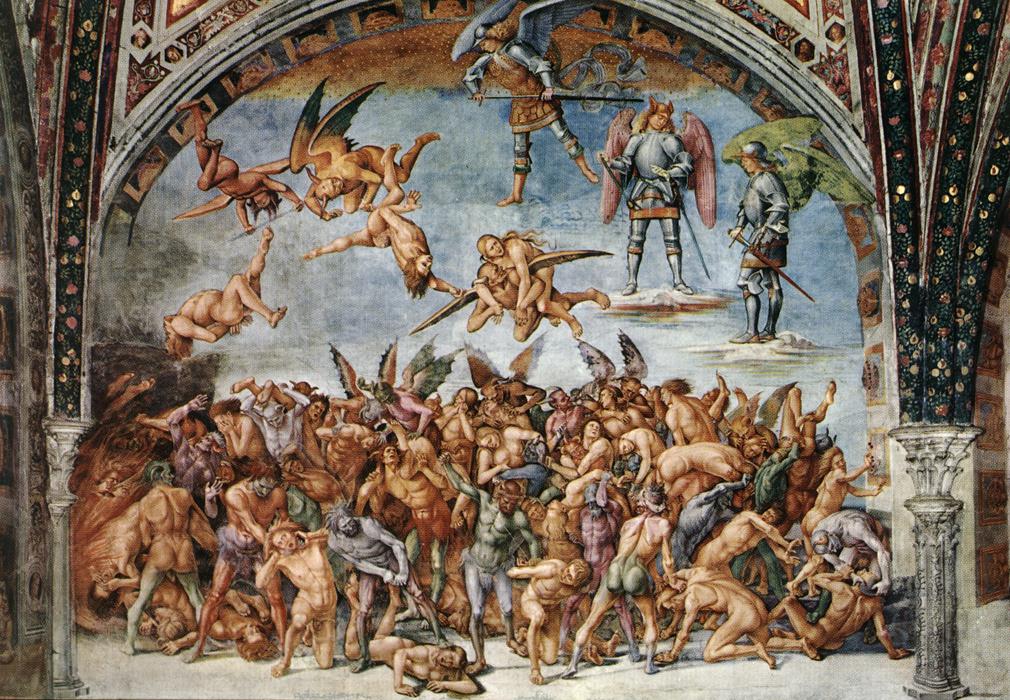
A one-way ticket: Luca Signorelli’s masterpiece in Orvieto Cathedral

Who is the most magnetic bad guy in world lit? BigThink comes up with a number of candidates here. The article considers several for the personification of evil: Dante‘s Satan, Goethe‘s Mephistopheles, and Bulgakov‘s Woland in Master and Margarita. Perhaps you can come up with a few names of your own.

From the unsigned article:

“In her book, The Origins of Satan, religious historian Elaine Pagels argues that Satan did not become a true antagonist to God until the 1st century. Looking to unite the Jewish followers of Christ during their relentless persecution at the hands of the Roman Empire, Gospel writers adopted an us-versus-them narrative that depicted their oppressors as incarnations of the Devil himself.”

The eternal skeptic on the side of the…

“As the personification of evil — be it mindful or mindless — Satan soon began appearing in nonreligious writings. Placing this larger-than-life figure outside of the scriptures in which he was first introduced, these storytellers not only influenced our thoughts on the nature of sin, but also taught us a thing or two about the religious institutions that have claimed to protect us from it.”

But it looks like BigThink will plump for Lucifer in Paradise Lost.

From the unsigned article:


Lucifer, the antagonist of John Milton’s epic poem Paradise Lost, is often considered as one of the most striking characters in all of British literature. As far as depictions of Satan in modern media are concerned including the titularly titled Netflix show as well as series such as Breaking Bad and Peaky Blinders, Milton’s version of the character – mobile and full of personality – has proven to be far more influential.

As with Dante, Milton’s poetic genius was so great that he was essentially able to add his own chapters to a religious narrative that had been passed down for centuries. In the poem, he attempts no less than to offer an alternative version to the book of Genesis, built around the theme of “Man’s disobedience, and loss thereupon of Paradise.”

Spending considerable time and effort on developing the personal motivations behind Lucifer’s rebellion, Milton speaks concretely about things the Divine Comedy had only hinted at. Milton’s take on the character likewise wants autonomy, but this desire is made to seem all but pathological. “Better to reign in Hell,” this Lucifer famously speaks, “than to serve in Heaven.”

The Satan found in Paradise Lost became especially popular among western readers. Writing for The Atlantic, editor and literary critic Ed Simon proposed that this particular iteration had an “independent streak that appeals to the iconoclasm of some Americans.” His need for freedom, even if it would lead to chaos and suffering, perfectly matched the spirit of a developing capitalist economy.

Read the whole thing here.

George Bernard Shaw salutes Albert Einstein in a 1930 film clip

Tuesday, November 2nd, 2021
Share

Today marks the 71st anniversary of George Bernard Shaw’s death, at age 94 in 1950. What better way to honor him than posting this short video, filmed at the Savoy Hotel in London, England on 27 October 1930. In less than two minutes, the Irish playwright wittily honors another Nobel winner, physicist Albert Einstein in a short speech. (With a hat tip to Neil Silberblatt.)