Archive for March, 2022

Leon Wieseltier: “Her intuition is right: Czesław Miłosz and California are indeed a chapter in each other’s history.”

Wednesday, March 30th, 2022

Share

The Book Haven has been pretty silent on our our newest book, Czesław Miłosz: A California Life. Let’s end that now, and begin catching up. Here are the words from one of America’s foremost critics, Leon Wieseltier: “Cynthia Haven’s book is delicious. She evokes so much so vividly and so intelligently; for me her pages were a restoration of a richer and less lonely time. And her intuition is right: Czeslaw Milosz and California are indeed a chapter in each other’s history.” 

From Cory Oldweiler over at the Los Angeles Review or Books:

The Polish poet Czesław Miłosz dubbed Dante “a patron saint of all poets in exile” and, as an exile himself for much of his life, likely could relate to both the Florentine’s proud defiance and his urge to seek some measure of solace in the constancy of the natural world. When, in 1960, Miłosz moved to the United States, accepting a teaching position at UC Berkeley, nature was very much on his mind. He was already living in exile, having defected to France nearly a decade earlier, but he had not escaped the haze of history that hung heavily over postwar Europe. The past was integral to Miłosz’s writing throughout his career, especially the horror he witnessed so viscerally in wartime Warsaw, but in order to continue to describe it “in such a manner that it is preserved in all its old tangle of good and evil, of despair and hope,” he had to soar above it, as he put it in 1980, after winning the Nobel Prize for Literature.

Miłosz felt that the United States, specifically the American West, could provide that lofty vantage, that distance, that relative stability from the “demoniac doings of History.” He would live in the Golden State for 40 years, from 1960 to 2000, but according to Czeslaw Miłosz: A California Life, Cynthia Haven’s deeply considered new biography of the poet, Miłosz’s move to America was predicated on a fundamental error. “In immigrating to the United States, and specifically to California in 1960,” Haven writes, “he thought he was coming to the timeless world of nature. However, Berkeley was about to become a lightning rod for […] the world of change […] and he would be in the thick of it.”

He concludes:

Haven lets us into her thought processes, even when she is questioning them, and lovingly recreates conversations — in the relative present, at a café with Robert Hass as they thumb through Miłosz’s 2001 volume New and Collected Poems; and in the recent past, at Miłosz’s Grizzly Peak home as the poet drinks bourbon and chats with friends into the wee hours.

Oldweiler: “She evokes A California Life that soared high above an era of inescapable change.”

Miłosz, writing in his ABC’s, did not place much faith in biographies: “Obviously, all biographies are false, not excluding my own. […] They are false because their individual chapters are linked according to a predetermined scheme, whereas in fact they were connected differently, only no one knows how.” Haven does not possess any magical insight into those linkages in Miłosz’s timeline, but by giving relatively free rein to her decades of contemplation, she often achieves what Miłosz believed to be the only redeeming value of biographies, namely that “they allow one to more or less recreate the era in which a given life was lived.” In this case, she evokes A California Life that soared high above an era of inescapable change.

There’s more! Lots more! Over at the National Review‘s “Great Book” series, I have a podcast interview with John Miller about The Captive Mind, Miłosz’s examination of the human psyche under totalitarianism. It’s his bestselling book, the only book of his that has never gone out of print. Listen to it before it disappeared behind a paywall in early May: it’s here. Over at City Lights Bookstore, of Allen Ginsberg fame, I team up with my friend James Marcus, former editor of Harper’s and author of Amazonia: Five Years at the Epicenter of the Dot.Com Juggernaut, for a video conversation to discuss Czesław Miłosz: A California Life. James is great fun. Go here. My Spotify/Apple Podcasts interview with xx over at The Athenaeum is here.

Stay tuned in the weeks to come for more about Czesław Miłosz: A California Life, out with Heyday Books in Berkeley.

After Adam

Monday, March 21st, 2022
Share

Adam Zagajewski, polychromed plaster (©Hirschfeld, 1990)

It’s been a year to the day since the unexpected death of Poland’s leading poet Adam Zagajewski. He was 75. Yesterday, sculptor Jonathan Hirschfeld sent me his retrospective, “Without Irony,” in the January/February issue of Britain’s PN Review. I can do no better, in the waning hours of the day, to include a few excerpts from his excellent tribute. It begins:

About a year ago Adam Zagajewski wrote to me, and now his words echo as only last words can.

Dear Jonathan,

Today I’m crying for Wojtek Pszoniak who just died. As you know, when you lose a friend there’s an avalanche of things that come to your mind. I knew Wojtek for 70 years, he was like a brother for me.

I’ve read your essay on Milosz, I like it very much, you’ve found a way to capture his essence not only in clay but also in words.

It’s a pity that we’ve lost contact years ago. Let’s hope that – at least – we can be in touch through words. I remember many beautiful moments in your study, with leafless trees outside or spring trees.

Love to all of your family,
Adam

Last March I received the news that Adam was very ill. Initially there were some grounds for hope, but
within barely a few weeks it was over. Suddenly it was I, struggling to restore coherence to my own
recollections as he gazed from a pedestal a few meters away. “Leafless trees outside / or spring
trees” – this familiar hesitation and this nod to time – Adam’s voice.

I have become familiar with this feeling of irrevocable void, but nothing can compress the time it takes
to absorb it.

***

Early on we had shared our appreciation for a proverb that we only knew in English, by Malebranche, a French eighteenth-century religious philosopher: “Attentiveness is the natural prayer of the soul.”

***

One day Adam asked if we could use my studio as the setting for a documentary about him to be filmed for German television. We had spent many hours together in this luminous space, working against the background chatter of chirping birds that he loved and recognized. There is a sequence in which he meanders through the atelier and settles on the small head of a young boy, for which he felt a particular affection. As I watch this video today I am reminded of his affirmation, with which he concluded his Neustadt lecture in 2004, that “innocence is perhaps the most daring thing in the entire world.” The camera panned across the collection of portrait heads. Adam was among them.

***

On sculpting Adam:

I am reminded of what I saw and felt when I made the sculpture. He looked shy, yet warm, quiet, solitary and contained, watchful, extremely sensitive; a certain stillness. Yet there was also a current of inner motion, as if I could feel his mind at work, or more precisely, his way of sensing the world. This became a conscious theme for the portrait – a state of receptivity and preparedness, even his skin needed to feel like an organ of the senses. Within his way of being I sensed a quiet, determined strength. It took me some time to grasp that this demeanor was a reflection of his conscious urge “to dissent from dissidents”. He held true to his contemplative gaze and to an unabashed search for beauty; he could write of the ecstatic and he believed in the soul – this was the form of his resistance, more radical than it might appear. A dissident in the regime of post-modern decline, he wondered how the clay could take that on. And I thought to myself, only clay could take that on.

There’s more. Of course there’s more. Read the rest here. There’s much more about Adam in the Book Haven, too: type “Zagajewski” into the search engine.

“I dreamt we were occupied by Nazis, and that those Nazis were us.”

Saturday, March 19th, 2022
Share

Maria Stepanova, one of Russia’s most recognized and honored figures – as poet, novelist, journalist, essayist, and publisher – has penned a knockout essay (translated by the excellent Sasha Dugdale) over at The Financial Times. A few excerpts :

One of Russia’s most honored writers speaks out.

I can’t stop looking at photographs taken in Ukraine during these unending days of war, a war so unthinkable that it’s still hard to believe in the reality of what is happening. The streets of Kharkiv — rubble, concrete beams, black holes where windows should be, the outlines of beautiful buildings with their insides burnt away. A station, a crowd of refugees trying to board a departing train. A woman carrying a dog, rushing to get to a shelter in Kyiv before the shelling begins. Bombed houses in Sumy. A maternity hospital in Mariupol after a raid — this I will not describe.

An 80-year-old friend told me of a dream she’d once had: a huge field filled with people lying in rows of iron beds. Rows and rows of people. And rising from this field, the sound of moaning. I always knew, she said, that this was to be expected. It would come to pass. Dreams about catastrophe are common in what was once called the “post-Soviet world”; other names will surely appear soon. And in these recent days and nights, the dreams have become reality, a reality more fearful than we ever thought possible, made of aggression and violence, an evil that speaks in the Russian language. As someone wrote on a social media site: “I dreamt we were occupied by Nazis, and that those Nazis were us.”

The word “Nazi” is one of the most frequently used in the political language of the Russian state. Speeches by Vladimir Putin and propaganda headlines often use the word to describe an enemy that they say has infiltrated Ukraine. This enemy is so strong that it can and must be resisted with military aggression: the bombing of residential areas, the destruction of the flesh of towns and villages, the living tissue of human fates.

The word still horrifies us, and in our world there are certainly candidates for its application. But propagandists use the word like the black spot in Treasure Island, sticking it wherever it suits them. If you call your opponent a Nazi, that explains and justifies all and any means.

***************

Urban training in Yavoriv (NARA/DVIDS)

Right now a decision is being made about the sort of world we will live in and, in some ways, have already been sucked into: we exist and act in the black hole of another’s consciousness. It calls up archaic ideas of nationhood: that there are worse nations, better ones, nations that are higher or lower on some incomprehensible scale of greatness; that all Ukrainians (or Jews, Russians, Americans and so on) are weak, greedy, servile, hostile — and these cardboard cut-outs are already promenading through the collective imagination, just as they were before the second world war. As they say in Russia, “the dead take hold of the living”, and here these dead are ideas and concepts into which new blood flows and they begin killing, just as in a horror film.

***************

Resisting today means freeing ourselves from the dictatorship of another’s imagination, from a picture of the world that grasps us from inside and takes hold of our dreams, our days, our timelines, whether we want it or not. A battle for survival is going on right now in Ukraine; a battle for the independence of one’s own rational mind. It is going on in every house and in every head. Here as well as there, we must resist.

Read the whole thing over at The Financial Times. It’s brave; it’s stunning; it’s urgent.

Living a nightmare: Ukrainian soldiers assigned to third battalion (NARA/DVIDS).

April 12: Stanford discusses “The Strange Case of Dr. Jekyll and Mr. Hyde” – be there!

Monday, March 14th, 2022
Share
It came to him in a dream.

PLEASE REGISTER HERE.

Stanford’s “Another Look” book season continues in 2022 with Robert Louis Stevenson’s The Strange Case of Dr. Jekyll and Mr. Hyde. The discussion will take place at 7 p.m., Tuesday, April 12, at the Bechtel Conference Center in Encina Hall. Go here to register.

Stevenson’s short 1885 novel is universally known but little read today – an important reason why it needs “another look.” Vladimir Nabokov called it “a fable that lies nearer to poetry than to ordinary prose fiction.” The Russian author compared it to Flaubert’s Madame Bovary or Gogol’s Dead Souls.

“Is Jekyll good?” he asked. “No, he is a composite being, a mixture of good and bad, a preparation consisting of a 99% solution of Jekyllite and 1% of Hyde … He is a hypocritical creature carefully concealing his little sins.” Popular author Stephen King agreed that Stevenson’s novel is moral tale, “a close study of hypocrisy – its causes, its dangers, its damages to the spirit.” Utterson, he contends, is the book’s real hero.  

Henry James called Dr. Jekyll and Mr. Hyde a “short, rapid, concentrated story, which is really a masterpiece of concision.”  

Stevenson’s dark vision had come to him in a dream – as it had for Mary Shelley, who went on to write Frankenstein, a book that Another Look featured in 2018. Both works share a fascination with the limits of science, medicine, and technology on our humanity.  

Michael Caine as Jekyll and Hyde

Acclaimed author Robert Pogue Harrison will moderate the discussion. The Stanford professor who is Another Look’s director writes regularly for The New York Review of Books and hosts the popular talk show, Entitled Opinions. He will be joined by eminent novelist Tobias Wolff, founding director of Another Look and a National Medal of Arts winner, and Ana Ilievska, Andrew W. Mellon Postdoctoral Fellow and Stanford Humanities Center and a lecturer in Stanford’s Department of French and Italian. 

Books are available at Stanford Bookstore and Kepler’s – but the book is also widely available online and is offered as a free e-book on Amazon as well.

The event marks our first in-person event since the beginning of COVID in 2020. The occasion will also be offered virtually for those who cannot attend on the Stanford campus. (Registration encouraged, but walk-ins are welcome.) 

We survive on donations, so go here if you’d like to further the cause of good books. Register HERE to attend what looks like it will be a terrific event!

The 1920 silent film with John Barrymore – a silent classic.

Ukrainian poet Ilya Kaminsky: “the wrecked word” confronts the wrecked world.

Thursday, March 10th, 2022
Share
Born in the Odessa, now in America.

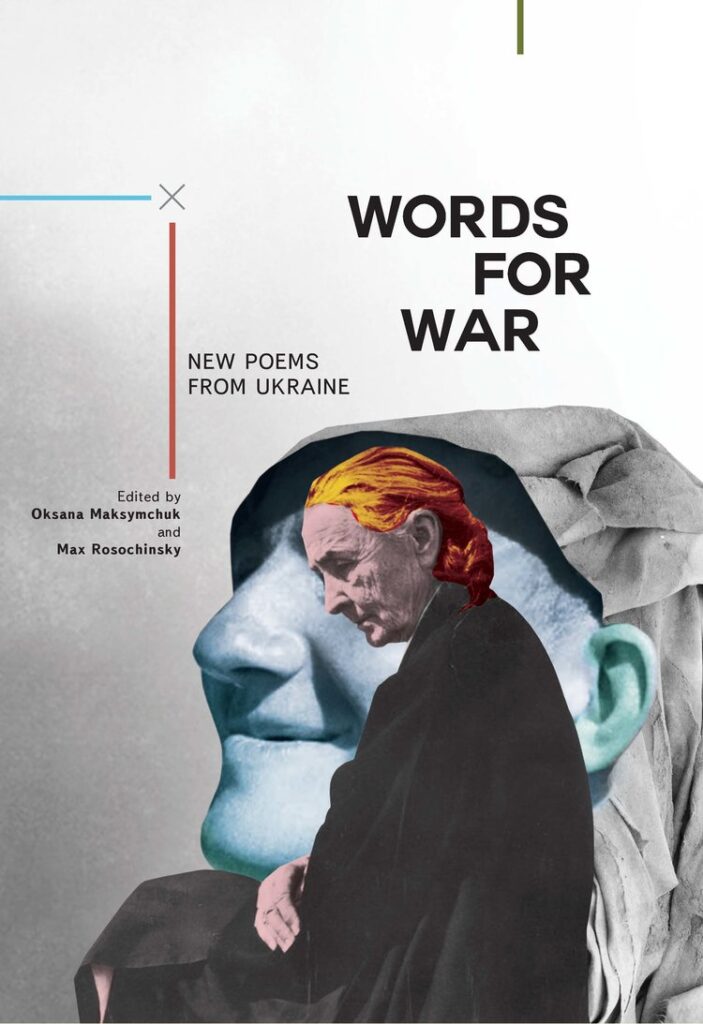
Ukrainian-American Ukrainian-Russian-Jewish-American poet, writer, critic, translator Ilya Kaminsky (we’ve written about him here and here and here) has been much in the news lately, which is often bad news for Ukrainians. Over at Lithub, you can read his 9-part essay on “Ukrainian, Russian, and the Language of War,” excerpted from Words for War: New Poems from Ukraine, published by Academic Studies Press.

Meanwhile, let us here focus on the essay’s section dedicated to the young poet Lyuba Yakimchuk:

In the late 20th century, the Jewish poet Paul Celan became a patron saint of writing in the midst of crisis. Composing in the German language, he has broken speech to reflect the experience of a new, violated world. This effect is happening again—this time in Ukraine—before our very eyes.

Here is the case of poet Lyuba Yakimchuk, whose family are refugees from Pervomaisk, the city that is one of the main targets of Putin’s most recent “humanitarian aid” effort. Answering my questions about her background, Lyuba responded:

“Literature is changed by war.”

I stare into the horizon
. . . I have gotten so very old
no longer Lyuba
just a –ba.

“I was born and raised in the war-torn Luhansk region and my hometown of Pervomaisk is now occupied. In May 2014 I witnessed the beginning of the war … In February 2015 my parents and grandmother, having survived dreadful warfare, set out to leave the occupied territory. They left under shelling fire, with a few bags of clothes. A friend of mine, a [Ukrainian] soldier, almost shot my grandma as they fled.

“Discussing literature in wartime, Yakimchuk writes: ‘Literature rivals with the war, perhaps even loses to war in creativity, hence literature is changed by war.” In her poems, one sees how warfare cleaves her words: don’t talk to me about Luhansk,’ she writes, ‘it’s long since turned into hansk / Lu had been razed to the ground / to the crimson pavement.’ The bombed-out city of Pervomaisk ‘has been split into pervo and maisk‘ and the shell of Debaltsevo is now her ‘debaltsevo.’ Through the prism of this fragmented language, the poet sees herself:

Just as Russian-language poet Khersonsky refuses to speak his language when Russia occupies Ukraine, Yakimchuk, a Ukrainian-language poet, refuses to speak an unfragmented language as the country is fragmented in front of her eyes. As she changes the words, breaking them down and counterpointing the sounds from within the words, the sounds testify to a knowledge they do not possess. No longer lexical yet still legible to us, the wrecked word confronts the reader mutely, both within and beyond language.

Reading this poem of witness, one is reminded that poetry is not merely a description of an event; it is an event.

You can read the rest of Ilya Kaminsky’s essay here. Ukrainian poet, screenwriter, and journalist Lyuba Yakimchuk’s poem “Crow, Wheels” is here.

Ukrainian writer Ilya Kaminsky: “Putins come and go.”

Tuesday, March 1st, 2022
Share

Ukrainian-Russian-Jewish-American poet, writer, critic, translator and professor Ilya Kaminsky shared two tweets on Twitter. I share them with you: