
Archive for April, 2022

“Czesław Miłosz: A California Life” – in London! Plus: Miłosz’s odd interview with Wallace Stegner.

Friday, April 22nd, 2022

Share

The eminent Poetry London has featured Czesław Miłosz: A California Life for its spring issue – and we couldn’t be more pleased that England is taking notice of the Nobel poet’s American life. The issue includes a long selection from the book, which was published by Heyday Books in Berkeley. In the selection, the Lithuanian-born poet talks about the American wilderness and the “prickliness” of California. Where to get your copy? Try here.
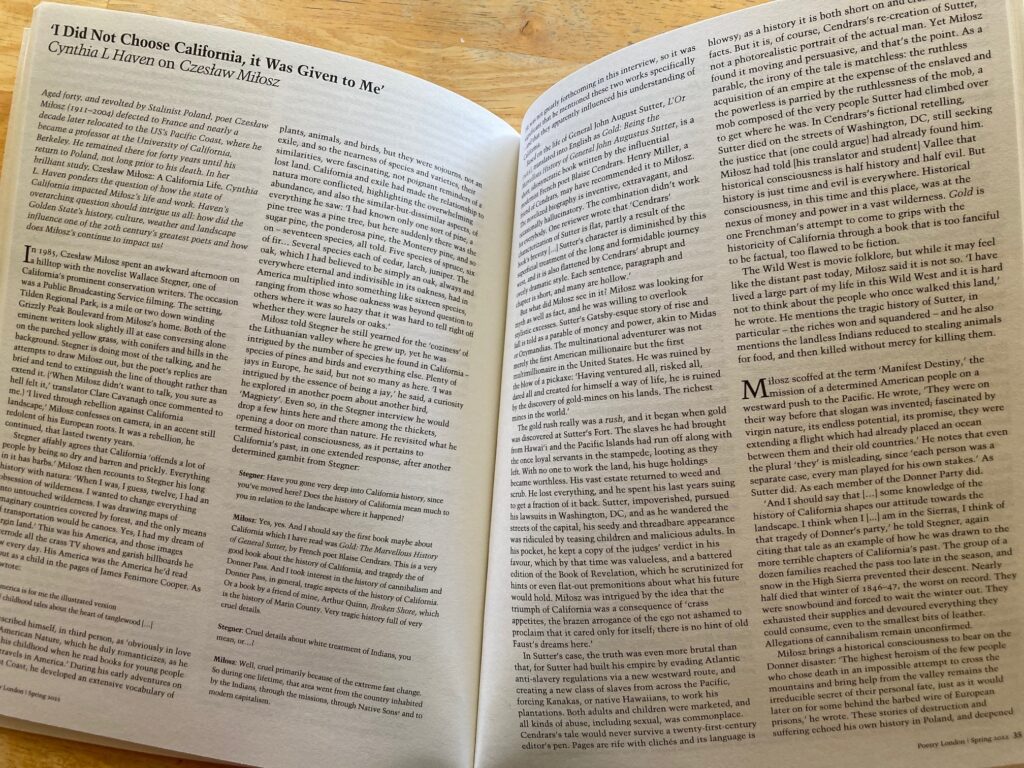
The journal’s Poetry Editor, André Naffis-Sahely, contacted me last winter to make all this happen, and he also recorded a podcast with me. Stay tuned for its appearance on the Poetry London website; it will also be online as an Apple Podcast. (We’ll link it on this post, too.)

Meanwhile, let us excerpt Poetry London’s excerpt, from the chapter in my book called, “I Did Not Choose California. It Was Given to Me”:

In 1985, Czesław Miłosz spent an awkward afternoon on a hilltop with the novelist Wallace Stegner, one of California’s most prominent conservation writers.

The occasion was a Public Broadcasting Service filming. The setting, Tilden Regional Park, is a mile or two down winding Grizzly Peak Boulevard from Miłosz’s home. Both of the eminent writers look slightly ill at ease conversing alone on the parched yellow grass, with conifers and hills in the background. Stegner is doing most of the talking, and he attempts to draw Miłosz out, but the poet’s replies are brief and tend to extinguish the line of thought rather than extend it. (“When Miłosz didn’t want to talk, you sure as hell felt it,” translator Clare Cavanagh once commented to me.)

“I lived through rebellion against California landscape,” Miłosz confesses on camera, in an accent still redolent of his European roots. It was a rebellion, he continued, that lasted twenty years.

Stegner affably agrees that California “offends a lot of people by being so dry and barren and prickly. Everything in it has barbs.”

Miłosz then recounts to Stegner his long history with natura: “When I was, I guess, twelve, I had an obsession of wilderness. I wanted to change everything into untouched wilderness. I was drawing maps of imaginary countries covered by forest, and the only means of transportation would be canoes. Yes, I had my dream of virgin land.” This was his America, and those images overrode all the crass TV shows and garish billboards he saw every day. His America was the America he’d read about as a child in the pages of James Fenimore Cooper. As he wrote:

America is for me the illustrated version
Of childhood tales about the heart of tanglewood …

He described himself, in third person, as “obviously in love with American Nature, which he duly romanticizes, as he did in his childhood when he read books for young people about travels in America.” (Watch the whole 33-minute film here.)

Stegner and Miłosz the Movie: Watch it here.

During his early adventures on the East Coast, he developed an extensive vocabulary of plants, animals, and birds, but they were sojourns, not an exile, and so the nearness of species and varieties, their similarities, were fascinating, not poignant reminders of a lost land. California and exile had made the relationship to natura more conflicted, highlighting the overwhelming abundance, and also the similar-but-dissimilar aspects, of everything he saw: “I had known only one sort of pine, a pine tree was a pine tree, but here suddenly there was the sugar pine, the ponderosa pine, the Monterey pine, and so on—seventeen species, all told. Five species of spruce, six of fir . . . . Several species each of cedar, larch, juniper. The oak, which I had believed to be simply an oak, always and everywhere eternal and indivisible in its oakness, had in America multiplied into something like sixteen species, ranging from those whose oakness was beyond question to others where it was so hazy that it was hard to tell right off whether they were laurels or oaks.”

Join Stanford writers for “A Company of Authors” on Saturday, April 23 – a great way to celebrate Shakespeare’s birthday!

Tuesday, April 19th, 2022
Share

Prof. Peter Stansky‘s annual “A Company of Authors” will take place from 1 to 5:05 p.m., this Saturday, April 23. The virtual event, sponsored by Continuing Studies and the Stanford Humanities Center, features Stanford authors discussing their newest books. (Some of us pictured above.) It’s free and open to all. You can read full schedule below. Bring a cup of coffee and enjoy! It’s a wonderful way to celebrate Shakespeare’s birthday.

One among many reasons to attend: I’ll be presenting my new book, Czeslaw Milosz: A California Life on the 2:40 p.m. panel. I’d be happy to see some Book Haven readers – even if virtually only.

Register here.

And please forward this announcement to your friends! I look forward to seeing you there!

EVENT SCHEDULE
1:00 pm — Welcome (Peter Stansky)1:05 – 1:35 pm — Culture Peter Stansky, Chair Gavin JonesReclaiming John Steinbeck: Writing for the Future of Humanity Richard Thompson Ford, Dress Codes: How the Laws of Fashion Made History Jeannette Ferrary, Eating Alone

1:40 – 2:10 pm — A Better Life Barbara Gelpi, ChairJudith Mundlak Taylor & Susan Groag Bell, Women and Gardens: Obstacles and Opportunities for Women Gardeners Throughout History William Damon, A Round of Golf with My Father: The New Psychology of Exploring Your Past to Make Peace with Your Present Tracie White & Ron Davis, The Puzzle Solver: A Scientist’s Desperate Quest to Cure the Illness That Stole His Son

2:15 – 2:35 pm — Changing the World Larry Horton, Chair Lenora Ferro & Susan Southworth, Sidney D. Drell: Into the Heart of Matter, Passionately David Alan Sklansky, A Pattern of Violence: How the Law Classifies Crimes and What It Means for Justice Rob Reich, Mehran Sahami & Jeremy M. Weinstein, System Error: Where Big Tech Went Wrong and How We Can Reboot

2:40 – 3:20 pm — The Arts and Humanities Roland Greene, ChairPeggy Phelan & Richard Meyer, Contact Warhol: Photography Without End Cynthia HavenCzeslaw Milosz: A California Life Emily J. Levine, Allies and Rivals: German-American Exchange and the Rise of the Modern Research University

3:25 – 3:55 pm — History and Humans Carolyn Lougee, Chair Steven Press, Blood and Diamonds: Germany’s Imperial Ambitions in Africa Niall FergusonDoom: The Politics of Catastrophe Henry T. Greely, CRISPR People: The Science and Ethics of Editing Humans

4:00 – 4:30 pm — The Bay Area and Beyond Tania Granoff, Chair Mary Beth Meehan & Fred Turner, Seeing Silicon Valley: Life inside a Fraying America Gene Slater, Freedom to Discriminate: How Realtors Conspired to Segregate Housing and Divide America Destin Jenkins, The Bonds of Inequality: Debt and the Making of the American City

4:35 – 5:05 pm — Germany Paul Robinson, Chair Samuel Clowes Huneke, States of Liberation: Gay Men between Dictatorship and Democracy in Cold War Germany Adrian DaubThe Dynastic Imagination: Family and Modernity in Nineteenth-Century Germany Peter Mann, The Torqued Man: A Novel

Easter on Fifth Avenue, NYC – masks are optional and therefore rare!

Sunday, April 17th, 2022
Share

Easter celebrations have an additional layer of meaning this year, and the public fête on Fifth Avenue had an exuberant post-COVID feel. Zygmunt Malinowski, the Book Haven’s roving photographer, sent us a couple photos to share with California and the world, and yes, it looks like the pandemic is winding to an infamous close. So happy Easter to all of us!

What were the NYC festivities like? The street was closed to traffic, and very crowded, he said. Except for public transportation, masks are optional now. However, they are rarely worn as you can see. Party animals in front of St. Patrick’s were maskless, as well Cardinal Dolan celebrating mass within the cathedral. Woo hoo!

The women in the top photos remind us of the wreathed young women on St. John’s Day in Kraków, but that’s in June. We won’t ask what that guy in the bottom photo is chewing on. A burnt carrot? A cigar? Only Zgymunt Malinowski knows. “Yes, parades can be repetitive but still nice to be there,” he said. Outdoors in the springtime? What could be better.

(All photos  ⒸZygmunt Malinowski)

“Dr. Jekyll and Mr. Hyde” comes to Stanford on April 12 – we’re making it easy for you. Register on the QR code!

Wednesday, April 6th, 2022
Share