
Archive for July, 2025

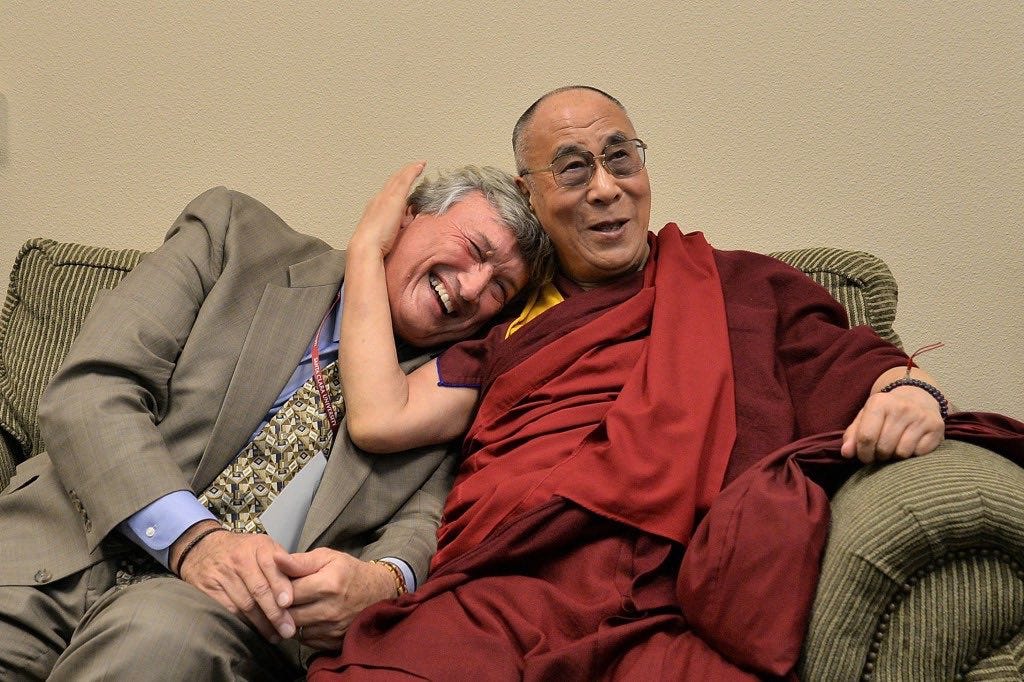
Stanford’s trailblazing “Doctor of Compassion,” James Doty, has died.

Sunday, July 27th, 2025

Share

“Often when we see immeasurable suffering, we feel overwhelmed. But every one of us has the capacity to make one person suffer less every day. Every day go forth and do what you can do.”
Jul 19, 2025

(Image credits: L.A. Cicero)

Fifteen years ago, I had the “Dalai Lama” beat at Stanford. The occasion: the Dalai Lama was swinging through the campus for a 2010 visit and auditorium lecture. As the arts and humanities writer at Stanford, I wrote about the visit. A big reason for the Dalai Lama’s presence was his friend Dr. James Doty, a Stanford neurosurgeon and neuroscientist, who was founding a center for compassion called CCARE at Stanford. Over the years, he gave $29 million to charity, according to the Wall Street Journal in an article titled “Giving Till It Hurts.” That was about 99% of his net worth.

James R. Doty died on Thursday, July 17. He was 69. He had been struggling with serious medical challenges following a surgery last October.

Here’s what I wrote back then for the Stanford News Service on the Dalai Lama, on my tour of duty with James Doty:

“I want to stand to see more faces,” the 75-year-old Dalai Lama said, refusing a chair to address the capacity crowd in Maples Pavilion Thursday.

There were plenty of them to see. The spiritual leader spoke to about 6,300 people on “The Centrality of Compassion in Human Life and Society” and, as this year’s Rathbun Visiting Fellow, about 1,000 students for the “Harry’s Last Lecture on a Meaningful Life” series in Memorial Church a few hours later (see photo below). But in both venues, the message was the same.

He repeatedly stressed a secular approach to compassion that reaches beyond individual creeds and beliefs. He spoke of the need for mutual respect and friendship, the care and education of children, and ongoing dialogue for conflict resolution.

Evident throughout was his fascination with science, the neurology of the mind and brain, the interest in the intricate distinctions between mind and body that led him to be a founding benefactor for the Center for Compassion and Altruism Research and Education (CCARE) at Stanford.

The 14th Dalai Lama, Tenzin Gyatso, is an old friend at Stanford: This week marks his third visit in recent years, with the promise of more to come. His talk was peppered with personal anecdotes, and although he spoke in a broken, heavily accented English, occasionally consulting his translator – Stanford visiting research scholar Thupten Jinpa – his infectious chuckle quickly had the audience eating out of his hand.
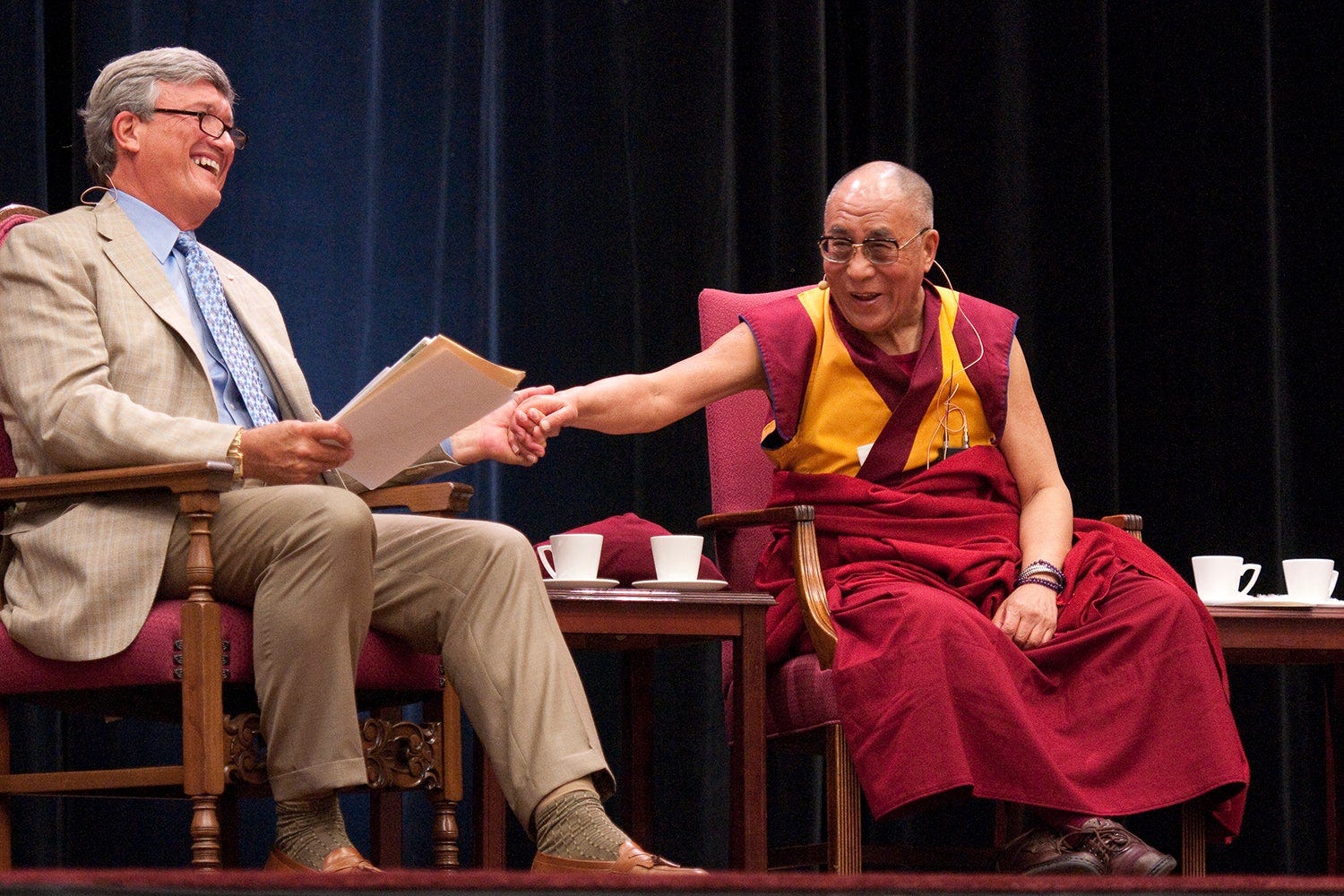
He chose to focus on what unifies us: Beyond race, ethnicity, nationality and religion, “We all have the desire to achieve a happy life, and everyone has the right to achieve a happy life,” he said.

“We are 100 percent the same on this level,” he said. “My enemy also has every right to work on suffering.”

“We human beings are created as social animals. Any social animal in order to survive depends on community,” he said.

In answer to complicated situations of deceit and injustice, he emphasized taking a holistic view – “compassion, combined with wisdom, always helps a broader perspective.”

(Image credit: L.A. Cicero)
“Someone who takes advantage of you and unjustly does something – ultimately, they will suffer, even within this lifetime.” He advocated action out of “a concern for their well-being.”

Violence and non-violence can appear the same, he said, and can be distinguished by motivation. “Out of hatred, out of desire to cheat,” someone could “smile, using some nice word, and with some gift.”

“It looks non-violent. But look at the motivation – they want to cheat, they want to harm. It is essentially violence,” he said.

A parent, on the other hand, “out of concern for others’ well-being may sometimes use some harsh word or disciplinary action. It looks rough, but it arises out of a sense of concern. Therefore it is essentially not violence.”

He repeatedly praised Tibet’s southern neighbor, India – a stable democracy that has thrived under a secular constitution for 70 years. He recently attended a dedication for a Buddhist temple in Patna, and recalled its invocation for Buddha’s blessings on the Indian state of Bihar. The Dalai Lama told those attending that “the Buddha’s blessing must go through human hands, human actions.”

The Dalai Lama presented “Harry’s Last Lecture on a Meaningful Life” in Memorial Church. At left is his longtime interpreter Thupten Jinpa and at right is the Rev. Scotty McLennan, the dean of religious life at Stanford. (All photos L.A. Cicero)

Affection begins in the home, he said, and particularly from mothers – but this biologically rooted compassion will not extend far beyond the family unless extended by reasoning and unless the understanding our own well-being is linked to the love of others.

Perhaps the most surprising digression was his memories of childhood in a family of barley farmers in northeastern Tibet – an uneducated, illiterate mother who was kindly and compassionate, and an affectionate father who sometimes lost his temper.

He noted societies with abundant material wealth where the youth is nevertheless plagued with “a lot of suicide, a lot of depression,” he said.

His engagements in the Bay Area included a visit with 400 students in East Palo Alto on Wednesday.

During a question-and-answer session, about the poor – why one is unable to bridge the “compassion gap” from feeling sympathy to acting with compassion – the Dalai Lama recalled a night in Bombay, where he saw the “really poor people, hundreds,” and uncared-for and drug-addicted people.

“But nothing can be done,” he said, pointing to the need to weigh considerations. “Sometimes when I saw these things, I only pray. You should be realistic: If you can do something on the spot, do it.”

The Dalai Lama presented “Harry’s Last Lecture on a Meaningful Life” in Memorial Church. At left is his longtime interpreter Thupten Jinpa and at right is the Rev. Scotty McLennan, the dean of religious life at Stanford. (Image credit: L.A. Cicero)

At the Memorial Church gathering, largely question-and-answer, one student asked about the Buddhist injunction to overcome desire – if one is choosing to live a meaningful life, isn’t the desire for a meaningful life just another layer of desire?

The Dalai Lama agreed that the Buddhist texts say that desire is the cause of suffering, but added that “without desire, movement is not possible. Even wishing happy life, a happy life for others – all is desire.”

“Desire leads our action. Action must come from motivation. Motivation comes from desire,” he said.

He encouraged the students to practice contemplation and self-discipline.

In a valedictory note, he turned the future over to the students gathered to hear him. “This century, whenever we face problems, we have to find ways through dialogue,” he said. The 200 million people murdered in the last century, he said, underscore the need for non-violence, mutual respect and compassion.

“You belong to the 21st century,” he said. “My people belong to the 20th century. We’re ready to say goodbye.”

Stanford neurosurgeon James Doty, the director of CCARE, told the Maples Pavilion gathering: “Often when we see immeasurable suffering, we feel overwhelmed. But every one of us has the capacity to make one person suffer less every day. Every day go forth and do what you can do.”

***

Said a friend Julie Neelama Eyres on Dr. Doty, writing on Facebook “He was so full of life, energy, irreverence, love, kindness and purpose! He founded the center for compassion CCARE at Stanford University and I’m blessed to have been able to work together with him on this mission. His teachings, books, unique spark and loving presence were such a gift to me and to countless others around the globe.”

Postscript: There’s more on the good doctor here: “A neurosurgeon’s road to compassion: ‘They need each other – the brain and the heart.’”

Remembering historian, poet Robert Conquest on his 108th birthday

Tuesday, July 15th, 2025
Share
Conquest at work (Photo: L.A. Cicero)

This article and many others from the Stanford News Service are now archived and no longer publicly available. To celebrate this poet, historian, and so much more, I thought I’d make at least this one available to all of you. Enjoy!

Robert Conquest is a man of contradictions: He has been called “a comic poet of genius” and “a love poet of considerable force” – but he made his mark as one of the first to expose the horrors of Stalinist communism.

Susan Sontag was a visiting star at Stanford in the 1990s. But when she was introduced to Robert Conquest, the constellations tilted fora moment.

“You’re my hero!” she announced as she flung her arms around the elderly poet and acclaimed historian. It was a few years since she had called communism “fascism with a human face” – and Conquest, author of The Great Terror, a record of Stalin’s purges in the 1930s, had apparently been part
of her political earthquake.

Sitting in his Stanford campus home last week and chatting over a cup of tea, the 93-year-old insisted it’s all true: “I promise.We had witnesses.” His wife, Liddie, sitting nearby confirmed the account, laughing.

Robert Conquest published his seventh collection of poems last year and a book of limericks this year, finished a 200-line poetic summa and is working on his memoirs.

Conquest, a Hoover Institution senior research fellow emeritus, moves gingerly with a walker, and speaks so softly it can be hard to understand him. But his writing continues to find new directions: He published his seventh collection of poems last year and a book of limericks this year, finished a 200-line poetic summa and is working on his memoirs.

He’s been a powerful inspiration for others besides Sontag. In his new memoir, Hitch-22, Christopher Hitchens described Conquest, who came to Stanford in 1979, as a “great poet and even greater historian.” The writer Paul Johnson goes further, calling Conquest “our greatest living historian.”
Conquest is still, however, a man of contradictions. With The Great Terror, published in 1968, he became the conscience of an era, a historian denouncing Stalinism when communism was trendy with the left in the West. His new book collects scabrous and salacious limericks.

His advice to young poets is unconventional: “Write under a pseudonym, and pretend it’s a translation from the Portuguese.”

Not a serious poet? Think again. He’s just completed a poem that may prove to be among his greatest. His 200-line reflection, forthcoming this fall in the British magazine Standpoint, opens:

Into one’s ninetieth year.
Memory? Yes, but the sheer
Seethe as the half-woken brain’s
Great gray search-engine gains
Traction on all one’s dreamt, seen, felt read,
Loathed, loved…
And on one’s dead.

Which makes one’s World, one’s Age, appear
Faint wrinkles on the biosphere
Itselfthe merest speck in some
Corner of the continuum.

The poem moves in scope from the caves of Lascaux to the minutest observations of the deteriorations of age, from “the skin-and-psyche blend” of sex and love to “dark matter.”

“I don’t think any poet has written as well about aging as he has,” said R. S. Gwynn, Conquest’s friend and fellow poet.

“As a poet Bob is funny, intensely lyrical and deeply reflective,” Gwynn said. “Whenever I read him I think of how rarely we are allowed to see a mind at work, and what a mind it is.”
The new unpublished poem would appear to be light-years from his polished little limericks with their exuberant, far-fetched (and not always successful) rhymes.

Yet Conquest takes his limericks seriously.As he writes in the introduction to his pseudonymous A Garden of Erses: Limericks by Jeff Chaucer: “While, under the protection of portentous apologetics, the meaningless, and the structureless can now pass for serious verse, the limerick remains a voice of talent and common sense, and it lends itself to (or rather demands) a specially skilled oral recital.”
While Gwynn insisted the poems are certainly Conquest’s, Conquest himself says they were mixed up with those by some friends, including Kingsley Amis and Philip Larkin. He’s not even sure anymore which ones are his.

At the very least, he is the editor and a significant, if not sole, contributor.
Given his more prominent role as a Stanford historian, some might consider him a “gentleman poet.” Conquest cackles at the notion.

“Limericks are not very gentlemanly – or it’s a special kind of gentleman.”
Whatever the provenance of the limericks, this stanza from “This Be the Worse,” a poem included in his collection Penultimata, published last year, is certainly his, and has the same esprit.

To each of those who’ve processed me
Into their scrap offame or pelf:
You think in marks for decency
I’d lose to you? Don’t kid yourself.

Angry old man? Not in the least. David Yezzi, writing in the Yale Review, said that although Conquest “has lodged his share of barbed lines and rhymes where they will be hard to get rid of,” his recent poems remind us “with the immediacy of a dose of smelling salts, that he is not only a comic poet of genius but also a love poet of considerable force.”

Hitchens, speaking of Conquest’s “devastatingly dry and lethal manner,” also wrote that his was “the softest voice that ever brought down an ideological tyranny.” Naming Conquest among his handful of favorite poets, Hitchens called him not only “the king of the limerick” but also “the dragon slayer ofthe Stalinoid apologists.”

It’s hard to believe now that Stalin ever had any apologists at all, but that was not the case when Conquest wrote The Great Terror. Reading like a thriller, the book is a detailed log of Stalin’s assassinations, arrests, tortures, frame-ups, forced confessions, show trials, executions and incarcerations that destroyed millions of lives. It was especially impressive because Conquest, who wrote the book as a freelancer, had to rely largely on what is called “unofficial material.”

“Of course history isn’t a science,” he said. Balancing and assessing incomplete, partial and uneven information, he had to figure out what was omitted and focus on eyewitness accounts that contradicted “other things printed on beautiful paper.”

The book instantly became a classic of modern history, and other titles followed, including The Harvest of Sorrow: Soviet Collectivization and the Terror-Famine (1986) and a 1977 translation of Solzhenitsyn’s 1,400-line poem, Prussian Nights, undertaken at the author’s request.

In the preface to the 40th anniversary edition of The Great Terror, Conquest wrote: “One of the strangest notions put forward about Stalinism is that, in the interests of ‘objectivity’ we must be – wait for it- ‘non-judgmental.’

But to ignore, or downplay, the realities of Soviet history is itself a judgment, and a very misleading one. Let me conclude with Patrick Henry saying in 1775, ‘I know no way of judging of the future but by the past.””

“His books made a huge impact on the debate about the Soviet Union, both in the West and in the East. In the West, people had always had access to the information about Communism but were not always ready to believe in it,” said Radosław Sikorski, Poland’s minister of foreign affairs, while awarding Conquest the country’s Order of Merit last year. (Conquest received a U.S. Presidential Medal of Freedom in 2005.)

“We longed for confirmation that the West knew what was going on behind the Iron Curtain,” Sikorski said. “Robert Conquest’s books gave us such a confirmation. They also transmitted a message of solidarity with the oppressed and gave us hope that the truth would prevail.”

He wasn’t always a champion in this cause. The British-born Conquest was a member of the Communist Party while at Oxford between 1937 and 1938.

“He always tended to extremes,” the British Labour politician Denis Healey told the Guardian in 2003.
Not anymore, according to Hitchens, writing in the Wall Street Journal: “A few years ago he said to me that the old distinctions between left and right had become irrelevant to him, adding very mildly that fools and knaves of all kinds needed to be opposed.”

Poet and Nobel laureate Czesław Miłosz, speaking in 1992, called Conquest “the poet who was right.” Miłosz recalled a time when speaking the truth about communism meant being shunned in the West’s intellectual community. Even Sontag took considerable heat for her reversal in the 1980s – which came a decade-and-a-half after Conquest’s book.

Conquest retired at 90. That means “if I don’t feel like it,I don’t work,” he said. But so far he seems to feel like it. He’s working on memoirs and has “far more material than people can use,” though he never kept any notes.

He still has a research assistant. And Liddie, his fourth wife, whom he married in 1979, is the point person for manuscripts, correspondence and interviews, and offers the occasional correction. When her husband leaves the room briefly, Liddie notes that his Bulgarian is splendid, and so is his French, contrary to his modest protestations.

A younger friend recently wrote Conquest a heartfelt letter that had a bit of a farewell flavor to the poet’s ear, and Conquest was worried. Was his younger correspondent seriously ill?

Liddie had to suggest the idea that maybe the letter-writer, reasoning a nonagenarian might pass away at any moment, was concerned about him. Apparently, the thought hadn’t occurred to Conquest.
After all, he’s just finished his 200-line poem. And now, he said, “I’ve got a lot of prose to catch up with.”

“Playing jazz is a spiritual journey.”

Friday, July 11th, 2025
Share

. “You are in constant dialogue with the voice of shame, the brutal self-critic.

Jazz pianist Frank J. Barrett received the Jazz Legacy Award from the Tri-C Jazz Festival in Cleveland last week, after a long lifetime in jazz. He certainly deserves it. (I wrote about him a few years ago here.)

He is a former pianist with the Tommy Dorsey Orchestra, author of Say Yes to the Mess: Surprising Leadership Lessons from Jazz. He is also a professor in Weatherhead School of Management at Case Western University. I found his talk inspirational, and I’m not even a jazz aficionado. (Although he’s gone some way to making me one.)

What he said:

“I think jazz offers lessons for all of us – musicians and non-musicians. Playing jazz is a spiritual experience. It’s a spiritual journey. Why? Because the goal of jazz is to pay attention in the moment, to let everything else fade away, which means that you are in constant dialogue with the voice of shame, the brutal self-critic, the one that says that what you know is not enough, that you’re not good enough, that someone else can play better than you. We are constantly working to keep that voice silent, as much as possible, and try to say “yes” to what emerges. It is life on the edge of the unknown. We take action with no guarantee that what we do is going to be successful, is going to lead somewhere positive. But we do it anyway. We are constantly throwing ourselves in over our heads. If you read autobiographies and writings of mystics, like Teresa of Avila, and accounts of jazz musicians, you can’t tell the difference.

“It’s important to know that this is not just individual experience. In our country there’s so much emphasis on individuality. Maybe it’s one of the offshoots of the libertarian spirit that has taken over our country, the belief that the individual is autonomous and supreme. Jazz says that’s not true.”

“In this country we valorize leadership. There are so many books on leadership. Whoever talks about followership? Is it possible that followership can be a noble calling? We don’t have a vocabulary for it, so we don’t notice it and can’t even talk about it. But in jazz we do. We call it comping, short for accompanying. It means staying with the soloist, being committed to help that person be their very best. It means seeing their gift sometimes better than they see it themselves, with the belief that something good is going to come. You can’t do it too well or too pronounced because then you would become another soloist and no one is going to call you for gigs. This is a vocabulary, and a theory, and a model that this country needs. What does noble followership look like? That’s what this country needs. Because if we had good high-quality followership, a commitment to help the other think out loud, learn as they go, then we would have great leadership. We would bring the best out in each other.

Bill Moyers passed away last month. Some of you may recall the series he did on Joseph Campbell. Joseph Campbell’s phrase was “follow your bliss.” I thought about that and I don’t think it’s quite right. I think what is better is to say “follow your gift.” Find your gift and follow that. That’s what jazz is devoted to, an invitation to continually discover your gift, to find the edge of your competence and pursue where your gift lies. And it’s about trying to find the gift in each other. The only way to find your gift is by experimenting and discovering. You are creating and discovering at the same time. Jazz musician’s life is devoted to experimentation. A life of experimentation is a spiritual life.”

”The work that Dominick Farinacci and others are doing at Tri C, developing young jazz musicians, is so inspirational. They are changing these students’ lives, teaching them much more than jazz – the joy of discovery, the experience of collaboration in the midst of the unknown, and more. Thank you to Tri C for this recognition. I treasure the memory of the whole weekend. I also had a chance to play with the all stars, especially Anthony Taddeo.

In closing: “This is such a pleasure and a surprise. It’s been sheer positive energy and so inspiring. I’m so heartened by the work you are doing here in this college. You have a fan for life in me.”