Happy birthday to poet Charles Gullans! “He did political poetry especially well!”

May 5th, 2017

Share
hogarth

Wilkes as seen by Hogarth

Another birthday celebration, coming to us courtesy the Los Angeles poet (and Stanford alum) Timothy Steele:

The poet and translator Charles Gullans was born on this date in 1929. Educated at the University of Minnesota and Stanford University, where he studied with Yvor Winters, he achieved significant notice in the 1950s and appeared in such anthologies of the time as “New Poets of England and America.” Though his classically inclined work fell from favor during the ascendency of the Beats and the Confessionals, he was a popular and productive professor at UCLA and continued to write excellent poems until his death in 1993. He did political poetry especially well, as is illustrated by his poem about John Wilkes, the eighteenth-century Whig politician, journalist, and thorn-in-the-side of George III. (Wilkes once declined an invitation to play cards, remarking that he couldn’t tell the difference between a king and a knave.) In view of this past fall’s election, some readers may find timely Gullans’ suggestion that we should prefer an imperfect political leader to one who is barbaric. The anecdote to which Gullans refers at the end of his poem exists in several versions and may be apocryphal. But it suits the context and Wilkes’ character in any case. Happy Cinco de Mayo! Happy Birthday, Charles Gullans! (The caricature of Wilkes that accompanies this post is by William Hogarth. [Go here for Tim’s birthday tribute to the artist – ED.])

John Wilkes

Lord Bute, whose rant was the establishment,
Had studied and had mastered the appearance
Of public virtue, but his private bent
Was mistresses and whores built for endurance.

The public interest hid his private acts.
His principle, self-interest of the few,
The fool aristocrat, he hated facts,
And any man of strong, contrary view.

But here was Wilkes, the upstart gentleman,
Bourgeois, with an aristocrat’s disdain
Of canting ethics and of rant in one,
Or in the many, whom he hoped to gain.

“I have no minor vices,” though a boast,
Was license to quick, brittle fools to laugh;
Then, teaching what hyperbole may cost,
His wit pursued him like an epitaph.

No hypocrite, his vices all well known,
“Godless, but never womanless an hour,”
Hard and contemptuous, still the man had grown
Hating restriction and abusive power.

Consistency is firmness in each type.
Yet men of principle may simply be—
Hero or saint, coward or guttersnipe—
Persistent in the partial good they see.

Then if defect seems equal in each eye,
Prefer the cynic to the hypocrite.
Despise the Bute who said to him, “You’ll die
Of syphilis or on the gallows yet.”

birthday cakePrefer the Wilkes who looked into that face,
And with the swift inconscience of the bored
Said, “That depends on whether I embrace
Your mistress or your principles, my Lord.”
Charles Gullans (1929-93)

A Stanford story (and winner!) behind this year’s Compass Translation Awards in NYC

May 4th, 2017
Share
Bella Akhmadulina

Akhmadulina: Singing in another language.

Last Saturday, Stanford’s Glen Worthey spent an unusual evening in Manhattan: he was at the Poets House accepting a Compass Translation Awared Second Prize for his translation of a Bella Akhmadulina poem from the original Russian.

Stepanova @Stanford

She’ll help next time. Maria Stepanova at Stanford Libraries, photographed by C. Haven.

The poet for next year’s translation competition is another friend: one of Russia’s leading poets (and a recent Stanford visitor) Maria Stepanova, and the first-ever living poet to be featured for a Compass competitions.  Maria has offered to consult on her poetry with any translators who may desire it, “which sounds both fun and daunting,” said Glen.

In addition to loads of new impressions and new friends, Glen returned with a small stack of sample journal issues for himself and the Stanford Libraries, as well as signed copies of Irina’s latest book, and some catalogs of the archive of Mark Khedekel’s fascinating father, Lazar Khedekel, a Suprematist architect-philosopher who was a contemporary and collaborator with Malevich and El Lissitzky in the Vitebsk Art Institute.

Oh, and the poem. Read Glen’s translation below, or listen to Akhmadulina read the poem in the youtube video he made at the bottom of this post:


Oh, Runner, Run!

Behold the man, whose race was first begun
So long ago, when light first lit creation;
One cannot count the centuries he’s run:
Run high, run far, toward some consecration,
 .
Some blessed goal.  What triumph might it be
That beckons him to run, to conquer distance?
Behold the man — oh, look at him! and see
Through fogs of time his face’s fine persistence.
 .
Egyptian deserts held him as a slave,
A swarthy outcast, breathless in his fleeing,
Whom death awaited should he cease to crave
To win this race: the essence of his being.
 .
Around him all is motionless and dead.
But he: alive with passion, flexed emotion,
His golden muscles’ movements all embed
Humanity’s own most perfected motion.
 .
Oh, runner, run!  Run, brother; run, my friend!
By force of will your final lap completed,
You run one more, your victory to extend,
To nobly face a future undefeated.
 .
Oh, runner, run!
.
 

NEA? NEH? PBS? We told you so!

May 1st, 2017
Share

Donald_TrumpI’ve always maintained that the three most beloved words in the English language are not “I love you,” but rather, “You were right.” So I’m waiting…

Still waiting… Crickets?

When I said that President Trump doesn’t have the ability to eliminate federal agencies, as he suggested by recommending the complete defunding of the National Endowment for the Arts and the National Endowment for the Humanities, I was challenged. One Facebook friend, a well-known editor, flamed and unfriended me. Others expressed expressed skepticism. Meanwhile, champions of the agencies lobbied fiercely in Washington D.C., where the NEA and NEH  have wide bipartisan support, as I reported here.

Dana Gioia was one of them, and he said to the Sierra Poetry Festival in Grass Valley last month that he was 99% certain all would be well. (More on that event later.)

According to the Los Angeles Times:

The spending bill that Congress is expected to vote on this week includes a promotion for the two agencies:  $150 million for the National Endowment for the Arts and the same for the Humanities endowment. In both cases, that’s a $2-million increase over last fiscal year. No cut in funding for the Corporation for Public Broadcasting.

Budget Director Mick Mulvaney had advocated the cuts, saying that it was unfair to take money from working families to support programs such as the endowments and public television.

But it was clear from the outset that Trump’s plan would face trouble in Congress. Most NEA funds go to support community arts groups in all 50 states, with rural, Republican-leaning states topping the lists of spending per person. As a result, arts programs have a strong constituency in Congress, especially on the appropriations committees that dole out spending.

Mulvaney and his allies in the most conservative wing of the GOP have tried to cut money for arts programs in the past with no success.

The deal only lasts through the end of September, and the fight could be renewed for the new fiscal year that begins Oct. 1, but the basic congressional dynamics aren’t likely to change.

Of course, it still has to get voted on, but I refer you to the third paragraph above, and also my earlier report.

What’s that? Oh yes. You’re so very welcome.

Melissa Green and the long climb back from darkness

April 30th, 2017
Share

green-melissaPoet Melissa Green has wrestled with mental illness all her life (we’ve written about her here and here). As a child, she knew she wanted to write poetry, but every two years she was felled by depression. Four years ago, the Massachusetts writer had a dozen shock treatments. The result was catastrophic: the woman whose poetry had entranced Nobel poets Joseph Brodsky and Derek Walcott could no longer read. She had no memory of having written anything, and said her “ziggurats of books meant no more to me than a pile of two-by-fours.” This is the story of her long climb back. She’s since published Magpiety: New and Selected Poems (2015), and last December a critical volume called Soundings: On the Poetry of Melissa Green was published about her (and Humble Moi has a short piece in it, too).

Melissa’s friend, Melissa Shook, a Boston artist and documentary videographer, made a short video about what she described as “my battle to find language again after a series of shock treatments destroyed my attachment to it, how as artists we try to negotiate Keats’ ‘negative capability’ when the press to be a maker is so strong.”

Conversation with Melissa Green is below.  She added: “I thank you from the bottom of my heart, for your caring friendships, and for taking the time to watch this, so important to me.” She’s not the only one suffering from mental illness. I think a lot of writers, poets, and ordinary people who have walked along the same difficult path will welcome this kindred spirit, and her courageous journey.

Conversation with Melissa Green from Melissa Shook on Vimeo.

Is it “the best thing he ever wrote”? Nabokov thought so. Join us for Dostoevsky’s The Double on Monday, May 15!

April 25th, 2017
Share
Dostoevskij_1872

He’s nervous. Very nervous. Be there.

Our spring “Another Look” event at Stanford will discuss Fyodor Dostoevsky‘s The Double: A Petersburg Poem. The 1846 novella portrays the disintegration of a neurotic government clerk into two distinct entities – one toadying and nervous; the other self-assured, exploitative, and aggressive. Vladimir Nabokov, not usually a fan of Dostoevsky, called The Double “the best thing he ever wrote” and “a perfect work of art.” And so Another Look champions The Double as an overlooked masterpiece from a familiar author. It is our final event of the season.

We’ll have a special guest for the event: Russian photographer Lena Herzog will be joining us from Los Angeles. Some of you met Lena at our event with Werner Herzog for J.A. Baker’s The Peregrine. I interviewed her at that time for Music & Literature here. An excerpt, where she remembers moving to St. Petersburg as a teenager in 1986:

“Everybody wanted jeans, wanted to be a Westerner, but in the most superficial, shallow way. And yet it still was St. Petersburg. It still had walls and the canals that whispered with the voice of Dostoevsky. It still had culture and ideas and architecture. Saint Petersburg is such a beguiling city. … I loved to walk through the fog enveloping the cathedrals and canals, heart pounding, anticipating the gold-winged griffins on the Bank Bridge over the Griboyedov canal, which emerged from the fog as I walked past them.”

The discussion will take place at 7:30 p.m. on Monday, May 15, at the Bechtel Conference Center. We recommend the Vintage Classic edition, translated by Richard Pevear and Larissa Volokhonsky.

Acclaimed author Robert Pogue Harrison will moderate the discussion. The Stanford professor writes regularly for The New York Review of Books and hosts the popular talk show, Entitled Opinions. He and Lena will be joined by Monika Greenleaf, associate professor of Slavic languages and literatures. Many of you will remember Monika from our event on Joseph Conrad’s Shadow-Line, and some of you met Lena at our event with Werner Herzog for J.A. Baker‘s The Peregrine.

The preeminent Dostoevsky scholar of our times, Stanford’s Joseph Frank, said of the novella: “the internal split between self-image and truth, between what a person wishes to believe about himself and what he really is – constitutes Dostoevsky’s first grasp of a character type that became his hallmark as a writer.” The Double marks a turning point in the life of the author. While the book owes a debt to Nikolai Gogol, the younger author moves beyond social critique to the psychological drama that would become his trademark in the great novels that followed.


dostoyevsky-poster-EMAIL


Czesław Miłosz: the moment his world turned upside down

April 23rd, 2017
Share
franaszek

Author, author!

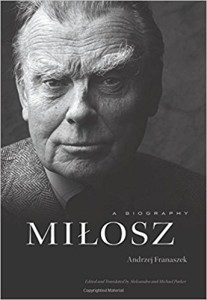
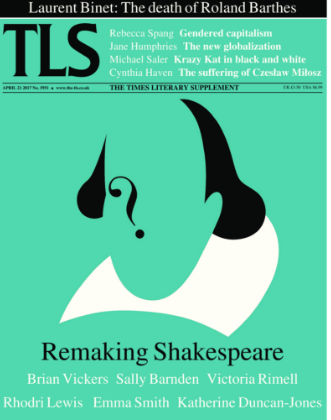
My review of Andrzej Franaszek’s Miłosz: A biography (Harvard University Press) is in the current issue of the Times Literary SupplementI also discuss the publication of the Nobel poet’s fragmentary science fiction novel, Mountains of Parnassus (Yale University Press). Kudos to translators Aleksandra and Michael Parker for the former, Stanley Bill for the latter.

My piece, “Writing Not Fighting,” is behind a paywall, alas. But you can read the first few paragraphs here.  An excerpt:

It may be a cliché that the great poet gives everything to his art, but in [Czesław] Miłosz’s case the platitude appears to have been agonizingly true. Miłosz: A biography  by Andrzej Franaszek, abbreviated and translated from the 960-page Polish edition published in 2011 (TLS, November 25, 2011), describes Miłosz’s unsparing choices. Literary ambition drove him to abandon the woman he called his “true and tragic love” in his native Lithuania in the 1930s (she may have been pregnant as well). After the Warsaw Uprising, he told friends that he would not take arms, because he must survive the war. His death would be meaningless: he must write, not fight.

milosz-biographyAt one shattering moment in his life, however, he rejected his vocation: on February 1, 1951, Miłosz, in Paris as a cultural attaché for the Stalinist government of Poland, stepped into a waiting taxi that took him to Maisons-Laffitte in the suburbs. The thirty-nine-year-old defector spent three and a half months in hiding at the offices of Kultura, an important émigré journal of politics and literature. He wrote: “my decision marks the end of my literary career”. He had walked out on more than five years of service to the Communist government, most recently in the grim, barricaded Paris embassy where insubordinate employees were drugged and delivered to the airport, and where others never left the building for fear of being dismissed. He had longed for “a place on earth where I could wear a face and not a mask”, but still believed he had turned his back on the future by defecting.
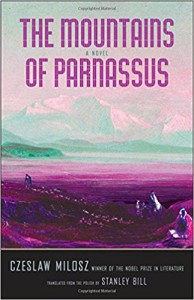
parnassusMiłosz was the first writer and intellectual of such distinction to defect from the Soviet bloc, and the first to give his reasons publicly, saying that a lie is the source of all crime and that “the paramount duty of a poet is to tell the truth”. For this, he was subjected to vicious slander and attacks from old friends in Poland, the left-wing Parisian intelligentsia, and even other émigrés. Miłosz became an Orwellian un-person in his native land, and would not see his wife and two sons again for more than two years.
At Maisons-Laffitte, he spent his days shouting, pacing, chain-smoking and drinking as he skirted a nervous breakdown. He could not “shake off his attraction towards Stalinism, like a rabbit toward a snake”, wrote Jerzy Giedroyc, the editor-in-chief at the publishing house Instytut Literacki as well as its journal Kultura. The émigrés who gathered round Kultura seemed to be history’s has-beens, fighting a rearguard action for a cause that had long ago been lost. But the “future of history” may not go where we imagine, and the cause that looks lost may, in fact, have time on its side. Today, Giedroyc is a legend, along with Józef Czapski, Zygmunt Hertz and his wife Zofia, who shared the villa in Maisons-Laffitte.

Well, we’ve told some of that story in the Book Haven after our own visit to the villa in Maisons-Laffitte. Again, the full article is here

Postscript: Oh, and we got a line on the cover of the issue. How cool is that?

.
tls


<<< Previous Series of PostssepNext Series of Posts >>>