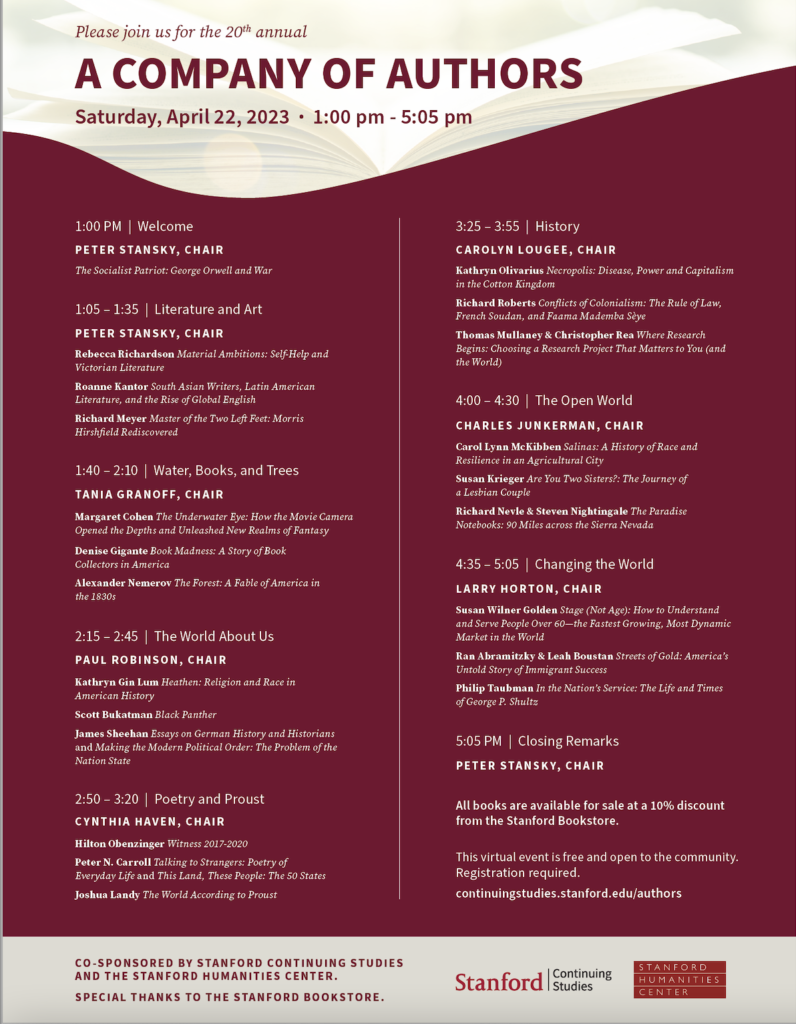
Stanford’s resident George Orwell expert, Prof. Peter Stansky, hosts his annual “A Company of Authors”zoom event this Saturday, April 21, from 1 to 5 p.m. “A Company of Authors” gives you a chance to hear about this year’s latest offerings by Stanford authors. Tune in for the books that interest you, or stay for the whole afternoon! See the poster below for the line-up of books and speakers.
Registration is open and the link to the event page (where registration can be found) is here. Feel free to share this link with your friends and networks.
I’ll be moderating a panel, so I’ll look forward to seeing you there!
And if you can’t need the iddy-biddy writing – you can go to the website to read, here.
Spy novelist John le Carré‘s anti-hero George Smiley is “arguably the most memorable character in modern fiction,” writes Rosa Lyster in her article “George and Ann” in the current Gawker, but comparatively little is said about Smiley and his wife Ann, “which plays out over the five novels where George Smiley appears as a central figure and is one of the weirdest portraits of a marriage ever committed to the page.” Lyster adds “it’s nice to think that le Carré’s portrayal of their marriage is not given the attention it is due because it is so strange, to the degree that if you start talking about it you will never stop.” Want to watch it? Just make sure you see the Alec Guinness, Patrick Stewart, and Siân Phillips version! The performances are matchless.
More:
Alec Guinness as Smiley: “everyone in the world has an Ann.”
“Here is George attempting to interrogate Karla [i.e., the KGB agent whose chase is the central plotline of Tinker Tailor, Soldier, Spy, The Honourable Schoolboy, and Smiley’s People]. “These two geniuses sit across from each other under a broken fan in the Delhi jail where Karla has been briefly detained after ‘the San Francisco operation’ has been blown and another KGB agent (referred to throughout as ‘Brother Rudnev,’ which is not important but still a nice treat for those of us who appreciate le Carré’s high, ridiculous style) is busily denouncing him in Moscow. Smiley tells Karla that he should defect because if he goes back to Moscow he will either be shot or put in jail. He tells him that he should defect because he is ‘an old man,’ and because surely it is evident that his faith in the system has been misplaced. Nothing. Then, who does he start talking to Karla about? Why, Ann! Ann. ‘As it was, the next thing I knew, I was talking about Ann…not about my Ann, not in as many words. About his Ann. I assumed he had one. I had asked myself … what would a man think of in such a situation, what would I? And I came up with a subjective answer: his woman.’
Siân Phillips as an unforgettable Ann
“Still nothing, but as anyone who believes they understand the resolution of these three novels knows, the Ann line of questioning is the one that ultimately leads to Karla’s defeat/defection. Thinking about who Karla loves and why becomes George’s chosen mode of attack and without attempting to paraphrase one of the most complicated plots on earth, this approach works. To George, it is self-evident that everyone in this world has an Ann, someone they love beyond all reason and would do anything for even when the rewards are dubious or non-existent. This belief is repeatedly exposed as false throughout the novels, which are full of people who don’t really love anyone and who are cheating on their pissed-off wives with exhausted violinists, but George sticks to it regardless.”
Lyster concludes: “These are spy novels, but there is a strong case to be made for them being romance novels as well, or at least ones that present a mortifyingly recognizable picture of what it’s like to not be able to live without someone, and to see the world and yourself through their eyes first. There are a lot of books that will confirm your sense that being in love is one of the most embarrassing things that can ever happen to a human being, but I can’t think of that many that go on to persuasively demonstrate that this state of abjection is to be sought out not only because it is exhilarating and consuming and makes you feel like a demon, but because it makes you smarter and better at your job, whether that job is being a spymaster negotiating the end of empires or a woman who has in her time lost her cool over someone to the extent of writing poems about it. This is one of the most comforting things Ican think of.”
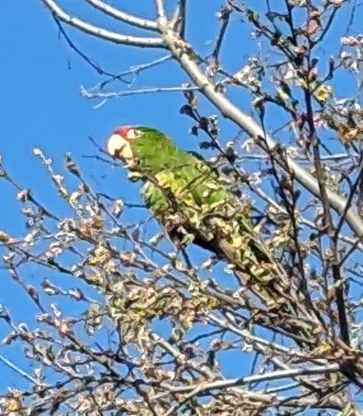
William Wang is part of the information technology team over at the Lucille Packard Children’s Hospital at Stanford, but on his way to work he had an experience much older and wilder than any technology. So he wrote to the Book Haven.
Here’s how it happened: As he crossed the intersection of Loma Verde and Alma, he recalled: “I heard a strange bird call and saw a flock of these guys up in a redwood. I didn’t bother getting closer since they were high up, but after I got in my car to go to work and stopped by a shorter tree next to the redwood, I looked up and saw a bunch of them with their green feathers.”
“A local bird rescue has one of the individuals from this supposed flock, and it’s described as a Cherry Head/hybrid, so I’m guessing it’s half parakeet and half conure.”
Half parakeet, half conure (Photos: William Wang)
He continued, “I found your blog post from 2020 after doing a little research and figured I’d send you photos and sentence or two about my sighting of the critters. They are quite photogenic, but unfortunately I was in a rush to get to work so I didn’t have time to stick around and get a better shot.”
How Did They Get Here? They were brought here to be sold as pets in the exotic pet trade. The U.S. was the largest importer of birds in the world before the government banned the trade of wild exotic birds in 1992.
How Did They Get Out? The founders of the wild flock of conures either escaped or were released.
So what about the Palo Alto birds? They are said to be escapees from Monette’s Pet Shop on California Avenue. I remember it well from years ago. According to one post, a few took shelter in trees just on the south side of Oregon Expressway. Could these be these rugged birds?
Beware! Beware! They are not as innocuous as they might seem:
“Years ago there was a flock of about a dozen who were all over the place in our city. Two local churches had to have work done on their roofs to evict the parrot flock from carving out little caves in the eaves.”
And this: “Many years ago we heard the sound of ripping wood in our attic. I thought it was some aggressive rodent, but when I took a look a saw… a conure I guess making a nest !?!?”
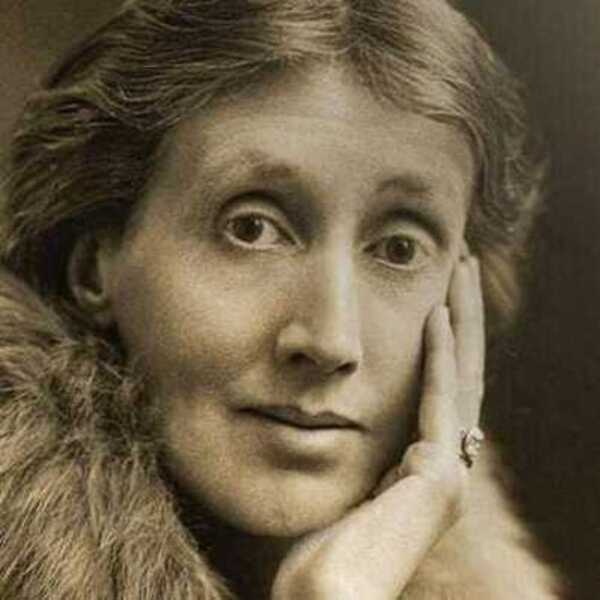
Please join us for a discussion of Virginia Woolf‘s 1929 A Room of One’s Own at 7 p.m. (PST) on Tuesday, April 11, in Levinthal Hall, Stanford Humanities Center, 424 Santa Teresa Street on the Stanford campus.
The Guardian called the book “a landmark in feminist thought and a rhetorical masterpiece” and rated it one of the top 100 non-fiction books of all time. Read about that here.
According to a contemporary review in The Los Angeles Times: “If you miss this book, which is profound and subtle and gently ironic and beautifully written, you will have missed an important reading experience.” Another Look will consider the work’s legacy a century later. The Bloomsbury author’s iconic book, an extended essay, is in public domain and widely available.
Panelists will include: Stanford Prof. Robert Pogue Harrison, author, director of Another Look, host of the radio talk show and podcast series “Entitled Opinions,” and a regular contributor to The New York Review of Books and Stanford Prof. Tobias Wolff, one of America’s leading writers, a founding director of Another Look, and a recipient of the National Medal of Arts.
Constance Solari is a writing coach and the author of four novels, including 2012’s Sophie’s Fire: The Story of Saint Madeleine Sophie Barat. Maria Florence Massucco, is a PhD candidate in Italian Studies who specializes in the 20th century novel. You’ll remember her from our discussion of Dorothy Strachey‘s Olivia.
Join us in person or virtually, but please register here. Or scan the QR code. We look forward to seeing you on April 11th! It’s going to be a great discussion.
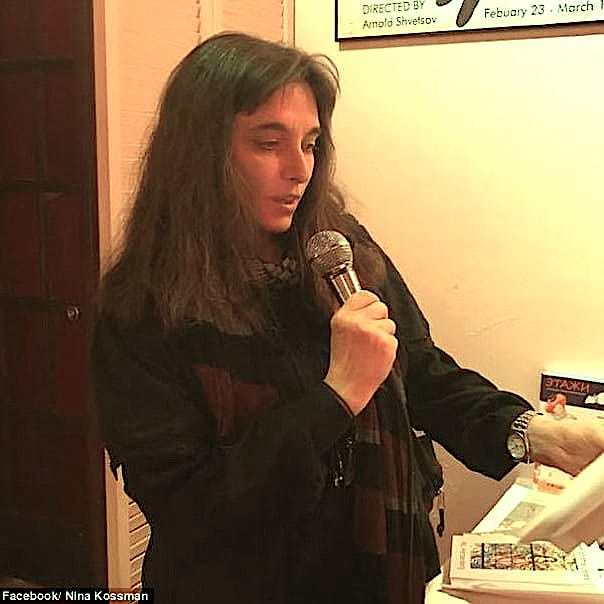
Russian poet Nina Kossman and a stranger sat next to each other on a recent flight from New York to Prague, en route to Ukraine. We’ve written about the U.S.-based writer’s translations of Marina Tsvetaeva here, but that was in a far less fraught time. A few minutes’ conversation between the two women laid bare the ongoing challenges of overlapping ethnicities, the terrible war, and the lifelong plight of the émigré. It went like this:
The woman in the seat next to me said something I didn’t understand right away. Something about a belt. I was thinking about something else, so I was a bit slow to react. Ah, a seatbelt! Is this my seatbelt or yours? I pointed at my seatbelt, already clasped on me, and then at hers, hanging from under her armrest.
Nina Kossman reading from her poems
“Ah!” she said, “Okay!” Her accent – the reason I didn’t understand her right away – sounded very familiar to me. “Do you speak Polish?” I asked.
“Yes,” she said. “And you? Where you from?” she said.
“I’m from the country that I’m sure you don’t like,” I said.
“Russia?” she guessed.
“Yes,” I said. “I was born in Russia. But I live here.”
“Why I don’t like?” she exclaimed with that mix of deep feeling and the hyper-drama I’m used to seeing in Eastern Europeans and which I notice in myself, too, once in a while.
“Russian people want war. So war.”
It sounded like a statement rather than a question, therefore I said, “The government wants the war, not the people. The people who approve of this war are just brainwashed.”
A very loud, emotional tirade ensued, and I suggested we not discuss politics. “I don’t want to fight with you while we are flying over the ocean.”
“You Russian,” she said. Again, it sounded like an assertion rather than a question, therefore I said, “Not really, although it’s true that I was born there.”
“What’s your last name?”
Ah, I thought, now I really feel like I am going to Eastern Europe. I knew what would follow my telling her my last name. Only in Russia and Eastern Europe I expect this question about my last name to be followed by “Not Russian,” and an instant later, by contemptuous “Jew?” Years ago, when I was a member of the now defunct PEN chapter “PEN/ Writers in Exile,” its Hungarian-born president never missed an opportunity to mispronounce my last name as “Koshman,” with barely concealed contempt, often followed by “Why is someone with the last name Koshman claiming to be Russian?”
That was in New York, where you don’t expect this sort of thing to happen, and it might be worth adding that the lady in question was not your usual illiterate antisemite but someone who knew every European writer personally and signed every PEN letter protesting the imprisonment of writers no matter where in the world the imprisonment took place, and herself was no lightweight as an author of critical studies of Hungarian literature as well as a literary translator. To prevent our conversation from taking the familiar route, I said calmly, “I’m Jewish, not Russian. Not ethnically Russian, that is.”
“Ah,” she said. “Then you not guilty. Not guilty of Russia war.”
“Right, I’m not responsible for this war – and not only because I’m Jewish and not Russian. “
“So why you say you Russian? Say ‘I Jewish,’ then no one thinks you guilty of this war.”
“In America, I’m seen as a Russian,” I say. “Being Jewish is a nationality only in Russia and Eastern Europe. In the rest of the world, and certainly in the U.S., you’re seen as Jewish if you go to a synagogue at least a couple times a year, that is, if you identify as a Jew, at least a Jew culturally, because here” – we were leaving the U.S., so I felt that “here” needed a clarification – ”in the U.S.,” I added, “Judaism is a religion, not a nationality as it is in Russia or Eastern Europe.”
“NO!” she said, with more feeling than I thought was necessary. “No! Say you Jewish, not Russian, then no one thinks you guilty. You not guilty of this war!”
“Whatever,” I said. “Perhaps we shouldn’t have this conversation here, just so we can have a peaceful flight.”
“You do not understand me! I say ‘Jewish – good!’ Not bad!”
“Okay,” I said, “Okay, okay.”
But we were not finished, because when a short pause during which she sat with her eyes closed was over, she said: “Tell me! Why you fly to Praga [Prague] now?”
“I’m flying to Prague just because I can’t fly straight to Ukraine. No passenger planes are flying to Ukraine, as you know.”
“I know!”
“Good,” I said, hoping this would be enough to end our conversation on a peaceful note.
I was wrong again. She sat in silence for a minute, and then said: “But why you go to Ukraine?”
“I want to work with animals that have been traumatized by the war.”
“But if you live in America, you can’t work in Ukraine! You need special papers to work there! Work papers! It’s another country! To work in another country, you need work papers!”
“I am not going to work for money. I’m going as a volunteer. Volontyor,” I used the Russian form of the word, thinking it might sound like Polish. “I wouldn’t work for money in a country at war.”
“Ah, you go there to help! Not to work!”
“Right.”
“That’s good!” she said Good luck!”
“Thank you,” I replied.
“My mother was a teacher of Russian in Poland. She went to Moscow many times. She said beautiful city! I wanted to see it but now I will never see it. Because of this war. Moscow is beautiful, right?”
“In a way.”
“But Leningrad is more beautiful. I always wanted to see it. Only if Putin dies! But he is only 70! And he has good Jewish doctors to keep him alive! War will end when he dies.”
“I hope it won’t be that long. But you never know.”
“Never know! That’s right! He wants to make the Soviet Union like in the old days. You know Poland was like number sixteen republic? It had fifteen republics – and Poland was sixteen!”
“Yes, I know.”
“It was like a train – one car, another car, Ukraina, Latvia, Belorussia, Estonia, Lithuania, fifteen republics, fifteen cars – and Poland car number sixteen! And after Ukraina, he will want to take Poland – to get his train back!”
“But Poland is part of NATO, so he won’t dare.”
“NATO is his fear! He sees NATO even where it is not!”
“Yes,” I said, “it’s a crazy fear of his.”
She touched my armrest gently.
“Jewish and Russian – not the same! Say you’re Jewish next time! It’s better! And good luck to you in Ukraine!”
“Thank you,” I said again. Like a real American, I’ve learned to say “thank you” to avoid saying anything substantial.
“I sleep now.”
“Okay,” I said, careful not to add “thank you” one more time.
She leaned back in her seat and closed her eyes. I tried to sleep, too, but nothing came of it, so I took out a piece of paper and a pencil and jotted down our conversation, while every word we had said was still fresh in my memory.
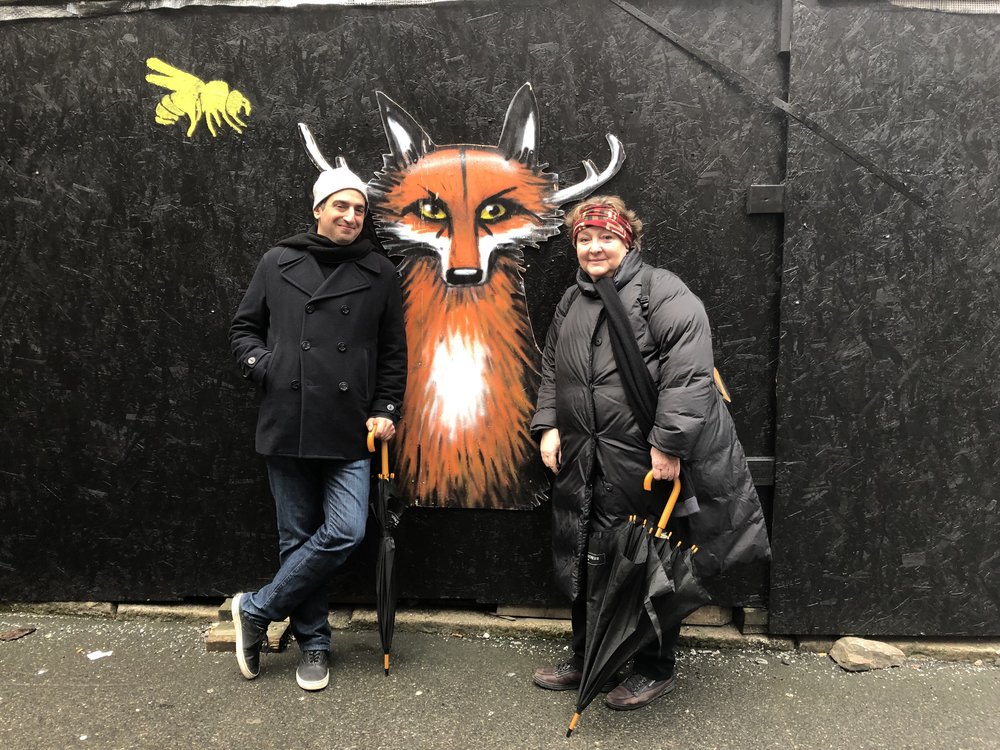
In happier times: Ugrešić with Prof. Daniel Medin of the American University of Paris, and an antlered fox in Bergen. Photo: Alisa Ganieva.
The Croatian writer and Neustadt winner Dubravka Ugrešićdied two days ago, on March 17, at her home in Amsterdam, surrounded by family. She was 73. I interviewed her at the inaugural Bergen Literary Festival in Norway, 2019. That interview was published in Music & Literaturehere.We talked about the break up of Yugoslavia, we spoke about the hate campaign against her and how she became one of the region’s many scapegoats.
But she also spoke the relationships between men and women, and, as the biographer of the French theorist René Girard, I couldn’t help but see a mimetic thread in her conversations. An excerpt from that interview:
CH: Something you said that I think is very true: “That through women, men find their way to other men.”
DU: Let us be fair, men are not the only ones who, consciously or unconsciously, manipulate. However, it is fair to say that there are some examples of women in history who attracted men because they were known as mistresses of other men. Love is often a struggle for territory and power, a social game. Literary life is rich in such examples. One such example is Lily Brik, wife of Russian futurist Osip Brik and mistress of Vladimir Mayakovsky. Both of her men died, and she carried on, living with another two men who were honored by inheriting “the territory” previously owned by two famous men. Such liaisonsdangereuses are not foreign to human nature, but Brik’s story happened in the time of sexual liberation—remember Alexandra Kollontai! Also later, during the Communist era, sexual privacy was the only territory of freedom that was left.
CH:The comment we’re discussing is another remark from the character of the Widow in [her novel] Fox, who was speaking about Alma Mahler. You wrote—or rather, the Widow said—“her main talent was a deep and abiding knowledge of the economy of love.” What else might she had said that you didn’t have time to write down?
DU: Everything’s about the economy of love. When I see men—how they are natural, relaxed, and comfortable in the company of other men—I realize that it will take much longer for both genders to become emancipated from God’s given roles. Many men see the world like military life—that is the strongest human meme, where women stay at home and wait for men to come back from glorious battles with other men. Or, to use an analogy that is a bit more current, many men see the world like a football game, where they play with each other in order to play against each other. Why do men never wonder why women are so obviously excluded from so many zones of public life? Why doesn’t one of them ever protest that he will not participate in the conference, discussion, forum, or event unless the number of participants is equally divided: half women and half men? Why? Because they don’t see anything unusual in the landscape they are so used to.