Robert Conquest remembers Solzhenitsyn: “How should one judge him?”

May 21st, 2016

Share
Conquest at work (Photo: L.A. Cicero)

Conquest at work in 2010 (Photo: L.A. Cicero)

Next month, I’ll be giving a talk about Robert Conquest – the legendary historian of Russia’s Stalinist period, and also a very fine poet. The occasion will be the West Chester Poetry Conference outside Philadelphia. Tonight, I’m working and thinking about Bob, who died last year at 98. While checking dates on the internet, I found this article from him about his collaboration with the larger-than-life Russian writer Alexander Solzhenitsyn.

You can read it in its entirety in the Wall Street Journal here. Or settle for a couple excerpts below:

solzhenitsyn4

He’s working too, at Hoover Institution Archives.

Those of us who had long been concerned to expose and resist Stalinism, in the West as in the USSR, learned much from Alexander Solzhenitsyn. I met him in Zurich, Switzerland, in 1974, soon after he was expelled from the Soviet Union – the result of … The Gulag Archipelago, being published in Paris. He was personally pleasant; I have a photograph of the two of us, he holding a Russian edition of my book, The Great Terror, with evident approbation. He asked if I would translate a “little” poem of his. Of course I agreed.

The little poem, Prussian Nights, turned out to be 2,000 lines! Thankfully, he and his circle helped. It was an arresting composition, increasing our knowledge of him and his times – something worth reading, and rereading, for its stunning historical background.

Solzhenitsyn was one of the most striking public figures of our time. How should one judge him? As a writer, up there with Pasternak? As a moralist, up there with Czeslaw Milosz? But he should also be judged as one who might have won two Nobel prizes – not just for Literature, but also for Peace.

In his public capacity, he felt bound to stand forward as the conscience of his people. He said, in a July 2007 interview in Der Spiegel, “My views developed in the course of time. But I have always believed in what I did and never acted against it.” Yet above all, he saw himself as a writer – a Russian writer.
 .
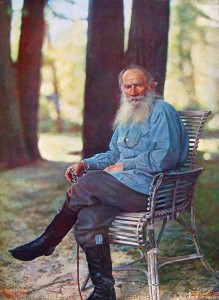
For most of us, Russian literature is like a triangle around Pushkin, Dostoevsky, and ChekhovTolstoy is in his own class. Solzhenitsyn, on the strength of August 1914 alone, competes in the Tolstoy lane.
.

***

L.N.Tolstoy

“Class of his own.”

Some giants of Russian literature appear more preachy than is common in the West, a trait that brings us to what many see as weaknesses in the Russian tradition. First is the feeling, without basis, that one is somehow being cheated – as in Gogol; second is a tendency to exaggerate or invent. Yet along with these weaknesses there is also painful honesty.

I did not sense the weaknesses when I met him. He was religious and Russian, but without exhibition – though it became clear he embodied Fyodor Tyutchev‘s famous dictum that “Russia can neither be grasped by the mind, nor measured by any common yardstick – no attitude to her other than one of blind faith is admissible.”

He remained staunchly anticommunist, noting in the July 2007 interview in Der Spiegel that the October Revolution “broke Russia’s back. The Red Terror unleashed by its leaders, their willingness to drown Russia in blood, is the first and foremost proof of it.” He also hoped that “the bitter Russian experience, which I have been studying and describing all my life, will be for us a lesson that keeps us from new disastrous breakdowns.”

Incidentally, I would never call Milosz “a moralist” – he certainly would not have considered himself as such, and was far too aware of his fallibility. Nevertheless, read the whole thing here.

Photographer Lena Herzog: “I fall into breathing with the world…”

May 19th, 2016
Share
Lena_Herzog

Herself. (Photo: Wikimedia)

Russian American photographer Lena Herzog is a phenomenon – well beyond the books she has published and her international exhibitions. She’s witty, incisive, profound, and thoroughly original. You can read for yourself in my Q&A with her at the Music & Literature website – here

I caught her during a recent trip to San Francisco, while she was visiting on break for her tours with her newly published Strandbeests: The Dream Machines of Theo Jansen. Lena Herzog spent seven years tracking the evolution of a new kinetic species, intricate as insects but dwarfing its creator, a scientist-artist, in size as they roam the beaches of Holland. 

But this particular visit to the City wasn’t a solo visit: her husband Werner Herzog was in town for Stanford’s Another Look book club event, in which Herzog joined author Robert Pogue Harrison for an onstage conversation (we wrote about that here and here). Robert met the Herzogs a few years earlier, when he interviewed Lena for his Entitled Opinions radio show.

But I consider it a privilege to have had a short squished hour with Lena alone, before the Herzogs headed back to their Los Angeles home.

Here’s an excerpt:

strandbeestsHaven: So how do you capture a moment that is movement? With the Strandbeests, you’re trying to take a still photograph of something that is essentially motion, by definition.

Herzog: By definition, yes. That’s the whole point of it. One of my first two books was about dance—Flamenco: Dance Class in 2004. By the way, it was dedicated to a great Flamenco dancer Yaelisa of Spanish decent, the daughter of the great Flamenco singer Isa Mura. Yaelisa lives and works in the Bay Area. I had a similar challenge with her and her troupe, how do you photograph something that is all about motion? Or anything that’s alive, really? A dancer is not a breathing, living being in my photographs, but, I hope, you get a sense of her, of her dance. A photograph is not a calcification. For me, it’s capturing the spirit of something, a tree, a person, an object, a moment. At its best, a good shot is the opposite of clarification—it is a mystery.

I normally photograph at a regular speed, 125 fractions of one second. So it’s one second divided by 125 times. That’s the slice of the time I use to capture something. I click when I feel something—when my heart sinks for a brief moment. Everything that constitutes me, coalesces, dances with that moment.

flamencoThat connection is what matters, what makes me take a picture. That’s why, for example, I don’t use tripods. I have them, I just haven’t used them. I realized that even when I’m photographing a tree or a mummified human specimen in the Cabinet of Wonders I need to be one with my camera. The lost souls are not moving, but I am moving. My soul is moving. It’s breathing. It feels like I fall into breathing with the world. And then I click.
I need that last breath, that sense of becoming the thing I’m photographing—as if my soul jumped out of me and into that person. I need that brief second, that possession, and so that last breath is crucial. When I am responding to motion, to a dance or to Strandbeests, that’s what I’m reflecting—something that’s in me. It’s not technically photographing something and making sure the viewer understands this motion. It’s this after-image effect, the moment when your heart sank because you saw that. And it translates. It’s a mystical moment. I don’t know why it translates, but I know that it does.

Well, you can read the whole thing online here

Has entertainment turned our minds into jello and our politicians into clowns? Vargas Llosa thinks so.

May 16th, 2016
Share
MVL_©_zygmunt_malinowski

Mario Vargas Llosa in NYC with interlocutor John King at right. (Photo: Zygmunt Malinowski)

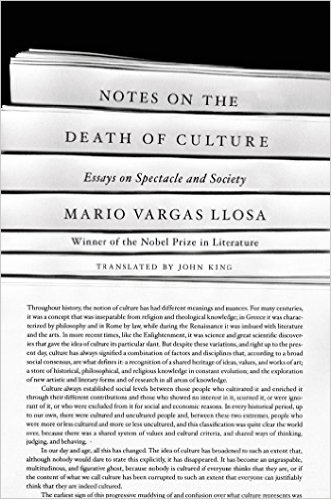
We’ve written about Peruvian Nobelist Mario Vargas Llosa before (here and here and here). Now it’s The Guardian‘s turn. Vargas Llosa has just come out with a new collection of essays, Notes on the Death of Culture. (This isn’t a new article, but perhaps you also missed it when the book was published last year.)

From The Guardian:

llosa-bookVargas Llosa has long been known as a public intellectual as well as a novelist in the Spanish-speaking world – and indeed in the UK, where he lived in the 1980s. One-time contender for his country’s presidency, a cultural liberal who wants value in the arts, ideas and literature to rule over easy relativism, the register of price and the “civilisation of spectacle”, he worries over the dangers to democracy the latter group poses. He’s at home with the giants of French theory, from Guy Debord, inventor of situationism, to Jacques Derrida and his archival fever. Their impact, he notes, has hardly been salutary. Meanwhile, neither artists nor critics, journalists nor politicians value judgment or intelligence.

By succumbing to what Marshall McLuhan called an “image bath”, he writes, the 21st-century west has ushered in a time of “docile submission to emotions and sensations triggered by an unusual and at times very brilliant bombardment of images that capture our attention, though they dull our sensibilities and intelligence due to their primary and transitory nature”. A shallow levity has taken over. The ethics of Hello!, which he reminds us was originally a Spanish magazine, rule. Entertainment is all. Translated into the political sphere, this means our politicians increasingly become clowns, prepared to do anything to capture media attention. The press, whose freedom is crucial, is more symptom than outright cause of this regrettable phenomenon.

Read the whole thing here.

Editor extraordinaire Daniel Medin: he’s “raise-your-eyebrows smart”

May 13th, 2016
Share
medin-krasnahorkai

Man Booker award-winner László Krasznahorkai’s with Daniel Medin at last year’s ceremony. (Photo: Hans Balmes)

One of our favorite people is international literary tastemaker and editor extraordinaire Daniel Medin of the American University in Paris. We’ve written about him here and here and here, among other places. It’s been a pleasure to watch his rise as a truly great editor and homme de lettres, fostering literary excellence wherever in the world he finds it.

Fortunately, our good taste is contagious. An article on the Washington University of St. Louis’ The Source called him “an evangelist for outstanding contemporary foreign-language writers.”

Case in point: Medin is a judge for the 2016 Man Booker International Prize. The annual award honors a fictional book translated into English and published in the United Kingdom. The winning title earns a lofty £50,000 ($75,800), split equally between author and translator.

...and his admirer

Literary evangelist

Medin and the four other jurists pored over 160 novels and met several times throughout the winter and early spring to create the prize’s longlist and then select the winner. “What I’m doing doesn’t feel like work,” he says. “It’s a privilege.”

Warm, self-effacing and raise-your-eyebrows smart, Medin works in three languages — German, French and English — allowing him to read fiction by authors famous in their own countries but underrepresented or completely unknown by Anglophones.

When a novelist or poet impresses him, Medin gracefully labors to expose that person’s prose to English-language readers. He publishes translated selections of their work in Music & ­Literature, The White Review and The Cahiers Series, the three literary ­magazines that he helps edit. He also sends copies to publishers, critics and writers all over the world.

“Reading these books is a pleasure,” Medin says. “It’s similar to having something delectable to eat; the delight is enhanced by sharing it with others.”

Read the whole thing here. The only thing I’d fault it for is that it doesn’t mention Daniel’s long stint at Stanford, which is where our paths finally crossed.

Philip Gourevitch: “People want to speak so as not to be annihilated.”

May 11th, 2016
Share
tallent

Tallented.

The English Department at Stanford, along with its Creative Writing Program, regularly hosts five-star writers to the Stanford campus, but to my mind they’ve outdone themselves this spring with the dynamite team of Philip Gourevitch and his wife, Larissa MacFarquhar, both of The New Yorker.  

Gourevitch is best known for his first book We Wish to Inform You That Tomorrow We Will Be Killed with Our Families: Stories from Rwanda (1998), which was honored with, among other awards, the National Book Critics Circle Award, the Los Angeles Times Book Award, and, in England, the Guardian First Book Award. In 2011, We Wish to Inform You was included in the Guardian’s list of the hundred greatest non-fiction books from the past 2,500 years. He has returned to Rwanda in recent years and is working on a new book about the country, You Hide That You Hate Me and I Hide That I Know. He gave a reading from it a few weeks ago – it was an unforgettable experience. 

Today at a 11 a.m. colloquium, he fielded questions from the Stanford community. Fortunately, he had Elizabeth Tallent provide the introduction. She’s a powerful essayist (and fiction writer) in her own right. Here’s what she said:

Philip_gourevitch

Signing books in 2008. (Photo: Larry D. Moore/Creative Commons)

At a PEN America panel, talking about his reportage on the genocide in Rwanda and its aftermath, Philip Gourevitch said:

“Three words that motivate the political reporting I’ve done on the aftermath of political violence: unimaginable, unthinkable, and unspeakable, reflexive words that give voice to the magnitude without actually addressing it. They are words with which the press gives you permission to forget about and ignore things. They are the words by which we let ourselves off the hook…These words were almost universally applied to Rwanda. ‘Unbelievable’ was the casual form of all three words put together. But: believe it. What else is a writer supposed to do but think and speak. And imagine.”

A little later he added:  “People want to speak so as not to be annihilated. Often in situations where there’s a sense of crushing forces very, very close to the bone, people want to speak simply to exist.”  …

About We Wish To Inform You, the Guardian’s reviewer Rory Stewart wrote, “Gourevitch’s book insists on being always articulate. In the hardest situations, his reactions can remain uncannily precise.”

gourevitch-bookAgainst, counter to, conventions of authority and detachment, We Wish to Inform You offers a humane, troubled voice that meticulously documents its uncertainties and offers moments of self-disclosure. After having been taken through a hospital ward full of the mutilated survivors of machete assaults, he has to lie down on the cool cement of the hospital corridor.
A vigorous style characterized by vivid small separate acts of noticing. In We Wish to Inform You, Philip Gourevitch has a series of conversations with a doctor who is a survivor of the genocide, and about one of these conversations, she wipes at her eyes, and he writes, “It was the only time she wept in telling me her story. She covered her face with one hand, and the fingers of the other tapped a fast pulse against the table. Then she said, ‘I’m going to get us some sodas.’”

Philip Gourevitch’s careful, forceful, sustained search for the reality of our—of humanity’s—varied, sometimes truly horrific struggles enlarges the share of available reality for each reader of his work. If the reality we gain from reading Philip Gourevitch is sometimes an intractable or wounding reality, we are offered, in his clarity, in his searchingness, in his repeated defiant decisions to keep looking, a model of what it may be like to resist conventional evasions and do, instead, the hard work of finding the horrors we have inflicted on ourselves imaginable, speakable, thinkable.

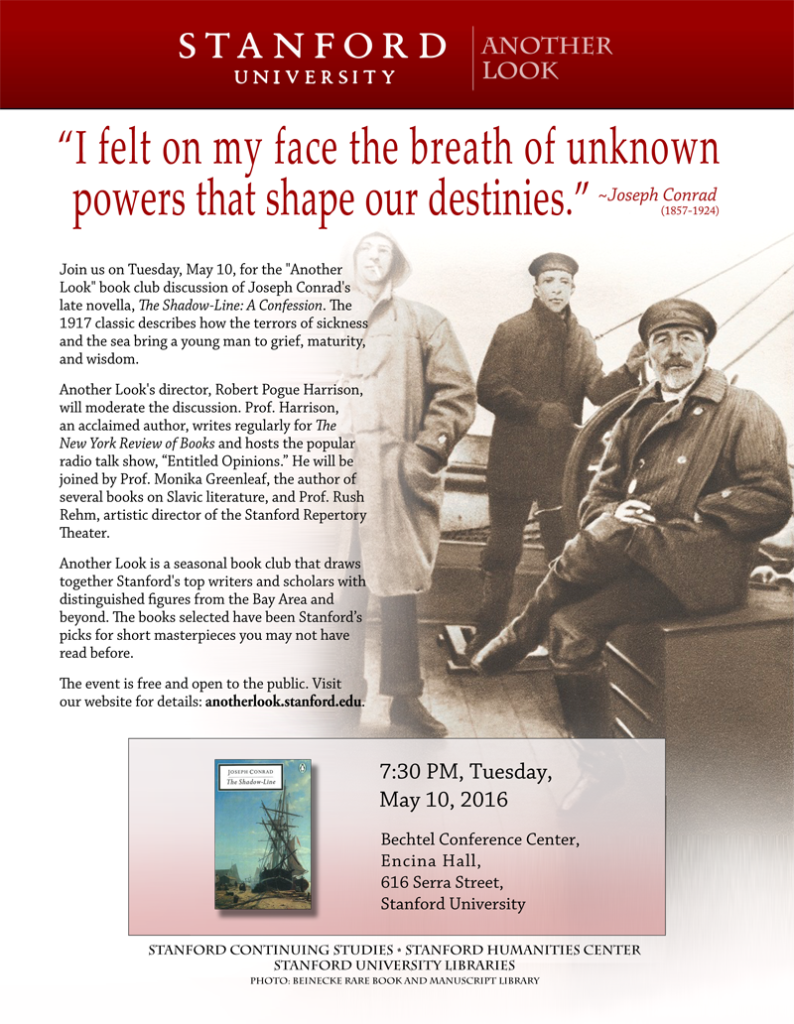
Last call! Joseph Conrad’s late novella The Shadow-Line tomorrow night!

May 9th, 2016
Share

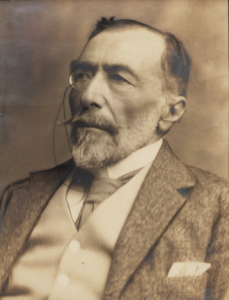
conrad5Last call! On Tuesday, May 10, the Another Look book club will weigh in on Joseph Conrad‘s late novella, The Shadow-Line, written by one of the darkest and most prophetic voices in English fiction. The panel will be moderated by Another Look director Robert Pogue Harrison, an acclaimed author and professor of Italian literature. Harrison is a regular contributor to the New York Review of Books and the host for the popular radio talk show Entitled Opinions. He will be joined by drama Professor Rush Rehm, artistic director of the Stanford Repertory Theater, and Monika Greenleaf, associate professor of Slavic languages and literatures and of comparative literature. Read more about the event here

conrad-poster-mocks5


<<< Previous Series of PostssepNext Series of Posts >>>