“I tricked myself to write”: Philip Glass discusses his new book on home turf

April 18th, 2015

Share
Philip Glass with Ira Glass at Barnes & Noble, Uniion Square, NYC. 3/6/2015

Cousins: Ira Glass interviews Philip Glass at Barnes and Noble in NYC. (Photo: Zygmunt Malinowski)

.

The latest word from the big city on the Atlantic, from our roving reporter/photographer Zygmunt Malinowski (he’s written for us before here and here and here and here, and lots of other places):

Philip Glass, considered to be one of the best contemporary composers, is part of the New York City fabric. He is a quintessential New Yorker who had his start in the New York downtown scene of the 1970s.

So I was pleased when I picked up a local paper for a subway ride recently, and learned he would be appearing locally, at Barnes & Noble on April 6, to discuss his new autobiography, Words Without Music. I had photographed Czeslaw Milosz for his book launch of Roadside Dog, the same sort of event at the same venue.

Philip Glass at Barnes & Noble, Uniion Square, NYC. 3/6/2015

Time for a close-up. (Photo: Zygmunt Malinowski)

Glass’s first opera, Einstein on the Beach, a collaboration with Robert Wilson, catapulted him to fame in 1976. He had honed his craft in Paris, where he was inspired by avant-garde theater and Samuel Beckett plays. He went to India in 1966, and encountered refugee Tibetans and Buddhism. Eventually, he would write the score for Martin Scorsese’s 1997 film about Dalai Lama, Kundun, using the repetitive Tibetan cymbals and horns as a motif.

At Barnes & Noble, the 78-year-old composer was accompanied by his cousin Ira Glass, who was also his interlocutor for the event, as well as the host and producer of NPR’s “This American Life.” The organizers warned me that the photo-op would be short, but I still had enough time to get a good close-up as he posed in front of bookstore’s logo. The overflow event, on the bookstore’s top floor, featured a large panel of Moby Dick graphic and Gulliver’s Travels. The green panel behind the center table blocked the large windows and view of city buildings, a photographer’s minor disappointment at a great event.

“Before age 41 I had a day job, I was moving furniture and things like that,” Glass told his cousin. “This is very common in our country, artists, dancers …have a day job … I thought I was successful. I had an ensemble, I went on tours. I was traveling in Europe and America.” However, even after the Einstein on the Beach triumph at the Metropolitan, he returned to his day job, driving a taxi. Soon afterwards he received a lucrative commission from Netherlands.

He claimed that it is still hard to write and sometimes he has to throw away what he started and start over. One of the ways he described it is that writing music is like “looking out the window at buildings on a foggy morning, and after a while you can see a [an outline of] a window.” Then he has to figure out a way to describe it in music. Rather like writing, in fact.

Nowadays, he particularly likes “offbeat music, especially music from other countries and music from 30s and 40s.” His tastes are omnivorous, he likes all music, and said that he has heard “some awful playing but young people are doing wonderful things.”

The written questions from the audience were randomly selected at the end of the session.

Q: Is it best to write music when you are heartbroken?

Glass: No. To me music is continuous like an underground flow…

Q: What music do you listen on a subway?

Glass: The other day, symphony music … that I composed. When we have a Tibet concert I listen to everybody. [Glass is the artistic director of annual Tibet House benefit concert at Carnegie Hall.]

Q: It’s hard to sell music.

Glass: The question should be who wants music [i.e., dancers and others need music.] Find someone your age…theatre needs music. One of the things that goes on today is collaborative. No one says you will make money; you do it because you love it. This is what we call vocation, from Latin word ‘vocare’ [to call, to name, to invoke]

Glass recalled that when he was young he set aside a period of time to compose. “I sat at the piano between 10:00 and 1 in the morning waiting for what would happen. I tricked myself to write. At first it was difficult and finally I wrote music to pass the time. Now I write anytime I want to. Now there is a feeling of anticipation, of satisfaction to come. Writing now has become joyful, but it was not like this when I was younger.”


Philip Glass books; Barnes & Noble; Uniion Square; NYC. 3/6/2015

In prose, not music. (Photo: Zygmunt Malinowski)


Langston Hughes and his thousands of letters

April 16th, 2015
Share

hughesI haven’t read much of the work of Harlem Renaissance poet Langston Hughes, but I adore the man already, after reading Arnold Rampersad‘s engaging, straightforward introduction to him in the new Selected Letters of Langston Hughes. The new Knopf volume is the first comprehensive selection of his correspondence, edited by Rampersad, winner of the National Humanities Medal (we’ve written about him here and here and here) and David Roessel, with Christa Fratantoro.

Hughes and I both have a complicated relationship to the world of letters. As he put it, it’s not the writing, but the “getting down to writing” that’s the problem. Here’s the first paragraph of Rampersad’s introduction:

“Who knows better than I,” Langston Hughes once wrote to a friend, “what letter writing entails?” Certainly he knew much about letters. With a crowded life that put him in touch over the decades with thousands of people, the mail was crucial to starting and keeping friendships and to doing business. He admired people who answered letters promptly. His friend Carl Van Vechten, for example, received a flood of mail but usually answered each piece on the day it reached him. Hughes was not so disciplined. In fact, at one point he called himself “the world’s worst letter writer.” Another time, he confessed to stuffing away a swelling pile of answered pieces. “Two drawers are full,” he noted, “so I’m moving my sox over.” All the same, he wanted to be a faithful correspondent. “I leave you now,” he ended a letter in 1944, “to consider the stack of mail on top of mail piled on the bed. I cannot take my rest until I unpile some of it.”

I can sooo relate. Rampersad continues:

Later in life, living near one of the noisier sections of Harlem, he wrote through the night, when the brownstone row house he shared was likely to be quiet. Then, at three or four or five o’clock, or even later, he sat at his typewriter and pounded out letters (more than thirty on many nights) that went all over the world. This was in addition to writing the poems, novels, short stories, plays, autobiographies, histories, translations, opera libretti, song lyrics, children’s books, and newspaper columns, as well as editing anthologies and other volumes, that made so many people long to be in touch of them.”

As early as 1923, Hughes wrote an early letter to Countee Cullen, “Certainly it is very kind of you to offer to read my poems for me at the library and very beastly of me not to have written a single line since returning from New York.” He was already behind in his letter-writing. But that was the least of his problems.

About two decades ago, I remember reading the letters of Katherine Mansfield, and the dominant theme of the letters was: money. Constantly short of cash as she coughed the last of her life in resort towns to relieve her tuberculosis, as she wrote, wrote, wrote … letters, diaries, short stories. Francs, dollars, yen … At least that seems to be one eternal part of the equation, and Hughes was no exception.

Did you ever try livin’
On two-bits minus two?
I say did you ever try livin’
On two bits minus two?
Why don’t you try it, folks,
And see what it would do to you?

A winner

Thousands of letters, and he edited them.

The new volume opens with the early beseeching letters to father in 1921, after he published his first poem, “The Negro Speaks of Rivers,” in a national magazine. The humiliating financial exigencies were an ongoing condition. He wrote to his publisher Blanche Knopf, from a Mexican house above a pear orchard in Carmel Valley as he wrote his long (and somewhat premature) autobiography in 1939: “The house is entirely my own for work, and as remote and quiet a place as one would want to find, so I shall not be interrupted. I am sorry the manuscript is not ready to send you now, as I had hoped it would be, but it is going along splendidly and is two-thirds finished, so a month more of steady work should get it done. However, my difficulty at the moment is this: having turned down all lectures for this fall and put aside everything else in order to get the book done, my sources of income have temporarily ceased – and I find myself with an eviction warning from my New York landlord if I do not come through with the August rent. Which is bad enough, but not quite as bad as being unable to employ a typist to assist me in preparation of a final draft – some five hundred pages – which I shall shortly have ready to have recopied. So much as I dislike to do it at this stage of the game, I am writing to ask you if it would be possible to now allow me an advance of $200.00 on the book…” He lived in a time, you see, when $200 was more than a spit in the bucket.

Some things don’t change, even with fame. He wrote to Van Vechten in 1955: “What I was about to write you abut you about yesterday was (and is) to ask you if by any chance you’ve got a spare hundred lying around loose anywhere you could lend me for a month. Brokeness suddenly descended upon me unawares and my stenographer’s last check bounced. Turned out I was $1.48 short! … I don’t mind being broke myself, but typists live more hand to mouth than author, and I don’t want to get more than a week or two behind with her…” Working on a film project in 1940, he wrote that he had been “entangled in that unprofitable thing known as the show business,” adding that “in this charming democracy of ours there seems to be no place for Negroes to live in Hollywood even if they do work out there occasionally.”

Thousands of letters. We’re grateful they haven’t disappeared over the years – including letters to Richard Wright, James Baldwin, Ezra Pound, Wole Soyinka, Rev. Martin Luther King. Although, in a 1936 letter, he wrote, “I seem to be out-doing even myself as the world’s worst letter writer,” his correspondence is so huge that it could easily fill a score of large volumes. But then, he saved everything. “I guess I never throw anything away ever,” he admitted.

Can’t write? Failing your exams? You, too, can be a great philosopher! Derrida did it!

April 13th, 2015
Share

derrida-shakespeare

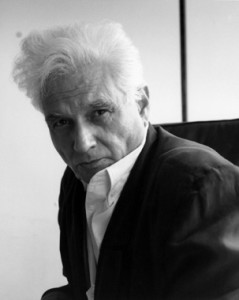
A colleague in Southern California alerted me to the current exhibit at the University of California at Irvine: Through Discerning Eyes: Origins and Impact of Critical Theory at UCI. The new exhibit, which runs through mid-September, spotlights the personal papers of many famous thinkers, such as Jacques Derrida, Paul de Man, Edward Said, and J. Hillis Miller, housed in UCI Libraries Special Collections and Archives’ Critical Theory Archive. But the showstopper seems to be the paper above from Derrida, which is appearing in the social media. The essay on Shakespeare, written in English, received a 10 out of 20.

In case you can’t read the diagonal handwriting in red across the top by the anonymous grader, it says this: “In this essay you seem to be constantly on the verge of something interesting, but, somewhat, you always fail to explain it clearly. A few paragraphs are indeed totally incomprehensible – Probably this essay would have been good with just a little more work in it. As regards language, your English is not idiomatic enough (if generally correct). My advice is: read a lot of English, pen in hand.” I have my questions about the writing of the grader, frankly. “but, somewhat, you always fail…” Huh? And his English is not idiomatic enough? And what good does it do to read a lot of English with a pen in your hand?

Derrida

Loser.

On the facing page, “quite unintelligible” is scribbled over an entire paragraph. I don’t know about Derrida being “unintelligible,” but it is barely legible, at least in this tiny image. The exam is dated 1950 – Derrida would have been 19 or 20 years old, and he was in the “khâgne” – educational preparation for one of France’s grandes écoles.

During these years, according to the exhibit, “Derrida met many individuals who have played an important role in his life, including Pierre Bourdieu, Michel Deguy, Louis Marin, and his future wife, Marguerite Aucouturier.” “By the end of 1952,” the description continues, “he had gained admittance to the Ecole normale supérieure.” That’s a big deal.

According to the Critical Theory website, on one occasion when Derrida failed his entrance exam, a juror remarked: “Look, this text is quite simple… You’ve simply made it more complicated and laden with meaning by adding ideas of your own.” He later failed his initial license exam for philosophy. “An exercise in virtuosity, with undeniable intelligence,” one juror wrote, “but with no particular relation to the history of philosophy…Can come back when he is prepared to accept the rules and not invent where he needs to be better informed.” Failing is commonplace on these rigorous exams. Derrida failed several times before passing – but the comments were brutal.

The New York Review of Books writes that during one exam, Derrida “choked and turned in a blank sheet of paper. The same month, he was awarded a dismal 5 out of 20 on his qualifying exam for a license in philosophy.”

The moral of the story? According to Jack Cade in the comments section: “How many Jaques Derridas get rejected and discouraged by, essentially, the hegemonic systems of thought that are in every discipline? Read, judge, and grade more generously. Not easier, just wiser.”

Asian megastar Agnes Chan in South Sudan: “Their future is our responsibility.”

April 11th, 2015
Share
agnes3

Spreading the love: Agnes in South Sudan

I received a note from Asian megastar Agnes Chan, author of about 60 books and Japan’s high-profile ambassador for UNICEF (I’ve written about her before here and here). She wrote: “I am in South Sudan on a UNICEF mission. Fighting continues in several areas. Displaced people, malnourished children, lost lives and bleak prospects. Decades of war makes this resource rich country an aid dependent state. Needless fighting must stop already. The children are adorable and their future is our responsibility.” Could I blog her note and photos? “It will be great to let more people know about the situation,” she replied.

Here is a description of the visit form the author, singer, journalist, and humanitarian (who also holds a Stanford PhD), according to a report from Yambio in South Sudan:

Ambassador, Agnes Chan says UNICEF will reach out-of-school children in all 10 states, targeting approximately 400,000 children whose schooling has been interrupted by the conflict in South Sudan to return to their studies this year.

She said that children have started joining schools while others still need awareness and support to go to schools.

Ms. Chan stated that UNICEF and the Government of Japan will continue to support South Sudan.

“We will continue supporting children’s education in South Sudan urging the people to make good use of facilities to making sure that children are educated well,” she noted.

She thanked Western Equatoria Government for being devoted in helping women, children and the youth in life skills.

Ms. Chan in her meeting with the State Governor, Bangasi Joseph Bakosoro appreciated his leadership and the entire government for keeping and promoting peace in the State.

“It is not easy but the people of this state are committed to maintaining peace in the area because peace is a very important tool, that for any country to do well for its citizens there must be peace,” Chan said.

More photos below:

agnes5

agnes4

<agnes2

<agnes1

Poet X.J. Kennedy wins $50K award – and he deserves it!

April 8th, 2015
Share
XJKennedy

The reason this man looks happy.

One of the greatly beloved figures on the American poetry scene is X.J. Kennedy, known to his friends as “Joe” – though he’s too little known. (We’ve written about the 85-year-old poet here and here.)

Let’s work on the “little known” part. That may change a little bit with today’s announcement that Poets & Writers has just made him the winner of the ninth annual Jackson Poetry Prize. The $50,000 prize is awarded each year to an American poet of exceptional talent “who deserves wider recognition,” according to the Poets & Writers website. (See? The P&W folks also think he’s too little known.) “The award is among the most substantial given to an American poet, and is designed to provide what all poets need: time and encouragement to write.”

Kennedy was selected by a panel of three judges: the poets Heather McHugh, Vijay Seshadri, and Rosanna Warren. Here’s the citation that went with the award:

“X. J. Kennedy’s forms are perennial, his rhetoric is at once elaborate and immediate, and his language and diction are always of the American moment. He translates the human predicament into poetry perfectly balancing wit, savagery, and compassion. His subtly dissonant rhymes and side-stepping meters carry us through the realms of puzzlement and sorrow to an intimated grace. The size of his poems is small but their scope is vast.”

Previous recipients of the Jackson Poetry Prize are Claudia Rankine (2014), Arthur Sze (2013), Henri Cole (2012), James Richardson (2011), Harryette Mullen (2010), Linda Gregg (2009), Tony Hoagland (2008), and Elizabeth Alexander (2007).

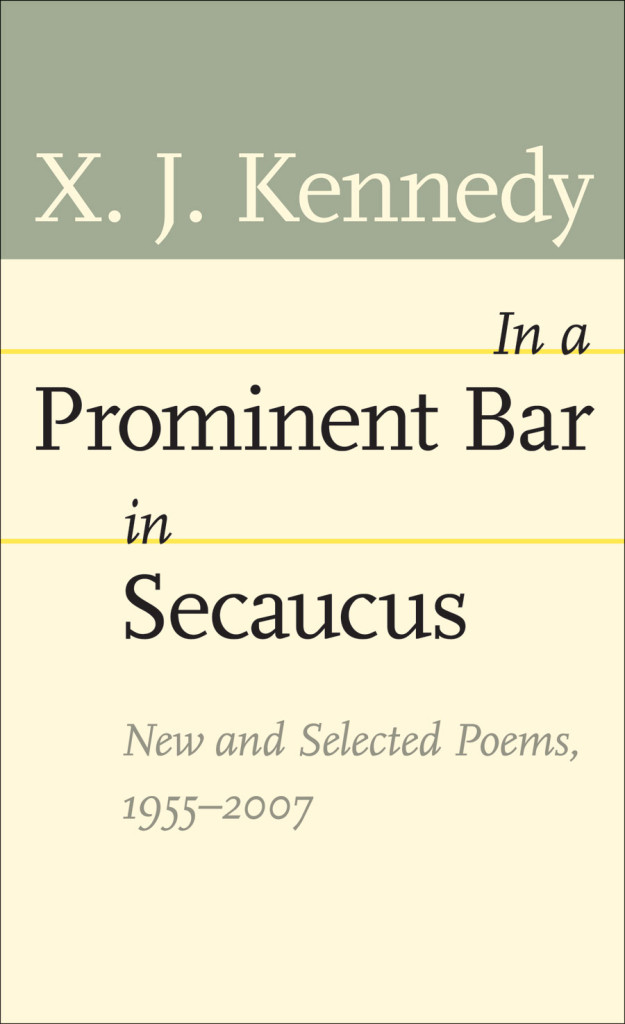
kennedy_rgbKennedy’s many books of poetry include Nude Descending a Staircase (1961), his first collection, which won a Lamont Award, Cross Ties, and The Lords of Misrule. In a Prominent Bar in Secaucus: New & Selected Poems (2007) was an American Library Association “Notable Book.” His most recent titles include Fits of Concision: Collected Poems of Six or Fewer Lines (2014) and a comic novel, A Hoarse Half-human Cheer (2015). He is the author of 24 children’s books.

In 2009, he received the Poetry Society of America’s Robert Frost medal. His work has appeared in the Atlantic, the New Yorker, the Paris Review, and Poetry, and others, as well as in 287 anthologies. He is also a former poetry editor for Paris Review. His awards include a Guggenheim fellowship, a National Endowment for the Arts grant, the Bess Hokin Prize for Poetry magazine, and a Los Angeles Times book prize. Kennedy has taught at the Universities of Michigan, North Carolina (Greensboro), and California (Irvine), as well as Wellesley, Tufts, and Leeds. On a more personal note, P&W writes: “He and Dorothy M. Kennedy have collaborated on two children’s books and five children. They sometimes host six grandchildren in Lexington, Mass.”

I always assumed the “X” stood for Xavier. What else could it be? Not so, according to P&W: the New Jersey-born poet was “irked by the hardship of having the name of Joseph Kennedy, he stuck the X on and has been stuck with it ever since.” He studied at my own alma mater, the University of Michigan, and also at Columbia.

Dana Gioia, who coauthored the textbook An Introduction to Poetry, said the award is “long overdue” – that was on someone’s Facebook page. I can’t find where he actually said that, but it sounds about right. The kudos are rolling around the social media – as an educator, editor, and mentor, he has been a champion of many (and one of mine, too – thank you, Joe!)

Poets & Writers will host a reading and reception in honor of Kennedy in May in New York City. Wish I could attend! Many of us will be there in spirit. Read his “The Purpose of Time is to Prevent Everything from Happening at Once” – one of my all-time favorites – over here.

“Poetry Out Loud” is ten years old – and California celebrates!

April 5th, 2015
Share
poetry-outloud6

Dana in Sacramento. (All photos Jay R. Hart)

Poetry Out Loud wasn’t an easy sell. When Dana Gioia, then chairman of the National Endowment for the Arts, first suggested a national high school poetry recitation competition a decade ago, state arts education departments dug in their heels. Kids hate poetry, he was told – besides, it’s too intellectual for the average students. Memorizing poetry? That’s repressive and “not creative” enough. (One rather wonders at the thinking – teenagers love performing, and all high-school plays involve memorization.) It’s since become perhaps the most successful and enduring legacy of Dana’s tenure at the NEA.

He finally persuaded all the states to give it a try, at least for a year. To perhaps everyone’s surprise except Dana, Poetry Out Loud was a stunning success, right from the outset. It soon had hundreds of thousands of American teenagers memorizing and reciting poems. The competition has now involved about two and a half million students. I can’t think of anything else on this scale in the U.S. to build a new audience for poetry. (Dan Stone, now editing Radio Silence, did much of the ground work in making the program national.)

Poetry Out Loud celebrated it’s tenth anniversary in Sacramento last month. Dana gave a talk at the state finals. The national finals take place next month in Washington, D.C. Meanwhile, a few photos from the Sacramento event.

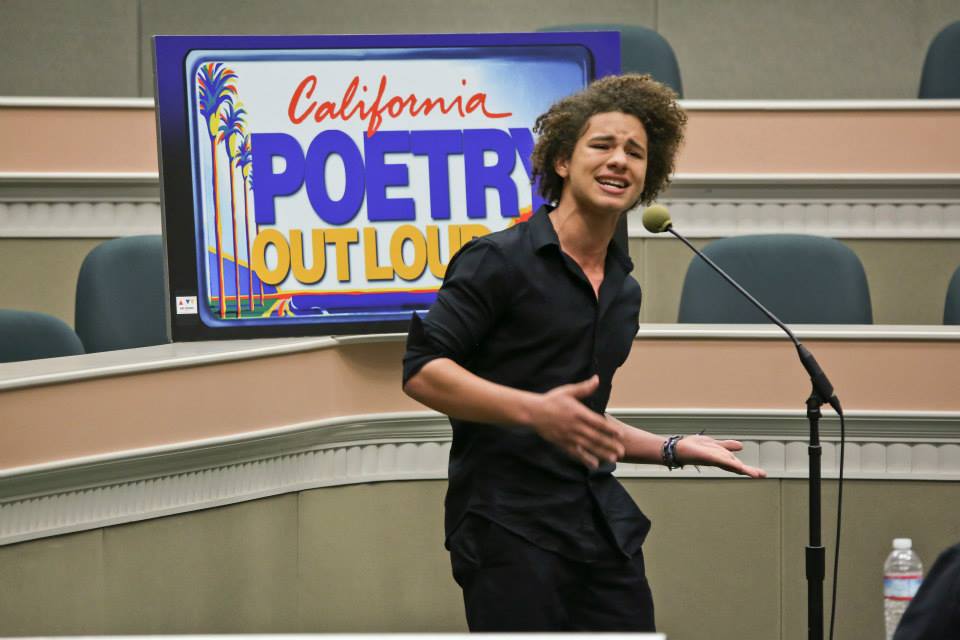
Top photo below: Dana Gioia, founder of Poetry Out Loud, speaking in Sacramento last month. On the second photo below, you can see state winner Levi Lowe gettin’ into it, as he recites Al Young‘s “The Blues Don’t Change.” Below that, Steve Hansen, recipient of the 2015 California Poetry Out Loud “Hero” Award, as best poetry teacher. And rounding out the picture: Shelly Gilbride, Arts Program Specialist; Dana Gioia, poet, critic, former NEA chair; Al Young, judge, poet, and former California poet laureate; state champion Levi Lowe; Craig Watson, director of the California Arts Council; and Jason Jong, arts program specialist. All photos by Jay R. Hart.

poetry-outloud3
poetry-outloud2
poetry-outloud4

<<< Previous Series of PostssepNext Series of Posts >>>