Kierkegaard on inexhaustible, indescribable love – and solitude, too.

March 16th, 2015
Share
Kierkegaard

A lovely man.

I recently dropped in on Martha and René Girard (I’ve written about him here and here and here) – and my visit pleasantly coincided with the visit of another friend, Randy Coleman-Riese, a Stanford alum. Somehow the conversation turned to philosophy, and Randy’s years at Stanford:

“In college I was introduced to the works of the Danish philosopher Søren Kierkegaard. In the preface to his book Works of Love I read this:

‘These are Christian reflections; therefore they are not about love but about the works of love.

‘These are reflections on the works of love – not as if hereby all love’s works were mentioned and described – far from it, nor even as if a single one described were described once and for all – God be praised, far from it! That which in its vast abundance is essentially inexhaustible is also essentially indescribable in its smallest act, simply because essentially it is everywhere wholly present and essentially cannot be described.’

“In this book Kierkegaard reflects on the strangeness, yet appropriateness, of being commanded to love – on the Christian duty to love – to love God, to love our neighbor, and to love ourselves. While this is certainly not romantic, he believes it is what saves the Christian from despair. It saved me. (Aspects of this despair can be seen in the current movie Birdman which involves the Raymond Carver short story ‘What we talk about when we talk about love.'”

IMG_20150307_142658

All mine.

Well, I’ve killed the punchline somewhat – he wrote a Valentine’s Day blog post about it here. When I went home I googled a bit on Kierkegaard, and found the portrait at right. I also found the anguished story of his broken engagement with Regine Olsen – the encounter changed both their lives, but apparently, he didn’t impress everyone. Hans Brøchner wrote in 1836: “I found [his appearance] almost comical. He was then twenty-three years old; he had something quite irregular in his entire form and had a strange coiffure. His hair rose almost six inches above his forehead into a tousled crest that gave him a strange, bewildered look.” Well, I think he’s rather lovely.

I also found that his Works of Love had occupied another blog, two years ago, with these passages:

“From whence comes love, where does it have its origin and its source; where is the place, its stronghold, from which it proceeds? Certainly this place is hidden or is in that which is hidden. There is a place in a human being’s most inward depths; from this place proceeds the life of love, for ‘from the heart proceeds life’…

“…The hidden life of love is in the most inward depths, unfathomable, and still has an unfathomable relationship with the whole of existence. As the quiet lake is fed deep down by the flow of hidden springs, which no eye sees, so a human being’s love is grounded, still more deeply, in God’s love. If there were no spring at the bottom, if God were not love, then there would be neither a little lake nor man’s love. As the still waters begin obscurely in the deep spring, so a man’s love mysteriously begins in God’s love.”

Lost love.

Lost love.

Quotes taken from Manifest Propensity: Thoughts for Deposed Royalty here.

Last week, I had an unexpected package at the Stanford post office: Randy had performed a little act of love himself – or at least one of kindness. He sent me my own copy of Kierkegaard’s Works of Love – so now I don’t have to hunt around the blogosphere. In a perverse spirit, let me quote a passage of my own finding, which is not about love:

“It is a frightful satire and an epigram on the temporality of the modern age that the only use it knows for solitude is to make it a punishment, a jail sentence. How different from the time when – however worldly-minded temporality has always been – people believed in the solitude of the cloister, when they honored solitude as the highest, as a qualification of the eternal – and nowadays it is detested as a curse and is used only as a punishment for criminals. Alas, what a change!”

And that was written in 1847, long before the 24/7 din of the worldwide web!

Yalom’s Cure: Stanford’s famous psychotherapist onscreen – and it’s fun!

March 12th, 2015
Share
-1

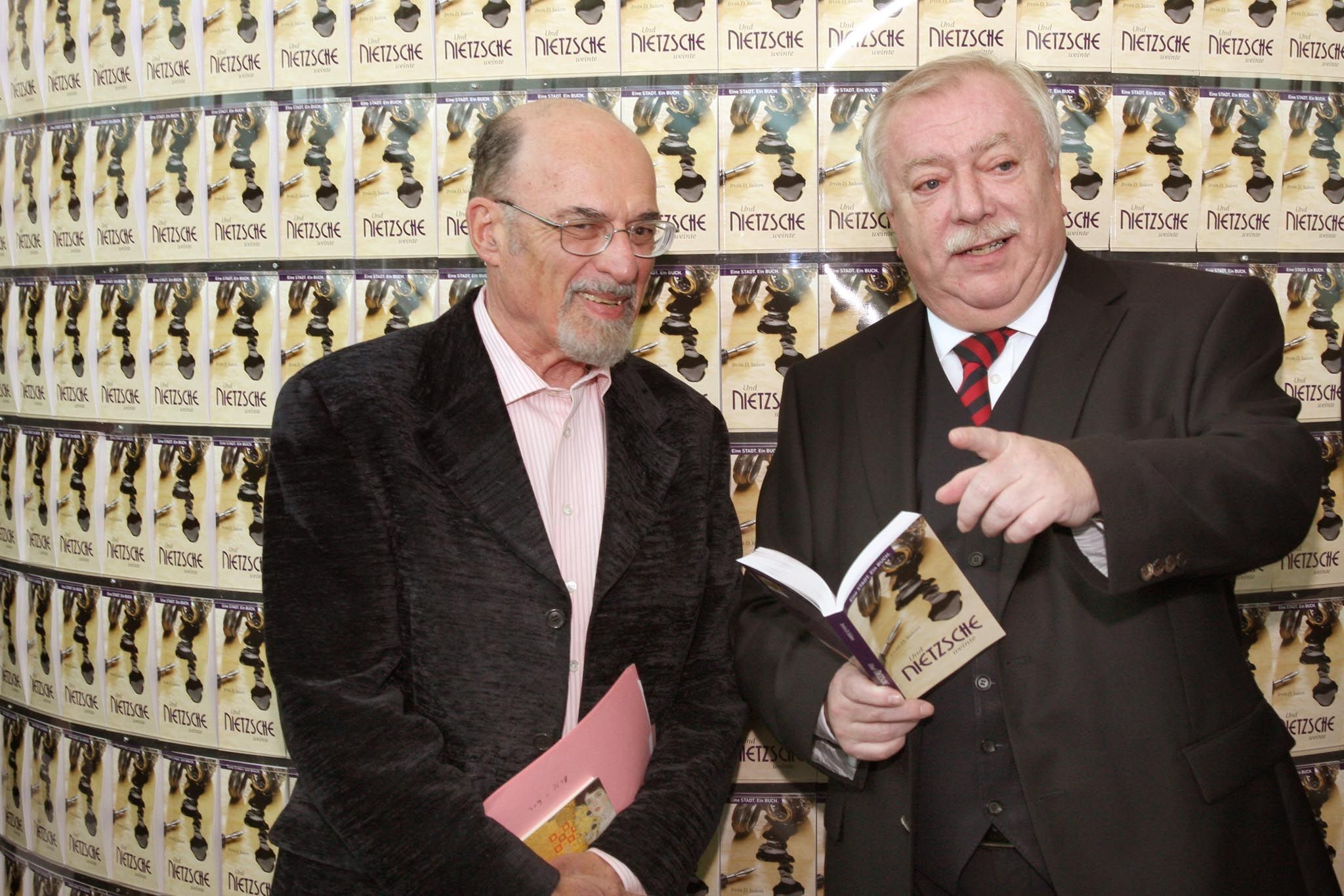
With Vienna’s mayor Michael Häupl in 2009 – and lots and lots of his books

André Malraux once asked a parish priest who had listened to confessions for half a century what he had learned about mankind. On the first page of his 1968 Anti-Memoirs, the French writer recorded the priest’s reply: “First of all people are much more unhappy than one thinks…and then the fundamental fact is that there is no such thing as a grown up person.”

Not a bad starting point for this week’s Stanford premiere of Yalom’s Cure, an hour-long film about Irvin Yalom, one of the world’s most celebrated existential psychotherapists. Irv is now a well-known author as well, leveraging psychology into literature with Love’s Executioner and Other Tales of Psychotherapy, When Nietzsche Wept, The Schopenhauer Cure, The Spinoza Problem, and others. (We wrote about the Viennese “Eine Stadt. Ein Buch” celebration of his book here and here – 100,000 copies of When Nietzsche Wept were distributed throughout Vienna.)

yalom3

The Yaloms enjoying Vienna’s Freud Museum.

Stanford’s Irv was obviously guest of honor for the screening, along with his wife Marilyn Yalom, one of the founders of the Clayman Institute for Gender Research and author of the acclaimed How the French Invented Love – which, I’m told, is as big a hit in France as it has been on this side of the Atlantic. (We wrote about it here and here and here.) The screening was also attended by a number of Stanford luminaries we’ve written about – among them Gerhard and Regina Casper, John and Mary Felstiner, Myra Strober, Marguerite Frank, and also Georgia May, widow of the eminent existential psychologist Rollo May.

Writer/director Sabine Gisiger and her film crew filmed hundreds of hours of the Yaloms and their family – the result? “This movie is making me squirm. I feel very exposed,” the good doctor said. But I came to the event cold, with no expectations, and was both exhilarated and moved by the film, which premiered in Zurich and already has been featured in San Francisco and Mill Valley film festivals. For locals, it features an awful lot of Stanford and Palo Alto, and brought back memories of my previous visits to their idyllic Palo Alto home… well, I didn’t need much in the way of memory… I had visited a few days ago.

The doctor turns 84 this June, and said that facing death has been a “long odyssey… I’m much less terrorized by it.” He explained part of his attitude towards psychotherapy with Thomas Hardy‘s words: “If way to the better there be, it exacts a full look at the worst.”

Don’t be puzzled by the German. The trailer is in English. Want the whole movie? Try here.

A minute’s silence? Try an hour: Billie Whitelaw and Beckett

March 10th, 2015
Share
whitelaw2

Ta very much, Billie.

One among the many attractions of living in London is getting a chance to see some of the world’s leading actors onstage – and so I was introduced to the legendary Billie Whitelaw as Andromache in a brilliant 3-night Sir Peter Hall/John Barton Royal Shakespeare Company production, The Greeks. Her powerful performance seemed rooted to the center of the earth. Whitelaw, best known for her work with Samuel Beckett, who wrote several roles for her, remained my favorite actress. She  was too little-known and appreciated in the U.S., so my chances to see her again were few (she appeared in The Omen and Hitchcock‘s Frenzy, but I don’t do horror films – the daily news is bad enough).

In the lead-up to Christmas, I hadn’t noticed that she quietly passed away in London on December 21. From The Guardian obituary:

Speaking in 1997, she said that death held no fear for her. “Death’s not one of those things that frighten the life out of me. Getting up on stage with the curtain going up frightens me more. I very often wake up at two in the morning with my stomach going over. Sometimes it’s difficult to work out why – it’s all the things you’ve put to one side during the day,” she told the Independent.

BillieWhitelaw

Ashamed of the good life.

During the war, her family moved from her native Coventry to Bradford to escape German bombing of the latter. Her father died of lung cancer when she was aged 10 and the family struggled for money at times.

Speaking about the stark difference between her relatively comfortable later life and her childhood, she said: “It’s something I haven’t come to terms with – I’m rather ashamed of having the good life I have.”

“Sad to see Billie Whitelaw has died,” tweeted comedian Robin Ince. “I’d suggest a minute’s silence, but I imagine Beckett would suggest it should be much longer than that.”

Below, her landmark performance in Beckett’s Happy Days (read about the Stanford performance here). This grainy video is taken from a production directed by Beckett himself, with Leonard Fenton as Willie.  Act II is here.  And thanks to George Szirtes for alerting me to this video.


Heirs of history – or its orphans? Michael Krasny in conversation with Robert Harrison

March 7th, 2015
Share

Robert Harrison on radio (Photo: L.A. Cicero)

Neoteny. It’s a word that combines two Greek roots: neos, meaning new or young; teinein, meaning to stretch or retain. In evolutionary biology, it’s “a general slowing of the rate of development that makes it possible to retain juvenile features in later stages of the life cycle,” writes Robert Pogue Harrison in his new book Juvenescence (we’ve written about it here and  here and here). “We don’t know if society can survive on genius alone without wisdom,” said Robert during a recent radio interview. “We may be on cusp.”

He spoke with Michael Krasny on KQED’s “Forum” (listen to it here), arguing that as the world gets older and the millennia stack up, we nevertheless have become younger than all previous generations – a very difficult paradox, he says.

Like Robert, I have pondered neoteny in our culture. We live longer and longer, on average – but have we had any net gains for human wisdom? Lately I’ve wondered if the added years are simply chunked onto a prolonged adolescence and youth. Education continues into one’s twenties and beyond. People wait till their forties and even fifties to have children. Old age has become a prolonged period of taxidermy.

michael-krasny

KQED interlocutor

Still, we’re under the illusion that more time means better life, a greater fulfillment of potential. Does it? Mozart didn’t require middle age to finish his work (well, not much of it – he died at 45), John Keats completed his oeuvre at 25 – both relied on the youthful fire of genius. But what of the balancing wisdom of age? As Silicon Valley strives to extend our lifetimes to the brink of immortality (no doubt only prime specimens will be selected for the honor) – what kind of society will it yield, when the gravitas that traditionally comes with maturity is eschewed in favor of a fevered quest for the trappings of youth?

“I don’t deny that Silicon Valley high tech is every day changing our way of being in the world,” Robert said in the interview. But both he and Krasny  pointed out that the most highly touted “revolutionary” changes wrought by Silicon Valley are often producing … well … sophisticated toys and doodads.  A new app for local restaurants, for example. The trade-off should cause reflection, Robert said, for we’re increasingly passing our “reality” through the screen of a smartphone. Social media? I’m on Twitter, too, but I realize that it’s driven by a world of children – for teenagers with time on their hands, tweeting their grumbles about school lunches. We can never keep up. In the face of dizzying change, “we need a certain amount of inter-generational stability,” Robert said. Good luck with that. In a world of toys, who wants to be a grown-up? What’s the payoff?

Hey baby, it's you.

Hey baby, it’s you.

I recall  of comedy in the early 60s, the era of the beach party movies and others of that ilk, where you have fun, fun, fun till your daddy took the t-bird away. A staple comedic figure in these films would be a guy who had a title like “Dean of Students,” balding and a little stout and stuffy. He’d burst into the students’ dorm rooms where the girls in bikinis were partying with the boys. Arms akimbo, he’d open his mouth to raise his voice in outrage – and bam! – a bucket of slops prepared for a nerdy student would empty on his head instead. Laughter for all.

As I grew up, I realized what an essential figure the Dean of Students is – and not just for comedy. Somebody had to be the authority figure to say no. Somebody had to be willing to make themselves the figure of fun and face the ridicule of reckless youth, that hasn’t yet learned of the big pricetag attached to early decisions. It’s a thankless role – but part of a grown-up is not waiting for thanks or some sort of payoff to do what needs to be done. Maybe that’s words like “duty” have passed out of our rituals of praise – duty is a drag.

My father used to say that kids don’t need a dad to smoke marijuana with – they’ll find those buddies on their own. (Actually, his example was “to learn to skate,” not marijuana, but still…) Kids need parents to make sure they do their homework, are kind to animals, and can eat without revolting other people. They need grandparents for the lessons of time. Instead, our media regularly shows us a series of elderly women (cough, cough, Helen Mirren, Madonna) in bikinis, to prove to us they can still “get away with it” – and regularly features the masks of famous Hollywood zombies who have had so much surgery that they are now unrecognizable. In that sense, every Oscar ceremony is a “Night of the Living Dead.” This is what maturity offers us – the opportunity to compete with youth.

Who wants to be an adult? Growing up outside Detroit, the new Mrs. Henry Ford II, the Italian socialite Christina Ford regularly filled the local newspaper pages – her husband, in fact, rather resembled the Dean of Students in those beach party movies. I remember my mother reading one article where the forty-something Mrs. Ford lamented the disappearance of the Italian mamas of her youth, the thick-waisted, enveloping women in shapeless black dresses, who always had something wonderful about to pop out of the oven. My mother hooted with derisive laughter. “She’s supposed to be one of those women!” And well, you can see from the Life cover above.

juvenescenceWhich is not an argument in favor of wearing shapeless black rags. The emphasis on wishing to be mothered, rather than wishing to mother – the wish to be loved, rather than exposing oneself to the great suffering that loving often entails – makes me wonder. What became of maturity, and eventually the graceful surrender to time? There’s a great freedom in not needing to be cool. The evening by the fireside with conversation and port instead of the evening with the trophy bride and papparazzi. (Cough, cough, Salman Rushdie – we wrote about that here.) In our public and political life, many keep calling for a Churchill – but would we want one if we could find one, and would we recognize one if we saw one?

So does that mean that we are all in the throes of adolescence, that we are all young? Not really, says Robert. “We’re a youth-worshiping society,” and yet “our society is waging pitiless war against the condition of youth, which requires idleness, shelter, freedom to fail, full-bodied relationship to nature.” It also requires “the freedom to pursue idiosyncratic call of the self, which requires disconnection from the noise of collective. It bears fruit later in human relations. We have made it more difficult to be truly young.”

Robert recalled leafing through his father’s school yearbook – the teenagers were “fully grown adults – youngish, but fully grown adults. I hardly see that in my undergraduates today.” Similarly, the faces of boys in developing countries who look like “weathered, fully formed adults. Dignfiied, majestic, senile traits – in the First World, we hardly ever acquire them.” Senile, that is, in the classic OED sense – “characteristic or caused by old age” opposed to puerile, “like a boy.”  Our older people crave youth, and our youth are born into a vacuum. Are we the heirs of history – or its orphans?

A passage from his book:

“…neoteny resists the tyranny of legacy. To delay the rate of development entails not only a reluctance to grow up but a reluctance to reproduce a fixed and senile form that links us to ancestry by the laws of repetition and identity. In that regard neoteny gives humans a greater species freedom, both from the genetic dictates of the past and for new, as yet unrealized, possibilities. By holding on to the plasticity of youth for much longer periods, and in some cases throughout our entire lives, we have expanded our evolutionary options considerably, becoming over time a lighter, freer, more agile, and adventuresome species. In short, a more intelligent and youthful species. Or better, a more intelligent – because more youthful – species.

“The Ode on Man in Antigone offers us a glimpse into the more terrifying side of this youthful openness to wonder, discovery, and knowledge of the world. The determination to boldly go where no one has gone before takes us to the moon and into the arcana of chromosomes; it gives us the microchip and the atom bomb. Yet for all the novelties it has brought into the world since Sophocles composed the ode, there is one part of the ongoing human story that doesn’t change. Even if our youthful intelligence one day succeeds in rendering death optional rather than necessary, what the chorus says about anthropos will remain true: ‘everywhere journeying, inexperienced and without issue, he comes to nothingness.’ Thus, if our genius derives from our reluctance to grow up, our wisdom derives from our heightened awareness of death … it is when the two work together – and not one against one another – that human culture flourishes.”

Listen to the Robert Harrison interview on Michael Krasny’s “Forum” here.


Join us tonight for James Baldwin’s The Fire Next Time!

March 5th, 2015
Share

baldwin-poster-EMAIL4

James Baldwin: “You want to write a sentence as clean as a bone. That is the goal.”

March 3rd, 2015
Share
Baldwin

March on Washington, 1963. With Marlon Brando, Charlton Heston, Harry Belafonte, Sidney Poitier.

James Baldwin was an eminent essayist, novelist, and playwright – but he was also a master of the Q&A interview. Perhaps his 1984 Paris Review interview was his best, with interviewers Jordan Elgrably and George Plimpton (read the whole thing here). We include some excerpts below.

May this post serve as a reminder that this Thursday, March 5, at 7:30 p.m., the Another Look book club will feature a discussion of Baldwin’s incendiary The Fire Next Time (1963) at the Bechtel Conference Center at Encina Hall at 616 Serra Street on the Stanford campus. Another Look discussions are free and open to the public, with no reserved seating. The discussion will be moderated by Michele Elam, professor of English, with Harry Elam, vice provost for undergraduate education, and acclaimed author Tobias Wolff, professor of English and the founding director of Another Look. Michele Elam is a widely published authority on race and culture; Harry Elam is a leading scholar of African American theater and performance.

Now here are the excerpts from The Paris Review.  In the first passage, the interview asks Baldwin about his flight to France, where he eventually died at his home in Saint-Paul de Vence in 1987:

INTERVIEWER: Why did you choose France?

BALDWIN: It wasn’t so much a matter of choosing France—it was a matter of getting out of America. I didn’t know what was going to happen to me in France but I knew what was going to happen to me in New York. If I had stayed there, I would have gone under, like my friend on the George Washington Bridge.

INTERVIEWER: You say the city beat him to death. You mean that metaphorically.

BALDWIN: Not so metaphorically. Looking for a place to live. Looking for a job. You begin to doubt your judgment, you begin to doubt everything. You become imprecise. And that’s when you’re beginning to go under. You’ve been beaten, and it’s been deliberate. The whole society has decided to make you nothing. And they don’t even know they’re doing it.

INTERVIEWER: Has writing been a type of salvation?

BALDWIN: I’m not so sure! I’m not sure I’ve escaped anything. One still lives with it, in many ways. It’s happening all around us, every day. It’s not happening to me in the same way, because I’m James Baldwin; I’m not riding the subways and I’m not looking for a place to live. But it’s still happening. So salvation is a difficult word to use in such a context. I’ve been compelled in some ways by describing my circumstances to learn to live with them. It’s not the same thing as accepting them.

INTERVIEWER: Was there an instant you knew you were going to write, to be a writer rather than anything else?

James_Baldwin

“Claim it all – including Shakespeare.” (Photo: Allan Warren)

BALDWIN: Yes. The death of my father. Until my father died I thought I could do something else. I had wanted to be a musician, thought of being a painter, thought of being an actor. This was all before I was nineteen. … My father didn’t think it was possible—he thought I’d get killed, get murdered. … He died when his last child was born and I realized I had to make a jump—a leap. I’d been a preacher for three years, from age fourteen to seventeen. Those were three years which probably turned me to writing.

INTERVIEWER: Were the sermons you delivered from the pulpit very carefully prepared, or were they absolutely off the top of your head?

BALDWIN: I would improvise from the texts, like a jazz musician improvises from a theme. I never wrote a sermon—I studied the texts. I’ve never written a speech. I can’t read a speech. It’s kind of give-and-take. You have to sense the people you’re talking to. You have to respond to what they hear.

INTERVIEWER: Do you have a reader in your mind when you write?

BALDWIN: No, you can’t have that.

INTERVIEWER: So it’s quite unlike preaching?

BALDWIN: Entirely. The two roles are completely unattached. When you are standing in the pulpit, you must sound as though you know what you’re talking about. When you’re writing, you’re trying to find out something which you don’t know. The whole language of writing for me is finding out what you don’t want to know, what you don’t want to find out. But something forces you to anyway. …

INTERVIEWER: Was there anyone to guide you?

Dostoevskij_1872

Baldwin’s teacher – or one of them.

BALDWIN: I remember standing on a street corner with the black painter Beauford Delaney down in the Village, waiting for the light to change, and he pointed down and said, “Look.” I looked and all I saw was water. And he said, “Look again,” which I did, and I saw oil on the water and the city reflected in the puddle. It was a great revelation to me. I can’t explain it. He taught me how to see, and how to trust what I saw. Painters have often taught writers how to see. And once you’ve had that experience, you see differently.

INTERVIEWER: Do you think painters would help a fledgling writer more than another writer might? Did you read a great deal?

BALDWIN: I read everything. I read my way out of the two libraries in Harlem by the time I was thirteen. One does learn a great deal about writing this way. First of all, you learn how little you know. It is true that the more one learns the less one knows. I’m still learning how to write. I don’t know what technique is. All I know is that you have to make the reader see it. This I learned from Dostoevsky, from Balzac.

***

INTERVIEWER: “One writes out of one thing only—one’s own experience,” you’ve said.

BALDWIN: Yes, and yet one’s own experience is not necessarily one’s twenty-four-hour reality. Everything happens to you, which is what Whitman means when he says in his poem “Heroes,” “I am the man, I suffered, I was there.” It depends on what you mean by experience.

***

INTERVIEWER: You were in utter despair after the death of Martin Luther King Jr. Did you find it difficult to write then, or do you work better out of anguish?

BALDWIN: No one works better out of anguish at all; that’s an incredible literary conceit. I didn’t think I could write at all. I didn’t see any point to it. I was hurt . . . I can’t even talk about it. I didn’t know how to continue, didn’t see my way clear.

***

INTERVIEWER: Is there a big shifting of gears between writing fiction and writing nonfiction?

BALDWIN: Shifting gears, you ask. Every form is difficult, no one is easier than another. They all kick your ass. None of it comes easy. …

INTERVIEWER: But the essay is a little bit simpler, isn’t it, because you’re angry about something which you can put your finger on . . .

Martin_Luther_King_Jr_NYWTS

“I was hurt … I can’t even talk about it.”

BALDWIN: An essay is not simpler, though it may seem so. An essay is essentially an argument. The writer’s point of view in an essay is always absolutely clear. The writer is trying to make the readers see something, trying to convince them of something. In a novel or a play you’re trying to show them something. The risks, in any case, are exactly the same.

INTERVIEWER: What are your first drafts like?

BALDWIN: They are overwritten. Most of the rewrite, then, is cleaning. Don’t describe it, show it. That’s what I try to teach all young writers—take it out! Don’t describe a purple sunset, make me see that it is purple.

INTERVIEWER: As your experience about writing accrues, what would you say increases with knowledge?

BALDWIN: You learn how little you know. It becomes much more difficult because the hardest thing in the world is simplicity. And the most fearful thing, too. It becomes more difficult because you have to strip yourself of all your disguises, some of which you didn’t know you had. You want to write a sentence as clean as a bone. That is the goal.

***

INTERVIEWER: Yes, before 1968, you said, “I love America.”

BALDWIN: Long before then. I still do, though that feeling has changed in the face of it. I think that it is a spiritual disaster to pretend that one doesn’t love one’s country. You may disapprove of it, you may be forced to leave it, you may live your whole life as a battle, yet I don’t think you can escape it. There isn’t any other place to go—you don’t pull up your roots and put them down someplace else. At least not in a single lifetime, or, if you do, you’ll be aware of precisely what it means, knowing that your real roots are always elsewhere. If you try to pretend you don’t see the immediate reality that formed you I think you’ll go blind. … I believe what one has to do as a black American is to take white history, or history as written by whites, and claim it all—including Shakespeare.




<<< Previous Series of PostssepNext Series of Posts >>>