No money for the arts? Remembering Britain during the Blitz…

February 13th, 2015
Share
J.B. Priestley: one of the best-known voices during the Blitz

J.B. Priestley: one of the best-known voices during the Blitz

“University officials talk endlessly about how hard the financial times are and say that’s why they can’t fund anything but the flashy hardware for the wet and hard sciences. I’m sure that’s true, but I’m not convinced we can just say that and fold. We make choices. Great Britain started its Arts Council during the Blitz. The Nazis bombed British cities every day and while it was going on the Brits worked diligently to make music, theater, poetry and painting available to more and more people. Their notion was, if you just dig in and hide in your bunker, then the Nazis win. Screw the Nazis, the Brits said, we like music and we are going to have music. And they had music. Things happen when there’s the imagination and courage to make music happen.

“I’ve been tap dancing around the past here, but the past is only good for how it helps us see today and get ready for tomorrow. I keep thinking of the line from Kierkegaard that Jerome Groopman quoted in one of his wonderful medical stories in the New Yorker: ‘It is perfectly true, as philosophers say, that life must be understood backward. But they forget the other proposition, that it must be lived forward.'”

– Prof. Bruce Jackson, State University of New York at Buffalo


The book that rocked a nation: Another Look takes on James Baldwin’s The Fire Next Time. Join us on March 5!

February 10th, 2015
Share
Portrait

The 1963 Civil Rights March on Washington, with Charlton Heston, Marlon Brando, Sidney Poitier, and Harry Belafonte.

In the last year, the killings of black youth have sparked protests and violent clashes with police across the nation, putting racial justice in the headlines. Next month, the Another Look book club will reflect on these issues with a public discussion of James Baldwin’s 1963 The Fire Next Time, the author’s scathing, yet compassionate, reflections on the consequences of America’s racial inequities.

The event will take place at 7:30 p.m. on Thursday, March 5, at the Bechtel Conference Center at Encina Hall on Serra Street. Another Look discussions are free and open to the public, with no reserved seating.

The discussion will be moderated by Michele Elam, professor of English, with Harry Elam, vice provost for undergraduate education, and acclaimed author Tobias Wolff, professor of English and the founding director of Another Look. Michele Elam is a widely published authority on race and culture; Harry Elam is a leading scholar of African American theater and performance.

baldwin-bookMichele Elam, who will moderate the event on the novelist, playwright, essayist and activist, said that she selected the The Fire Next Time“because its urgent insistence that black lives matter is as poignantly relevant today as it was in the civil rights era.” Elam, whose Cambridge Companion to James Baldwin will be out this month, added that “The Fire Next Time offers some of his most cogent and searing insights into race, power, and love in America.”

Read the full Stanford Report article here or click the link below.

The book has two parts: Baldwin’s essay, “Down at the Cross: Letter from a Region in My Mind,” which originally ran in the New Yorker, and also “My Dungeon Shook: Letter to My Nephew on the One Hundredth Anniversary of the Emancipation,” a shorter piece that Elam called “a meditation on the fragility of black boyhood.”

Baldwin wrote to his nephew of the hundreds of thousands of lives destroyed, and his countrymen “do not know it and do not want to know it. He added, “But it is not permissible that the authors of devastation should also be innocent. It is the innocence which constitutes the crime.”

He claimed in the longer essay that white men project their fears and their longings onto African Americans. “The only way he can be released from the Negro’s tyrannical power over him is to consent, in effect, to become black himself, to become part of that suffering and dancing country that he now watches wistfully from the heights of his lonely power and, armed with spiritual traveller’s checks, visits surreptitiously after dark.”

Baldwin was born in Harlem in 1924, the first of nine children. He never knew his biological father, but his stepfather was a harsh preacher. At school he studied with Countee Cullen, a leading figure in the Harlem Renaissance, and worked on the high school magazine with Richard Avedon, who would become a world famous photographer. The book dwells briefly on his precocious and brief teenage career as an evangelical preacher. He moved to Greenwich Village at 17 to be a writer. A British television journalist recalled that when he started his career he was black, impoverished and homosexual – how disadvantaged can you get? “No, I thought I hit the jackpot,” he said, grinning. Then after the laughter subsided, added, “It’s so outrageous you could not go any further, so you had to find a way to use it.”

He hit the jackpot. (Photo: The Granger Collection)

He hit the jackpot. (Photo: The Granger Collection)

Use it he did. He wrote than a score of fiction and non-fiction works, including novels, essays, and plays. The Fire Next Time sold more than a million copies, and put Baldwin’s face on the cover of Time magazine. The award-winning author was a popular speaker – lively, epigrammatic, scathingly witty, passionate and deeply humane. He eventually settled in the south of France, where he was named a Commander of the Legion of Honor the year before his death of cancer in 1987.

The Fire Next Time is one of the great books of the last century,” said Wolff, who teaches the book every fall. “With forensic calm born of rage, Baldwin performs an autopsy on the self-flattering myths by which we blind ourselves to the radical injustices of our society,  even as we congratulate ourselves on its moral superiority. Grounded in historical and personal experience, relentlessly logical, his words burn as hot today as when they left his pen.”

Certainly the book changed minds and lives. When he was still a graduate student, Bob Fitch, who currently has a photography exhibit spotlighting the Civil Rights era at the Stanford University Libraries spent all night reading the book and the next day bought a camera and began photographing the Civil Rights movement. A few years later, at an informal staff meeting held in Martin Luther King’s bedroom, he saw The Fire Next Time among the leader’s rumpled bedsheets. King told the young photographer that the book had inspired his own 1967 book, which would be his last, Where Do We Go From Here – Chaos or Community? The Green Library exhibition continues through March 18.

Stanford Bookstore, Kepler’s in Menlo Park, and Bell’s Books in Palo Alto have copies ofThe Fire Next Time.

***

The “Another Look” book club focuses on short masterpieces that have been forgotten, neglected or overlooked – or may simply not have gotten the attention they merit. The selected works are short to encourage the involvement of the Bay Area readers whose time may be limited. Registration at the website anotherlook.stanford.edu is encouraged for regular updates and details on the selected books and events. Another Look also invites readers far away to join us in reading the book, and to send us comments. Podcasts of previous events are on the website.

Afrikaans author André Brink, 1935-2015: Remembering a conversation long ago in London

February 8th, 2015
Share
640px-André_Brink_Portrait

Not what he looked like then. (Photo: Seamus Kearney)

André Brink, the Afrikaans author banned during the apartheid era, died Friday, February 6, after he became fatally ill during a flight from Amsterdam to his native South Africa. He had just received an honorary doctorate in Belgium.

I interviewed him in London, way back in the late 1970s, when I was working on Fleet Street. He was already an an awarded and acclaimed author, and already censored in South Africa. He was rather good-looking in a way I can’t find in any of the photos of him. Not craggy, as he was to become, nor with the bushy mop of hair he would acquire in the 80s. He was rather a “square” –  clean cut, professional, in a business suit. But his stories about being a banned writer were anything but square. He was continually watched by the security police, his phone tapped, and his mail intercepted and occasionally stolen. My cover story on him may no longer exist anywhere, except perhaps in one of the boxes in the garage. I think his book Rumours of Rain had just come out – or perhaps he had just published his Looking on Darkness in English.

According to the New York Times, “Mr. Brink’s work was often cited alongside that of Nadine Gordimer and J. M. Coetzee as an exemplar of South Africa’s ability to transform the experience of harsh racial politics into literature with a global reach.”

From The Guardian:

He was born in 1935 in Vrede, a small town in the Free State and became famous for using Afrikaans to speak against apartheid. His novel Looking on Darkness, was banned by the apartheid government in 1974. His other works include Devil’s Valley, Before I Forget and Praying Mantis. The books An Instant in the Wind and Rumours of Rain were both shortlisted for the Booker prize.

After circulation of copies of Rumours of Rain was held up for six months by the South African authorities in 1978, Brink reverted to private distribution for A Dry White Season.

darkness

Hard work.

“We had a subscription list of those who had bought the earlier books,” he said the following year. “We sold about 4,000 copies that way.” After several months the censors gave approval to the book, also lifting a ban on Nadine Gordimer’s Burger’s Daughter, and it was released through formal publication channels.

Ten years later, Brando left retirement on Tahiti to take a small part in the film of A Dry White Season, which starred Donald Sutherland, Zakes Mokae and Susan Sarandon, and was banned in South Africa.

In 2012, Brink was again long-listed for the Man Booker prize for his slavery novel Philida.

His 1974 novel was the first book written in Afrikaans to be banned – so he translated it into English, thus Looking on Darkness launched his international reputation. And here’s the part of our conversation I do remember: I asked him what it was like to translate his own books into English. He said it was difficult, because Afrikaans was a young language and English a comparatively old one. In Afrikaans, you could express love and patriotism – and the emotions would be fresh and vital and new. But when tried to do the same thing in English, the effect would be overblown, hackneyed, and a little foolish. It was the difference between Shakespeare and Austen, he said. Shakespeare could express himself in English and he was inventing the world anew. Everything was possible. By the time Austen wrote, all the effects are understated. She achieves her effects by pulling back. (One reason why Darcy never makes his proposal to Elizabeth in her pages – it’s only the failed marriage proposals that are described in blow-by-blow detail.)

I’ve been thinking about what he said ever since. (And if I find the article in the garage someday, I’ll let you know.)


Quoting Diane Middlebrook

February 7th, 2015
Share

Quotable (Photo: Amanda Lane)

Brendan Boyle has written a review of Diane Middlebrook’s posthumous Young Ovid for the Wall Street Journal here, in a piece titled “Love and Other Crimes.” (And I’ve written about the book here and here.) My attention was immediately drawn to it because it leads with a line from my obituary for the celebrated biographer – here. The quote was taken from the unpublished bits of an interview I did with her in 2003, for my Stanford Magazine interview here.  Since obituaries typically aren’t chatty and first person-y, I didn’t mention my 2003 interview, and simply quoted her.

Here is the whole passage:

When asked several years ago why she picked Ovid as her subject, she responded with characteristic breeziness, “No estates, no psychotherapy, no interviews, no history—I just make it up.” She frequently pointed out that there is no historical record of Ovid’s life; all we know is in his poetry. In other words, the biographer is forced to rely on the text itself. Can literature be primary source? Her answer was always a resounding yes—especially evident in her biography of Hughes and Plath, a book that was called the “gold standard” on a contentious theme.

But later, Middlebrook would add that she was also attracted to “the remarkable confidence that Ovid had in his own survival.” At a Stanford address last January, Middlebrook noted, “The evidence inside his poetry is the key to this longevity. His voice comes to us like a plucked string, immediate and recognizable across two millennia…”

Why is there no attribution? Presumably Boyle picked it up from Wikipedia, which didn’t attribute the source, either. Nor did it credit me with this quotation from her obituary: “One of the reasons I like working on biographies is that it takes a long time,” she said. “You don’t have to work quickly. People are going to stay dead.”

middlebrook1

Redundant?

In my ham-fisted way, I’ve corrected the Wikipedia listings. Honestly, what is the point of doing interviews, trying hard to make the quotations accurate, transcribing recordings, which takes hours and hours … if people are going to treat what you’ve written as if it popped out of thin air? Boyle writes, “It’s the second half of the response that’s worrisome and surely can’t have been meant in earnest.” Well, of course it wasn’t. If he had gone to the article that included it, he would have seen that it was said with “characteristic breeziness.” She was being flippant. But he couldn’t. Because he was using Wikipedia, which didn’t list a source.

In any case, Boyle didn’t think much of the book, apparently, and what she said to me about “making it up” sealed her doom in his eyes, since he refers to that remark a lot. “The fictionalized interludes that Middlebrook herself writes do not add much and often have that florid, overripe air that descends upon so much writing about the ancient world.” He repeatedly makes it clear that “there is already a very fine account of Ovid’s life in Peter Green’s 1982 introduction to the Penguin edition of Ovid’s erotic poems.”  After recounting its virtues, he concludes, “All of this, and far more, is available in Mr. Green’s introduction, and no one looking for a sophisticated, compendious account of the poet’s life should search elsewhere.” Then why review this book at all?

Jean Genet’s “The Balcony” at the San Francisco Old Mint – tonight through February 21!

February 5th, 2015
Share
florentina5

Audrey Dundee Hannah and Jack Halton explore the Old Mint.

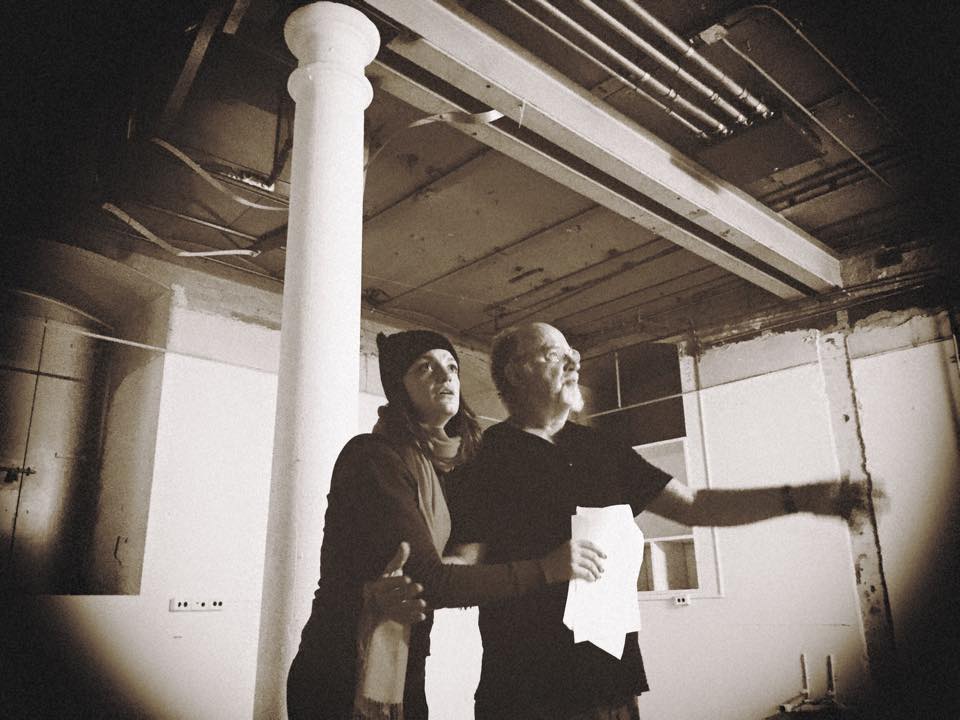
I received a note from actor-director Florentina Mocanu-Schendel a week or so ago, inviting me to the Collected Work’s new production of Jean Genet‘s The Balcony. It promises to be an unusual production. Here’s one reason why: it’s performed at the gloomy Old Mint in San Francisco – also known as the City’s “Granite Lady,” with its dark stone corridors and vaults. You can see at the two bottom photos exactly what I  mean, if the other photos don’t give you a feel for the place. (All photos, by the way, taken by Jamie Lyons, who co-directs the play with Michael Hunter.) The Granite Lady is a survivor, the only financial institution open for business after the 1906 earthquake. They thought it was an apt setting for a play about the struggle for institutional power.

florentina6

San Francisco’s cheery landmark.

The Balcony is about a revolutionary uprising in the streets of an unnamed city. While armed rebels fight to take control of the city’s power structures, most of the action takes place in a brothel or “house of illusions,” where clients act out their fantasies of institutional power: they play judges, biships, and generals as their counterparts in the “real” world struggle to maintain their authority.

Important voices had lots to say about the controversial classic: Genet’s biographer, the critic Edmund White, wrote that, with the foregrounding of illusion and meta-theatricality i creating contemporary power and desire, Genet invented modern theater.  The psychoanalyst Jacques Lacan described the play as the rebirth of the spirit of Aristophanes, while the philosopher Lucien Goldmann called it “the first great Brechtian play in French literature.” Martin Esslin has called The Balcony “one of the masterpieces of our time.”

Collected Works was founded in 2012 by a a group of theater directors, actors, and designers, mostly from the PhD program in drama at Stanford, where they had worked under the enlightened guidance of Carl Weber, who in turn had been the assistant director to Bertolt Brecht at the Berliner Ensemble. The San Francisco Weekly said the group is “hell-bent on bringing exceptional, experimental performance to the West Coast theater scene” – and in offbeat venues, too. Go here for more information.

We’ve written about Collected Works before, here, for it’s earlier production of Gombrowicz’s Princess Ivona. This one definitely sounds like it’s worth checking out. Go here for times and tickets.


florentina1

Right to left: Ryan Tacata (facing the wall) Scott Baker, Val Sinckler, and Florentina herself. (Photo: Jamie Lyons)

florentina7

Ryan Tacata has a nightcap, with Valerie Fachman.

florentina3

Val Sinckler ponders the script.

florentina2

Ryan Tacata finds a lot to ponder, too.

“I am dying, and that’s a helluva way of introducing the book of my greatest love”: Middlebrook’s posthumous Young Ovid; Djerassi’s last public appearance

January 31st, 2015
Share
×Ä

Last wishes fulfilled. (Photo: Amanda Lane)

Carl Djerassi had a way of stealing the show, and last week may prove, in retrospect, to have been no exception. The January 22 occasion was the launch of biographer Diane Middlebrook‘s posthumous book, Young Ovid: A Life Recreated (Counterpoint Press) a book that has taken seven years since the author’s death to find its way into book form. Last week’s event, at the fabulous Djerassi digs atop Russian Hill, will be known equally as Carl’s last public appearance. The eminent chemist who has been called “father of the pill” (surely a contradiction in terms) – and also an author, playwright, and founder of an artists’ colony – died yesterday of cancer at 91. It’s certainly appropriate that his final public appearance was a last salute to his late wife, who died of cancer in 2007.

According to Diane’s daughter, Leah Middlebrook, the posthumous book would not have come out with him. “He kept her alive and kept her distracted,” she recalled. She had reached a lowpoint in her long illness when she realized she would not be able to finish her book. Carl suggested a “Young Ovid” biography, and that gave her new life. She discussed the manuscript with Carl to the last days of her life. A pleasure as well as a duty, for Ovid was her lifelong passion. “Reading a page and a half will convince you her voice is still present with us,” said her daughter.

I bought a copy, available at the event courtesy Green Apple Books in San Francisco, and though I’ve only had a chance to cast a casual eye over it, it’s impressive, perhaps some of her best work. “It is Diane’s prose. It is Diane’s writing,” said Leah. It wasn’t easy. Middlebrook had continued writing until a month before her death. She conveyed to a circle of insiders her plans and intentions for the finished book. The execution finally rested in the hands of others – and the search of a publisher was a labor of its own. The New Yorker has already named it as one of their “Books to Watch Out For” here.

At the event last week, however, tribulations were forgotten amid plenty of champagne, plenty of brie, plenty of dolmas, and plenty of little bits of goat cheese wrapped in strips of fried zucchini, against the backdrop of what must be one of the most stunning views in a city full of them. I described it a dozen years ago (here) this way:

“The couple’s art interests are evident in their home, surely one of the most fabulous apartments in San Francisco. It occupies the entire 15th floor (they gradually absorbed four apartments) of an art-deco building on Green Street, atop Russian Hill. The elevator from the lobby opens onto blue walls meant to suggest a night sky, with poetry by Ovid, Paul Klee, Wallace Stevens, Basho, Hughes and others written across it in different scripts and languages and illustrated with zodiacal signs. To the left are living quarters; to the right, offices and the salon area, where the couple entertains. They enjoy a 360-degree view of the city.

(Photo: Isabella Gregor)

He liked this one. (Photo: I. Gregor)

“Middlebrook’s office features Eurodesign cabinets and built-in bookcases, with a computer desk and round work table. As in the hotel room, all is very neat, very well-organized—a Middlebrook cardinal virtue. A painted baroque ceiling, with blue, gray and plum-colored swirls, gives the impression the sky is right above you.

“Works of art by Klee, usually on the walls in the salon area, are currently on loan to San Francisco’s Museum of Modern Art, keeping company with the permanent Klee collection Djerassi donated. The couple has one of the world’s most significant private Klee collections.”

Much of the evening buzz over hors d’oeuvres was about Carl’s health – whispers that this would be his last public appearance, and so it was. (I still can’t believe that he won’t email me tomorrow with the photo he’d rather have me use for this farewell post – but the one I’m including is the one he preferred last time, so here it is again.) When Carl finally appeared and was helped to a chair at the front of the gathering he was startlingly thin, exceedingly frail, but erect and dignified, surprisingly present, altogether there. “Can you hear me back there? All of you back there?” he called. “I’m losing my voice, and I am losing my voice because I am dying, and that’s a helluva way of introducing the book of my greatest love.”

He had a slender, old-fashioned paperback – 1930s, Europe – on the small table next to his side as he spoke, and told his story about fleeing Austria with his mother in 1938 to escape the Nazis. “What would you take as a refugee? No furniture of any size, nothing heavy,” he recalled. Just clothing, pictures, and some books – and one of the books was this one – naturally, a book of Ovid. Heavy going for a teenager who had only four years of Latin, he admitted, but the relic from his past traveled with him to New York; Newark, New Jersey; the Midwest; Mexico; and California. It’s still with him. If he were writing a book, it would be framed as a prefiguration of the woman he would find towards the end of a journey – a woman whose lifelong passion was Ovid – and the book that would connect them at the end of both their lives.

middlebrook1“Diane, I want to tell you how important that book was to me that you finally finished,” he said.

Let the last words be hers, however. Her close friend Marilyn Yalom read, if not a page and a half, at least this part from the introduction to the book, turning on Ovid’s own words: “Throughout all ages,/if poets have vision to prophesy truth, I shall live.”

“To a biographer, Ovid’s declaration ‘I shall live’ can feel like a glove slapping a cheek across twenty centuries. Quite aside from its embarrassingly self-promotional aspect, the phrase can be dismissed as empty convention: Ovid’s most celebrated contemporaries incorporated lines like this in work of their own they most admired. But what if Ovid meant it? What could support a writer’s belief that works of poetry could be immortal and that his own was destined for this rare elevation?

“Biography is a medium for working out solutions to such puzzles. Yet Ovid is not an obvious candidate for biography; there is almost no documentation of Ovid’s life outside his poetry. The evidence inside his poetry is all we have to go on. But it is enough, for Ovid was an unusually autobiographical writer for his time. His voice comes toward us like a plucked string, immediate and recognizable across two millenia, partly because he made frequent use of an effective rhetorical strategy: accosting us readers as if we were present in the room with him. At one point he even calls us, his heirs, by name: ‘Who is this I you read … ?/You want to know, posterity? Then attend” (Tristia 4.10.1-2).




<<< Previous Series of PostssepNext Series of Posts >>>