My amazing Miłosz legs

October 28th, 2014
Share

legs3Can poetry matter? At a time when poetry is put on subway signs and the backs of buses, in a desperate attempt to show its relevancy to our times, I decided to vote with my feet. Or rather with my legs.

Okay, okay … I know it was a bit naff. But when I saw poet Molly Fisk‘s Facebook post about a woman in Israel who makes Emily Dickinson tights, I knew I had to have a pair. But given a choice among poems to choose … with myself as a sort of billboard… what could I do?

The international package arrived a few days ago from “Coline” in Netanya – elegantly wrapped and tied with a red ribbon. Black letters on dark gray tights, in a photo taken by my artiste daughter, Zoë Patrick. (Here’s the link for Coline’s magic tights – here.)

What did I choose? Who else but Nobel laureate Czesław Miłosz! It’s poet Jane Hirshfields favorite poem, and soon became one of mine – she reads and discusses the poem in the video below. Not the usual thing to have on one’s legs, admittedly but it’s a great poem for the middle-to-the-end of life, and a great poem as we roll into a California winter. So here’s what’s written on my legs (translation by Robert Hass):

Winter

The pungent smells of a California winter,
Grayness and rosiness, an almost transparent full moon.
I add logs to the fire, I drink and I ponder.

“In Ilawa,” the news item said, “at age 70
Died Aleksander Rymkiewicz, poet.”

He was the youngest in our group. I patronized him slightly,
Just as I patronized others for their inferior minds
Though they had many virtues I couldn’t touch.

And so I am here, approaching the end
Of the century and of my life. Proud of my strength
Yet embarrassed by the clearness of the view.

Avant-gardes mixed with blood.
The ashes of inconceivable arts.
An omnium-gatherum of chaos.

I passed judgment on that. Though marked myself.
This hasn’t been the age for the righteous and the decent.
I know what it means to beget monsters
And to recognize in them myself. …


Read the rest here. Or listen to Jane below:

Join us Monday night for the “Another Look” book club discussion of Calvino’s Cosmicomics!

October 26th, 2014
Share

19It’s here! On Monday night, October 27, Stanford’s “Another Look” book club will take on Italo Calvino‘s twelve science-inspired fantasies, Cosmicomics, with moderator Robert Pogue Harrison, joined by panelists Tobias Wolff and Humble Moi. The event begins at 7:30 p.m. at the Stanford Humanities Center at 424 Santa Teresa Street on the Stanford campus.

Award-winning author Tobias Wolff, who founded the group three years ago, said that the book club is Stanford’s “gift to the community.” Hence, the Another Look book club  is open to all members of the public, as well as Stanford’s students, staff, and faculty. Not only can everyone attend, but we positively want you to come to our first event in the third season. The event is free, but come early, because seats are available on a first-come basis.

We’ve written about the Calvino event already here and here and here. There’s even more at the Another Look website here.  The only missing piece right now is you. Join us!

calvino-postermockup5


Nobelist Wisława Szymborska on “work as one continuous adventure”

October 24th, 2014
Share
May in Kraków – must they be compared?

When I saw her Kraków, with poet Julia Hartwig (at right) – in May 2011

An embarrassingly long time ago, someone from the Adam Mickiewicz Institute’s online magazine, Culture.pl, wrote to bring my attention to a recent post about Wisława Szymborska and her “9 Secret Sides” – I’ve written about the poet here and here, but not much since. I liked this story about getting the Nobel Prize, though I’m not sure how “secret” it is. In Kraków, I spoke to the friend, Michał Rusinek, who “cut the cord,” literally, after the announcement was made, severing her endlessly ringing telephone line with a pair of scissors. Anyway, from the website:

“Szymborska was notoriously private and rarely gave interviews. It is thus not surprising that she met the sudden global recognition thrust upon her with the awarding of the Nobel Prize for Literature in 1996 with great hesitancy, calling it the ‘Stockholm Tragedy.’  Szymborska was at a writers’ retreat in the Polish mountain town of Zakopane when the prize was announced and initially refused to take calls with the news, preferring to instead finish her lunch privately.  It was only after a number of calls – including one from her friend and colleague Czesław Miłosz – that she agreed to speak to the press.  By the end of that day, however, she’d had enough and retreated to place even more remote, where she hoped she would not be found by reporters.

“Though the majority of media coverage of the prize feature quotations from her colleagues, rather than from Szymborska herself, she was, of course, center stage at the awarding of the prize.  She admitted to Miłosz that ‘the most difficult thing will be to write a speech.  I will be writing it for a month.  I don’t know what I will be talking about, but I will talk about you.’  In the end she delivered one of the shortest Nobel Lectures to date, the beautiful The Poet and the World.

Szymborska

With “love and imagination”

She didn’t mention him in the speech, actually, but it’s a good Nobel talk nevertheless (translated by the incomparable Stanisław Barańczak over here). I picked this passage out, in particular, on today’s rereading:

“I’ve mentioned inspiration. Contemporary poets answer evasively when asked what it is, and if it actually exists. It’s not that they’ve never known the blessing of this inner impulse. It’s just not easy to explain something to someone else that you don’t understand yourself.

“When I’m asked about this on occasion, I hedge the question, too. But my answer is this: inspiration is not the exclusive privilege of poets or artists generally. There is, has been, and will always be a certain group of people whom inspiration visits. It’s made up of all those who’ve consciously chosen their calling and do their job with love and imagination. It may include doctors, teachers, gardeners – and I could list a hundred more professions. Their work becomes one continuous adventure as long as they manage to keep discovering new challenges in it. Difficulties and setbacks never quell their curiosity. A swarm of new questions emerges from every problem they solve. Whatever inspiration is, it’s born from a continuous ‘I don’t know.’

scissors“There aren’t many such people. Most of the earth’s inhabitants work to get by. They work because they have to. They didn’t pick this or that kind of job out of passion; the circumstances of their lives did the choosing for them. Loveless work, boring work, work valued only because others haven’t got even that much, however loveless and boring – this is one of the harshest human miseries. And there’s no sign that coming centuries will produce any changes for the better as far as this goes.”

I may not be a Nobel poet – but let’s raise a glass in thanks from those of us (Humble Moi included) who get to do our jobs with love and imagination. It’s always a privilege. I never forget it. Now let me get back to my work…

New children’s opera Three Feathers: “magic naturally lends itself to rhyming spells”

October 22nd, 2014
Share
gioia-laitman

Dana, Lori, and a very tall Frog King

I wrote about the new children’s opera, Three Feathers, a week or two ago here. Since then, the collaboration of composer Lori Laitman and librettist (and friend) Dana Gioia made its world premiere on October 17 at the new Moss Arts Center in Blacksburg, Virginia. I haven’t been able to find an actual review online, but I did find an October 14 article in The Huffington Post here. An excerpt:

“‘We wanted to have a strong story that appealed to both kids and adults,’ Mr. Gioia explains in an email: ‘There’s nothing better than Grimm’s Fairy Tales for compelling plots and memorable characters that quietly speak to our deepest fears, fantasies, and desires. At the heart of Grimm’s best tales is a young person’s quest to find love and meaning in a world that seems scary and chaotic. Lori and I chose The Three Feathers because it was a great story that almost no one in America knew. Disney or Broadway had never touched it…And who can resist an underground world ruled by a giant Frog King?’

“Lori Laitman adds, ‘There’s also an upperworld with three princesses: Dora, the heroine, sings a soul-searching aria, ‘Just Once,’ and there’s an aria for the shopaholic Gilda and one for the athletic, bossy Tilda. While there are similarities in the lyrics for these princesses, I wanted to create distinct character differences in the music so each one had her own motif. When they return you can instantly tell which princess it is because of what’s happening in the orchestra.’

“‘Also, since there are three children’s choruses,’ Ms. Laitman says, ‘we wanted to have bats, rats, and frogs, the denizens of the underworld. The opera has a very large cast, and all the kids sing except for a few supernumeraries. Here’s where my prior experience was helpful, because I’d written the oratorio Vedem for a boys choir. And when you’re constructing musical lines for children you have to keep in mind that their ranges are different [from adults], and you have to create music they can learn that is instantly memorable to them.’

“Given the whimsical tone of the text, Dana Gioia chose to write all the songs and choruses in rhyme. ‘That’s what kids want, and so do adults, even if they won’t admit it. Our opera needed to be both fun and at times mysterious. Comic opera needs rhymes and magic naturally lends itself to rhyming spells. Oddly, writing a rhyming libretto nowadays is slightly avant-garde. Most of the new libretti I see are in free verse.'”

Happy birthday, Elfriede Jelinek! A few words from her on herd instinct…

October 20th, 2014
Share

birthday cakeHappy birthday, Elfriede Jelinek! The Nobel-winning playwright and novelist was born in Mürzzuschlag, Austria, on October 20, 1946. To celebrate, you might want to check out the renowned Cahier Series edition of Her Not All Her here (and we’ve written about the Cahier Series here and here and here, among other places.)

A few rather severe words from Ms. Jelinek for the occasion:

“After all, people with a herd instinct hold mediocrity in high esteem. They praise it as having great value. They believe they are strong because they are the majority. The middling level has no terrors, no anxieties. They huddle together, indulging in the illusion of warmth. If you’re in the middle, you’re alone with nothing, and certainly not yourself. And how content they are with that state of affairs! Nothing in their existence offers them any reproaches and no one could reproach them for their existence.”

– from The Piano Teacher, translated by Joachim Neugroschel

jelinek

Chevalier Robert Harrison: reason and the educated heart

October 19th, 2014
Share
photo-3

Consul générale Pauline Carmona, chevalier Robert Harrison, cultural attaché Stéfane Ré (Photo: Anaïs Saint-Jude)

Many of us at Stanford needed no proof that author Robert Pogue Harrison is a chevalier gallant, nonetheless formal certification was given on the mild California evening of October 9 when he was formally made a Chevalier de l’Ordre des Arts et des Lettres de la République Française, complete with a little green medal pinned to his lapel and a gift of 14th-century spurs. Someone mentioned that the spurs were from the Battle of the Spurs, which would have put them in the early 16th century, but no matter. I mention this detail only because I was curious about the story behind these heavy spurs, crusty with time and rust, laid out so beautifully in a presentation box. I should have snapped a photo, but I needed all the remaining juice in the smartphone to find my way home from the consul general’s residence, in a remote and tony corner of the hills overlooking San Francisco.

The occasion also welcomed the brand-new consul general to San Francisco, Pauline Carmona (the transition may account for the delay in the ceremony, since Robert was named to the honor a year ago – I wrote about that here). Her children were among the charming servers who passed the silver trays of hors d’oeuvres. A few of the consul’s words at the presentation (in translation):

medailles

He got the one on the left, I think.

“We are gathered tonight to celebrate Robert Harrison, a man whose dedication to the French language and culture and whose exemplary career have been recognized by his peers. It is for me a true honor to preside over this ceremony, which is, almost one month after my arrival in San Francisco, the first ceremony of arts et lettres I am hosting. … France is honored to thank you for the exemplary work you have accomplished in literature and in the realm of ideas. You are today one of the finest ambassadors of the dialogue between the United States and Europe, and you count among those who have achieved the most to further mutual understanding of the cultures of both continents.”

Robert delivered his own remarks ex tempore. He did homage to the French notion of reason, pledging to champion its cause. The French penchant for reason was one of several admirable traits he attributed to the nation. Now here’s the kicker: nobody recorded the talk and Robert apparently used no notes for the event. No one recorded it, that is – except that I nudged Anaïs Saint-Jude, standing next to me, and she dutifully whipped out her smartphone (which apparently had more juice than mine did) and caught the last few minutes of what was perhaps a memorable and unexpectedly provocative ten-minute talk.
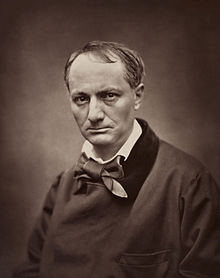
baudelaire

Check the lost and found.

He spoke a good deal about reason, and also the limits of reason, with a wonderful quote from Charles Baudelaire about  the need to unravel reason for the sake of poetic creation – I couldn’t find the quote later, though I looked and looked for it. But I did find this one, which was intriguing: “I have to confess that I had gambled on my soul and lost it with heroic insouciance and lightness of touch. The soul is so impalpable, so often useless, and sometimes such a nuisance, that I felt no more emotion on losing it than if, on a stroll, I had mislaid my visiting card.”

Well, that comment illustrates the limits of reason, too. So much in life is intangible, invisible, and unreasonable, and reason may know the weight of things but not always their value. Reason makes good servant but a lousy master – the French know a little about that, too. For example, in the days when Notre Dame was made into a Temple of Reason. My own thinking, I guess, owes as much to Lev Shestov as to Diderot or Voltaire.

Harrison continued (and this is a part that was caught on tape): France, he said, offers “a shining example of how one can be absolutely modern without betraying or repudiating the legacies and traditions that allowed the modern era to come into existence in the first place. Oftentimes, experiments in modernization lead to schizophrenia between a modern present and a pre-modern past. France has known how to not surrender what is most valuable in its tradition.”

The next French virtue he named is an educated heart: “Emotional intelligence is one of the great lessons that I take from modern French literature, but it’s also a value that, strangely enough, is not shared many cultures, not even many modern Western cultures. We have a tendency in the United States and Italy, he said, to see emotions as “that which bring us back to a primordial spontaneity and a childlike innocence. It’s not seen as a cultivated part of the human psyche, whereas French tradition and culture has always valued very highly a certain kind of emotional intelligence.”

marilyn-monroe-and-yves-montand

Maybe not so reasonable.

He used Simone Signoret as an example, for the attitude she expressed about her husband Yves Montand‘s very public affair with Marilyn Monroe. Signoret famously said, “If Marilyn is in love with my husband it proves she has good taste, for I am in love with him, too.” But surely the educated heart takes in more than what people say about themselves? After all, she didn’t get a vote in the situation, and was humiliated and embittered by it, later admitting, “I detest women who come too close to him. Our friends are very carefully selected.” Nine-tenths of what people say about themselves, I find, is self-justification, and the remaining tenth is PR. Moreover, I agree with William Maxwell, “In talking about the past, we lie with every breath we draw.” Signoret wrote of Monroe, “She will never know how much I didn’t hate her,” but that was after the movie icon was long and safely dead. The affair had accelerated the downward spiral that led to Monroe’s suicide. The unstable star had stumbled into a triangle where two people were playing poker, and one roulette. She was playing for keeps in a world where nothing was for keeps…

Anyway, these thoughts began to roll through my mind, so I almost missed what he said next – about France having “a kind of emotionality that is the fruit of a cultivation of certain intelligent analysis of what the emotions can do.”

veuve_clicquotThen his final point: “One quick word about form. One thing I respect the most about almost any kind of French event or meal or place, is that it’s done in a holistic fashion. There is nothing that is done halfway. Now that I’ve become a chevalier, I shouldn’t use the language that I might have used before,” he said and paused, with a glance at Madame Carmona. “I hope Madame le Consul will forgive me for the expression we use in English – saying we do something ‘half-assed.’ With the French, in my experience, it’s always ‘whole-assed.’ Tonight is another example of how things are not done halfway.” Everyone laughed.

Something about form, something that I wanted to say … oh, I don’t remember now. Like most of Robert’s talks, this one, though brief, was seminal, and I wanted to continue the conversation – but the room was growing loud, cacophonous even, and I was quickly enveloped by hubbub, champagne, and the solitude that occurs when what’s inside your head is so different from the noise around it.


<<< Previous Series of PostssepNext Series of Posts >>>