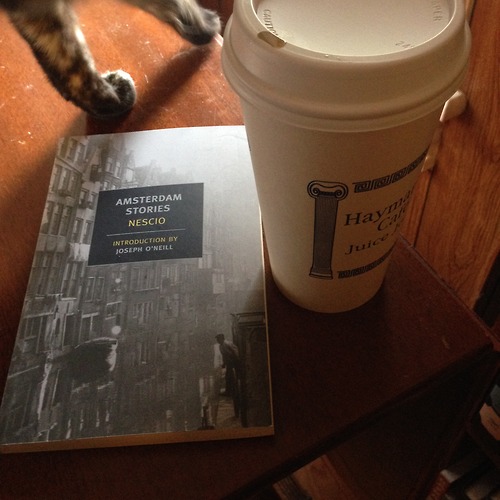
Join NYRB Classics at the “Classics and Coffee Club”

July 10th, 2014
Share

nyrb

Over at tumblr, “A Different Stripe: Notes from NYRB Classics” is inviting everyone to partake in its “Classics and Coffee Club.” Here’s the invite: “Do you have a picture of an NYRB Classic with a cup of coffee or tea? Send it to this address and we’ll post it here (making you an honorary member of the Classics and Coffee Club). And let us know where you bought or borrowed your book from. We would love to shout out bookstores and libraries.” They aren’t fussy. Later on they admit they’ll take a photo of a book with a cup of tea or – what the hell – vodka or beer or a hot toddy. How, in fact, do they know that’s coffee in my photo above, and not, say, Jamaica rum?

It sounds like fun. We’ve interviewed NYRB Classics founder and editorial director Edwin Frank before here, and we’re awfully fond of managing editor Sara Kramer, too. Most of the photos on the tumblr site are accompanied by a quote from the photographed book about coffee (or tea or vodka, etc.) – such as this one: “Of course, we always drank coffee, no matter what the weather,” from Nescio‘s “Insula Dei,” in Amsterdam Stories, translated by Damion Searls. We post that photo below, because we can’t turn down the chance to add another book cat to our gallery. This one is a half-Siamese at Haymarket Café in Northampton, MA. (I couldn’t find a coffee quote to go with the tweet I sent for Vassily Grossman‘s Life and Fate, but I rather liked this one: “”Life’s grace and charm can never be erased by the powers of destruction…”)

Exactly what the club will do I don’t know, but I’m sure the imaginative folks at NYRB Classics will think of something. Meanwhile, check out some of the photos here.

haymarket

From the Met: a superb collection of Japanese books

July 9th, 2014
Share


yoshiwara

In the era of Kindle, we regularly retreat for refreshment to the book-as-art-object, and no destination is better suited to this shift-in-focus than the Metropolitan Museum of Art in New York. Last fall, the museum acquired about 400 volumes spanning the 17th to 19th century, from a private collection – but unless you have mastered the Japanese from a few centuries ago, you won’t be able to read them. No problem!  You can simply look at them. That’s the whole idea of book-as-art-object. We’ll give you a head start.

japanese3Although the museum began collecting of fine art Japanese books began 60 years ago, the newest cache is choice: it includes masterpieces of woodblock printing, many nearly impossible to find in such fine condition today. Here are a few (photos by Karin L. Willis): Above, Santō Kyōden (1761–1816), New Mirror Comparing the Handwriting of the Courtesans of the Yoshiwara (1784).  Below, an illustration of seashell lovers from Kitagawa Utamaro‘s Gifts of the Ebb Tide (The shell book), probably 1789; the illustration at right is from the same volume.  Go to the the museum website here to see dozens more images. (Check out Katsushika Hokusai‘s One hundred views of Mount Fuji, 1834; 1835; ca. 1849, too.)

According to Asian Art curator John Carpenter, “Artists represented in the collection include Utamaro, Hokusai, and Hiroshige, who are best known today for their woodblock prints, but who also excelled at illustrations for deluxe poetry anthologies and popular literature. In one fell swoop, the Met now has a superb collection of Japanese books to complement its excellent holdings in paintings and prints of the Edo period (1615–1868).”

Enjoy.

japanese2

A few wise words from Dame Hilary Mantel about writing

July 7th, 2014
Share
mantel

Photo: John Haynes

Yesterday, we mentioned author Hilary Mantel in passing, not knowing it was also her birthday. Thanks to Joseph Peschel, we found these wise words from her, more than fitting for the coming week:

“If you get stuck, get away from your desk. Take a walk, take a bath, go to sleep, make a pie, draw, listen to ­music, meditate, exercise; whatever you do, don’t just stick there scowling at the problem. But don’t make telephone calls or go to a party; if you do, other people’s words will pour in where your lost words should be. Open a gap for them, create a space. Be patient.”

birthday cake

– Dame Hilary Mary Mantel, twice awarded the Booker Prize

“Mock not, mock not”: Shakespeare’s curious nod to July 6

July 6th, 2014
Share

more


Don Pedro: Well, you temporize with the hours. In the meantime, good Signior Benedick, repair to Leonato’s: commend me to him and tell him I will not fail him at supper; for indeed he hath made great preparation.

Clare Asquith

She solved the riddle.

Benedick:  I have almost matter enough in me for such an embassage; and so I commit you—

Claudio:  To the tuition of God: From my house, if I had it,—

Don Pedro:  The sixth of July: Your loving friend, Benedick.

Benedick:  Nay, mock not, mock not. The body of your discourse is sometime guarded with fragments, and the guards are but slightly basted on neither: ere you flout old ends any further, examine your conscience: and so I leave you.

I know of no one who has been able to explain these curious lines from Act 1, Scene 1 of William Shakespeare‘s Much Ado About Nothing better than Clare Asquith in her controversial book Shadowplay, which I reviewed years ago for the Washington Post.  Not even my comprehensive Riverside Shakespeare provides a gloss on the line. While I found some of her interpretations extreme (read more about them and Asquith’s book in The Guardian here), this one seemed spot on.

July 6 marks the anniversary of the execution of Sir Thomas More, an occasion that was remembered in England long after Harry the Eighth was buried. Yes, yes, I know about Hilary Mantel and what she said. Still, his contemporaries and near-contemporaries had a different view:  John Donne called him “a man of the most tender and delicate conscience that the world saw since Augustine.” Jonathan Swift referred to him as “the person of the greatest virtue these islands ever produced.” And if the play Sir Thomas More is to be considered as the Bard’s handiwork, Shakespeare himself called him “the best friend the poor ever had.”

Famous film about him below:

Henry David Thoreau: “I was not born to be forced. I will breathe after my own fashion.”

July 4th, 2014
Share
thoreau

Free spirit

Happy Fourth of July. In my thinking about the day, it occurred to me that this may be the first and only nation that actually formed around the notion of dissent. We do more than tolerate dissent, we view it as the absolute bedrock of a democracy.

Then I recalled an all-time great American, Henry David Thoreau, who, in July 1846, spent a night in jail because he refused to pay six years of a delinquent poll tax at a time when American was waging what he viewed as an unjust war (the Mexican war) and while slavery was still practiced.

According to some accounts, Ralph Waldo Emerson visited Thoreau in jail and asked, “Henry, what are you doing in there?” Thoreau replied, “Waldo, the question is what are you doing out there?”

Emerson missed the point of Thoreau’s protest, which was not intended to reform society but was a pure act of conscience. If we do not act on our discernment of right from wrong, he argued, we will eventually lose the capacity to make the distinction.

Prior to these events, Thoreau had been living a quiet, solitary life at Walden, an isolated pond in the woods about a mile and a half from Concord (reconstruction of the place below looks pretty nifty to me). Perhaps the sudden collision with the affairs of the world was a jolt to him: “The State never intentionally confronts a man’s sense, intellectual or moral, but only his body, his senses. It is not armed with superior wit or honesty, but with superior physical strength. I was not born to be forced. I will breathe after my own fashion. Let us see who is the strongest.”

Toward his jailers, Thoreau expressed sadness: “They plainly did not know how to treat me, but behaved like persons who are under-bred. In every threat and in every compliment there was a blunder; for they thought that my chief desire was to stand the other side of that stone wall. … I saw that the State was half-witted, that it was timid as a lone woman with her silver spoons, and that it did not know its friends from its foes, and I lost all my remaining respect for it, and pitied it.”

Thoreau's_cabin_inside

Home sweet home

Apparently, Bronson Alcott had been taken to prison for a similar refusal, but was sprung by a friend who paid the tab. Hence, he wrote, “I took great pleasure in this deed of Thoreau’s.”

Too often the importance of respecting dissent, not quashing it, gets lost in a big busy country. On my Facebook page this morning I posted a comment from Robert Reich, “True patriotism isn’t simply about securing our borders from outsiders. It’s about coming together for the common good.” I added this thought: Let’s make this a special Fourth of July. Left-wingers – go hug a right-winger. Right-wingers – go hug a left-winger. Try to listen to a point of view not your own. You don’t have to adopt it, just hear it out, trying to understand where the other is coming from without refutation, denigration, or ridicule. Try to see the other person as someone who also has a collection of life experiences and who is also fighting a tough battle. Put aside hatred, not just for today, but forever. Try to enjoy the cacophony of voices that make up a democracy. Any takers?

Meanwhile, here are a few words from Jerome Lawrence, one of the two playwrights (the other is Robert Edwin Lee) who wrote the very successful The Night Thoreau Spent in Jail:

.

Jerome Lawrence on The Night Thoreau Spent in Jail from William Inge Center for the Arts on Vimeo.

Long-lost recording of Tolkien … what’s it worth to you?

July 2nd, 2014
Share
tolkien

At the 1958 Rotterdam Hobbit Dinner… presumably after a few drinks.

What would you give to hear a recording of J.R.R. Tolkien at the top of his form? What if it held new revelations about The Lord of the Rings? It’s a practical question.

The Rotterdam Project is fund-raising to remaster a newly discovered  reel-to-real tape, partnering with the Tolkien site MiddleEarthNetwork.com to raise awareness and funds in order to remaster the original recording, chronicle the event, and make it available to the world this fall.  From the scratchy youtube video below, they have their work cut out for them – that’s a pitch for your support. Hey all you techies in Silicon Valley – want to come to the rescue?

The recording is from the Rotterdam “Hobbit Dinner” on March 28th, 1958. The tape was found in 1993 by Tolkien enthusiast René van Rossenberg, who owns a shop for the Tolkien-obsessed in the Netherlands, “the only brick-and-mortar shop in the world entirely dedicated to J.R.R. Tolkien,” according to the website.

So how come we didn’t know about the recording till now? “Like Smaug I am guarding my treasure, hissing at any collector who comes near,” he recently wrote in response to an email query. Fortunately, he was persuaded him to open his dragon hoard. Now, he says, “I am looking forward to sharing with all Tolkien aficionados the great joy I felt when I first played the tape and heard Tolkien give his great speech.”

Noble Smith, author of The Widsom of the Shire, listened to the recording, the first person other than Rossenberg to hear it, and called it “awesome.” Here’s what he had to say about it at HuffPo:

At the start of the speech Tolkien is indeed full of high-spirits and cracks jokes in a way that we’ve never heard him do before. Rather than the ultra-serious Oxford don whom most of us know from his scanty recordings, we get Tolkien-as-Bilbo, right out of the chapter “A Long-expected Party.” He even makes reference to that famous eleventy-first birthday, for Tolkien’s oration was intended as a parody of Bilbo’s farewell speech. The author’s merry voice, with its brusque and rich accent, dances around your head like a hobbit drinking song. For the Professor, it was said by one of his former students, “Could turn a lecture room into a mead hall.”

Tolkien thanked the assembled “hobbits” for giving him the greatest party of his life. He spoke very modestly about The Lord of the Rings calling it “A poor thing, but my own.” He couldn’t believe that the people there would want to hear an after-dinner autobiography. So he jumped right into explaining the construction of his great narrative work, stating that the One Ring is a mere mechanism that “sets the clock ticking fast.” And then he quite plainly spells out what the books are about–something he only alluded to once in a letter, but is incontrovertible in this speech. (If you want to know exactly what he says you’ll just have to listen for yourself!)

At one point he read a poem in Elvish, joking that hobbits were always terrified when someone threatened to recite poetry at a party. He prefaced the poem by saying it was almost twenty years to the day since he had started working on The Lord of the Rings. His mellifluous voice makes the imaginary language come alive, like sinuous silvery mithril script etched in the mind’s eye:

Twenty years have flowed away down the long river
And never in my life will return for me from the sea
Ah years in which looking far away I saw ages long past
When still trees bloomed free in a wide country
And thus now all begins to wither With the breath of cold-hearted wizards
To know things they break them
And their stern lordship they establish
Through fear of death

Tolkien had spent the afternoon walking around Rotterdam–a city that had suffered much destruction during World War II. The sight of it had saddened him, reminding him of the “orc-ery” that he so lamented taking hold of the world. The “cold-hearted wizards,” in their quest for knowledge and power, were only good at destroying things. In his final salute to the assembly of hobbit-lovers, Tolkien said that Sauron is gone, but the descendants of the hateful, Shire-polluting wizard Saruman are everywhere. The hobbits of the world have no magic weapons to fight them. But, he adds with a robust and hopeful declaration:

“And yet here gentlehobbits may I conclude by giving you this toast. To the hobbits! And may they outlast all the wizards!”

The Rotterdam Hobbit Dinner was the first of its kind, and also the last. For Tolkien never again attended another party like this in his honor. But now we have the proof of what took place on that wonderful night, and what the great author said. And the sound of Tolkien’s voice, like his works, will outlast death.

Go here for an evening of Tolkien, W.H. Auden, and an evening of mushrooms and Elvish.
.


<<< Previous Series of PostssepNext Series of Posts >>>