David Mason’s hard birth

March 21st, 2014
Share

david

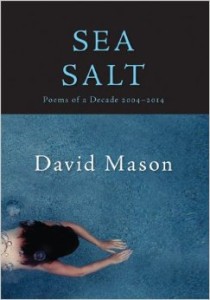
I wrote about Colorado poet laureate David Mason and his quest for “necessary poems” a few weeks ago here.  No sooner said than…  his latest collection of poems arrived in the mail, Sea Salt: Poems of a Decade, 2004-2014. David Sanders‘s “Poetry News in Review” described it as “an almost entirely new poetic voice and his most rigorous and memorable book to date.” Our friend George Szirtes said this: “The language is humane, unfussy, firm, moving but not calculated to move.”

This one grabbed me. See if it grabs you, too.  (I know, I know. You don’t have to tell me  it’s not the Fourth of July. It’s not 2011, either, for that matter. I like this one anyway.)
.

seasalt4 July 2011

.
From over the ridge, chrysanthemums of fire
burst into color. One hears the pop-pop-pop
of another birthday, but the heart is flat champagne.

Who cares about freedom, and Damn King George?
Who cares about sirens out in city lights?
I’ve got enough to fight about right here,

the howitzer let loose inside my ribs
the thudding ricochet from hill to hill,
from hurt to hurt. Hard birth. Hard coming to.

.

.

Timothy Snyder nails it.

March 19th, 2014
Share

We’ve written about Tim Snyder  here and here and here and here and here.

snyder

“A profound intellectual joy”: In memoriam, legendary editor Helen Tartar

March 16th, 2014
Share
tartar_1

Endless cups of bad coffee

The first impression I had meeting legendary editor Helen Tartar a dozen years ago was … silver.  She was wearing a calf-length silver-gray dress, with silver chandelier earrings and silver bracelets, and her straight hair was a striking complement in the same color. She appeared to be a shimmering silver Christmas tree.  Well, you can get a little of the idea from the thumbnail at left.

In 2002, her position as humanities acquisitions editor had just been eliminated at Stanford University Press … an agonizing wrench for her and for the authors she nurtured.  At the time, I was writing an article about the cutbacks and faculty reaction for Stanford Magazine – it’s here. The following year, Helen was snapped up by Fordham University Press to serve as its editorial director, and is credited with transforming Fordham University Press into one of the leading scholarly presses in the United States. She was on a roll.

Hence her death in a Denver car accident on March 3 came as a shock. She was 62.

No doubt she was in Denver for one of her restless cross-continental ramblings in quest for the perfect book. University of Chicago’s Haun Saussy over at PrintCulture  wrote this: “She was ferocious in the defense of things she thought precious and endangered– for example, first books by academic authors. She could be tough. She could be brittle. She worked herself ragged. Something was always new and exciting. She traipsed from conference to conference, drinking endless cups of bad coffee, knitting while she listened to an infinity of tedious papers, in pursuit of the beautiful book somebody had in them without knowing it.”

“What is less random than the taste, dexterity and care that Helen brought to the reading of proposals, drafts, manuscripts, reports and editorial memos? I trusted her more than almost anyone else (which doesn’t mean we never disagreed). We worked on many overlapping projects, almost continuously, for twenty-four years. She was my friend and I worried about her.”

tartar

Saussy and Tartar

In Publishers Weekly, press director Fred Nachbaur called Tartar, “one of the most passionate and dedicated editors in the academic publishing community. I feel fortunate to have had the opportunity to work with her for the past five years.”  In a widely circulated email, he added a more personal note: “As I wrapped myself up in an orange hand-knitted scarf given to me as a belated holiday gift from Helen, I thought fondly of her constant desire to thread things together; thoughts, ideas, words, and people. Helen would rarely be seen without her yarn and needles, always managing to satisfy her need for movement and creativity.”

The accolades are endless. From the Stanford University Press website, in an article titled “Without Precedent”: “Her energetic acquisitions efforts during a period of intellectual upheaval within a number of humanities disciplines enabled the Press to play a leading role in advancing critical scholarship in those areas throughout the English-speaking academic world.”

The praise is nothing new. In my 2003 article, I reported how her elimination caused widespread consternation:

Within minutes of Burn’s September e-mail announcement to some 50 or 60 interested parties, scholars from as far away as Cambridge University, Paris, Berlin, Hong Kong and Australia reacted in scores of letters and e-mails. For many, Tartar’s departure was the biggest bombshell. “Helen Tartar has transformed what was once no more than a moderately respectable academic press into a luminous beacon of intellectual creation,” wrote UCLA French professor Peter Haidu. “Her unique combination of talents has built an institution of importance, eminence, and authority without equal in America.” A message from Michael Puett, assistant professor of early Chinese history at Harvard, stated that Tartar had “built up the Press as a community.”

yarnAt the Stanford University Press blog last week, Norris Pope, who was the Press’s director for much of the time that Helen was at Stanford, commented that “Helen’s acquisitions efforts in the humanities were without precedent in the history of Stanford University Press, and they contributed enormously to the Press’s reputation and standing in a number of fields. The high esteem in which she was held by her authors and by scholars in many parts of the humanities was the result of her extraordinary abilities and dedication. Her work will have a lasting effect in a number of intellectual areas and on the careers of a great many authors at all stages in their careers.”

Let the last words be Helen’s, via the Fordham University newsroom:

In a 2004 interview with Fordham magazine, Tartar said that she took pleasure in creating a booklist that displayed what she termed “discursive coherence”—one that included microbiology to sociology to literature to philosophy, drawn together less by theme and more by a quality of mind or thinking.

She said she enjoyed being an editor in part because “you’re a perpetual student . . . you’re constantly learning, even if [the authors] are much younger than you are.”

“Part of [my] task in the job is to enhance the role of the press as an asset to the university,” said Tartar. “I also want to renew a profound intellectual joy I had, a sense of bringing truly exciting books into the world, things that will keep people thinking for decades.”

Naimark on the Ukraine crisis: “It’s scary. Things could get a lot worse.”

March 13th, 2014
Share
naimark1

“What is to stop him next time?” (Photo: John LeSchofs)

“It’s scary. Things could get a lot worse.” That’s how Norman Naimarkan expert on Eastern Europe and author of Stalin’s Genocides, summarized the crisis in Ukraine.

The Stanford scholar was delivering a short, galvanizing talk on the exuberant growth of democracy in the 1990s at the Hoover Institution’s Stauffer Auditorium on Tuesday. In the questions that followed, inevitably someone asked about the Ukraine crisis. And then the situation was like the top pulled off a  bottle of Coke after its been shaken for a quarter-hour. His language was unequivocal and condemnatory: “I think the situation is awful, depressing, and a major challenge, not a minor one, to the international system and how it operates. It’s a terrible thing that happened with the invasion. The real historical analogy is, as Hillary [Clinton] said it, the late 1930s.”

naimark3

“The Baltics are scared to death.” (Photo: John LeSchofs)

“I think concessions are not going to work, much like the 1930s,” he added, referring to the West’s yielding of the Sudetenland in the 1938, which was followed by other compromises. Despite the analogies with the 1930s, “Putin is not Hitler,” he said, but the international community must nevertheless “show Putin and Russia this will not go.”

 “Crimea is gone,” he said definitively. “The Baltics are scared to death.” Now he said the international community must shore up Ukraine’s Donetsk, Khargiv, and Odessa. “The natural question is: What is to stop him next time?” Naimark was deeply concerned that “we’re not taking charge of actions and steps that will contain the crisis.” He said it was vital to fortify the destabilized government in Kiev.

“We should be there in a big way, and use this opportunity because Putin has broken the rules.” It’s going to have a price tag for the West, in terms of trade, dollars, resources, and alliances, and will require “a serious commitment, a readiness to sacrifice.”

Naimark said he is very irritated by the West’s readiness to accept Russia’s rationale that Ukraine has historically been a Russian territory. Crimea, in particular, has belonged to the Cimmerians, Bulgars, Greeks, Scythians, Goths, Huns, Khazars, the state of Kievan Rus, Byzantine Greeks, Kipchaks, Ottoman Turks, Golden Horde Tatars, and the Mongols. In the 13th century, it was partly controlled by the Venetians and by the Genoese; then the Crimean Khanate and the Ottoman Empire in the 15th to 18th centuries. “It was not part of Russia till Catherine took it,” he emphasized.  That would be Catherine the Great in the 18th century.

In one surprising anecdote, he said a visiting Russian scholar recently told him that  “they’re under pressure from their side” not to partner with reputable American institutions.

As a “humble historian,” Naimark said he deplored the ignorance of the press about history and the negligent media coverage. For example, he said, there has been universal press silence about the 6,000 Russian intellectuals protesting the the invasion. Not quite universal; it was reported in Frankfurter’s Allgemeine Zeitung on Monday, in an article entitled “Sorry Ukraine”:

Catherine_II

“It’s mine, mine, mine.”

More than six thousand Russian intellectuals, including the writers Ludmila Ulitzkaya, Boris Akunin, Olga Sedakova, and Sergei Ganlewski have signed a protest letter against the Russian invasion of Ukraine, because … it in no way protects the peace, but only makes a bad situation worse.

The demagogic reporting of Russian media reminds one of the publicity policies of Hitler and Stalin before the outbreak of World War II, according the the text, that carries the slogan of “For Our and Their Freedom,” with which Soviet Russian human rights activists already protested the invasion of Czechoslovakia in 1968. Also among the signatories are the composer Dmitri Kurliandski, the Architect Evgeni Ass, the liberal Russian priest Jakov Krotov. The writer and publicist Lev Rubinstein directed, in addition, a personal message to “Ukrainian friends” in which he asks for forgiveness because the few Russians not poisoned by imperial poison gas were unable to prevent this “shameful occupation.” Rock musicians produced a video urging Russians and Ukrainians to resist efforts to get them to fight each other.

Only the reactionary Russian writers union spoke directly for the military action to “protect the Russian speaking population.” Sixty authors signed a similar resolution. In addition the businessman Roman Romanenko from Vologda in Northern Russia directed a satirical appeal to Putin to send troops and money to Vologda because the rights of Russian speakers were being abrogated in terms of education, medical care, and honest elections. A group from Tver demanded the same by return mail.

Lev_Rubinstein

“Ukraine, forgive us.”

Inevitably, there was blowback. In response to the petition of 6,000 names, the competing “reactionary” petition mentioned above circulated with words to this effect, defending Putin: “In the days when the destiny of Crimea and our compatriots living there are being decided, we, the responsible workers of Russian culture, cannot remain indifferent and cold-hearted observers. Our common history and roots, as well as our culture and its spiritual origins, our common fundamental values and language, united us forever. We wish to secure a durable future for the bond between our peoples and cultures. This is why we firmly declare our support for the Russian Federation president’s position in the Crimea and Ukraine.” I’m told the document bears a striking resemblance to Soviet era “letters in support of the Communist Party.”

The list of 86 signatures includes Russian artists and cultural figures, some of them prominent figures who travel around the world with concerts and performances, exhibitions and book tours, participate in film festivals and conferences.

Names are on the breakover page below. Norm said no one stateside is covering this. Well, now I am.

Read the rest of this entry »
NYC techie kids buck trend, take on humanities

March 11th, 2014
Share

contrariwiseA group of New York City students have taken on an ambitious venture: a finely produced journal, with 128 pages of dialogues, essays, letters, diaries, poems, roundtable discussions, questions, commentary, and art on philosophical topics ranging from time to tyranny. Here’s the kicker: these aren’t lit kids. They’re science kids at Columbia Secondary School for Math, Science, & Engineering. Not fuzzies, but techies. We keep hearing how kids have to be engaged with gimcracks and videogames and teaching techniques that include smartphones. It’s cheering to see a few kids buck the trend. This kind of thoughtfulness is the very essence of the humanities, after all. (They do, however, have a website here.)

Here’s how the editors-in-chief, Ron Gunczler and Nicholas Pape describe the genesis of Contrariwise: A Journal of Philosophy in a public school that includes sixth to twelfth grade students:  “Juniors in Political Philosophy wrote continuations of Plato‘s Republic, Book VIII – the section in which Socrates and Adeimantus discuss the decay of the kallipolis, city of philosopher-kings. Professor Senechal was so stunned by the breadth and depth of the responses that she felt they necessitated some form of permanence – a booklet, perhaps? She asked the student body for input, and overwhelming feedback indicated CSS needed a literary journal.”

“We had originally anticipated that Contrariwise would be limited to Political Philosophy. It was then expanded to encompass the whole school, and we now represent the entire student body. We didn’t imagine anyone but parents buying copies, but Contrariwise is going national.” And a good thing, too. The first issue was funded by donations. The next will be funded on sales.

senechal

Free advice.

Topics in the inaugural issue include Alba Avoricani‘s “Letter from Folly to Platon Kovalyov,” Khadijah McCarthy’s “John Locke on the Nature of Marriage,” and, taking on Hamlet, Sofia Arnold‘s “Claudius: A Flawed Machiavel.” I was rather intrigued by Megan Almanzar‘s essay on freezing time, “The Key to Immortality,” and Fariha Wadud‘s “The Book of Job’s Greater Message.” And especially fond of Daniela Batista‘s cover art, with a peppy bird on the nose of a dyspeptic buffalo. I’d like to know its title, and the story behind it.

The results of their labor arrived in my mailbox unsolicited. I wondered how I got on the mailing list. I scanned the staff page all the way to the end before I recognized the name … ah … this is also the latest venture of the students’ faculty adviser, Diana Senechal, also a translator of the preeminent Lithuanian poet Tomas Venclova. Said Diana on her blog here: “This inaugural issue was five months in the making, and here it is. I am honored to have witnessed my students’ inspiration, care, and wit throughout the project—and thrilled to hold and read the book.”

They told him to kneel and kiss the Russian flag. Then he told them to…

March 8th, 2014
Share
Zhadan

Get better soon. (Photo: Maciek Król)

Last weekend, pro-Russian demonstrators attacked the activists who had occupied a government building in Kharkiv, the second largest city of Ukraine.

As they were striking him with bats, the writer Serhiy Zhadan said they told him to kneel and kiss the Russian flag. “I told them to go fuck themselves,” he wrote on his Facebook page.  Then they beat him up good.  He was hospitalized later that day, and photos of his face covered in blood circulated online.

“Americans need to understand, in Eastern Europe, writers still have a huge influence on society,” Vitaly Chernetsky, a professor of Slavic literature at the University of Kansas told the New Yorker. “It may sound like an old-fashioned ‘poet stands up to tyranny’ story, like something out of Les Miz—‘Can you hear the people sing?’—but it’s really kind of like that. … He’s a writer who is a rock star, like Byron in the early nineteenth century was a rock star.”

The incident has shaken up Russians as well as Ukrainians.  In a statement, the Russian PEN Center said:  “We are observing a severe noetic crisis, akin to what was described by Orwell: the meanings of the words ‘peace,’ ‘war,’ ‘fascism,’ and ’democracy,’ ‘defense,’ and ‘invasion’ are shamelessly warped.”

Zhadan is a poet, novelist, essayist, and translator – the leading countercultural writer in Ukraine. His works have been translated into German, English, Polish, Serbian, Croatian, Lithuanian, Belarusian, Russian, Hungarian, Armenian, Swedish, and Czech. In 2008, the Russian translation of his novel Anarchy in the UKR made the short list of the National Bestseller Prize. It was also a contender for “Book of the Year” at the 2008 Moscow International Book Exhibition. He also recieved BBC 2010 Book of the Year for Voroshilovgrad. His novel Anthem of Democratic Youth has been adapted for the stage and is being performed at the Ivan Franko National Academic Drama Theater in Kiev.

His most recent book, The Invention of Jazz in Donbass, is work of magical realism that sounds like it’s earned the title. According to Sally McGrane’s article in the New Yorker:

letters-from-ukraine-3In the book, a yuppie type living in a large Ukrainian city is called back to his small eastern-Ukrainian hometown to take over his brother’s gas station. His brother has disappeared—he may have emigrated to the Netherlands, but no one knows for sure. Running the gas station (where fending off corrupt oligarchs is part of the job), he finds that, to his surprise, he is proud of the place he is from—that it is unique, possessed of its own dignity and beauty, no matter how depressed it may be. (Depressed it is: at one point, the narrator is invited to play with his old soccer team in a match against a nearby factory. Only after the game ends does he realize that his entire team was composed of ghosts—friends who had died as the result of crimes, accidents, or alcoholism.)

He’s back in the hospital; his jaw never healed property. Read the New Yorker story here.


<<< Previous Series of PostssepNext Series of Posts >>>