“My friendship with him was perhaps the longest he’d ever had.” Stanford’s Paul Gregory on Lee Harvey Oswald

November 7th, 2013

Share

gregory_paulr_biophotoI’ve known Paul Gregory for several years (and written about him here and here and here) –  I know him as a compelling writer, a fine Russian scholar, and the author of books on the women of the U.S.S.R.’s gulag, Nikolai Bukharin, and Lenin’s brain. He’s mentioned before that he knew Lee Harvey Oswald, but I certainly didn’t know how well until I read today’s story in the New York Times Magazine. I also learned of his unusual donation to the Hoover Archives – more on that below.

Like everything Paul writes, the current NYT story is an excellent read.  It’s also a profoundly sad one, the story of an insecure and misguided misfit’s attempt for grandeur, and how an unlucky confluence of events led him to shoot and kill President John F. Kennedy on November 22, 1963.  It’s also the story of his wife, Marina Oswald, a confused and abused Russian wife pulled into an international crisis before she knew more than a handful of English words and phrases.  So many theories have been spun around the assassin since – after reading this, the theories seem bigger than the man.

But I’ll let Paul tell the story:

oswald-in-dallas

Oswald arrested at the Texas Theatre

It was 7 a.m. on Sunday when the single phone at the bottom of the stairs echoed through my parents’ red-brick house, right off Monticello Park in Fort Worth. “Mr. Gregory,” a woman said as my father picked up, “I need your help.” Who are you? he asked in his Texas-Russian accent, still half-asleep.

The caller said only that she had been a student in his Russian language course at our local library, and that he knew her son. In that instant, my father, Pete Gregory, linked the voice to a nurse who sat in the back of his class and had once identified herself as “Oswald.” Until this phone call, he hadn’t realized that she was the mother of Lee Harvey Oswald, a Marine who had defected to the Soviet Union only to return two and a half years later with a Russian wife and a 4-month-old daughter. My father helped Lee and his young family get settled in Fort Worth a year earlier. The Oswalds had been my friends. …

time-coverMy father recounted that weekend’s events to me a few days later over Thanksgiving dinner, when I returned home from the University of Oklahoma, where I had just begun graduate school. Through my father, I had become a close — or, as Robert Oswald would later say, almost the only — friend of Lee and Marina Oswald’s from virtually the moment they arrived in Fort Worth, in June 1962, until the end of that November. While that five-month period might seem fleeting, it was a significant period in Oswald’s life. He was never in the same place for long. By age 17, he had already moved some 20 times. Then he dropped out of high school and joined the Marines, before being released and traveling to Moscow. He avoided deportation by attempting suicide and was sent to Minsk, where he met Marina. In the year and a half after he returned to the United States, he moved several more times. My friendship with him was perhaps the longest he’d ever had.

My family tried to put those tragic events behind us, but over the ensuing decades, as I became an academic and a research fellow at the Hoover Institution at Stanford, I felt compelled to combine my memories and the historical record to present my own sense of Oswald. Most Americans believe that Oswald shot Kennedy. Yet according to one recent A.P. poll, only a quarter of Americans believe that one man acted alone to kill Kennedy. “Would Oswald,” as Norman Mailer wrote, “pushed to such an extreme, have the soul of a killer?” As I pored back over those months, I realized that I was watching that soul take shape…

post_card

A postcard from the Oswalds (Photo: Hoover Archives)

Read the rest here.  But this fascinating postscript is not in the New York Times – Paul has just made a valuable  donation to the Hoover Archives.  The story behind it:  Young Paul Gregory began taking Russian lessons from Marina.  Here’s what he says in the article about it on one occasion:  “As I was leaving their house, he raced to the bedroom and returned with a faded pocket English-Russian dictionary that he used during his time in Minsk. ‘Take this,’ Lee told me. Only later did I realize that Oswald was showing off in front of Marina, pointing out that he didn’t need the dictionary but that I did.”  Now that dictionary is at the Hoover archives, thanks to Paul’s generosity.  Read about it here.  Paul also donated the postcard from the Oswalds that may have ended their friendship. Paul had congratulated Marina on her English after receiving the postcard, with a few corrections. Then he got a phone call from the distraught wife:  “’I did not write that letter. Lee did.’ Her tone told me all I needed to know; Lee had been deeply insulted and mortified by my response. Marina then told me she was unhappy. She hinted at physical abuse and explained that she had left him only to reconcile after he pleaded for her to attend Thanksgiving at his brother’s house.”

Why the humanities? Because “evil is always a bad stylist,” says Brodsky

November 4th, 2013
Share
menlo

Menlo Circus Club … a classy venue for a book club

Last week at lunch with a friend, we both shared our distaste for the current thinking to defend the humanities – I’ve written about this in the last two days in a rant here and with Nobel laureate Coetzee’s remarks here.  The best antidote I know is Joseph Brodsky‘s Nobel lecture, excerpted below.  In fact, I focused on this essay during a lively get-together at the Menlo Circus Club recently, and it provoked a stimulating discussion.

Not everyone appreciates Brodsky’s circumlocutious Russian sentences, I know, but it’s well worth bearing out, believe me.

From the Nobel lecture (or read the whole thing here):

If art teaches anything (to the artist, in the first place), it is the privateness of the human condition. Being the most ancient as well as the most literal form of private enterprise, it fosters in a man, knowingly or unwittingly, a sense of his uniqueness, of individuality, of separateness – thus turning him from a social animal into an autonomous “I”. Lots of things can be shared: a bed, a piece of bread, convictions, a mistress, but not a poem by, say, Rainer Maria Rilke. A work of art, of literature especially, and a poem in particular, addresses a man tête-à-tête, entering with him into direct – free of any go-betweens – relations.

brodsky3

Doing time for his verse, Archangelsk 1964

It is for this reason that art in general, literature especially, and poetry in particular, is not exactly favored by the champions of the common good, masters of the masses, heralds of historical necessity. For there, where art has stepped, where a poem has been read, they discover, in place of the anticipated consent and unanimity, indifference and polyphony; in place of the resolve to act, inattention and fastidiousness. In other words, into the little zeros with which the champions of the common good and the rulers of the masses tend to operate, art introduces a “period, period, comma, and a minus”, transforming each zero into a tiny human, albeit not always pretty, face.

The great Baratynsky, speaking of his Muse, characterized her as possessing an “uncommon visage”. It’s in acquiring this “uncommon visage” that the meaning of human existence seems to lie, since for this uncommonness we are, as it were, prepared genetically. Regardless of whether one is a writer or a reader, one’s task consists first of all in mastering a life that is one’s own, not imposed or prescribed from without, no matter how noble its appearance may be. For each of us is issued but one life, and we know full well how it all ends. It would be regrettable to squander this one chance on someone else’s appearance, someone else’s experience, on a tautology – regrettable all the more because the heralds of historical necessity, at whose urging a man may be prepared to agree to this tautology, will not go to the grave with him or give him so much as a thank-you.

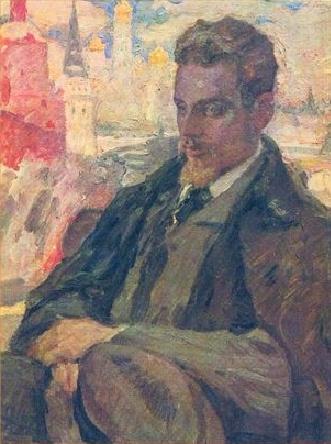
Rilke_in_Moscow_by_L.Pasternak_(1928)

Rilke in Moscow, painted by Leonid Pasternak (1928)

Language and, presumably, literature are things that are more ancient and inevitable, more durable than any form of social organization. The revulsion, irony, or indifference often expressed by literature towards the state is essentially a reaction of the permanent – better yet, the infinite – against the temporary, against the finite. To say the least, as long as the state permits itself to interfere with the affairs of literature, literature has the right to interfere with the affairs of the state. A political system, a form of social organization, as any system in general, is by definition a form of the past tense that aspires to impose itself upon the present (and often on the future as well); and a man whose profession is language is the last one who can afford to forget this. The real danger for a writer is not so much the possibility (and often the certainty) of persecution on the part of the state, as it is the possibility of finding oneself mesmerized by the state’s features, which, whether monstrous or undergoing changes for the better, are always temporary.

The philosophy of the state, its ethics – not to mention its aesthetics – are always “yesterday”. Language and literature are always “today”, and often – particularly in the case where a political system is orthodox – they may even constitute “tomorrow”. One of literature’s merits is precisely that it helps a person to make the time of his existence more specific, to distinguish himself from the crowd of his predecessors as well as his like numbers, to avoid tautology – that is, the fate otherwise known by the honorific term, “victim of history”. What makes art in general, and literature in particular, remarkable, what distinguishes them from life, is precisely that they abhor repetition. In everyday life you can tell the same joke thrice and, thrice getting a laugh, become the life of the party. In art, though, this sort of conduct is called “cliché”.

Art is a recoilless weapon, and its development is determined not by the individuality of the artist, but by the dynamics and the logic of the material itself, by the previous fate of the means that each time demand (or suggest) a qualitatively new aesthetic solution. Possessing its own genealogy, dynamics, logic, and future, art is not synonymous with, but at best parallel to history; and the manner by which it exists is by continually creating a new aesthetic reality. That is why it is often found “ahead of progress”, ahead of history, whose main instrument is – should we not, once more, improve upon Marx – precisely the cliché.

Read the rest of this entry »

Why the humanities? Coetzee asks if universities have “redefined themselves out of existence”

November 3rd, 2013
Share
J.M._Coetzee

Going beyond “critical literacy”

Yesterday, I posted a brief rant about the plight of the humanities, likening it to a dancing bear, here.  But why take my word for it?  The South African Nobel laureate J.M. Coetzee gives a different slant on the same subject in an article here,  an excerpt from a foreword to John Higgins‘s book, Academic Freedom in a Democratic South Africa.  Coetzee asks: “Is a university without a proper faculty of humanities (or faculty of humanities and social sciences) still a university?”

“All over the world, as governments retreat from their traditional duty to foster the common good and reconceive of themselves as mere managers of national economies, universities have been coming under pressure to turn themselves into training schools equipping young people with the skills required by a modern economy,” he writes. “You argue – cogently – that allowing the transient needs of the economy to define the goals of higher education is a misguided and short­sighted policy: indispensable to a democratic society – indeed, to a vigorous national economy – is a critically literate citizenry competent to explore and interrogate the assumptions behind the paradigms of national and economic life reigning at any given moment. Without the ability to reflect on ourselves, you argue, we run a perennial risk of relaxing into complacent stasis. And only the neglected humanities can provide a training in such critical literacy.”

That’s Higgins’s stand, but I wish all that we were risking was a “complacent stasis.”  I don’t believe in stasis.  The escalator is either going up or down.  Stasis is an illusion, or at best a pause, a snag, in a movement in one direction or the other.  Coetzee admits “the traditional humanities have become alien ground” for many in academia.  He is pessimistic, but for different reasons.  He describes a move underway since the 1980s, pursued by “neoliberal enemies of the university,” to purge what he described “as a leftist or anarchist or anti-rational or anti-civilisational malaise.”  It has  has succeeded to such an extent “that to conceive of universities any more as seedbeds of agitation and dissent would be laughable.” He adds that “there are too few people left who really believe in the humanities and in the university built on humanistic grounds, with philosophical, historical and philological studies as its pillars.” This is an excerpt of a longer foreword, and I wonder if some of the logic of his argument wound up on the cutting room floor.  Then he tackles the commonplace Higgins’s defense of the humanities, that they alone can teach “critical literacy”:

petrarch1

Whozat guy on the right?

… I envisage a telling question will be asked of you: even if we grant that critical literacy is as important as you claim, do students really need to know about Hesiod and Petrarch, about Francis Bacon and Jean-Paul Sartre, about the Boxer Rebellion and the Thirty Years War, to attain a sufficient competence in such literacy? Can you not simply design a pair of one­-semester courses – courses in which all undergraduates, no matter what their career track, will be required to enrol – one course to be entitled “Reading and Writing”, in which students will be trained to dissect arguments and write good expository prose; and the other to be entitled “Great Ideas”, in which they will be briefed on the main currents of world thought from Ancient Egypt to the present? A pair of courses like that will not require an entire faculty of humanities behind them, merely a school of critical literacy staffed with bright young instructors.

Basic courses in cultural literacy are not a new idea. They have been mounted at countless American universities under the rubric of “Freshman Composition”. These universities have been responding to precisely the same pressure that the humanities in South Africa now feel.

There is nothing wrong with arguing that a good humanistic education will produce graduates who are critically literate, by some definition of critical literacy. However, the claim that only the full apparatus of a humanistic education can produce critical literacy seems to me hard to sustain, since it is always open to the objection: if critical literacy is just a skill or set of skills, why not just teach the skill itself? Would that not be simpler, and cheaper too?

He concludes:

higgins… in the end, I believe, you will have to make a stand. You will have to say: we need free enquiry because freedom of thought is good in itself. We need institutions where teachers and students can pursue unconstrained the life of the mind because such institutions are, in ways that are difficult to pin down, good for all of us: good for the individual and good for society.

In institutions of higher learning in Poland, in the bad old days, if on ideological grounds you were not permitted to teach real philosophy, you let it be known that you would be running a philosophy seminar in your living room, outside office hours, outside the institution. In that way the study of philosophy was kept alive. It may be something along the same lines will be needed to keep humanistic studies alive in a world in which universities have redefined themselves out of existence.

Have we come to that?  Of course I’d heard about such secret classes in Poland during both the Nazi and Communist era.  But could I find a picture?  Obviously, participants had an interest in not documenting these events.  So I noodled around on Google for a bit.  Instead I turned up this, a rather clumsy translation on a French article, “Sans Armes Face au Nazis,” from L’Histoire Magazine, 2007.  The Polish universities, closed by the Nazis, continued secretly to accept hundreds of students. The photo purports to show the dean of the University of Bromberg and others, awaiting execution.  I can find no confirmation of this incident anywhere online.

Nevertheless, my point, and I do have one, is to point out the enormous payment made by others to preserve precisely the areas of knowledge whose worth we are now questioning, “frills” like literature and philosophy and art, which don’t seem jazzy or cool enough compared to our smartphones.  Yesterday, I likened the situation of the humanities to a dancing bear.  But there have been times in the not too remote past when the bear has risen up to is full stature and power and majesty, and was nobody’s circus pet.

bromberg

The enormous price.


The questionable utility of the dancing bear, or, the future of the humanities

November 2nd, 2013
Share
dancing-bear

The role of the humanities in our society

The New York Times’ article,  “As Interest Fades in the Humanities, Colleges Worry,” once again decries declining enrollment.  I don’t understand why this should come as a surprise to anyone. The humanities are devalued everywhere you look in our society – so why should kids study them?  The humanities are prized only when we can hook them up to consumer interests, make them turn a coin, demand that they entertain us.  There’s always the implicit threat that if we can’t get the bear to dance, the poor old fellow will be put down.

In the world of education, we value humanities only if we can team people onto digital projects that make cool onscreen images or turn them into rap lyrics to make them palatable for the kids. I applaud a lot of these efforts, and appreciate their intent, but they’re rather beside the point.  Coolness and likability aren’t the reason Ovid was exiled, why Osip Mandelstam died scavenging a rubbish heap in a transit camp, why Reinhold Schneider was slated for trial and probable execution had the Third Reich not fallen first, or why André Brink was banned in South Africa.  And it certainly wasn’t why Joseph Brodsky, when I studied with him, made us memorize hundreds of lines of Robert Frost, W.H. Auden, Thomas Hardy, and others – in fact, it made him distinctly unfashionable; some kids fled the class rather than make the effort.  William Shakespeare can be mutilated, but he can’t be tamed.  As one teacher said, after a student had made a snarky, sophomoric comment about Hamlet:  “Mister, when you read Shakespeare, Shakespeare’s not on trial. You are.”  And that is the point.

André_Brink_Portrait

Censored in South Africa (Photo: Creative Commons)

The tacit, self-calming assumption behind our continual cuts in the arts and humanities has always been always that the eternal things are durable, and will survive our neglect.  However, these values must be inculcated and passed on – a baby isn’t born appreciating the subtleties of Piero della Francesco or Raoul Dufy, after all.  Anything that isn’t fed eventually withers.  (I know; I have a garden to prove it.)  I’m told by those who teach that we now have a generation of young people who, in large measure, no longer ponder the terms of their existence or question their reason for being.  Tomorrow is for another pizza, ace-ing the PSAT, or another video game.  The “Holocaust” is a description of a description of Black Friday sales; the Civil Rights movement has something to do with … what?  Will I be graded on it?  I know, I know – it’s the “same old,” isn’t it?  But a serious study of history, another one of the humanities, would show that civilization is a delicate, perishable thing, appearing and disappearing throughout the centuries, and we can never take its continuance for granted (read Constantine Cavafy, Zbigniew Herbert, or the memoirs of Nadezhda Mandelstam). When we don’t pass it on, we break a fundamental chain of civilization. We’ll pay the price down the road … wait, we already are – but it’s not taking the form we had anticipated.

Reinhold-SchneiderI’m also tired of cheesy efforts to defend the humanities, which pander to the standards of our society, which are themselves a broken fence in need of repair. In any case, the fence is broken, in part, by the abandonment of literature, art, and music as the commitment of a civilized society, rather than a “frill.” I’m not saying a Haydn string quartet will save your life, but what often passes for music when I’m put on “hold” when calling my credit card company might be seen as the shocking invasion of psychological space that it is.  Sloppy thinking is everywhere, and not the province of one political party or the other – and the fact that it is inevitably attributed to the “other” in itself shows what a bad pass we’ve come to (it’s something that might have been corrected with an introductory study of Carl Jung, or René Girard, for that matter). Our political life is riddled with clichés that should be jeered offstage, because it’s a nasty way to use your Mother Tongue.  Technology, which has the power for good, has accelerated our race to the bottom, just as nuclear power, which could rescue nations, propels us toward annihilation.

Rant over.  Whew!  Not to worry!  I’m back on my medication now.  More on this subject in the coming days…from better minds than Humble Moi!  I’ll start with one of them, Michel Serres, of Stanford and the Académie Française.  I’ve featured it before, and recently, but if you haven’t seen it, please listen to his description of the fate of the humanities.  It’s not pretty.

Watch Michel Serres at Stanford, interviewed by Robert Harrison. A terrific interview clip here.


More praise for the Cahiers Series – with new works by Anne Carson and Paul Griffiths

October 31st, 2013
Share

ship

Anne Carson’s essay, translations, and the Greek poet Ibykos

From this week’s Times Literary Supplement:

The Cahiers Series is a collection of beautifully produced booklets (twenty-two have been published so far), around forty pages in length, all illustrated with images, which are sometimes apposite, sometimes not, but always interesting. The declared goal of the series is ‘to make available new explorations in writing, in translating, and in the areas linking these two activities’. Some editions have a fairly tenuous connection to translation: in Shades of the Other Shore, two Americans, a poet and an artist respectively, are “translated” from the United States to rural France, with Jeffrey Greene’s short prose pieces and poems exploring “imagined correspondences between personal and historical ghosts tied to the seasons”, and Ralph Petty’s watercolours recording a journey to the source of a local river; in Józef Czapski: A life in translation, the novelist and translator Keith Botsford writes an imaginary autobiography of the Polish author and critic; in In the Thick of Things, the French architect Vincen Cornu attempts ‘to “translate” architectural sensation into words and images’. Then there are the cahiers written by translators or by poets who also translate, as well as translations of stories or plays followed by a brief translator’s note.”

That’s about as good an introduction to the Cahiers Series as I’ve seen anywhere (I’ve written about the valiant endeavor here and here – and the Book Haven even sponsored the Józef Czapski giveaway here).  Alternatively, you could take this, from the Book Trust: “The Cahiers Series represents all that we should be striving for in our increasingly interwoven world.” The effort is managed on a shoestring out of American University of Paris, and yet the short cahiers are truly elegant productions with thick paper and hand-stitched bindings, lavishly illustrated – a friend, Assoc. Prof. Daniel Medin (we’ve written about him here and here) is one of the admirable champions behind the project, and one damn fine editor, too.  Margaret Jull Costa‘s article about the Cahiers Series in the current Times Literary Supplement here seems to pretty much weave together all the past issues. Although I don’t have the list in front of me, it looks like she’s been able to fit about every title into her text.

Except the newest two.  That gives me an opening to tout them:

noh

Eleven Noh plays become stories in English.

Nay Rather
Anne Carson

This cahier unites two texts by celebrated Canadian poet Anne Carson, encouraging readers to experience them alongside and illuminating each other. ‘Variations on the Right to Remain Silent’ is an essay on the stakes involved when translation happens, ranging from Homer through Joan of Arc to Paul Celan; it includes the author’s seven translations of a poetic fragment from the Greek poet Ibykos. ‘By Chance the Cycladic People’ is a poem about Cycladic culture where the order of the lines has been determined by a random number generator. The cahier is illustrated by Lanfranco Quadrio drawings and gouaches, inspired by his reading of Anne Carson’s texts.

The Tilted Cup: Noh Stories
Paul Griffiths

Paul Griffiths effects a multi-layered translation, taking a series of eleven Japanese noh plays and turning them into stories in English. The reader will encounter spirit-beings set free, lovers lost and found, dreams and desires fulfilled, lessons learned from nature, and always a longing for the infinite, as the long, slow drama of each noh play is transformed into a short and moving tale. Interspersed and contrasting with the stories are ten photographs of contemporary Japan by John L. Tran which further explore the relation between theatricality and narrative, while offering hints of a very different vision of infinitude.

The price (£12) is pretty good. Order them here.

Surviving the Holocaust: One man remembers Raoul Wallenberg’s safe house

October 28th, 2013
Share

PS portrait

The face of a survivor

During Bengt Jangfeldt‘s presentation on Raoul Wallenberg last week , one man in the audience asked a question about the Holocaust hero’s safe houses in Budapest, where Jews were protected from deportation and almost certain death.  His interest was personal: he had been a child in one of them.  When the Book Haven asked him to write a little about his experiences, Peter Stangl, who has written an unpublished memoir, gave us more than we had hoped for.

Stangl is director emeritus of Stanford Medical Center’s Lane Library. He was born in Budapest on December 19, 1936.  His father was a businessman, his mother a graphic artist and illustrator.  His mother perished in the Holocaust, probably at Dachau.  The boy, however, was hidden by nuns, then took shelter with his father in a Wallenberg safe house in the Budapest ghetto.  After the war, he graduated from high school in Communist Hungary in 1955.  He signed up for a lathe mechanic apprentice program after high school to avoid the draft, but was a few months shy of finishing the program when the 1956 October uprising broke out.  He escaped to Vienna with a school buddy and then emigrated to the U.S., arriving in December 1956.

He received a scholarship to go to Yale, where he received a B.A. in Russian Area studies in 1962.  He studied linguistics at the Sorbonne and Yale School of Graduate Studies, 1963-64.  He received an M.S. in Library Science, Southern Connecticut State College, 1968. He worked at the Yale University library system 1964-71, and became director of Lane Library, 1971 -1996. 

Here’s a shard of his Holocaust memories:

In 1944, I was seven years old.  That was the year of mass deportation of Jews from Budapest.  My father was among the first, being an able-bodied man in his forties.  Young Nazi soldiers came to the house to take him away and he was taken to work camp.   Within hours he was back, having escaped from the train station where they were loaded onto trains.  He knew he would be rearrested shortly, so he gave hurried instructions to my mother to stay put, not to respond to calls of reporting for deportation.  He kept repeating that he would be back, no matter where he would be taken, and that he would take care of everyone and everything.

stangl2And sure enough, the soldiers were back and took him away again.  Posters appeared all over the city announcing times and gathering places for Jews, by age and gender, to report for registration – meaning to be transported to concentration camps.  This is what my father was talking about.  But my mother was too scared not to report, and she went.

My father escaped again and came home (altogether he escaped seven times) and was furious with my grandmother for letting mother go.  He made arrangements for me to go to a half-finished house on the edge of the city, where two nuns were hiding about a dozen jewish children and trying to keep us safe. I stayed there for some weeks, until my father – back again – sent for me. Dad explained that we were going to move to a new place where we will be safe, thanks to a very good man named Wallenberg. We walked a short distance and entered a big apartment house with the emblem of the Swedish Embassy by the gate.

Most of this period is a jumble in my mind. The building was teaming with people, five or six persons to a room.  Food was scarce; I remember the constant feeling of hunger and stomach aches.  I know from accounts that I was quite sick there: I had a severe case of multiple vitamin deficiencies.

A notable episode, still painful in its memory, is worth retelling here. One day, as my father called me, I could tell from the tone of his voice that there was something special.  “Listen carefully,” he said. “Through an old friend I managed to get a little cocoa powder and dried milk.  Grandmother will fix you a cup.”

“Really??” I could hardly believe it. “Now?

“Yes, in just a minute.  You know the nice lady two floors down, who always wears that red robe?”

I knew.  I didn’t like her.  She had false teeth that always seemed like they were about to fall out.  She scared me when she smiled at me.

Budapest, Festnahme von Juden

Jewish women in Budapest, October 1944 (Photo: Deutsches Bundesarchiv)

He continued, “I want you to go downstairs to her.  Be very polite, and tell her that your Daddy sent you.  She will give you some saccharine.  She is diabetic, you know?  Since there is no sugar, we will use that in your cocoa.”

“Thanks, Dad, can I go now?” I asked breathlessly.

“Yes, go.  Just one other thing — don’t say anything about this to any of the other kids, they would only feel jealous or envious.  You don’t have to share it, you are sick.”

I was enormously thrilled, and flew down the stairs, two steps at a time.  The lady was very nice.  She knew about the cocoa.  She told me to wait a moment while she went inside to get her saccharin.  I held out my hand and she dropped the tiny pill, just a little bigger than the head of a pin, into it.  I held it tight, said thank you, and was gone.  The smell of the cocoa, as I reached the door upstairs, was almost unbearable.  I went racing through the hallway to Grandmother, just as she was pouring the cocoa into a cup.  I opened my tight fist to drop the little tablet on the table — nothing.  It wasn’t there.  I felt like lightning had struck me.  I stared at my empty hand and started to cry.  My father went crawling down the stairs, looking everywhere, finding nothing.

After a long time and with much cajoling from Grandmother, I stopped crying long enough to taste the cocoa. It was bitter, very, very bitter.  I cried some more. . .

Read the rest of this entry »


<<< Previous Series of PostssepNext Series of Posts >>>