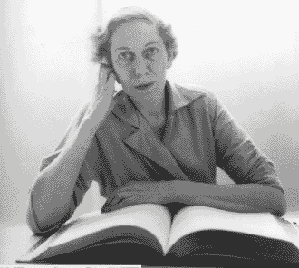
Au revoir, Marek Skwarnicki (30 April, 1930 – 12 March, 2013)

March 25th, 2013

Share
marek

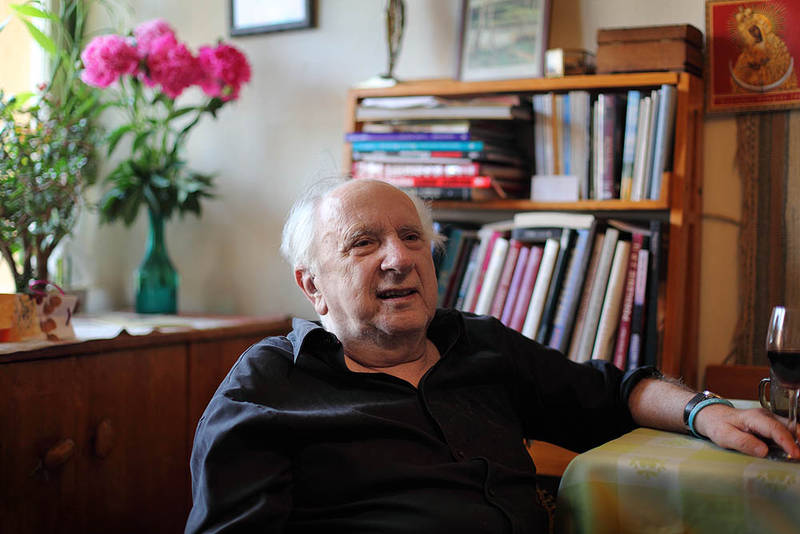
Marek Skwarnicki, in the crowded apartment on Ulitsa Pigonia

For the last week or two, I kept thinking that I should drop a note to Polish poet, novelist, essayist, journalist, and translator Marek Skwarnicki   So I finally wrote him a friendly email on Saturday, inquiring about his well-being and that of his wife, Zofię.  Marek is another in the tribe of people I wanted to stay in touch with – but he was so easy to lose track of, even in Kraków, living way out on Prądnik Biały, in the most farflung northern outskirts of the city, in one of the highest floors of an anonymous apartment block on Ulitsa Pigonia.

I googled him yesterday, just to see what he might be up to, and had another shock:  according to the Polish media, he had died on the 12th of March, about the same time I began having the impulse to write him.  (This is the second time this has happened in two months, which is eerie to say the least.)  He was a month shy of his 83rd birthday. President Bronislaw Komorowski posthumously awarded him the Officer’s Cross of the Mark Skwarnickiego Polish Order of Polonia Restituta, for “outstanding contribution to Polish culture.”  The Polish media don’t list a cause of death (nor does Rome’s La Stampa), nor tell us whether his wife survived him.  Obviously, I didn’t attend the 20 March funeral mass at the Benedictine abbey in Tyniec, celebrated by Cardinal Franciszek Macharski – the eminent poet Julia Hartwig spoke afterwards at the event, which was attended by former colleagues at Tygodnik Powszechny and Znak.

So let this be my tribute to one of the kindest people I remember.

Moj-Milosz-Krakow-Bialy-Kruk-2004-CzeslawMarek was one of the contributors to An Invisible Rope: Portraits of Czesław Miłosz – I don’t remember who suggested I talk to him.  This is what I had to say about him in the Contributors Notes:

Marek Skwarnicki—Polish poet, writer, and translator of poetry—was imprisoned in the German concentration camp Mauthausen in 1944. From 1958 to 1991, he was on the editorial board of Tygodnik Powszechny. He has written many volumes of poetry and memoirs from his travels with John Paul II, which he covered as a reporter. His correspondence with Miłosz is included in his book Mój Miłosz (My Miłosz).

I made the trek out to meet Marek and his wife Zofię in 2008, during my fellowship to Poland.  Did I bring flowers on this visit, or the second?  I can’t recall, but flowers always seemed plentiful in that apartment, along with the sweetish wine and store-bought pastries they served to guests.  At one point I brought an armload of bright yellow flowers – that I remember.

On my first visit, the devout Catholic writer told me cheerfully, “Miłosz was a heretic, like all great artists” – yet gave a nuanced portrait of the anguished religiosity of the Nobel poet. In Invisible Rope, he tells the story of his first contact with Miłosz:

“Because of the changes in the Soviet Union, Khrushchev coming to power and de-Stalinization, the year 1956 became pivotal in Polish political history. The publishing policies in my country experienced a “thaw,” an easing up of the state censorship that used to control not only every printed word, but also the size of periodical circulation and even the content of business cards. The name of Czesław Miłosz was now permitted to be mentioned in print.  Tygodnik Powszechny — a general-interest, political, Catholic, and sociocultural weekly — resumed its publication after a forced hiatus.

While still a student, I had written for the magazine under an assumed name. Later, I forged relations with the former editors and, in 1957, (since because I myself had started writing poetry), my poem titled ‘A Letter from Warsaw’ appeared in Tygodnik Powszechny; this poem was my way of thanking Czesław Miłosz for being the ‘daylight’ of my young years and the ‘rescue’ in Warsaw. Truth be told, the entire Communist press lashed out at me. Nevertheless, the poem was published.

marekskwarnicki

In younger days (Courtesy the Skwarnicki family).

On Christmas 1957, I received a letter from Paris. The envelope carried no return address. Inside was a white card with a red-and-white border. In the top left corner, there was a little Christmas tree and a handwritten inscription ‘Merry Christmas’; and in the lower rightcorner, it was signed ‘from Czesław Miłosz.’ This was the beginning of our relationship, which deepened into a friendship between an older poet and a younger one (this is how Miłosz described it) and ended only  with his death in Kraków.”

The two had a mutual friend in their fellow Pole and fellow poet, John Paul II.  Marek met Karol Wojtyla in the late ’50s in the editorial offices of Tygodnik Powszechny – well, Kraków is a small town.  From that time onwards, he became a sort of literary counselor to the poet-pope, and was invited to Rome to assist the Pope in the final editing of Wojtyla’s Roman Triptych: Meditations.  Marek also translated the Psalms – curiously enough, so did Miłosz, teaching himself Hebrew to do so.

The only time I riled this gentle man, even a little, was when, on his manuscript, I politely inquired whether Polish authorities weren’t tracking his unconventional trip across America, where he finally met Miłosz face-to-face after years of correspondence:

“I like to add that you made me slightly angry on you with your remarks about my fear of Polish political police. I am and I was in your free country the free man, not slave, not afraid of  Polish KGB.  I did not made report to them after return to [my] country.  They did not know that I was visiting office of Polish Section of Voice of America, what was more dangerous than [visiting] Milosz. Sorry. Warm wishes to you.”

I remember my second and last visit to the tiny, crowded apartment on Pigonia in 2011.  As I left, they urged me to come back again before the end of my trip – I remember saying goodbye, not knowing if I had the time in my tight schedule to find my way to this apartment building again.  I suspected I would not, but looked at the generous, expectant faces of this hospitable, open-hearted, and thoroughly devoted couple – half-blind, half-deaf, yet waiting for me – and I said I would try.

Moj-Milosz-Krakow2

“My music is better because I work harder”: Bach’s St. Matthew Passion

March 23rd, 2013
Share
johann_sebastian_bach

Don’t mess with him. He messes back.

Last night – Lenten fare.  Stanford’s Schola Cantorum performed Johann Sebastian Bach‘s St. Matthew Passion, widely considered to be the master composition of the entire Western canon.  I attended the performance at Stanford’s magnificent Memorial Church with a friend – and with a good many others, too, since it looked to be a sold-out performance.

In my googlings, I found this lively and informative post from Princeton’s Bernard Chazelle at “A Tiny Revolution”:

“Bach thought highly of his St. Matthew Passion. He called it his best work. Alas, few of his contemporaries shared the sentiment. After a performance in St. Thomas Church on Good Friday, 1735, the powers-that-be in Leipzig whispered into Bach’s ear that, as long as he kept that theatrical crap out of the Lord’s House, everything would be all right. He took the hint and applied for a job in Dresden, 70 miles away, submitting his Mass in B Minor as part of his application package. He was turned down. Perhaps that’s because Dresden had high standards and, after all, the Mass in B Minor is considered by many to be only the second greatest composition in Western music. The greatest? For Seiji Ozawa, it is ‘without a doubt, the St. Matthew Passion.’

Bach’s two surviving passions (the other two were lost! Imagine literature without Hamlet and Romeo & Juliet…) fell into oblivion after a couple of performances. They were too hard, too long, too demanding, too operatic for Lutheran sensitivities. Ignoring friendly advice, Mendelssohn re-premiered the St. Matthew Passion 100 years later. By doing so, he invented what we term ‘classical music’ today, i.e., the modern view of a concert hall as both a school and a mausoleum. Music had never before looked to the past. On that day in 1829, Bach became immortal. …

Bach made it very clear he was writing neither for humans nor for posterity. He was writing ‘for God.’ (If I lost 10 children, as he did, maybe I’d be doing the same thing, too.) He never gave in to any pressure to appeal to the local musical tastes. He was a big, tough guy, who was known to brawl in bars in his youth. He was even jailed once. When the local authorities threatened to block his promotion (which they did) if he didn’t “simplify” his music, his only reply to them was a loud ‘Screw you!’ Bach was fearless. But his Leipzig years were not happy ones. He had a much easier life composing for the Court (as the Brandenburg concertos make it very clear). But he chose to move to Leipzig to work for the church and take a huge salary cut. That was his own decision: a very Coltrane-like spiritual awakening. Sure, he was convinced his music was superior, but it’s fascinating to hear his reasoning: ‘My music is better because I work harder. Anyone who works as hard as me will write music that is just as good.’ At least the first sentence is partly true: he did work harder than anyone. It took him one year to write the St. Matthew Passion, and it was performed only twice in his lifetime. It’s humbling to think I’ve listened to it more often than Bach himself.”

Crucifixion-1445

Van der Weyden’s 1445 triptych … with supernumeraries.

Humbling for Humble Moi as well. However, I’m ashamed to admit to my barbarism: last night was the first occasion I have ever listened to it, beginning to end, with the libretto in hand.  It’s quite an experience, and an exhausting one – not only because it is three-and-a-quarter hours long (actually, longer than that last night).

The composition, with all its interspersed hymns, entreaties, and prayers, reminds me of one of those Flemish paintings a few centuries before Bach – say, the Crucifixion triptych of Rogier Van der Weyden – where an event is witnessed by the painter’s pious contemporaries.  Usually the donors, often with supernumerary saints, are kneeling or rapturously praying among the Biblical figures.  They are in, but not of, the event.  And in their role inside and outside of time, they invite you to join them, in witness.  Bach’s Passion forces you back on yourself, to take a position about the music, the ideas, the words you are hearing – and not just to think about them, of course, but to feel them, so the pondering and the pity transform you in the process.  (That’s one reason why the program notes’ generic words about how the composition “speaks to us of conscience, courage, compassion, acceptance, and hope” are so impossibly banal.)

zagajewski

What he said.

I’ve always been especially fond of the haunting “Blute Nur,” and to a lesser extent the final bass aria, “Mache Dich.” But in later years, I’ve been especially attentive to the “Erbarme Dich” – not because Yehudi Menuhin called it the most beautiful piece of music ever written for the violin (Bernard Chazelle has lots to say about this aria, too).  My reason lies in the words of Adam Zagajewski.

The Polish poet wrote in his Another Beauty: “When asked if European music has a core, that is, if one work or another might be called its heart, B. answered, “Yes, of course, the aria ‘Erbarme Dich’ from Bach’s Passion According to Saint Matthew.'”

While corresponding with Adam Z. in 2006, I asked him to elaborate, fully expecting him to dodge behind the alias “B.”  But he didn’t:  “Erbarme Dich – Bach represents the center and the synthesis of the western music. To say, as I did, that this particular aria is the center of western music is a leap of faith, of course. I couldn’t prove it. I love this aria.”

Chinua Achebe: “Some people may wonder if, perhaps, we were not too touchy … We really were not.”

March 22nd, 2013
Share
800px-Chinua_Achebe_-_Buffalo_25Sep2008_crop

Where was the Nobel? (Photo: Stuart C. Shapiro)

Critic Anis Shivani is better known for wit than reverence, so when I read this deferential tribute on his Facebook page, I sat up straight:

“I acknowledge with gratitude his profound influence. Things Fall Apart was as important a novel as any written in the 20th-century. I always thought he should have won the Nobel. Today a whole new set of figures have taken over the role of the Joyce Cary‘s of old: illegitimate appropriators of ‘third-world’ voices who give comfort to the propagators of new versions of colonialism.”

He’s talking about Chinua Achebe, Nigerian-born novelist and poet, who died yesterday in Boston at 82.  Here’s what the Washington Post had to say:

thingsfallapartHis novel was nearly lost before ever seen by the public. When Achebe finished his manuscript, he sent it to a London typing service, which misplaced the package and left it lying in an office for months. The proposed book was received coolly by London publishers, who doubted the appeal of fiction from Africa. Finally, an educational adviser at Heinemann who had recently traveled to west Africa had a look and declared: “This is the best novel I have read since the war.”

In mockery of all the Western books about Africa, Achebe ended Things Fall Apart with a colonial official observing Okonkwo’s fate and imagining the book he will write: The Pacification of the Primitive Tribes of the Lower Niger. Achebe’s novel was the opening of a long argument on his country’s behalf.

“Literature is always badly served when an author’s artistic insight yields to stereotype and malice,” Achebe said during a 1998 lecture at Harvard University that cited Joyce Cary’s Mister Johnson as a special offender. “And it becomes doubly offensive when such a work is arrogantly proffered to you as your story. Some people may wonder if, perhaps, we were not too touchy, if we were not oversensitive. We really were not.”

According to the Associated Press, the novel was repeatedly rejected, and even the Heinemann advisor’s enthusiasm resulted in an initial press run of only two thousand:

Its initial review in The New York Times ran less than 500 words, but the novel soon became among the most important books of the 20th century, a universally acknowledged starting point for postcolonial, indigenous African fiction, the prophetic union of British letters and African oral culture. …Things Fall Apart has sold more than 8 million copies worldwide and has been translated into more than 50 languages.

Vivian Yudkin’s Washington Post review weighed in at just over 100 words.  Here’s the whole thing:

Customs and mores of other cultures are always fascinating. A 28-year-old Nigerian writer, Chinua Achebe, takes us inside his world in his first novel, Things Fall Apart (McDowell, Obolensky). Mr. Achebe, writing in English, tells us the story of Okonkwo in the deceptively simple language of folklore. Okonkwo, who yearns to be the great man of his tribe, is instead doomed to failure and exile, for he believes that cruelty and suppression of emotion mean strength.

When misfortune befalls him, Okonkwo blames his “chi,” his personal god, but author Achebe’s message is clear – that there is a parallel between Okonkwo in his 19th century Nigerian clan governed by gods and ritualism, and 20th century man in a moon-ridden world.

The decades since this 1959 review have seen a revolution in the book’s critical estimation, obviously.  From the New York Times:

“It would be impossible to say how ‘Things Fall Apart’ influenced African writing,” the Princeton scholar Kwame Anthony Appiah once wrote. “It would be like asking how Shakespeare influenced English writers or Pushkin influenced Russians.”

Mr. Appiah, a professor of African studies, found an “intense moral energy” in Mr. Achebe’s work, adding that it “captures the sense of threat and loss that must have faced many Africans as empire invaded and disrupted their lives.” …

In his writings and teaching Mr. Achebe sought to reclaim the continent from Western literature, which he felt had reduced it to an alien, barbaric and frightening land devoid of its own art and culture. He took particular exception to”Heart of Darkness,”the novel by Joseph Conrad, whom he thought “a thoroughgoing racist.”

Conrad relegated “Africa to the role of props for the break-up of one petty European mind,” Mr. Achebe argued in his essay “An Image of Africa.”


Orwell Watch #23: Cliché alert! Be prepared for a “paradigm shift”!

March 20th, 2013
Share
Rose from obscurity...

Rose from obscurity…

Ooo! Ooo! Ooo!  A cliché alert!  Via Facebook, Jennifer Howard of the Chronicle of Higher Ed (and formerly one of my editors at the Washington Post Book World) alerted me to the Washington Post Outlook Section’s banned phrases.  We’re happy to see “double down” made the cut; we’ve written about that here.  It also nails the “not un-” formation, but George Orwell jeered at that one decades ago.

The list comes from Carlos Lozada, editor of the Outlook Section, who passed it on to Jim Romenesko‘s blog about the media. There are so many doozies, we can only list a few and refer you to the original source hereA sampling:

Imagine (as the first word in your lede)
Hastily-convened [which shouldn’t be hyphenated, anyway – ED]
Little-noticed (that just means the writer hadn’t noticed it)
Paradigm shift (in journalism, all paradigms are shifting)
Unlikely revolutionary (in journalism, all revolutionaries are unlikely)
Unlikely reformer (in journalism, all reformers are unlikely)

Da Man

Da Man

Grizzled veteran (in journalism, all veterans are grizzled – unless they are “seasoned”)
Manicured lawns (in journalism, all nice lawns are manicured)
Rose from obscurity (in journalism, all rises are from obscurity)
Dizzying array (in journalism, all arrays make one dizzy)
Withering criticism (in journalism, all criticism is withering)
Predawn raid (in journalism, all raids are predawn)
Ironic Capitalizations Implying Unimportance Of Things Others Consider Important
Provides fresh details
But reality/truth is more complicated (oversimplify, then criticize the oversimplification)
The proverbial TK (“proverbial” doesn’t excuse the cliché, just admits you used it knowingly)

One Facebook poster asked if we could add “perfect storm” to the list.  A worthy suggestion.  At the Romenesko’s website, someone suggested that one offender –  “remains to be seen” – might be appropriate if you’re writing about an open-casket funeral.

madcat

Cat that heard “double down” once too often.

Lozada was prompted to send on the list when he read the blog entry about Milwaukee Journal Sentinel managing editor George Stanley‘s note to the newsroom (perhaps inspired by all the stories about Princess Diana‘s “iconic” dresses on the auction block this week:

Folks,

It has been brought to my attention that we are seriously over-using the word “iconic.”

I could provide examples but would rather not.

It’s not a bad word but it is becoming a cliché. Let’s try not to use it unless it is truly the best possible word for that sentence.

Thank you!

His warning was timely: a search turned up 29 stories, blog posts, and photo gallery descriptions using the word in the last seven days.

Of course, Orwell’s whole point was to show how language is used to obfuscate, deceive, and hide meaning. So here’s a stinker offered by Erin Belieu, an associate professor at Florida State University (she also has a fourth collection of poetry coming out with Copper Canyon Press).  She’s written an open letter to editors who say that they aren’t publishing a representative percentage of women because they only publish “the best” work (and wow, look here, it’s pretty damning):

Dear Certain Editors, please stop saying in reaction to VIDA’s Count that you simply publish “the best” work. What you do is publish what you like. Both rhetorically and philosophically, my 5th grader can tell the important difference between these ideas. Either you actually don’t understand the difference or you choose not to. For your sake, I hope it’s the latter as the former isn’t something you can easily fix.

Good catch, Erin!

paradigm-shift-cartoon

Henry Miller loses it. Eudora Welty looks for a job.

March 19th, 2013
Share

lettersI just discovered the website “Letters of Note,” thanks to a couple of recommendations from friends.

The website is exactly what the title promises:  famous letters, culled from a variety of sources.  Here are the two my friends recommended.

First letter: author Henry Miller’s 1932 message to diarist and novelist Anaïs Nin.   They’d just started a torrid affair.  (And to think I’d settled for a dozen roses.)

August 14, 1932

Anais:

Don’t expect me to be sane anymore. Don’t let’s be sensible. It was a marriage at Louveciennes—you can’t dispute it. I came away with pieces of you sticking to me; I am walking about, swimming, in an ocean of blood, your Andalusian blood, distilled and poisonous. Everything I do and say and think relates back to the marriage. I saw you as the mistress of your home, a Moor with a heavy face, a negress with a white body, eyes all over your skin, woman, woman, woman. I can’t see how I can go on living away from you—these intermissions are death. How did it seem to you when Hugo came back? Was I still there? I can’t picture you moving about with him as you did with me. Legs closed. Frailty. Sweet, treacherous acquiescence. Bird docility. You became a woman with me. I was almost terrified by it. You are not just thirty years old—you are a thousand years old.

Inamorata  (Photo by Elsa Dorfman)

Inamorata (Photo by Elsa Dorfman)

Here I am back and still smouldering with passion, like wine smoking. Not a passion any longer for flesh, but a complete hunger for you, a devouring hunger. I read the paper about suicides and murders and I understand it all thoroughly. I feel murderous, suicidal. I feel somehow that it is a disgrace to do nothing, to just bide one’s time, to take it philosophically, to be sensible. Where has gone the time when men fought, killed, died for a glove, a glance, etc? (A victrola is playing that terrible aria from Madama Butterfly—”Some day he’ll come!”)

I still hear you singing in the kitchen—a sort of inharmonic, monotonous Cuban wail. I know you’re happy in the kitchen and the meal you’re cooking is the best meal we ever ate together. I know you would scald yourself and not complain. I feel the greatest peace and joy sitting in the dining room listening to you rustling about, your dress like the goddess Indra studded with a thousand eyes.

Anais, I only thought I loved you before; it was nothing like this certainty that’s in me now. Was all this so wonderful only because it was brief and stolen? Were we acting for each other, to each other? Was I less I, or more I, and you less or more you? Is it madness to believe that this could go on? When and where would the drab moments begin? I study you so much to discover the possible flaws, the weak points, the danger zones. I don’t find them—not any. That means I am in love, blind, blind. To be blind forever! (Now they’re singing “Heaven and Ocean” from La Gioconda.)

I picture you playing the records over and over—Hugo’s records. “Parlez moi d amour.” The double life, double taste, double joy and misery. How you must be furrowed and ploughed by it. I know all that, but I can’t do anything to prevent it. I wish indeed it were me who had to endure it. I know now your eyes are wide open. Certain things you will never believe anymore, certain gestures you will never repeat, certain sorrows, misgivings, you will never again experience. A kind of white criminal fervor in your tenderness and cruelty. Neither remorse nor vengeance, neither sorrow nor guilt. A living it out, with nothing to save you from the abysm but a high hope, a faith, a joy that you tasted, that you can repeat when you will.

All morning I was at my notes, ferreting through my life records, wondering where to begin, how to make a start, seeing not just another book before me but a life of books. But I don’t begin. The walls are completely bare—I had taken everything down before going to meet you. It is as though I had made ready to leave for good. The spots on the walls stand out—where our heads rested. While it thunders and lightnings I lie on the bed and go through wild dreams. We’re in Seville and then in Fez and then in Capri and then in Havana. We’re journeying constantly, but there is always a machine and books, and your body is always close to me and the look in your eyes never changes. People are saying we will be miserable, we will regret, but we are happy, we are laughing always, we are singing. We are talking Spanish and French and Arabic and Turkish. We are admitted everywhere and they strew our path with flowers.

I say this is a wild dream—but it is this dream I want to realize. Life and literature combined, love the dynamo, you with your chameleon’s soul giving me a thousand loves, being anchored always in no matter what storm, home wherever we are. In the mornings, continuing where we left off. Resurrection after resurrection. You asserting yourself, getting the rich varied life you desire; and the more you assert yourself the more you want me, need me. Your voice getting hoarser, deeper, your eyes blacker, your blood thicker, your body fuller. A voluptuous servility and tyrannical necessity. More cruel now than before—consciously, wilfully cruel. The insatiable delight of experience.

HVM

Second letter:  23-year-old author Eudora Welty was looking for a job in 1933.  Where else but The New Yorker?  And what else could the magazine say but “no”?  I wouldn’t have hired her either.  It’s a bit too arch for me.

March 15, 1933

Gentlemen,

I suppose you’d be more interested in even a sleight-o’-hand trick than you’d be in an application for a position with your magazine, but as usual you can’t have the thing you want most.

welty

Older but wiser.

I am 23 years old, six weeks on the loose in N.Y. However, I was a New Yorker for a whole year in 1930-31 while attending advertising classes in Columbia’s School of Business. Actually I am a southerner, from Mississippi, the nation’s most backward state. Ramifications include Walter H. Page, who, unluckily for me, is no longer connected with Doubleday-Page, which is no longer Doubleday-Page, even. I have a B.A. (’29) from the University of Wisconsin, where I majored in English without a care in the world. For the last eighteen months I was languishing in my own office in a radio station in Jackson, Miss., writing continuities, dramas, mule feed advertisements, santa claus talks, and life insurance playlets; now I have given that up.

As to what I might do for you — I have seen an untoward amount of picture galleries and 15¢ movies lately, and could review them with my old prosperous detachment, I think; in fact, I recently coined a general word for Matisse’s pictures after seeing his latest at the Marie Harriman: concubineapple. That shows you how my mind works — quick, and away from the point. I read simply voraciously, and can drum up an opinion afterwards.

Since I have bought an India print, and a large number of phonograph records from a Mr. Nussbaum who picks them up, and a Cezanne Bathers one inch long (that shows you I read e. e. cummings I hope), I am anxious to have an apartment, not to mention a small portable phonograph. How I would like to work for you! A little paragraph each morning — a little paragraph each night, if you can’t hire me from daylight to dark, although I would work like a slave. I can also draw like Mr. Thurber, in case he goes off the deep end. I have studied flower painting.

There is no telling where I may apply, if you turn me down; I realize this will not phase you, but consider my other alternative: the U of N.C. offers for $12.00 to let me dance in Vachel Lindsay’s Congo. I congo on. I rest my case, repeating that I am a hard worker.

Truly yours,

Eudora Welty

Howard Jacobson’s advice to writers: “If you see any sign of ideology in you, to kill it.”

March 17th, 2013
Share
jacobson

Great face. But he looks like he just killed an ideology.

I like this guy.  I don’t agree with him, I’ve never read his books, I’d like to argue with him – but I like him.  And interviewer Devika Bakshi is right – he has a great face.  See for yourself (at right).

A few excerpts from her interview with Howard Jacobson, author of the Booker Prize-winning novel, The Finkler Question, over at India’s Open – here.  (With a hat tip to Vikram Johri for this one.)

On reading young writers:

Alan Bennett said something fantastic once. Someone said to him, “Which other playwrights do you like?” And he goes, “Well, I don’t really go to the theatre.” And the person interviewing him goes, “But you’re always at the theatre, we’ve seen you at the first nights…” and he says, “Yes, I go, it’s impolite not to go to a first night. I have a drink and things, and when the play begins, I quietly creep out.” And they said, “Well, why do you do that?” And he said, “Because I’m very easily influenced. And I don’t want to be watching another play and thinking: ‘I should be doing that’.” It’s a beautifully tactful way of saying I don’t want one of two things: I don’t want to be at a play where everybody’s saying ‘Isn’t this wonderful?’ and I think it’s rubbish. I don’t want to be in that position. But also, at my age and experience, I don’t want to be watching a play by someone who’s just born that’s so brilliant that I would feel threatened by it.

I once heard [Norman] Mailer talk in London, and someone was saying, “Who of the great successful writers of now do you like?” And he laughed, as though, you know, ‘Do I want to hear of the great successful writers?’—it’s a jealous profession we have—and he said, “I’m at work on my old rusty Lincoln, trying to get underneath, and I’m trying to get my old rusty Lincoln to start again, and somebody goes whizzing by in a brand new Maserati. Why would I get out from under my car to look at that?”

On writers “finding their voice” [Note: Here’s where I disagree profoundly – the claim to be “looking for my voice” is the mark of an amateur. Just try to tell your story as clearly and succinctly as you can.  That’s your voice.  I know Jacobson is a big famous dude, and I’m a nobody – but still, common sense is common sense. – ED]

Finklerquestion_bookcoverThe old cliché about a novelist is you have to find your voice, but you do have to find your voice. And I didn’t find it until it just found me, when somehow or other, it was forced upon me that my voice was not late Henry James, or even early Henry James. It was a very English voice, behind which, interlaced with which, was the demotic of the Manchester street. My father was a very, very vivid man, he worked on the markets, was a taxi driver; our house was full of uneducated Jewish people coming and going, making Jewish jokes, using bits of Yiddish, and I thought: ‘Actually, that’s my voice, forget Henry James.’ That first novel had a bit of that [voice]. Then more and more I thought that’s my unique contribution to English literature. This is where I draw my strength, and the particular thing I know that other people don’t know.

And in the end that’s what you have to tap: what do you know that no one else knows? How do you speak in a way that nobody else speaks? What’s your experience that’s not like anybody else’s experience?

Without that, I would’ve written boring, solemn books.

Advice to young writers:

Read other writers but don’t be other writers. Don’t be cowed by all the great writers that you like. I was really frightened by them, thinking, ‘I’m never going to be as good as that.’ Well, you’re not. None of us are. Dickens isn’t as good as Dostoevsky, and sometimes Dostoevsky isn’t as good as Dickens. Know how great they are, but don’t be cowed by it. Find your own voice, and revere it.

And remember that it’s your job as a writer, if you see any sign of ideology in you, to kill it. Writing is not the expression of your belief system. Don’t have a belief system. If you have a belief system, give up art—unless you’re confident that in the making of art, in the writing of a novel, you will lose your belief system.

What you believe is of no interest to anybody. Almost what anybody believes is of no interest to anybody. Remember how superior art is to belief. And away you go! And don’t expect to do very well.

[Excuse me – if good writing excludes a belief system, why are you reading Dostoevsky? – ED]

Read the whole thing here.  It’s a great interview.


<<< Previous Series of PostssepNext Series of Posts >>>