Save the Wales! Gwyneth Lewis defends a language spoken by 721,700 people.

January 8th, 2013

Share

Taking flak (Photo: Keith Morris)

I figure pretty much every language is going to become a boutique language sooner or later.  Eventually English, Spanish, and Mandarin will become boutique, antique, or extinct, swept into the sea of time with Pali and Koro.  It’s dismaying to think that only 40 million people speak Polish, only 7 million speak Czech … and Welsh?

That brings me back to the subject of Gwyneth Lewis, the poet who came all the way down from the Cardiff countryside to hear my talk at the British Academy last month.  Somewhere in the middle of all that brouhaha, we had a Christmas season lunch at the National Café, where I was introduced to a fittingly Welsh “wild mushroom, leek, and glazed salsify stew with chestnut dumplings” as Gwyneth told me about her exploits.

All in all, it had been a good year for Gwyneth.  She won the crown at the Vale of Glamorgan National Eisteddfod. Moreover, according to Wales Online,  “The National Eisteddfod in the Vale of Glamorgan presented an intriguing counterpoint between Gwyneth Lewis’ magical translation of The Tempest for Theatr Genedlaethol Cymru’s Y Storm, and the modern day tragedy of Ma’ Bili’n Bwrw’r Bronco staged by the Wales Millennium Centre in an innovative co production with Theatr na n’Óg. Winners all.”  I can’t pronounce any of it, so I’ll simply reproduce it.

I had meant some time ago to write about Gwyneth’s coronation – but I searched, in vain, for a video clip of the awards ceremony in Welsh, and then for Gwyneth reading anything in Welsh, and finally gave up the whole damn thing.

So I was grateful when her publisher Neil Astley of Bloodaxe Books alerted me to her article in The Guardian, “Welsh-language Books Deserve Their Subsidies,” in which she takes issue with a Daily Telegraph article dissing grants given to Welsh writers, under the headline Taxpayer Funds Welsh Authors to Write Books No One Wants.  She ably defends the language spoken by a mere 721,700 speakers (according to a 2011 census), principally in Britain and the Chubut province of Argentina.

Behold the queen!

“Welsh predates English in the British archipelago,” writes the inaugural National Poet of Wales. “If you want to know what cultural despair is, go to the US and see, as I did recently, the bleakness of a Native American poet trying to piece together his tradition from oral sources recorded by a white anthropologist. The rarity of a plant makes its preservation more important, not less.”

She concludes:

On an individual level, the creative economy works indirectly. It’s not a matter of putting in a pound and receiving a set piece of work from it. I’m not speaking here of commercial success (if you want that, become a banker) but of artistic quality. My first book of poems in Welsh, funded by the Welsh Book Council, paid me just over £14. I did consider framing the cheque (as my cousin did the $30 he received for expenses during each of four flights in the space shuttle), but I though it’d be useful for groceries. I publish Welsh poetry in Wales, English-language work with Bloodaxe Books and non-fiction with Harper Collins in London and America. Work in one form has an effect on what I can do in all the others. Therefore, a modest grant for a book of Welsh-language poems has a direct impact on what I can sell, say, in the U.S.

The imagination works by underground streams, proceeds by snakes and ladders. You grow new writers by doing not one thing but many different activities at the same time: promoting critical thinking, publishers whose commercial successes can subsidise fledgling talent and promotional services to expand the reach of high-quality writing like that of Owen Sheers and Rachel Trezise, Deborah Davies, Horatio Clare, Catherine Fisher, Fflur Dafydd, Belinda Bauer and many others.

What followed it was 261 comments, some of them surprisingly vitriolic (some of them had to be removed).  Who knew language could generate so much spit and fire?

And behold, we finally found a video of Gwyneth’s coronation…

The “scale of appraisal”: Woolf, Tsvetaeva, and Inspector Javert

January 6th, 2013
Share

Cause of death?

Last night, I finally made the trek to see Les Misérables with my daughter and her friend.  The film has many nice touches – among them, Russell Crowe, as the solitary Inspector Javert, reviews the row of slaughtered boys the day after the 1832 uprising is quelled.  Moved by the sight of the very young Gavroche in the macabre line-up of bodies, he gently pins one of his military medals on the dead child.  Javert leaps to his death in the Seine a few scenes later.  (My daughter sent me a youtube video of Crowe being interviewed about his interpretation of the role – it’s below.)

Although my memory of Victor Hugo‘s book has faded over the years, I don’t recall any account that has linked Javert’s suicide with these useless and unnecessary deaths, in addition to the inspector’s  confusion at Jean Valjean’s unexpected act of mercy.  But the connection with warfare is an obvious one – some producer or artist should have thought of it before now – and it brought me back to my post of a few days ago, discussing Virginia Woolf‘s last letter, before her own suicide.  I had never connected her death with the German bombing of Britain, but her husband had.

According to Leonard Woolf, “319 days of headlong and yet slow-moving catastrophe” preceded her death in March 1941. Two of their homes were bombed in succession, and this may have triggered a recurrence of Virginia’s mental illness.

“Gavroche” by Gustave Brion

So it was, also, with Russian poet Marina Tsvetaeva, whose suicide was preceded by German attacks on the two cities she loved most, Paris and Prague.  (I wrote about her final days for the Los Angeles Times here.)

Lydia Korneevna Chukovskaya related this August 1941 conversation, which took place in Chistopol in Tatarstan, the evacuation destination for many writers:

“Tell me, please,” here she came to a stop, stopping me also, “tell me, please, why do you think that it’s still worth living? Don’t you really understand what’s coming?”

“Worthwhile or not – I stopped debating that long ago. They arrested people close to me in ’37, and in ’38 they shot my husband. Of course, life’s not worth living for me, and in any case it doesn’t matter any more how and where I live. But I have a daughter.”

“But don’t you really understand that everything’s over? For you, for your daughter, and altogether.”

We turned onto my street.

“What do you mean – everything?” I asked.

“Altogether – everything!” She made a large circle in the air with the strange little bag she carried. “Well, Russia, for example!”

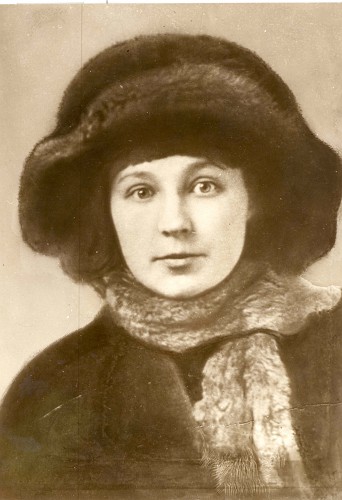
Tsvetaeva, 1917

“And the Germans?”

“Yes, the Germans too.”

In her excellent book The Death of a Poet: The Last Days of Marina Tsvetaeva, author Irma Kudrova writes:

I’ll risk taking this thought to its conclusion. In Tsvetaeva’s eyes the catastrophe that was going on was worse than the nightmare of war. A disaster of global proportions was underway, swallowing Russia too. The dark forces of the world had incarnated into ‘nonhumans’; they held absolute power and were pitiless toward man. The swarm of Hitler’s army, which was swallowing the Russian land, was only one of the faces of triumphant evil. It seems to me that it was precisely this – and nothing less – that Marina Ivanovna [Tsvetaeva] was talking about on 26 August 1941, four days before her death.

She was speaking to the only person she had met since leaving Moscow in whom she could sense a person like herself. She spoke, at last, in her own voice, without caution. Because it was her scale of appraisal, her characteristic viewpoint about what was happening: “from the roof of the world,” as she wrote in one of her poems.


Who’s got the ring now? “Tolkien has become a monster,” says his son.

January 4th, 2013
Share

A few days ago we wrote about the Tolkien, Auden, and an Evening of Musrooms and Elvish, describing the nerdy cult that has evolved around J.R.R. Tolkiens Hobbit and Lord of the Rings.

But Le Monde has described another side of the Tolkien fever, as seen by the author’s heirs: “Tolkien has become a monster, devoured by his own popularity and absorbed into the absurdity of our time,” [son] Christopher Tolkien observes sadly. “The chasm between the beauty and seriousness of the work, and what it has become, has overwhelmed me. The commercialization has reduced the aesthetic and philosophical impact of the creation to nothing. There is only one solution for me: to turn my head away.”

Son Christopher, who has edited Silmarillion as well as a 12-volume History of Middle-Earth, has dedicated his life to extending and completing his father’s work (but not the way director Peter Jackson has envisioned).  When I say “his life” – I don’t mean just the adult end of it. The involvement began almost from the cradle:

Christopher Tolkien’s oldest memories were attached to the story of the beginnings, which his father would share with the children. “As strange as it may seem, I grew up in the world he created,” he explains. “For me, the cities of The Silmarillion are more real than Babylon.”

On a shelf in the living room, not far from the handsome wooden armchair in which Tolkien wrote Lord of the Rings, there is a small footstool covered in worn needlepoint. This is where Christopher sat, age 6 or 7, to listen to his father’s stories. “My father could not afford to pay a secretary,” he says. “I was the one who typed and drew the maps after he did the sketches.”

“Absorbed into the absurdity of our time”

Little by little, starting in the late 1930s, The Lord of the Rings took shape. Enlisted in the Royal Air Force, Christopher left for a South African air base in 1943, where every week he received a long letter from his father, as well as the episodes of the novel that was under way.

Tolkien’s death in 1973 brought to Christopher’s doorstep “70 boxes of archives, each stuffed with thousands of unpublished pages. Narratives, tales, lectures, poems of 4,000 lines more or less complete, letters and more letters, all in a frightening disorder. Almost nothing was dated or numbered, just stuffed higgledy-piggledy into the boxes,” according to the article.  Christopher, a professor at New College in Oxford at the time, junked his day job and took on decades of labor on his father unfinished works.  “During all that time, I watched him type with three fingers on an old machine that had belonged to his father,” according to Christopher’s wife Baillie. “You could hear it all the way down the street!”

The nerdishness I described a few days ago illustrates the degree of Christopher’s success in conveying the world of Middle-Earth.  Tolkien’s vision, “like that of the Grimms’ fairy tales of the previous century, has become part of the mental furniture of the western world,” writes Thomas Alan Shippey.  But the family objects to the way the film has reduced Tolkien’s world to an action movie for teenagers, and a product line that includes comics, videogames, rock music, toys, bumper stickers, stationery, and God knows what else.

With the release of the new film, the Tolkiens are bracing themselves for yet more. “We will have to put up the barricades,” says Baillie Tolkien, smiling.

Read the Le Monde article in English translation at Worldcrunch here.

Teachers of sorrow: Oscar Wilde, Virginia Woolf, and breaking-up letters

January 2nd, 2013
Share

The meaning of sorrow…

Oscar Wilde went to prison for his erotic letters Lord Alfred Douglas – yet he wrote to Douglas sadly in 1896, “I had passed through two long years of imprisonment without ever having received a single line from you, or any news or message even, except such as gave me pain.”

Then he wrote this:  “I had always thought that my giving up to you in small things meant nothing: that when a great moment arrived I could reassert my will-power in its natural superiority. It was not so. At the great moment my will-power completely failed me. In life there is really no small or great thing. All things are of equal value and of equal size. …”

“All things are of equal value and of equal size.” Because of that passage, I have been thinking about that letter for two days.  It may be true, after all – and if so, perhaps the most important thing he ever said.  The letter concludes: “You came to me to learn the Pleasure of Life and the Pleasure of Art. Perhaps I am chosen to teach you something much more wonderful, the meaning of Sorrow, and its beauty.”

From the title of The Atlantic series,  ‘This Was Like Dating a Priest’: Famous Authors’ Breakup Letters,” you might expect these letters to be pure snark. Don’t believe it.  The Atlantic‘s  title is taken from a 1945 letter from Anaïs Nin to C. L. Baldwin, in which she sounds rather impressed with herself.  But some of the others are truly poignant, intelligent, and painfully self-aware.

“I’m going mad again.”

For instance this one, Virginia Woolf‘s final letter to her husband Leonard Woolf during the bombing of Britain in 1941.  Afterwards, she put stones in her pocket and drowned herself in the River Ouse:

“Dearest, I feel certain that I am going mad again. I feel we can’t go through another of those terrible times. And I shan’t recover this time. I begin to hear voices, and I can’t concentrate. So I am doing what seems the best thing to do. You have given me the greatest possible happiness. You have been in every way all that anyone could be. I don’t think two people could have been happier ’til this terrible disease came. I can’t fight any longer. I know that I am spoiling your life, that without me you could work. And you will I know. You see I can’t even write this properly. I can’t read. What I want to say is I owe all the happiness of my life to you. You have been entirely patient with me and incredibly good. I want to say that—everybody knows it. If anybody could have saved me it would have been you. Everything has gone from me but the certainty of your goodness. I can’t go on spoiling your life any longer. I don’t think two people could have been happier than we have been. V.”

Worth a read here.

2013: Out with the old, in with the new – and not a moment too soon.

January 1st, 2013
Share

Public service.

We’ve been waiting for some old words and phrases to be chucked out.  Looks like Michigan’s Lake Superior State University in Sault Ste. Marie has picked up the mop and the bucket for us – and cleaned up on a lot of publicity along the way, too.

Every year the way-up-north university compiles a “List of Words to be Banished from the Queen’s English for Misuse, Overuse and General Uselessness.” Its minions gather nominations from the U.S., Canada, and beyond – by fax, by email, on its website, and this year mostly via its Facebook page.  The contest is its 38th year – it’s probably older than the many Book Haven readers.  The organizers hope to jeer these terms out of existence.

We don’t agree with all the targets: “Fiscal cliff” doesn’t worry us, although it apparently grated on many of the judges – we figure that it will have worn out its welcome by February, if not sooner.

He heard “double down”one too many times.

But here’s the one that had our ears pinned back like a cat – all through the damn election season.  “Double down.”  Where did it come from? What does it mean?  Why was everyone saying it, again and again and again?

Said Allan Ryan of Boston:  “This blackjack term is now used as a verb in place of ‘repeat’ or ‘reaffirm’ or ‘reiterate.’ Yet, it adds nothing. It’s not even colorful. Hit me!”

On the NBC website here, you can even vote for your pet irritations, if you cannot keep them to yourself.  I could not, and as a result learned that I am in a minority.  Only 2.8 percent of the readers found “double down” to be the most obnoxious word or phrase in the last 12 months.  At the moment I voted, it tied with “superfood,” a word which doesn’t bother me at all.  The clear winner was YOLO (internet talk for “you only live once”). I was barely aware of it  (I thought it was a rural county in the California somewhere) – though, come to think of it, if LOL dropped off the face of the earth I wouldn’t cry.  It is particularly annoying when used among the young like a verbal tic, repeatedly and in quick succession accentuating thoughts and phrases that are neither witty nor uproarious, giving the impression that the speaker can barely hold back from a hearty laugh at each banality.

Retro – no?

But “job creators” struck many of the correspondents as heartless political jargon – “One of the most overplayed buzz terms of the 2012 presidential campaign. Apparently ‘lowering unemployment’ doesn’t have the same impact,” said Dennis Ittner of Torrance, Calif.  And “passion,” when used to rev up a mere enthusiasm or interest, bugged the bejeebers out of some:  “Diabetes is not just Big Pharma’s business, it’s their passion! This or that actor is passionate! about some issue somewhere. A DC lobbyist is passionate! about passing (or blocking) some proposed law. My passion! is simple: Banish this phony-baloney word,” fumed  George Alexander of Studio City, Calif.

As for the others … Isn’t “guru” a bit 1970s, anyway – and what’s a “boneless wing”?  Never heard of it.

Feel free to add a few of your own in the comments section.

YOLO
30.7%
(5,019 votes)
Fiscal cliff
27.5%
(4,505 votes)
Job creators/creation
11.9%
(1,943 votes)
Trending
8.8%
(1,437 votes)
Bucket list
5%
(817 votes)
Kick the can down the road
3.5%
(578 votes)
Superfood
2.8%
(460 votes)
Double down
2.8%
(452 votes)
Boneless wings
2.2%
(362 votes)
Guru
1.9%
(307 votes)
Passion/passionate
1.8%
(290 votes)
Spoiler alert 1.2% (192 votes)

Moscow’s 800th birthday party in 1947: Robert Capa captures a poignant moment

December 31st, 2012
Share

Women “celebrating” in Moscow 1947.

Slavic scholar Grisha Freidin is a child of Moscow – he and his family emigrated to the U.S. when he was teenager.  So that means he recalls the city’s 800th birthday party on September 7, 1947.  “I remember playing with the colorful commemorative insignia (few things were colorful then) and hearing my parents, probably in answer to my questions, refer to the celebrations with uncharacteristic ebullience. Clearly it was a major landmark of the post-war years in Stalin’s Russia.”

The era’s most famous war photographer, Robert Capa, was on hand to document the event with John Steinbeck – and add a little nuance to the official party line of a a people looking inexorably forward to a glorious future.  Grisha looked up Capa’s photos, and has a compelling essay over at his blog, The Noise of Time:

And yet, whatever the restrictions, this war photographer was able to convey the atmosphere of the 1947 Moscow. Indeed, many images are composed to give expression to the wrenching tension between the ordinary folks’ desire to cash in a little of that great WWII victory – to ease gently into the long-deferred private life – and the unspoken command shouting at them from every poster: “Attention! To the Glory of the Empire, March!”

Capa’s and Steinbeck’s work were serialized in The New York Herald Tribune, later published as A Russian Journal, with Photographs by Robert Capa, a book which is still in print.  I’m not sure even Steinbeck could top Grisha’s observations on the photograph above.  From his blog:

Muscovite Grisha

The woman facing the camera is wearing a thick shawl and a heavy coat, the other is in a light dress, epitomizing the two sides of the Russian “Indian summer” and, perhaps also, the desire to use hope to trump the cold reality, for “it was a brilliant cold day,” as Steinbeck noted in his Journal. Both women are young and beautiful and strikingly dignified. But their faces suggest a more complicated story. The furrowed brow, the lines around the mouth, the alarm in the eyes of the woman facing the camera – what is behind them? And what about her dancing partner? Alone in the frame in a white flowery dress, her hair beautifully arranged, but her gaze is fixed on a point in infinity and her  profile is frozen into a classical tragic mask. Her right arm, bare and vulnerable, is gracefully stretched out, and the slight curve of her back is protected by the hand of her partner, apparently, stronger and more practically dressed. The tension is palpable. Were the music to stop at that moment, one of them and perhaps both would hunch over and burst out crying. To make sure your are not imagining all of this emotional dynamite, you check their expressions and posture against the other two female couples in the background: they, too, look tentative, dispirited, and forlorn, though lacking in grace and dignity compared to the couple in the foreground. The out-of-focus smiling faces to the right of the dancers only amplify the grotesque contrast between the intended mood of the festivities and the pain of the city’s post-war life. So much sadness fills this instant captured by Capa that it can never be effaced or redeemed.

Read the rest of Grisha’s post, which includes a dicussion of Henri Cartier-Bresson‘s photos of the city a few years later, is here.

“So much sadness … can never be effaced or redeemed.”


<<< Previous Series of PostssepNext Series of Posts >>>