Another review from the Times Literary Supplement – however, unlike yesterday’s review of Adam Johnson’s The Orphan Master’s Son, this one is online and not behind a paywall. You can read it here.
We’ve written about Martin Amis and his recent visit to Stanford here and here andhere, and that round of talks has piqued my interest in the British novelist – the only thing I had read by him prior to this year is a short, business-like letter he sent me when he was the literary editor of the New Statesman in the late 1970s (like everything else, it is somewhere in my garage). I’ve been waiting for reviews of the British edition of the book. I wasn’t disappointed with the TLS review by Jonathan Barnes, author of The Somnambulist and The Domino Men.
TLS staffer David Horspool writes, in his introduction to this week’s edition (it hasn’t arrived in American mailboxes yet): “In reviewing the new novel by Martin Amis, Lionel Asbo, Jonathan Barnes introduces us to a character few would want to live next to, either before his National Lottery win, in the ‘knowingly Dickensian’ London borough of ‘Diston’, or in the shallow glamour-world he occupies afterwards. Lionel, Barnes concludes, ‘squats in a line of descent from [other] monstrous slobs’ created by Amis, from Keith Talent to John Self.”
Let me finish with Barnes own words about Amis’s novel:
Expert, finely wrought and unique (as Philip Hensher has noted, “no page of his could be mistaken for anyone else’s”), Amis’s style is so dear to him that he is unwilling to discard it even for a paragraph or a sentence, as if he cannot bear to adopt a mask of any sort.
Unless, of course, his high style is itself the mask that Amis wears – has always worn. Style is the means by which he filters and interprets the world, its traumas and most savage extremes. It often seems as if the application of that remarkable prose helps him to make sense of disaster, even perhaps to feel safe. It is suggestive that his style grows still grander, and the register still higher, when it is applied to those things which are most painful to him. In his memoir, Experience, while waiting to meet his hitherto unknown daughter for the first time in the Hotel Rembrandt, he fusses over the establishment’s name: “A potent name and a challenging spirit, for students of the human face; and very soon two human faces would be opposed, as in a mirror, each addressing the other with unprecedented curiosity”. Describing Frederick West, he produces the following “one-sentence verdict”: “West was a sordid inadequate who was trained by his childhood to addict himself to the moment when impotence became prepotence”. In a piece on 9/11 written in the immediate aftermath of the event he imagines the second plane in the attack first as “eagerly alive, and galvanised with malice, and wholly alien” and then as “the worldflash of a coming future”.
His style, perhaps, has always been a shield, a necessary means of protection from a judgemental world, the residents of which seem, no doubt incorrectly, to believe that they know him personally. This most famous quality of Amis’s writing may exist chiefly to provide a carapace for that “pinned and wriggling” soul. That it should also turn out to be so startling, so distinctive and so persistently impressive can be considered a magnificent side effect.
More praise for Adam Johnson‘s The Orphan Master’s Son, which we wrote about here and here and here and here. This time the kudos are from Kelly Falconer, the literary editor of the Asia Literary Review. She is also a former Korean linguist who served in the U.S. military as a Korean cryptologic analyst. The review is in the June 15 Times Literary Supplement, which landed in my Stanford mailbox today.
Most of the review recounts the storyline of the shapeshifting hero, Jun Do. Falconer concludes:
Author, author! (Photo: L.A. Cicero)
In Korean, jun do is a homonym and Jun Do himself embodies all of its various meanings, including topsy-turviness, as befits Alice in Wonderland absurdity of life in North Korea; a transmitter, of images and the truth, revealed with the “simplest answer”; a leader, unwittingly or not; inversion, as he takes on the identity of Commander Ga and also changes Ga into someone who is good; an advance on payment and someone who will have great difficulties, for Jun Do is fated to pay in advance for something he will gain later – freedom.
Adam Johnson … visited North Korea in 2007 as part of his research for the book, which is infused with subtly elided allusions both biblical and literary. But he is never high-handed; instead, his assured sense of playfulness tricks readers into letting down their guard and unexpectedly taking in the most shocking details that increase the intensity of the tale. Johnson’s deft hand gives us an accomplished, strangely entertaining and thoughtful insight into the oppressive, brutal and otherwise opaque regime in North Korea, where to see is not always to believe.
It’s always a pleasure to repeat any praise of Adam. He is a warm and quirky and wonderful man.
World turns brown with dust
can’t see red taillights ahead
until – oh crap! Oops.
Doesn’t quite have the rhythm of the thing, does it? Try this one, on a more lovelorn note:
I don’t yet know you –
Curious but fearful, haboob –
I will break for you
I guess it works if you somehow count “curious” as two syllables. Otherwise, this one’s a 5-8-5. And shouldn’t that be … brake?
Perhaps we’re winding down from the seriousness of Sir Geoffrey Hill‘s 80th birthday yesterday with the silliness of this. But we covered Koko the Gorilla‘s poetry contest, and haikumania – this seems like a logical follow-up. Dust storm poetry – or haboob poetry, if you want to get exotic about it.
“The challenge … is really designed to raise awareness that this is a problem and that drivers shouldn’t expect to sail through a dust storm,” Department spokesman Timothy Tait told Reuters.
You’re supposed to slow down and pull to the side of the road. And while you’re off to the side, you might try composing a little haiku on your smartphone. Post it at this Twitter hashtag: #haikuchallenge
“There’s no cash prizes, but we are offering bragging rights,” said Tait.
People are still tweeting on the hashtag, although the official haboob haiku campaign wound up last weekend. Mother Nature applauded the effort with this on Saturday:
It’s Sir Geoffrey Hill‘s 80th birthday today. How shall we celebrate?
At first I noticed two appearances in the day’s newspapers – well, in fact, both were in The Telegraph. In the first, U.K. Education Secretary Michael Gove hails Hill as “our greatest living poet” in the Commons. “Our” being… the U.K.? Or the English-speaking world? A.N. Wilson went further, calling him “the best writer alive, in verse or in prose.” That takes geography out of it.
I turned instead to the Paris Review interview of a dozen years ago, conducted by one of his former students at Boston University, Carl Phillips, which begins with a description of the poet’s outwardly unassuming home in Brookline, Massachusetts:
To step into it, though, was to enter a number of seemingly disparate worlds: one part literal menagerie (two dogs, along with seven cats of varying degrees of forwardness); one part a kind of gallery—in the form of photographs on sideboards, walls, and mantles—of what is clearly central to Hill: family, ancestry, the need for the relationship between the living and the dead to be an active and ongoing one. Hill gave me a tour through them, now pointing out an infant cousin circa 1917, now his own parents, now his wife Alice Goodman, and their daughter Alberta, and now a friend riding her tractor through the Lancashire village streets.
When I first arrived, I was greeted by Alice (herself an intriguing mixture: the librettist for Nixon in China and The Death of Klinghoffer, a translator of The Magic Flute for the Glyndebourne Opera, and a soon-to-be ordained Anglican priest). She led me into the living room where Hill arrived shortly, seating himself beside a life-sized dollhouse. We met in front of the fireplace, over whose mantle hung an amusing wedding gift: a copy of Hogarth’s The Distressed Poet. No way to explain it, exactly: I knew all would go well.
The sensual Milton
Then Phillips asked the inevitably question: “What comes up often in reviews of your work is the idea of an overly intellectual bent; in recent reviews of The Triumph of Love, often the word difficult comes up. People mention that it’s worth going through or it isn’t worth going through.”
Hill replied:
Like a Victorian wedding night, yes. Let’s take difficulty first. We are difficult. Human beings are difficult. We’re difficult to ourselves, we’re difficult to each other. And we are mysteries to ourselves, we are mysteries to each other. One encounters in any ordinary day far more real difficulty than one confronts in the most “intellectual” piece of work. Why is it believed that poetry, prose, painting, music should be less than we are? Why does music, why does poetry have to address us in simplified terms, when if such simplification were applied to a description of our own inner selves we would find it demeaning? I think art has a right—not an obligation—to be difficult if it wishes. And, since people generally go on from this to talk about elitism versus democracy, I would add that genuinely difficult art is truly democratic. And that tyranny requires simplification. This thought does not originate with me, it’s been far better expressed by others. I think immediately of the German classicist and Kierkegaardian scholar Theodor Haecker, who went into what was called “inner exile” in the Nazi period, and kept a very fine notebook throughout that period, which miraculously survived, though his house was destroyed by Allied bombing. Haecker argues, with specific reference to the Nazis, that one of the things the tyrant most cunningly engineers is the gross oversimplification of language, because propaganda requires that the minds of the collective respond primitively to slogans of incitement. And any complexity of language, any ambiguity, any ambivalence implies intelligence. Maybe an intelligence under threat, maybe an intelligence that is afraid of consequences, but nonetheless an intelligence working in qualifications and revelations . . . resisting, therefore, tyrannical simplification.
So much for difficulty. Now let’s take the other aspect—overintellectuality. I have said, almost to the point of boring myself and others, that I am as a poet simple, sensuous, and passionate. I’m quoting words of Milton, which were rediscovered and developed by Coleridge. Now, of course, in naming Milton and Coleridge, we were naming two interested parties, poets, thinkers, polemicists who are equally strong on sense and intellect. I would say confidently of Milton, slightly less confidently of Coleridge, that they recreate the sensuous intellect. The idea that the intellect is somehow alien to sensuousness, or vice versa, is one that I have never been able to connect with. I can accept that it is a prevalent belief, but it seems to me, nonetheless, a false notion. Ezra Pound defines logopaeia as “the dance of the intellect among words.” But elsewhere he changes intellect to intelligence. Logopaeia is the dance of the intelligence among words. I prefer intelligence to intellect here. …
Read the whole magnificent thing here. Or listen to Hill lecture on “Milton as Muse,” on the occasion of Milton’s 400th birthday, here. And pop open some champagne while you’re up.
“Evil is not good’s absence but gravity’s
everlasting bedrock and its fatal chains
inert, violent, the suffrage of our days.” – Geoffrey Hill, Canaan
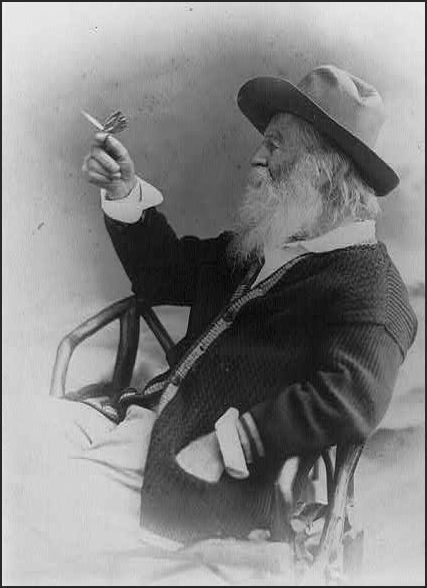
“Yes – that was an actual moth,” Walt Whitmantold his sidekick and chronicler, Horace Traubel; “the picture is substantially literal: we were good friends: I had quite the in-and-out of taming, or fraternizing with, some of the insects, animals.”
This was his myth he told of himself. He confessed to historian William Roscoe Thayer, “I’ve always had the knack of attracting birds and butterflies and other wild critters.”
The 1883 photo from the Miami Herald was his favorite photo of himself – and, like Lincoln, he relentlessly documented himself in photos. But the man who anonymously (and very enthusiastically) reviewed his own books was not one to balk at a fact.
And fact was, he was a devoted opera-goer, a man who, until the end of his life, read ten newspapers a day. He was no hayseed, but a city slicker – a Long Island born journalist and government clerk. So why the St. Francis of Assisi shtick?
It remains one of America’s great literary mysteries. One thing is clear: the gift for self-reinvention is the great seal upon the American psyche. Think Whitman. Think Lincoln. Think Gatsby. Think Obama.
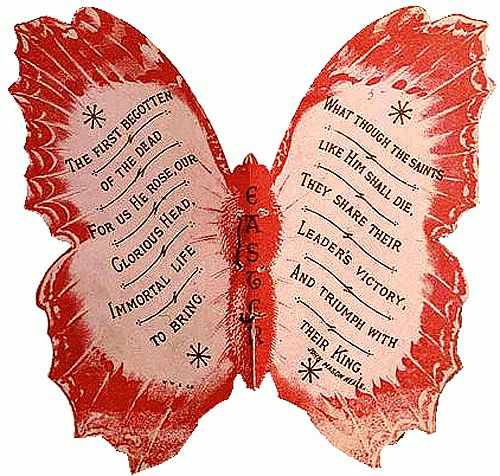
Here’s another fun fact: the alleged moth was “a gaudy cardboard butterfly produced in large quantities as part of an Easter celebration.” How do we know? In 1942, the Library of Congress shipped its most precious holdings inland. A crate with ten of Whitman’s notebooks went to Ohio. When the crate came back in 1944, the notebooks were gone. Fifty years later, in 1994, a young man showed up at Sotheby’s with four of the notebooks from his father’s estate. Thank you, sir, wherever you are: when he learned of their history, he returned them, without trying to get a penny of the estimated half-a-million dollars the cache was worth.
But here’s the big surprise: among the materials was the cardboard butterfly you see at right. The words are from John Mason Neale’s Easter hymn which began to appear in hymnbooks in the 1850s. Yup, it’s the insect from the photo.
So Whitman used the new cameras to make himself part of the poem. His own image became a dimension of his self-expression. He didn’t put his name on the title page of Leaves of Grass, he put his photo there – standing in rough clothes, the image of action, the image of the America he was writing about.
We all do that, of course. We offer a face to the world — strong, caring, reckless, intellectual, sinister. We all try to do what Whitman succeeded in doing. In the end, that fake butterfly doesn’t tarnish the poet at all; it explains him.
Whitman’s poetry was visual art. It was theater. Poetry was a process where he struggled to be one-and-the-same with the face he showed to the world. That’s surely the hardest thing any of us ever does. We try to decide whether we’re gentle or tough, while the real butterflies circle – always outside our reach.
Man of action? We think not.
Which is a fancy way of saying he lied, lied, lied. But this goes some way towards redeeming him, also describing the contents of the crate: “Here were draft portions of his epic poem, Leaves of Grass. Young Whitman described his work as a nurse in a Civil War hospital. That part gives us a very human picture of Whitman. He wrote letters for men who couldn’t write, and he recorded their deaths. He talked about requests from the wounded and dying – for an orange – even for a piece of horehound candy.”
But butterflies wafting to his finger? A PR stunt, at best. He would have given James Freyand Greg Mortenson a run for their money.
(Fun piece on the whole matter from a Leonard Cohen fan, at 1heckofaguy, over here.)
In the 1931 movie Frankenstein, the doctor’s hunchback assistant Franz raids the medical school’s lab to retrieve a brain for the monster. Whoops! He drops the jar that has the good brain and takes the bad brain instead – the brain of a demented murderer. (Video below.)
Who would have guessed that there is some factual basis for this set piece? Walt Whitman’s brain may have been on the back of someone’s mind as the scenario was written, though it cannot be proved for certain.
You see, Walt Whitman’s postmortem brain was put into some sort of a jam jar, and somebody dropped it, and it shattered. The brain, not the jar … or rather, probably, both. Or neither. Actually, it’s not certain the brain ever made it into a jar, or was dropped while it was in a sort of a rubber sack.
When I posted about “The Curious and Complicated History of Lenin’s Brain” two years ago, little did I know I would be writing a grisly sequel so soon. But scholar Brian Burrell has written an absolutely riveting account of Walt Whitman’s brain. I just discovered it (thanks to Twitter and Lapham’s Quarterly) in a back issue of the Walt Whitman Quarterly Review, the preeminent journal on America’s bard, but one not usually given to sensational revelation. (The 27-page article, “The Strange Fate of Whitman’s Brain,” is downloadable here.)
According to our scholar Burrell:
“When Mary Shelley wrote Frankenstein she made no mention of brains. To anyone who comes to the legend via the 1931 film instead of the 1818 novel, this might seem odd. But then the legend of Frankenstein has changed considerably since Shelley’s time in order to keep in step with the science that inspired it. If there are no brains in jars in Frankenstein the novel, it is because at the time she conceived the book, there were no brains in jars at all, and there would not be any for some time to come. The modern preoccupation with the human brain, it turns out, is a relatively recent phenomenon. Before Shelley’s time, very few people gave it much thought.”
Whitman wrote in 1855: “I have said that the soul is no more than the body. And I say that the body is not more than the soul.” But did he expect anyone should take this thought quite so much at face value?
Eight years after Lord Byron suggested that Mary Shelley write a horror story, the Romantic poet died, and his brain was removed at autopsy and weighed. That was the beginning. Others joined the party: Daniel Webster, Gaetano Donizetti, Ivan Turgenev, and many others had their brains removed, autopsied, and weighed, with a religious solicitude and ritual exactitude not shown since the days of the pharaohs. Great men, it was reasoned, would have magnificent and extraordinary brains. And by studying these brains, we could anatomize genius. A number of famous men felt they would be fit objects for such a study, and pledged their brains to science. Unfortunately, the weight of many of their brains fell short of expectations.
Could things get sillier? They could. And where else but France? In 1876, a French group formed the first brain donation society:
“They named it, rather eerily, the Société Mutuelle d’Autopsie (the Society of Mutual Autopsy). In their revolutionary fervor, they sealed their compact with a pledge that had the portentous ring of a fraternal oath: ‘Free thinker, loyal to scientific materialism and the radical Republic, I intend to die without the interference of any priest or church. I bequeath to the School of Anthropology my head, face, skull, and brain, and more if it is necessary. What remains of me will be incinerated.’”
Whitman showed an early interest in phrenology, a means to measure the internal qualities of a man by the bumps of his head. But he eventually outgrew this enthusiasm, citing Oliver Wendell Holmes’s remark that “you might as easily tell how much money is in a safe feeling the knob on the door as tell how much brain a man has by feeling bumps on his head.” However, in a moment of illness, the old faith returned. At least enough so that he, too, succumbed and signed away his brain. He owed it to science.
The denouement was revealed years later by the renowned anatomist, Dr. Edward Spitzka in 1907. A throwaway comment in the doctor’s magnum opus admitted that the brain was “said to have been dropped” by “a careless attendant in the laboratory.” Investigations by Whitman’s friends revealed the dismaying facts: the brain “was destroyed either during the autopsy or while being conveyed to the jar, or in the jar before the hardening process by formaldehyde had been completed” … “the records state quite definitely that the brain was accidentally broken to bits during the pickling process.” Whitman’s devoted friend William Sloane Kennedy scribbled, “This is a grewsome story!”
Time has not been kind to this particular scientific endeavor, and it’s hard to believe anyone ever took it seriously. Burrell wrote: “The founders of the Brain Society had acted on the enthusiasm of a moment of history of science that turned out to be a passing phase. Had someone not dropped Whitman’s brain, they would hardly be remembered at all.”
Spitzka, later the editor of two editions of Gray’s Anatomy, never recovered from the professional fiasco. Still in his twenties, he took to the bottle, and not the pickling kind. He began to imagine that ex-convicts were stalking him, seeking revenge for his brain snatchings at the prisons in his salad days. He had a nervous breakdown. He died at 46, and donated his brain – but there were no true believers left to study it. Brains had accumulated faster than any interest in them. Even the smart ones.
Spitzka was one of the last eminent men to be painted by Thomas Eakins, who was in his last days and could barely hold a brush. It would remain unfinished,
“except for the depiction of a plaster brain cast which Spitzka cradles in his right hand. (It was painted in by Eakins’s wife.) As Eakins left the work, Spitzka stands in ghostly outline, unrecognizable, still waiting to be immortalized. In the 1930s, the canvas was cut down from a full length portrait to make it more marketable, and the image of the brain was discarded, leaving nothing more than the indistinct outlines of a presumably great man. The painting now resides, out of sight, in a storage room of Washington’s Hirshhorn Gallery.”
A reminder of how speedily tragedy descends into farce and back to tragedy again. It’s also a reminder of the tomfoolery of hubris – scientific or otherwise. How could anyone expect that the unique concoction of an individual’s energy, will, spirit, character, élan vital, whatever, might be so easily reducible to scale measurements and creases on the brain?
After all, today we all know the real answer to the mysteries of genius and destiny lies in our DNA. That’s what the important scientists tell us.
Postscript on 6/27:Big Think has some thoughts on Whitman’s link with Dracula – and discusses the Book Haven and this column, too. It’s over here.


 Another review from the Times Literary Supplement – however, unlike yesterday’s review of Adam Johnson’s The Orphan Master’s Son, this one is online and not behind a paywall. You can read it here.