Hot new social media maybe not so new: plus ça change, plus c’est la même chose

November 2nd, 2011

Share

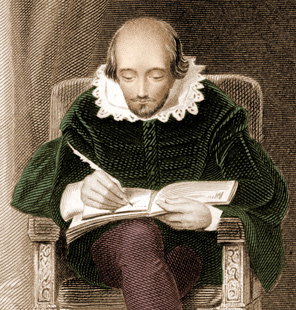
10 to 15 letters a day … and he still looks happy.

Remember a few days ago we promised that we’d have a lot more to say about the links between our hotshot social media and the information explosions that rocked previous centuries?

Well, here goes, my article earlier today:

If you feel overwhelmed by social media, you’re hardly the first. An avalanche of new forms of communication similarly challenged Europeans of the 17th and 18th centuries.

“In the 17th century, conversation exploded,” said Anaïs Saint-Jude, director of Stanford’s BiblioTech program. “It was an early modern version of information overload.”

The Copernican Revolution, the invention of the printing press, the exploration of the New World – all needed to be digested over time. There was a lot of catching-up to do. “It was a dynamic, troubling, messy period,” she said.

Public postal systems became the equivalent of Facebook, Twitter, Google+ and smartphones. Letters crisscrossed Paris by the thousands daily. Voltaire was writing 10 to 15 letters a day. Dramatist Jean Racine complained that he couldn’t keep up with the aggressive letter writing. His inbox was full, so to speak.

Stanford’s Mapping the Republic of Letters project, which forms part of the context for Saint-Jude’s remarks, shows that 40 percent of Voltaire’s letters were sent to correspondents relatively close by.

What was everyone saying? Not necessarily much. Rather like today’s email. “It was the equivalent of a phone call, inviting someone to tea or saying, ‘OMG, did you know about the Duke?'” said Dan Edelstein, an associate professor of French and the principal investigator for the project. He will be teaching a course in the spring called Social Animals, Social Revolutions and Social Networks.

Clearly, something had changed: Commercial postal services were on the rise. Though their prototypes had existed down through the centuries, they had mostly served government officials, and later (via the Medicis, for example) merchant and banking houses. Suddenly they were carrying private correspondence.

More people were writing, and more people could respond quickly, not only with friends and family, but across far-flung distances with people they had never met, and never would. Rather like some of our Facebook friends.

According to Saint-Jude, it was an era, like ours, of “hyper-writing,” even addictive writing. The aristocratic Madame de Sévigné wrote 1,120 letters to her married daughter in Brittany, beginning in the late 1670s, until her death in 1696. It was important to keep her kid up to date with the goings-on in Paris. Although she is remembered today for her witty epistles, she never intended them to be saved, let alone published.

For a time, the streets of Paris were littered with little bits of papers – les billets – filled with a few words of scabrous and politically defamatory verse that were thrown to the public. Sound like Twitter?

The little bits of paper in your pocket could cause big trouble – Voltaire landed in jail for his verse. Nonetheless, these short, anonymous postings bypassed the government censor. It was also a way of organizing uprisings. Edelstein points out that Egyptian social networks were critical to coordinating demonstrators and drawing large crowds this year.

Indeed, he noted that social networks are key to almost all revolutions. “The Egyptian youth organizers may have excelled at mobilizing people at a moment’s notice, but interestingly it’s another kind of social network that seems to be taking advantage of the post-revolutionary situation – the Muslim Brotherhood,” he said.

“This network may be less agile, but it has created longer and better sustained bonds between members over time.” Unlike Facebook networks that almost anyone can join, the Brotherhood echoed the older, more exclusive networks that vetted prospective members, such as France’s Jacobin clubs. “Flash mobs quickly splinter into cacophony,” Edelstein told an assembly of incoming freshmen last month.

What is public? What is private? More correspondence meant that letters could fall into the wrong hands. Laclos‘ epistolary novel, Les Liaisons Dangereuses, showed the dangers and disgrace that could befall the writers of wayward correspondence. In our own era, need we mention the fate that befell the indiscreet Rep. Anthony Weiner?

Meanwhile, modern journalism was born, via a precursor of the blog. Nobles, such as Cardinal Mazarin, hired their own “journalists” to report on scandal and sex in the city. These writers set up bureaus around Paris to get the juiciest news, and it was written and copied and distributed to subscribers. Literary reviews and newspapers soon blossomed, along with letters to the editor and a new environment of literary and cultural criticism.

These new networks flexed a new kind of media punch. For example, Edelstein noted that across the ocean in America, the Declaration of Independence was signed on July 2. The news was published in a newspaper on the legendary 4th. “What we’re really celebrating is not the fact that 56 men signed the declaration, but rather that a new network of people emerged around the published declaration – a network that would ultimately become the United States,” he said.

The poster was invented to invite more and more people to more and more public events – theater, for example, became the dominant art form in the 17th century. Posters mobilized these slow-motion “flash mobs.”

The new spaces we have created are virtual, not physical. But the physical spaces of the 17th century and Enlightenment were just as much of a psychological earthquake – l’Académie française, l’Académie des sciences, the celebrated salons. That large groups of people were getting together to chat about literature, discovery, ideas, revolution, or simply to watch a show, was a change from the carefully manicured guest lists of the court, where the principal order of business was big-time sucking up.

These spaces evoked new questions: How does one conduct oneself? How does one appear to others? Managing your public profile became vital. The result? A new self-consciousness was born, and a new social nervousness. The players had the same questions we have today, said Saint-Jude: “How do you curate all this information?”

“Relax,” said Saint-Jude. “You’re in good company. There’s nothing new under the sun.”

Or, “Ce qui fut sera, Ce qui s’est fait se refera, Et il n’y a rien de nouveau sous le soleil.

Postscript: Hey! We got some pick-up in the New Yorker here.


W.S. Merwin: “If something can’t be said, what do you do? You scream.”

November 1st, 2011
Share

"Famously handsome." (Photo: Dido Merwin)

Hat tip to Maureen Mroczek Morris for sending this Q&A with W.S. Merwin, former U.S. poet laureate and Pulitzer prizewinner.

In this interview with Nick Owchar of the Los Angeles Times, the poet talks about his friendship with Nobel laureate Czeslaw Milosz.  He talks about that subject at more length in An Invisible Rope: Portraits of Czeslaw Milosz, but here he talks about his relationship to technology, too:

Though Milosz is gone, can he still function as a mentor to other poets?

Oh, I think so, and I think every poet can do that. I still find myself reciting for pleasure, as I have ever since I was 18, [Yeats’] “Sailing to Byzantium” and hearing something in one of the lines that I didn’t hear before. You go on learning. What a great poem teaches you, and it’s not intellectual at all, is the resonance in the language that’s heard there. This goes back to the very origins of poetry and to the very origins of language. I think poetry is as old as language, and both come out of the same thing — an effort to try to express something that is inexpressible. If something can’t be said, what do you do? You scream. You make some terrible noise of pain or anguish or anger or something like that. You make a sound, an animal-like sound which, with time and society trying to calm you down, begins to take shape into something.

Is there still a place for this kind of primal expression in our wired-up culture?

I wonder, and I think one of the problems about so-called virtual reality — which is not even virtual and it’s certainly not reality either — is that homo faber [“man the creator”] is a creature who has made things that substitute for him doing them himself. These things may do them more conveniently, but they always atrophy his abilities to do them at all.

I’d guess that you probably don’t tweet.

No, and I don’t use email either.

Still a mentor

Yes, but convenience seems to be the answer to why we do everything now. I can’t believe it. That reminds me of something Czeslaw once said not to me but to [Milosz’s wife] Carol. They were coming to stay with us on Maui, and our home isn’t easy to find. It’s a little remote, and you can’t see it from the road. Czeslaw told Carol, ‘Wherever we go to see William, I know one thing. It’s always going to be a little hard to get there, and there won’t be many other places around it.’ It’s true. All of the places I’ve ever loved in my life have been inconvenient, and that has been part of the beauty too, you know.

It’s the same with poetry. What about the student who asks, ‘Why do we need to memorize a poem when we can find it on the Internet?’ In other words, why should I have this experience when I can allow the computer to have it for me? That is one of the things that still makes me deeply suspicious.


Future of humanities? “Death,” says Michel Serres, and pauses. “Maybe.”

October 31st, 2011
Share

Resident Socrates (Photo: L.A. Cicero)

A few days ago I wrote about Michel Serres new book Malfeasance.  But I didn’t have a chance to post the video, on that post or an earlier one.  Now I can.  It’s below.

He is a member of the Académie Française, one of its 40 immortels, and he is one of the most recognized public intellectuals in France.  Not here.  Why?  He’s not comfortable in English, and teaches his Stanford classes in French.  This video is one of the rare opportunities to hear him in English.

He comes to the sunny California for only a couple quarters a year, and has been doing so for decades – he’s here now, in fact. I had a chance to drop in on a class recently, the German Library is crowded, and not with the usual student types.

As I wrote in 2009:

His class attracts an eclectic and loyal coterie beyond its enrolled students—three decades is time enough to accumulate a following. A typical class might include a Silicon Valley mogul and his wife, a prominent publisher from Paris, a Stanford physics professor emeritus.

“Michel Serres presents his lectures in the form of fascinating questions, which he gradually answers and makes you feel as if you were participating in the thought process. His thinking is innovative and dynamic,” said Hélène Laroche-Davis, professor of French and film studies at Notre Dame de Namur University.

Alix Marduel, a former internist at Stanford and now a Palo Alto-based venture capitalist, said that Serres brings one thing that is AWOL in most philosophical discussions: passion….

“They are very well known as writers, but they have problems in France because they are unclassifiable. These kinds of people are disappearing. They don’t exist anymore—people who have encyclopedic knowledge, people who know civics, math, communication, science, anthropology. They are the rare and last humanists—what humanists used to be in the 16th century,” said Audrey Calefas, a doctoral candidate who has been Serres’ personal assistant for several years at Stanford (“out of friendship, really,” she added).

Enjoy the video (that’s Humble Moi in the red sweater in the opening shot):

Shakespeare or the Earl of Oxford? “It’s a shame sometimes that dead men can’t sue.”

October 30th, 2011
Share

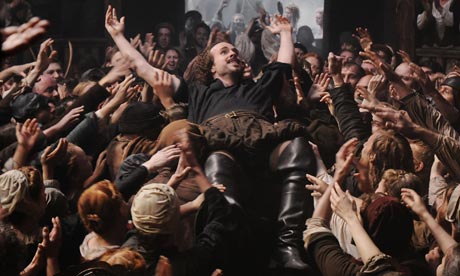
Rafe Spall as William Shakespeare ... or is it the Earl of Oxford?

Anyone who has attempted a novel, play, or screenplay based on real people, or a real event, has faced the difficult question: How much do you make up?  Do you make two people fall in love because it tidies up the script nicely – even though there’s no historical evidence for it?  Do you vilify a nice-man composer like Antonio Salieri because of a few rumors that started decades after his death – even for a top-notch script like Peter Shaffer’s Amadeus, which was further cemented in the public mind by a couple remarkable screen performances?  At what point are you simply defaming the dead?

Screenwriter John Orloff feels completely comfortable making stuff up for Anonymous, a new movie about the eternal Shakespeare authorship question.

Spoiler alert: Edward de Vere, the Earl of Oxford did it, and William Shakespeare was merely the front man in this version, which the New York Times called the “cold-blooded murder of the truth.” David Riggs told me the only reason the gullible seek out alternative authorship for the plays and poems is that people are generally unaware of what top-notch grammar schools the Elizabethans had – he wrote about it in The World of Christopher Marlowe.

Here’s another story that should discredit the theory: I actually knew of someone who had gone through the Earl of Oxford’s letters.  The man couldn’t write to save his life.

Rhys Ifans as Edward de Vere ... or is it Shakespeare?

Orloff is not a deep thinker, and the Wall Street Journal should be ashamed of printing platitudinous, clichéd passages like this:  “But I also wanted to tell a rocking good story and to express a theme that matters to me a great deal: that the pen is mightier than the sword.”

It gets worse.

The truth is, there is no truth in film—in any film. Even the films that we think are true, about real people in real places, actually aren’t.

This might seem obvious, but the emotions of a movie often overwhelm our intellect, blurring the line between fact and drama. We walk away feeling as if we have witnessed history.

But does this make a historical drama inferior to a history book or a documentary based on the same subject matter? Not necessarily.

Whatever a film might lack in literal truth, it can be far better at expressing the emotional truth of an event. [You don’t say! – ED]  In a movie, an audience can become connected to characters in a way that they often can’t in a straight historical account.

And this: “And, as I said, the film is not really about the Essex Rebellion. It is about showing that ideas are stronger than brute force. So how to make that point without wasting 20 minutes of the audience’s time?”  If the audience isn’t prepared to waste time, they shouldn’t be in the movie theater in the first place.

Then Orloff compares his historical liberties with those of Shakespeare himself.

This is a case where the comment section probes the issues more closely than the author of the article appears to have:

Harumph.

From Bill Wood:  “Nothing justifies outright lying to an audience. It’s one thing to present the argument that Shakespeare didn’t right [sic] his own work. It’s an idea that is baloney … It might make good drama. But it is also a lie. And most people will never bother to read the works which demonstrate what bunk it is.”

From David Brown: “One possible answer to Orloff’s question of how to make a point without wasting the audience’s time is to write your own story. If the history doesn’t support the story you want to tell, pick a different history that does fit – or just write your story without the crutch of misrepresenting great names and events.

From John Tufts: “Yes, stories exist to tell deeper truths, but Mr. Orloff is kidding himself if he thinks his movie is in the pursuit of truth. Neither movies nor theater, nor music, nor poetry, nor any art form has ever been very good at presenting what is real, but the history of all art has existed and been very successful at showing us what is true. That’s what makes Richard III great. Ultimately, it’s not about the real Richard III, it’s about the power of language, and the seduction of evil. Henry V isn’t about the real Henry Monmouth, it’s about the cost of war, and the challenges of leadership. These plays bend what was real to arrive at an essential truth. But for Mr. Orloff to say that he’s doing the same is nonsense. He’s bending what was real to arrive not an essential truth about the human experience, but instead to arrive right back where he started – a claim about what was real. He bends history to write not a great nor true screenplay, but a bad, and very unreal melodrama.”

Donald Forbes: “To aver that there is ‘no truth’ makes impossible any attempt to understand anything. There are no such things as facts, merely assertions of points of view. Relativism as usual morphs into nihilism and destructiveness. …”

As Thomas Conway, Jr., wrote, ” it’s a shame sometimes that dead men can’t sue.”

Was the blogosphere born in the French Enlightenment?

October 28th, 2011
Share


My friend, Anaïs Saint-Jude, sent me the link for this short piece, which brings the noble trade of blogging into disrepute.

Robert Darnton compares today’s blogging with what he considers an early-modern precursor, the “nouvelliste“:  “Gossip mongers who worked oral circuits of communication were known as ‘nouvellistes de bouche.’ When they reduced news to written anecdotes and strung the anecdotes together in manuscript “gazetins”, they graduated into the ranks of ‘nouvellistes à la main.”’

A couple samples of the genre:

The prince de Conti was knocked out of commission by a girl known as the Little F…..He blames it on Guerin, his medical advisor.

The duc de … surprised his wife in the arms of his son’s tutor. She said to him with an impudence worthy of a courtier, “Why weren’t you there, Monsieur? When I don’t have my esquire, I take the arm of my lackey.”

Well, of course I’d argue that not all blogging is of the scalding political kind, and not all of us are boiling scurrility and celebrity into one nasty soup.  Some of us politely exchange views about Tolstoy or Stendhal over our Limoges teacups.

Still, it’s reassuring that the much-ballyhooed breakdown of civility did not begin last year, despite the sanctimonious pronouncements of politicians.

The aptly named Amanda French, commenting on Darnton’s article, did her own research on the salon and journal culture of early 19th-century Paris – a bit later than the nouvellistes, admittedly – and was struck by this comment from the noted saloniste Delphine de Girardin, which she translates for us:

Finally, they say, “It’s hard to make a name for yourself in Paris.” Lie! Nothing is easier today. Published every morning, printed every week are a hundred enemy journals and twenty rival reviews that do nothing but talk, and which esteem themselves only too happy when you want to furnish them with some amusing pages for nothing, giving them the chance to say something a little malicious about their enemy while you show off. Nothing is easier for a young man of talent than to make a name in the journals. Ask rather about these old journalists without talent who are so celebrated.

“Boy, did that remind me of the blogosphere,” she writes.

But Darnton implies that these pre-bloggers were more than lazy gossip mongers. They may have lit the match that sparked the revolution:

“The anecdotes constituted the early-modern equivalent of a blogosphere, one laced with explosives; for on the eve of the Revolution, French readers were consuming as much smut about the private lives of the great as they were reading treatises about the abuse of power. In fact, the anecdotes and the political discourse reinforced each other. I would therefore argue that the early-modern blog played an important part in the collapse of the Old Regime and in the politics of the French Revolution. …

“I don’t believe that history teaches lessons, at least not in a direct, easily applied manner, but it does raise questions. Are blogs disrupting traditional politics today just as ‘libelles‘ did in eighteenth-century France?”

Over our teacups, we might point out – delicately of course – that Darnton himself is writing on a blog, denouncing the art of the blog from the blogosphere.  In fact, he himself realizes the irony as he pens his piece on the New York Review of Books blog.

Read more in his book,  The Devil in the Holy Water, or the Art of Slander from Louis XIV to Napoleon.

And we’ll have more to say on this topic at the Book Haven in a few days.

Postscript on 10/30:  Dave Lull sent me this link from 2Blowhards on the coffeehouse culture: “I’m not the first observer of the web and of blogdom to be reminded of the 17th and 18th century coffee-house. ‘It’s open! And everyone is having a say!’ – the parallels between now and then are striking. Even so, I haven’t yet run across a brief blog-intro to coffee-house culture. What was this coffee-house phenomenon about anyway?”  Check it out.

Rick Banks and his controversial question: “Is Marriage for White People?”

October 26th, 2011
Share

Provocative author (Photo: Natalie Glatzel)

My friend Elaine Ray has an interesting recent post on Rick BanksIs Marriage for White People?, a book that, with a title like that, has obviously gotten a lot of attention.  She did a short Q&A with him here.

These days, “black women are about half as likely to be married as their 1950s counterparts,” he writes. “Marriage has also declined among black men, fewer than half of whom are husbands.”

Elaine’s interesting blog, My Father’s Posts, honors the journalism of her father, Ebenezer Ray, who emigrated to the New York from Barbados.  He died when she was 13.  Last month would have marked her parents’ 63rd wedding anniversary.  She describes her parents’ courtship and marriage this way:

I don’t know if my parents had planned to get married anyway or if the pregnancy [with Elaine’s older sister] forced their hand. There also is the possibility that my mother’s father, John Henry Brown, a  piano mover who is said to have been around 6’4″ with a shoe size in the vicinity of a 13 EEE, might have offered a bit of “encouragement.” My dad was 5’4”.

My father was a printer by trade; and though he was quite erudite, I don’t think he had a college degree. My mother, a social worker and teacher, did.  Until my dad’s death, their 19-year marriage seemed sturdy and stable. For most of their life together, before my father took ill, they were able to live on his salary. My mother was a stay-at-home mom, an arrangement my father preferred.

Faced with the same set of circumstances today, would my parents’ marriage have survived?  Would they have even gotten married in the first place?

Her own story is a quick review of some of the social dynamics within the African American communities decades ago.

Banks says he is offering no advice in his book, but he does conclude that black women might find their professional and intellectuals equals in other races.  Hence, the uproar. I guess I don’t quite understand.  Hasn’t interracial marriage been happening for some time now, in both directions?

One excerpt from Elaine’s interview:

ER: What kind of reactions have you gotten from black men to your book?

Ebenezer's daughter (Photo: Photo by Rachael Behrens)

RB: The reactions range from very positive – Kirkus Reviews described the book as “Triumphant”– to very negative. I’ve been called a “racial pimp” who is trying to “profiteer” off black women’s difficulties with “sensationalized bullcrap”  In addition to my “reprehensible title” I have been told that the book “relies on haphazard, shabby research and unsubstantiated theories wrapped in hollow, sophisticated rhetoric to make you give it a good look.” Of course, these comments are all from people who I know for certain haven’t read the book. 
 Those people who have read the book are struck by its candor, insight, and writing. My favorite response is from a New York Times editor who told me it was “unputdownable.”  One of my aims with the book is to promote a national discussion about the obligations of black women to black men.  The issues are complicated and emotionally fraught, and are perhaps best captured in the question of one CNN viewer: Do black women deserve better than what black men have to offer?

Aside from Kirkus, I think the reviewers were black men. Others are supportive, even if they don’t like, as my brother-in-law put it, “giving the white man a hunting license to take the black man’s woman from him.” “Brothers done lost so much,” he said, “now the woman going to be taken away too!”

I bristle a bit that men still talk about women this way,  as if women were objects without agency, to be passed or ceded from one party to another.  I know, I know, he’s only quoting.  Still I bristle.


<<< Previous Series of PostssepNext Series of Posts >>>