Prime Time at Kepler’s: Jane Fonda is getting more out of life

September 8th, 2011

Share

Packing it in ... at the National Museum in Kraków

Several years ago in the National Museum of Kraków, I remember studying the Botticelli portrait of Giuliano de Medici, a historical figure previously unknown to me.  I was transfixed by the arrogant tilt of the head, the self-confident expression, the full possession of his black curls, his youth, and his virility.

Naturally, I wondered what became of him. What future was he blithely unaware of in this this portrait?  So I looked it up.

He was co-ruler of Florence in the 15th century, the “golden boy” – a handsome, athletic, renowned patron of the arts.  His illegitimate son by his mistress Fioretta Gorini, Giulio di Giuliano de Medici, became Pope Clement VII.

He was assassinated by a rival clan on 26 April, 1478, in the Duomo of Florence, killed by a sword wound to the head and was stabbed 19 times.

He was 25 years old.

They certainly knew how to pack it in back then.  But that got me to thinking about all those rulers and leaders and authors and statesman who were called cruel or neurotic or selfish or greedy.  Are they famous for traits they would have outgrown had they simply lived longer?

Remember, for example, when you judge Mr. Darcy harshly that he is a mere 28 years old, and Lizzie Bennett is just 20. Who among us does not regret being haughty, vain, or silly when they were Lydia Bennett‘s 15?  Most of us live it down.
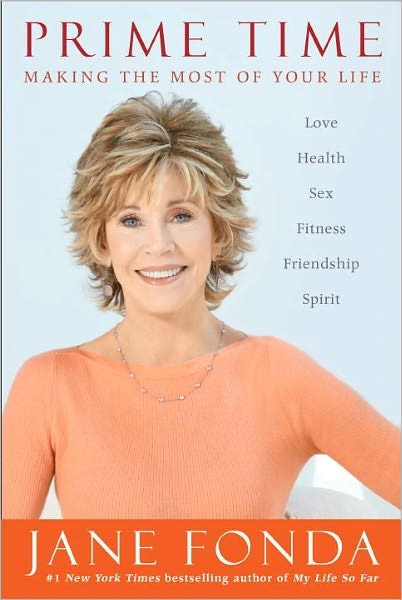
This is a long way to coming around to Jane Fonda‘s appearance at Kepler’s last month.  She is still living down the ill-advised moment she climbed into the seat of an anti-aircraft gun in Hanoi in 1972.  She was 34.  All those workout videos and film cannot erase that indelible moment.  Should it?

And here she was a few feet in front of me. (Video below. The first with my Droid. I’ll get better. Really I will.) Now she’s 73 and peddling a book called Prime Time.  She’s a cheerleader for the Boomers.

And admittedly a good looking one, no matter how much surgery it took.  She was glossy and very thin under a bushel of hair and tinted glasses. As she donned her reading glasses, she said she had “lost eyesight but gained insight.”

The room seemed to be filled largely with Boomers.  She gave a shout-out to Laura Carstensen of Stanford’s Longevity Center, with whom she had been spending time during her swing through the Peninsula.

She touched on Carstensen’s main themes: we are, on average, living 34 years longer than earlier generations. What are we going to do with all the time?

“A third of how well we do aging is genetics.  Two-thirds is us and the decisions we make.”  Over time, she said, we have “less of an ego-stake in the outcomes.”  She also said, “The art of being wise is the art of knowing what to overlook.”

She began talking about sex for the elderly, getting a ripples of knowing, cougar-like chuckles from the audience.  She recommended computer dating.  “Over here! Help me, Jane!” one called out.  “Match me up, Jane!”

She had a piece of good advice for one of the few young women in the audience (it was almost entirely women): “It gets better,” she said. “Understand that ‘no’ is a complete sentence. Your body is yours. Honor it. Don’t let anyone make you feel bad about it.”

Who would she go back to in time to talk to?  “Jesus.”  Who besides Jesus. “Eleanor Roosevelt.”  I didn’t quite follow the line of thinking.

Someone asked her about becoming a Christian.  “It changed my life. It also ended my marriage [to Ted Turner].”

“It has given me a core, a center. …Once we understand spirit, we’re strong.”

She cited Viktor Frankl, and said that a key to living well and longer was “generativity” – a fancy word for sharing.  But if caritas is merely another form of self-improvement – is it love at all? Isn’t it simply something else we are doing for ourselvse?

I had never seen Kepler’s so crowded. The room was transfixed.  The crowd was well educated, well heeled, well groomed.  They had everything, and many of them didn’t seem to know it.  They wanted to know how to get more from their lives.

But isn’t there an age when we should simply be giving more?

Can poetry save the world? Zagajewski, Auden: the poets of 9/11

September 7th, 2011
Share

"Try to Praise the Mutilated World"

Matthew Kaminski of The Daily Beast says that Adam Zagajewski was “The Poet of September 11,” thanks to his poem “Try to Praise the Mutilated World.”

Well, not quite so.  That honor belongs to W.H. Auden, with his “September 1, 1939.”  Let’s say that Adam was the greatest living embodiment of that atrocity:

“Try to Praise the Mutilated World” recalls a trip Zagajewski took with his father through Ukrainian villages in Poland forcibly abandoned in the population transfers of the post-Yalta years. “This was one of the strongest impressions I ever had,” he says. “There were these empty villages with some apple trees going wild. And I saw the villages became prey to nettles; nettles were everywhere. There were these broken houses. It became in my memory this mutilated world, these villages, and at the same time they were beautiful. It was in the summer, beautiful weather. It’s something that I reacted to, this contest between beauty and disaster.”

"We must love one another or die"

I have to agree with Adam – and I guess it’s sacriligeous to say it this week – that 9/11 didn’t change my fundamental worldview, which always included a mysterious allowance for evil in human goings-on. He thinks, however, it has changed our collective response to trauma. In “the past in general and not only in Europe,” he says, “the rule was to forget, to move on. There’s a relatively new idea that you have to work on it—that you have to keep everything in our memory. Which I like. It’s changing us. I don’t think people in the mid–19th century were going back to the Napoleonic wars and thinking, ‘We have to work on it’?”

Goodness, I wish that were the case.  The way I see it, memory has all but evaporated.  I was speaking to jazz artist Jim Cullum recently, and he was telling me about classes he taught, filled with bright students – but when he wrote “December 7, 1941” on the board, they had no associations with that date.

Kaminski says Adam “often purrs his words and speaks slowly” – well, not quite.  In America, we call it a kind of Polish drawl. I  recall someone hesitating to invite Adam as a speaker on a panel because, well … you really never knew how long a sentence from Adam would take.

I like this paragraph from Kaminski’s piece the best:

Polish poets have long thought of themselves as national bards, called to engage with the harsh world around them. “Polish poetry is one of the marvels of 20th-century literature,” wrote former U.S. poet laureate Charles Simic, who cited its “one rare virtue: it is very readable in a time when modernist experiments made a lot of poetry written elsewhere difficult.” Zagajewski says some critics see “something barbarian” in Polish poetry’s emphasis on meaning over syntax or style. “I’ve heard some French poets say Polish poetry is just journalism, because you can understand it.”


From the March event at NYC’s 92nd Street Y, which I wrote about here:

Maya Angelou is complaining – and she’s right.

September 4th, 2011
Share

Not arrogant. (Photo: Something Original, Creative Commons)

Somehow, in all the events of Hurricane Irene and the crashing economy, I missed the quiet unveiling of the impressive and dignified Martin Luther King, Jr., Memorial on the National Mall.  It was probably a smaller event than originally envisioned, pre-earthquake, pre-hurricane. (We wrote about MLK a few days ago, in connection with the postponed opening).

So when I first saw the headline that poet (laureate) Maya Angelou was kvetching about King’s words on the statue, saying it made King sound “arrogant,” I thought, well, that she was just kvetching, the way everyone on the internet kvetches.  I ignored the article.

Then I read it.  She’s right.

Here’s what’s one of the inscriptions, placed on one side of the statue says:

“I was a drum major for justice peace and righteousness.”

Here’s what King said on Feb. 4, 1968, two months before he was assassinated, in a sermon at Atlanta’s Ebenezer Baptist Church about a eulogy that might be given in the event of his death:

“If you want to say that I was a drum major, say that I was a drum major for justice. Say that I was a drum major for peace. I was a drum major for righteousness. And all of the other shallow things will not matter.”

Context is all.

Get out the chisel, Washington.

Postscript #1 : Elaine Ray wrote in to say: “I like your bookhaven item on the King monument. Just wanted to clarify that the opening of the monument was not postponed. In fact, the monument had a quiet opening days before the scheduled dedication. It was the dedication that was postponed.” Also read her comment and link in the comments section below.

From Jim Erwin: “Maybe I’ll feel differently once I see it in person, but from the photos it looks like Stalinist monumentalism, which could hardly be more wildly inappropriate for the subject. I suspect Frederick Hart, who did the ‘Three Soldiers’ Vietnam memorial sculpture, could have come closer.”

Winston Churchill “lived from book to book, and from one article to the next”

September 3rd, 2011
Share

Time Magazine‘s list of “bests” are often a pile of rubbish – but I was gratified to see one personal favorite given pride of place in “All-TIME 100 Best Non-Fiction Books“:

The Last Lion: Winston Spencer Churchill: Alone, 1932-1940 (published in 1988) was William Manchester‘s sequel to The Last Lion: Winston Spencer Churchill: Visions of Glory, 1874-1932 (published in 1983). Alone picks up the story with Churchill cast into the political wilderness and entering what the author believed was the most crucial period of the politician’s extraordinary life — his “finest hour,” if you will — which culminated in his becoming Prime Minister of Britain in 1940, his country once again at war with Germany. Churchill, as Manchester poignantly puts it, “resolved to lead Britain and her fading empire in one last great struggle worthy of all they had been.”

I read this unforgettable book some years ago – stunning, in its step-by-step revelation of Winston Churchill‘s dogged, determined, and humiliating journey through the 1930s to warn a resistant England of the growing dangers of Hitler’s Germany. The war weary U.K. was famously allergic to evidence and eloquence, leading it to the brink of annihilation when Hitler finally attacked.

His study at Chartwell

Partly it was in Churchill’s nature to be so.  In his first book he wrote: “Nothing is so exhilarating as to be shot at without result” and “There are men who derive as stern an exaltation from the proximity of danger and ruin, as others from success.” But the fortitude to face humiliation, rejection, and loneliness is never nature alone.

I was so impressed by Manchester’s book, his last, that I gave a copy to Toyko rock star, and peacenik Agnes Chan when she took her PhD at Stanford in 1994 (she’s the UN Goodwill Ambassador for Japan).  It is at once a depressing and a fortifying work for the peacemakers of the world, but offers a salutary lesson: Peace without justice is no peace, and, as Augustine said, “Charity is no substitute for justice withheld.”

But something else impressed me.  Few know that Churchill made his living as a journalist.  Every night, in his magnificent Norman-era estate Chartwell, after the nightly dinner party with tuxedos and evening gowns, silver buckets of champagne, the Gruyère, the pâté, soup, oysters, caviar, after the port, brandy, and cigars were finished, he would shuffle up to his study at about 11 p.m. and begin his working day in his slippers, “entering through the Tudor doorway with its molded architrave…”

Churchill's desk at Chartwell

Manchester writes:  “Only after entering his employ will [his assistant] Bill Deakin discover, to his astonishment, that Churchill lacks a large private income, that he lives like a pasha yet must support his extravagant life with his pen. The Churchill children are also unaware that, as [his daughter] Mary will later put it, the family ‘literally lived from book to book, and from one article to the next.’ Her mother, who knows, prays that each manuscript will sell.”

“…he enters the room in his scarlet, green, and gold dressing gown, the cords trailing behind him. Before greeting his researcher and the two secretaries on duty tonight, he must read the manuscript he dictated the previous evening and then revise the latest galleys, which arrived a few hours earlier from London. Since Churchill’s squiggled red changes exceed the copy set – the proofs look as though several spiders strained in crimson ink wandered across the pages – his printers’ bills are shocking. But the expense is offset by his extraordinary fluency. Before the night is out, he will have dictated between 4,000 and 5,000 words. On weekends he may exceed ten thousand words.”

I envy the fluency.  I envy the output. I even envy the study, in the oldest, 11th century part of Chartwell.  And above I envy the courage, bravado, and style.  I do not envy the pâté de foie gras, the trout, the shoulder of lamb, lobster, dressed crab, Dover sole, the roast beef, and the endless gin.  It’s an astonishment they all did not perish before 30.

Donald Hall laughs at death

September 1st, 2011
Share

Brush with fame, brush with death

Donald Hall‘s newest collection, The Back Chamber, arrived in my mailbox the other day.

I was at the University of Michigan during the years Hall was teaching, but I never crossed paths with Ann Arbor’s preeminent poet (by that time, Anne Stevenson had returned to England and was only a legend there). The small university burg is where he met and married poet Jane Kenyon.

In the postwar years, he spent a lone year at Stanford, but that was enough to fall under the spell of Yvor Winters.  Long before my day, however.

I would meet the poet finally at the West Chester Poetry conference in Pennsylvania, about a decade ago.  And a few other occasions since – even interviewed him once.

By that time, the former U.S. poet laureate had already survived metastasized colon cancer, against the odds.  As he was recovering, Kenyon succumbed to leukemia.  In his famous poem of mourning, “Kill the Day,” he wrote: “How many times will he die in his own lifetime?”

Now he’s 82 years old.  I wrote about his receiving the National Medal of Honor in Washington earlier this year.

I remembered all these brushes as I leafed through the new volume.  He defeated death once, perhaps many times, and now he mocks it in “Apple Peaches,” riffing on the jump rope rhyme:

Apples, peaches,
Pumpkin pie.
How many years
Until I die.

Here are two of his variations:

Hostess Twinkies,
Wonder Bread.
How many springs
Until I’m dead?

The New York Times,
Le Monde, Der Sturm
.
How many breaths
Before the worm?

Newspapers, advertisers, and book reviews – cont.

August 31st, 2011
Share

A few days ago, I posted about “The future of book reviewing and one cranky man.”

I wrote about the absurdity of newspapers expecting book review sections to be supported by advertising from the strapped book industry:  “Of course, sports sections aren’t asked to support themselves by the advertisements of sports stores or the manufacturers of catcher’s mitts, so this standard has always been unevenly applied.”

In the comments section, medievalist Jeff Sypeck asked:

Is there a reason newspaper executives have behaved as if the ads in a book-review section could only be for books and publishers and similar literary/cultural products? Is it a lack of demographic info about book buyers for the ad sales people to tout? The unwillingness of, say, tire manufacturers to advertise alongside reviews of novels? A belief that the book section ought to be free of commercialism? Mere tradition or habit?

Good question.

Frank Wilson at Books Inq. explained the simple demographics of newspaper advertising succinctly: “the point is that a book section would attract more readers to a newspaper – even a lot of people who watch baseball read – and the more readers you have, the more advertisers you get.”

Not a reader anyway

Literary people read lots of things besides great literature and book reviews – they’re more likely to read newspapers in general.  As Jeff has pointed out before, that’s a much better bet than trying to get stoners to read.  Said Frank:

Newspapers flap their wings hoping to attract young readers by reviewing pop music, but those (theoretical) young reader don’t care what newspapers think about what they’re listening to. I certainly didn’t care that the local pop music reviewers thought little of Elvis when I was in high school. I also wouldn’t have cared if they’d thought the world of him.

But the experience of listening to music is fundamentally different from the experience of reading. Readers want to know what others have to say about what they have read. It’s an extension of the reading experience. Reading about the music you have heard is not an extension of the listening experience.

Maybe if more newspaper executives did some reading of their own, they would understand.

More comments followed. Jeff again:

Your last point reminds me of how for more than 15 years, the Washington Post has been trying to lure young people with reviews of video games and hip-hop concerts, apparently misunderstanding how many outlets are already devoted to discussing those subjects with greater affection and thoroughness. Time has shown them to be unlikely and unsuccessful ways to lure new readers to old media.

More comments at Books, Inq. here.
.

<<< Previous Series of PostssepNext Series of Posts >>>