Eavan Boland’s new book: “her brilliance justifies the journey”

June 26th, 2011
Share

I’ve only met the eminent Irish poet Eavan Boland a handful of times, but we have one unexpected thing in common:  both our books – her A Journey with Two Maps: Becoming a Woman Poet and my  An Invisible Rope: Portraits of Czeslaw Milosz – were named in Publisher’s Weekly top ten books for the spring, in the “Belles Lettres and Reflections” category.  (You can read my euphoria here.)

I was reviewed in the Times Literary Supplement in May, and on June 10, so was she.  High praise from Abigail Deutsch:

“Delightfully surprising critiques spring from her analysis. The bland poet Speranza, Boland writes, subjected her poems to a ‘word-bath of acid, in which details and subtleties are dissolved”. Of Charlotte Mew, Boland notes: ‘There is a sort of salt and spray about reading Mew for the first time: her poems are not like anything else’. This formulation conveys the reader’s proximity to something at once thrilling and perhaps threatening. Boland has a rare gift for providing critical evaluations so compressed and illustrative that they approach poetry themselves.

That control sometimes slips. Boland takes a roundabout route through this volume; before introducing her ideas, she will often explain why we might dismiss them and point out why we shouldn’t. Her terms can be vague, and her organization tortuous. She loops about the concept of the ‘domestic poem’, for instance, several times. But when she finally homes in – using the concept of the sublime to explain the disparagement of the domestic – her brilliance justifies the journey.”

A Poetry Foundation interview with Eavan, “Of Antibiotics and iPods,” is here.

Meeting cyber-friends in Kraków: George Gömöri and Miłosz’s “Antigone”

June 25th, 2011
Share

Working on an edited volume is a lonely business.  One’s “relationships” with contributors are often no more than characters on a screen, as you work through the cycles of cyber-fights and cyber-calms, editing and proofreading back and forth in what passes for “together” online.

Inevitably, I developed imaginary pictures of the objects of my ether-relationships while working on An Invisible Rope: Portraits of Czesław Miłosz.  For example, I imagined my Hungarian contributor, George Gömöri of Cambridge, as a slightly crotchety curmudgeon, set in his ways and writing on an antique Mac with an enlarged screen for the sight-impaired (with a thick Hungarian accent). Nothing in his writing style or our correspondence suggested such a portrait, it was cut out of whole cloth, probably based on something as random as someone from my distant past with a similar name.

Travel always brings surprises, and one of mine on my trip to Kraków in May was meeting contributor George, the author of many books on Polish and Hungarian literature (Miłosz maintained there is a particular affinity between the two peoples), at the Jagiellonian University conference where we both spoke.  He was hardly a creaky recluse. He was charming, good looking, and cosmopolitan (with a pronounced English accent).  And he had a lovely wife, Mari, by his side – she is the dedicatee, it turns out, of many of his poems.

He also had a letter in the most recent Times Literary Supplement, which now I read through his wit and affability:

A Hungarian traveller

Sir, – Julian Evans mentions a Hungarian traveller, in his review of three books about travel (June 3), whose “erudition” according to him “is not to be trusted”, for he mixed up Cambridge (Cantabrigia in Latin) with Canterbury (Cantuaria). This error was made by Márton Szepsi Csombor, the author of the first great Hungarian travelogue, Europica varietas, who visited London in May 1618 and whose description of most foreign lands is usually accurate and rich in verifiable detail. Mixing up the Latin names of two towns in England does not mean that Szepsi Csombor was not erudite. He had certainly wanted to visit, as he puts it, “the famous academy where Whitaker and Perkins taught” and when, reaching Canterbury, he realized his mistake, the only reason why he did not make his way back to Cambridge was his lack of money – he found England too costly for his purse. Yet some weeks later, our Hungarian spent a whole day at the Sorbonne, listening to an immensely long academic discussion in Latin and enjoying it fully. Perhaps his erudition was after all in better shape than his finances.

GEORGE GÖMÖRI
Darwin College, Cambridge.

Anyway, one of the pleasures of An Invisible Rope was the chance to publish George’s (and Richard Berengarten‘s) translation of Miłosz’s “Antigone,”  that had not appeared in previous collections in English, but was published in The Hungarian Quarterly in 2001:

To accept what happens just as one accepts
Seasons piling pell-mell on one another,
And on our human world to cast the same
Indifference as on mute Nature’s transformations?
So long as I shall breathe I shall say—No.
Do you hear me, Ismene? I shall say—No.

That passage, as well as this one, are vintage Miłosz, touching on themes haunting his poetry:

Fools alone believe they can live easy
By relegating Memory to the past.
Fools alone believe one city falling
Will bring no judgement down on other cities.

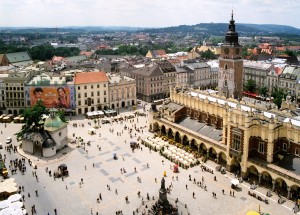
Meanwhile, my clumsy Droid photos above right – they are among my first, taken in the the Miłosz Pavilion set up in Szczepanski Square. But you get an idea of the hustle and bustle of the setting – you can see better photos of it here.

Orwell Watch #11: One man’s lonely war against cliché

June 23rd, 2011
Share

“The internet is not destroying the language after all, then, but giving us new ways of shaming its most prominent practitioners into using it better. Let us set politicians a quiz. What are guarantees always made from? Cast iron. And with what are their bottoms made? Copper. And what are they not worth? The paper they are written on. (Or, alternatively, the paper that they are not written on.) For whom do politicians speak? The silent majority. Or hard-working families. Especially the ones who work hard and play by the rules.

Well, it turns out that the silent majority want to read and hear fresh, clear and original language. So go to independent.co.uk/bannedlist and nominate your suggestions for inclusion. I’d say we should crowd-source this project, but I’ve put crowd-source and project on the Banned List.”

A man after my own heart (whoops! another one!)

These are the … dare I say it? … fighting words from John Rentoul of the Independent, and I’ve just discovered his cliché column.

The phrases that make him grind his teeth don’t necessarily make me grind mine – apparently, “any time soon” is the one kicked him over the edge – but he’s fingered “progressive” as an empty bit of self-congratulation, a charge that earned me some brickbats when I wrote about it here.  But how did he miss “heads up”?  Or “take responsibility for” when referring to those who will do nothing of the kind (I wrote about that one here)?

From the top 100  (check them out for yourself here:

1. Celebrating diversity.
2. Inclusive.
3. Black hole (in a financial context).
4. The elephant in the room.
5. Perfect storm.
6. IMO, IMHO, LOL, ROFL and so on. I mean, whose opinion is it going to be? Genuinely witty abbreviations, however, are permitted, for example, QTWTAIN, YYSSW, IICRS (Questions to Which the Answer is No; Yeah, Yeah, Sure, Sure, Whatever; Iraq Inquiry Coverage Rebuttal Service).  [Shall we add WTF? – Ed.]
7. Vibrant (when used to mean lots of non-English people).
8. It’s in his/her/their DNA.
9. Let’s be clear.
10. “The truth is…” before the peddling of an opinion.
11. Any journey not describing travel from A to B.
12. A no-brainer.
13. What’s not to like?
14. Max out (in relation to credit cards only).
15. Coffee, the waking up and smelling thereof.
16. Out of the box (especially thinking).
17. Radar, to be on someone’s, or to be under the.
18. “All the evidence tells us” to mean “I’ve read something about this somewhere that confirms my prejudices”.
19. Stakeholder.
20. Who knew?
21. “And yet, and yet …”
22. The suffix -gate added to any news theme supposedly embarrassing to a government.

I shudder to think how many of these I have used – and not in the distant past, but recently. Sometimes hourly.

Also banned this month:

“What a difference a day makes”, which was used on Newsnight to mean: “Yesterday we reported something and today the Government has done something about it.” It is a bit like “a week is a long time in politics”, which is as hard to eradicate as cockroaches.

Rentoul ends with George Orwell‘s six rules from “Politics and the English Language.”  Great comments section, too.  What’s not to like?

Postscript on 6/25: Some interesting feedback from Jeff Sypeck in the comments section:

I’d like to see pundits, commentators, etc., stop saying “You want fries with that?” when they talk about college kids majoring in unmarketable subjects. Not only is it unoriginal–Google News shows 27 news outlets using the phrase this month alone–but no one at a fast food joint has even asked a customer this question since the late 1980s! For 25 years, we’ve been ordering complete fast-food meals, with fries, by number. (I also question whatever truth supposedly underlies this cliche, because class distinctions generally mean that the recent college grad with an English or Sociology degree is more likely to be doing filing or photocopying in an office or perhaps working in retail. He’s not the most common sight in the fast-food biz.)

Go to the comments section for the rest of his remarks (about the use of “urban” to mean “black”) and also, Dave Lull directs you to the clichés of love.

More on the Stegner studio: a Stanford colleague passes the hat

June 22nd, 2011
Share

Stegner in the hills off Page Mill Road (Photo: Leo Holub)

In many ways, South Fork Lane in Los Altos Hills looks much as it did when author Wallace Stegner walked it, according to Deborah Petersen in yesterday’s San Jose Mercury:

Except now, beyond a “No Trespassing” sign, are the markings of a future that excludes the Stegner home, and the study where he wrote most of his great works. Orange banners mark the outline of a plan for a gigantic 7,337-square-foot mansion, to replace the 2,200-square-foot former home of the late Wallace and Mary Stegner.

Les Earnest, a former Stanford research scientist who used to run the artificial intelligence lab, was a friend of the late Pulitzer prizewinning author.  Now he’s collecting donations to move and preserve Stegner’s detached study.

Les ... with 3D drawing of 6D hyper-cube

“It is part of his legacy, and many people have great admiration for his writings. And since most of the writings were done in his studio, it seems important to make it a museum or something,” Earnest said.  The Book Haven wrote about it here and here.

Petersen concludes:  “Too often when today’s Silicon Valley wealth collides with remnants of yesterday, a bulldozer is involved.”

Earnest agreed:  “That’s the way it is in the hills,” Earnest said. “When I pass away, my house will be a scraper too.”

The rest of the San Jose Mercury article is here.

Update on 6/30:  The homeowners who plan to raze the studio have hired an attorney to evaluate whether the structure requires a historical assessment prior to demolition, as urged by a national preservation group. Read more here.

“Only silence is innocent”: Zagajewski on Rilke, irony, and the future of poetry

June 21st, 2011
Share

they warm themselves...

Kraków sustains a steady descant through the pages of Adam Zagajewski‘s new collection, Unseen Hand – most often, it’s Kazimierz, the old Jewish quarter where I stayed in May:

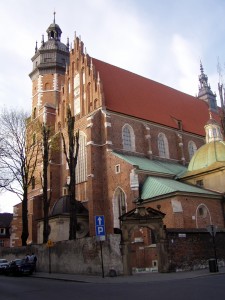
In the Church of Corpus Christi I lit candles for my dead,
who live far off – I don’t know where
– and I sense they warm themselves in the red flame too
like the homeless by a fire when the first snow falls.

That’s Corpus Christi, outside my window in Wolnica Square.  And one poem for St. Catherine’s Church, and at least three references to Jozef Street, catty-corner to Wolnica Square.  “Joseph Street in Winter,” is dedicated to Joachim Russek, the head of the Judaica Foundation, a tutelary spirit for my first trip several years ago:

In winter Joseph Street is dark,
a few pilgrims flounder through wet snow
and don’t know where they’re going, to which star,

And two references to pigeons – charitable, because I know Adam finds them contemptible.  It was the subject of our first discussion when we met in Rynek Główny, which was swarmed with pigeons.
He didn't like the pigeons.

I actually “met” Adam during an online interview six or seven years ago for an article that was published Poetry Foundation article).  But much of the short interview never made it to the final piece.  For example, I asked him what gave rise, to a generation of giants:

“Good question. I have many contradictory explanations. One of the main ones is that the attention given to the meaning of human life in radical circumstances  (as opposed to the hermetic direction, or to a purely formal quest) in Polish poetry after the WWII catastrophe was a very important move: it gave the dying Modernism a new energy. It ‘rehumanized’ a highly sophisticated but a bit empty palace of modern poetry.”

On irony:

“Well, the disease of irony seems to be well identified. I adore irony as a part of our rich rhetorical and mental apparatus but not when it assumes the position of a spiritual guidance. How to cure it? I wish I knew.”

"We'll be living in small ghettos..."

He has earned my own fealty, not only for his poetry, but for his many kindnesses.  So I was pleased when I read on Ann Kjellbergs website for her journal Little Star, a lengthy excerpt from his introduction to Edward Snow’s translations of Rainer Maria Rilke. (It was also excerpted by Poetry Daily here.) Adam is much in demand for introductions, blurbs, reviews, and essays.  This introduction is one of his best (I excerpt from Ann’s excerpts – and by the way, thank you, David Sanders, for pointing out the piece in Poetry News in Review):

“We have a new sorrow today: after the terrible catastrophes of the twentieth century, after the disasters that entered both our memory and imagination, we tread gingerly at the point where poetry meets society; “Don’t walk beyond this line,” as the sign on every jetliner’s wing warns us. And yet the central issue for us is probably the question of whether the mystery at the heart of poetry (and of art in general) can be kept safe against the assaults of an omnipresent talkative and soulless journalism and an equally omnipresent popular science—or pseudo-science. It also has a lot to do with the weighing of the advantages and vices of mass culture, with the influence of mass media, and with a difficult search for genuine expression inside the commercial framework that has replaced older, less vulgar traditions and institutions in our societies. In this respect, it’s true, poets have less to fear than their friends the painters, especially the successful ones, who, because of the absurd prices their works can now command, will never see their canvases in the houses of their fellow artists, in the apartments of people like themselves, only in vaults belonging to oil or television moguls who don’t even have time to look at them. Still, the stakes of the debate and its seriousness are not very different and not less important than a hundred years ago.

We know that the main domain of poetry is contemplation, through the riches of language, of human and nonhuman realities, in their separateness and in their numerous encounters, tragic or joyful. Rilke’s powerful Angel standing at the gates of the Elegies, timeless as he is, is there to guard something that the modern era—which gave us so much in other fields—took away from us or only concealed: ecstatic moments, for instance, moments of wonder, hours of mystical ignorance, days of leisure, sweet slowness of reading and meditating. Ecstatic moments—aren’t they one of the main reasons why poetry readers cannot live without Rilke’s work? I mean here readers of contemporary poetry who otherwise are mostly kept on a rather meager diet of irony. The Angel is timeless, and yet his timelessness is directed against the deficiencies of a certain epoch. So is Rilke: timeless and deeply immersed in his own historic time. Not innocent, though: only silence is innocent, and he still speaks to us.”

From my interview (I had cited this in an earlier post last fall, when Adam’s name came up again for a Nobel), when I asked him about the future of poetry and poetry-lovers in the world of tweets and sound bites he said this:

“We’ll be living in small ghettos, far from where celebrities dwell, and yet in every generation there will be a new delivery of minds that will love long and slow thoughts and books and poetry and music, so that these rather pleasant ghettos will never perish — and one day may even stir more excitement than we’re used to now.”

By the by,  Patrick Kurp of Anecdotal Evidence has a review of Unseen Hand here.

King Ludd himself: Nicholas Carr on little bits of information flying across a screen

June 20th, 2011
Share

Tiny bits of data zinging into your brain

I posted a couple weeks ago on Nicholas Carr‘s newest takedown of technology.  That was a few days after I wrote about Bill Keller‘s apparently unpopular column, “The Twitter Trap.”

James Temple’s dot.commentary over at the San Francisco Chronicle acknowledged the buzz: “The general take was that he was an old-media Luddite threatened by things he couldn’t understand. If Keller is a Luddite within these circles, Nicholas Carr is King Ludd himself, ready to smash the machines to preserve a world long ago lost.”

Well that’s not quite true.  Carr, when Temple tracked him down last week for a Q&A: said: “There are all sorts of benefits, intellectual or cognitive, that we get from the Internet. The most obvious is the fact that it’s much easier to find information than it was in the past, and that’s obviously a huge benefit in many instances. It’s also much easier to communicate very quickly with lots of people, and that can help a lot, particularly when you’re trying to solve particular problems.”

However, he added, “I think you really have no choice but to try to restrict the amount of time and the amount of mental energy that goes into watching information fly by on the screen.”

That’s kind of tame.  Then he was asked about the buzz he and Keller stirred:

Is contemplative thought expendable?

Q: There seems to be a reflexive reaction to your ideas in the tech world. When Bill Keller raised questions about Twitter in his recent column, some said dismissively that he was channeling Nicholas Carr, like it was an obvious insult. What do you think drives that kind of response?

A: One is that a lot of people, particularly people in the tech world, are deeply invested in technology. I mean economically invested, although they are also ideologically invested. Central to their thinking is that progress in computers equates to progress of humanity and society.

If you’re working in this area, that assumption makes you feel good about yourself and so you want to defend it when you hear someone making basic criticisms. Your natural reaction is to paint a caricature of nostalgia or Ludditism. That seems to be a completely normal reaction.

And second, I think there are simply people who don’t share my belief that more contemplative thought is important. They think getting as much information and processing it as quickly as possible, is really the height of their intellectual life. If you don’t care about quiet or more contemplative thought, then obviously you’re not going to even understand where I’m coming from.

Now that‘s scary.  Read the whole thing here.  Meanwhile, cheer up!  According to ReadWriteWeb, websites – including this one – will disappear within the next few years.  Boy, will that be a whole bunch of time down the toilet.

Meanwhile, Sara Barbour over at the Los Angeles Times thinks Kindle is way overrated – here.


<<< Previous Series of PostssepNext Series of Posts >>>