Old names, new faces: Book cover contest launched by a man with a pierogi obsession

June 10th, 2011
Share

"Lord of the Rings"

Dave Lull sent me this site some days ago, but it took me a while to “get it.”  Chalk it up to the whimsy of the internet.

The art blog 50 Watts‘ Polish Book Cover Contest asked contestants to design the “Polish edition” of their favorite book.  Why Poland?  According to the site, Poland has an “incredibly rich history of book design” – for example, see the new book 1000 Polish Book Covers.  Also, see this post.)

Who was eligible?  “Anyone in the entire universe, not just Poland,” writes Will Schofield, the man behind 50 Watts.  “The submission fee is zero dollars, made payable to the Ghost of Jan Lenica.”

"To Kill a Mockingbird"

“I’m asking you to create a fake cover in the style of the Polish book designers featured in this post and elsewhere on 50 Watts. Do I have a preference for styles from 1920 to 1985? I do, but don’t let that ‘cramp your style,'” he writes.

Some of the judges appear to have been real Poles: Aleksandra and Daniel Mizieliński (editors of 1000 Polish Book Covers, founders of Hipopotam Studio, and book collectors), as well as Peter Mendelsund (book cover designer and the man behind Jacket Mechanical); and Schofield, the man behind Jacket Mechanical as well as the proprietor of 50 Watts.

Schofield answers other questions about the contest here.

His ulterior motive? “Pierogi endorsement.”

Wally Stegner’s studio saved – for now

June 9th, 2011
Share

Stegner in his studio

A few days ago, we reported on the planned demolition of Wallace Stegner‘s writing studio, where the Pulitzer prizewinning author wrote for half-a-century – and on the last-ditch plans to save it.

Looks like the Stegner fans have saved it – for now.  From the Los Altos Town Crier:

A complaint lodged last week by a national group of preservationists temporarily sidetracked a plan to demolish prize-winning author Wallace Stegner’s former South Fork Lane home and writing studio in Los Altos Hills to make way for a 7,323-square-foot home.

While town officials May 31 were ready to fast-track the new two-story construction, the Washington, D.C.-based National Trust for Historic Preservation sent a letter to Los Altos Hills alleging that the home’s historical significance warrants a more complete review. If true, it could delay the project for months.

“Since there is ample evidence that this unique site is eligible for listing in the California Register of Historical Resources, we respectfully urge the Town to conduct (an) environmental review that analyzes alternatives to demolition before considering project approval,” reads the May 27 letter.

The definitive words come from Alice Sakamoto, Stegner’s longtime neighbor, who said, “In addition to (the studio) being personally sentimental, to me (it) is the literary equivalent of the Hewlett-Packard garage.”  This has a certain resonance for those of us who live in Silicon Valley.

Read more here.

Elena Danielson: The scintillating world of an archivist, and “a masterpiece”

June 8th, 2011
Share

She's more bubbly than this picture suggests

In April, I commented on Stanford’s “A Company of Authors” event, “a warm and friendly gathering of about 100 or so booklovers at the Stanford Humanities Center,” in which Humble Moi participated:

Particularly memorable: Elena Danielson‘s breathy presentation of the ethical issues of archiving.  Don’t think that sounds exciting?  You have to hear Elena tell about it.  The author of The Ethical Archivist has been privy to billets-doux of the long-dead and recently dead, and all the burning secrets held in donated letters and memorabilia.

Archivists aren’t usually considered to live scintillating lives, but Elena sure makes it look like hot stuff.  I recounted her vivid tale of the Martin Luther King, Jr., legacy here.  (She also wrote a guest review for Debra Satz‘s  Why Some Things Should Not Be For Sale, and is a regular commentor on the Book Haven.)

So we were pleased to see praise for her work in College & Research Libraries, in a review by W. Bede Mitchell:

“The reader cannot help but come away … impressed with how deeply entangled is the archival profession in ethical dilemmas. …

She [Elena, that is – ED] is invariably thorough, sensible, and sensitive when analyzing ethical challenges that can arise when acquiring or deaccessioning materials, providing equitable access, protecting the privacy of patrons and donors, authenticating materials, and determining the circumstances in which displaced archives should be relocated. In addition, her writing is clear, engaging, and imbued with a devotion to her professional values. No doubt her many years of experience have tempered idealism with realism, but not to the point of cynicism. When she convincingly demonstrates at many junctures that establishing ‘a standard of integrity that inspires confidence in the documentary record’ is neither easy nor safe, Danielson goes on to argue eloquently why ensuring such integrity is what the archivist profession should be about. …

It is difficult to imagine a better written or more thorough and thoughtful work on such thorny issues. ‘Masterpiece’ is an appropriate description.”

Fine words … but it’s all so stuffy compared to the real-life Elena, her eyes sparkling, confessing the secrets she’s collected over decades with barely contained excitement.  Or, more recently, telling me that nine months after the book launch, only 73 copies of the book are left.  Is there a second printing in the works?

Brava, Elena!

Orwell Watch #9: “I take full responsibility for…”

June 7th, 2011
Share

Taking responsibility, or accepting blame?

“I came here to accept the full responsibility for what I’ve done,” New York Rep. Anthony Weiner said at yesterday’s press conference, following his disclosure of unseemly online relationships with women.

But does he?  And what exactly does “take full responsibility” mean?

This verbal formulation, which surfaces most frequently following terrorist attacks or sexual confessions (à la Weinergate) always troubles me.  But not for the reasons cited on NPR, which seems to focus on the voluntary nature of the disclosure:

Doesn’t taking responsibility have to involve volition if it’s to be meaningful? What does it mean if you don’t have any choice? For Weiner, the image of the emperor having no clothes was about to become upsettingly literal. The existence of physical evidence — a child, let’s say, or a cache of photos and messages including a photo of himself literally holding up a sign with an arrow pointing to his own head that says “ME” — makes it hard to credit either man with much of anything other than not fleeing to Mexico or changing his identity. So … well done?

What [Arnold] Schwarzenegger seemed to mean by “taking responsibility” was partly the acceptance of the actual, tangible consequences of parenthood. For Weiner, it’s more complicated. What are the material consequences of his behavior that he’s now taking responsibility for? He’ll be publicly excoriated, but that’s only because he was found out, so what kind of a consequence is that? What kind of a consequence is it when the worst thing that happens to you because of something you did is that people treat you as having done it?

Taking responsibility exactly for what?

Does he take full responsibility for, say, the 21-year-old Seattle student Genette Cordova whose life and whose studies have been disrupted as she prepares for finals and was forced to drop a class? “I’m really upset. I feel like he’s a person of power and influence, who can make a statement and make all this go away,” her mother said when his actions still represented a choice rather than an inevitability.

In my book, “taking responsibility” is more than a synonym for “apologize.” It means actually doing something to ameliorate consequences.  Will he, for example, intervene with the college authorities on Ms. Cordova’s behalf?

I am always troubled in this usage when a terrorist group “takes responsibility” for a brutal attack that leaves people dead.  Do they comfort the bereaved?  Raise a fund for widows and orphans?

When we “took responsibility for” the liquidation of Osama bin Laden, in the terms that were bandied about several weeks ago – did we even sponge the blood off the walls of the hideout?  Do we take responsibility for the future of the children who watched the killing?  (How careful we are to call this a “killing” rather than a “murder or assassination” – why so much care on these phrases, but imprecise banalities on others?)  Please note:  I am not arguing for or against the necessity of what happened – I am pointing to the language used to describe the decision.  And, for that matter, Osama bin Laden “took responsibility” for a lot of killings on his own.

"We will weather this."

Doesn’t this really mean “accept the blame for”?  Or “takes credit for”? Or “confesses guilt”?

In the case of terrorists, I suspect the phrase “take responsibility for” is actually a journalists’ invention, and people like Weiner picked it up from the media, rather than his heartfelt intentions.

As George Orwell said in “Politics and the English Language,” this one could be “killed by the jeers of a few journalists.” I call out to journalists everywhere to jeer this phrase out of existence – unless it really means taking responsibility, the way I “took responsibility” for, say, raising a child, by paying for her upbringing, nursing her through illness,  attending back-to-school days, and preparing dinner every night.

Such phrases further the disjunct between words and actions – a chasm that already widened when Weiner was onstage weeping, and apologizing over and over, as if he had given names under torture, or crashed the car while drunk … yet when one looks at the photos from Twitter and Facebook, he hardly looks troubled or tormented.  He looks like he’s having a good time; he’s smiling and joking.  He is in full control of his faculties.

“We will weather this. I love her,” he said of his marriage, making his longstanding, premediated behavior sound like a force of nature – an earthquake, or a hurricane, perhaps.  The photos remind one that this wasn’t a momentary slip-up or the result of uncontrollable passion: it was a series of actions coolly considered, uninterrupted by his marriage almost a year ago.

I have to concur with NPR:

Maybe if public apologizers were better at just being sorry, we wouldn’t need “I take full responsibility for my actions” in the first place.

Orwell Watch:  Collect the whole set!

Orwell Watch #8:  “I know you’re disinterested in this, but…”

Orwell Watch #6:  “Like” and the culture of vagueness

Orwell Watch #5: Before we shoot off our mouths again…

Orwell Watch #4: Jared Loughner:  Madman, terrorist, or both?

Orwell Watch #3:  Please. No “gifting” this Christmas.

Orwell Watch #2: Murder in Yeovil

Orwell Watch #1: Paul Krugman vs. George Orwell. (Hint: Orwell wins.)

Postscript on 6/13:  More on “taking responsibility” – and some nice pick-up from Andrew Sullivan in the Daily Beast – over here.


Praise for An Invisible Rope from the TLS

June 5th, 2011
Share

OK, we’re bragging.  From Wojciech Jajdelski writing in London’s Times Literary Supplement:

In a number of late poems, Czesław Miłosz (1911-2004) pondered his status as the last person alive to remember a particular contemporary who had otherwise left no trace in other people’s thoughts or in the historical record. The old poet’s mind, and now the poem itself, were thus the long-gone individual’s only stay against perfect oblivion. But for Miłosz’s recollection, for example, it would be as if Miss X, with whom he shared a towel after an illicit swim more than half a century ago, had never existed. Miłosz himself is happily in no danger of a similar fate. …

Cynthia L. Haven‘s collection of reminiscences of Miłosz by people of various backgrounds, languages and ages is a welcome contribution to this international effort. It will delight Miłosz’s readers with gossip and add anecdotal texture to his image as a great Polish poet in Californian exile, who made a triumphant return to Cracow in old age. It comes as a surprise to hear of Miłosz’s early interest in structural literary analysis, for instance, the frolics he encouraged at graduate parties in Berkeley, or the quiet pride he took in being able to throw together a meal. The common themes include Miłosz’s roaring laughter and insatiable appetite, enduring desire for literary fame, and sense of loneliness. …

V.S. Naipaul opens mouth, changes feet: A round-up of literary kerfuffles, and a soupçon of misogyny

June 4th, 2011
Share

Friends again. (Photo: Daniel Mordzinski)

V.S. Naipaul has offered definitive proof against the adage that to be a good writer, you must be a good reader.

First, the happy news:  Naipaul has ended his 30-year feud-over-nothing with Paul Theroux.  The root of the matter seems to be that Naipaul thought Theroux was horsing around with his first wife.  From the Telegraph:

A furious Naipaul retaliated by trying to sell one of Theroux’s books, inscribed to Naipaul and his first wife, online for $1,500. When Theroux found out, Naipaul told him to “take it on the chin and move on.” Naturally Theroux didn’t, and went on to write a book, Sir Vidia’s Shadow, in which he’s said to detail Naipaul’s “elevated crankishness”. The fracas went on until last weekend when – in what is surely Hay [Festival]’s biggest literary coup to date – they made up, “corralled” into a handshake by Ian McEwan in the festival’s green room.

Perhaps Hallmark ought to create a card for the occasion.  The forgettable feud and its resolution is recounted here and here.

The episode has brought to mind other great literary feud of our times, recounted here:

We all love a good literary feud, not least because they are much more amusing and erudite than a spat between, say, a footballer and a reality television star. Of Tom Wolfe’s novel A Man in Full, Norman Mailer wrote: “Reading the work can even be said to resemble the act of making love to a 300lb woman. Once she gets on top, it’s over. Fall in love, or be asphyxiated.” Wolfe retaliated in his essay “My Three Stooges,” casting Mailer alongside his other critics, John Irving and John Updike.

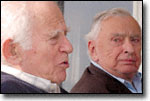
Mad men: Mailer, Gore

Revenge can take many forms. Norman Mailer punched Gore Vidal. “As usual, words failed him,” said Vidal. Evelyn Waugh used the name of his tutor at Oxford for such diverse characters as a quack doctor and a psychopathic burglar. Salman Rushdie and John le Carré had a row over who had suffered more at the hands of religious fanatics, which ended in Rushdie calling le Carré “an illiterate pompous ass”.

Rushdie not above the fray (Photo: Mae Ryan)

In 2006, Salman Rushdie also fell out with John Updike after the latter panned Shalimar the Clown, in particular Rushdie’s choice of names. “A name is just a name,” Rushdie retorted. “Somewhere in Las Vegas, there’s probably a male prostitute called John Updike.” The same year Bevis Hillier duped A.N. Wilson, the writer of a rival biography of John Betjeman, into publishing a spoof love letter; the first letter of each sentence spelt out: “A N Wilson is a —-.”

Which all goes to show that maturity or character, also, isn’t a prerequisite for being a writer, either.

But in the Telegraph here you can also read about the feuds between Mary McCarthy and Lillian Hellman (that one will not be resolved; the principals are dead) and Harold Bloom and J.K. Rowling.

And I thought the Poles were bad with their acrimonious literary feuds – I’ve recounted the one between Czeslaw Milosz and Zbigniew Herbert here, in “The Worst Dinner Party Ever.”

Naipaul must be anxious to promote himself, because he made these cranky comments to the press.  From the Guardian:

In an interview at the Royal Geographic Society on Tuesday about his career, Naipaul, who has been described as the “greatest living writer of English prose”, was asked if he considered any woman writer his literary match. He replied: “I don’t think so.” Of [Jane] Austen he said he “couldn’t possibly share her sentimental ambitions, her sentimental sense of the world”.

Queen of literary mathematics

He felt that women writers were “quite different”. He said: “I read a piece of writing and within a paragraph or two I know whether it is by a woman or not. I think [it is] unequal to me.”

The author, who was born in Trinidad, said this was because of women’s “sentimentality, the narrow view of the world”. “And inevitably for a woman, she is not a complete master of a house, so that comes over in her writing too,” he said.

He added: “My publisher, who was so good as a taster and editor, when she became a writer, lo and behold, it was all this feminine tosh. I don’t mean this in any unkind way.”

Of course that dropped the cat among the pigeons.  Why?  Why would one expect Sir Vidia to say something sensible on the subject?  He’s obviously not a careful reader of Austen.

Oh yeah?

As for women’s “sentimentality, the narrow view of the world,” I have only two words to say:  Simone Weil.

Jennifer Egan took the bait, however, and made these comments on the kerfuffle to the Wall Street Journal:

“He is such a kook. It makes me laugh because he sounds like such a cranky old man. It’s the classic case of how prejudice works – you feel like you see it confirmed all over the world but the prejudice is tainting your perception everywhere you look.”

“I would put money on the fact that he has not read Jane Austen in 10 years. She’s the most cool, mathematical writer to come along, male or female. It’s a word no one who’s familiar with her work would call her. The nature of the comments read as so silly that it’s hard to see it spurring a gigantic turmoil. They’re not remarks that lead to a deeply-engaged conversation because they’re just so easily dismissible, largely because of what he says about Austen. He raises questions about his authority by calling her sentimental. Only a person with an idea of what Austen is — and not actual familiarity with her work – would say that. She’s not a melodramatic writer.”

Meanwhile, the Guardian has published “The Naipaul Test:  Can You Tell an Author’s Sex?” – it’s here.

Naipaul is said to be a great writer (I haven’t read him, so I’m taking that on authority), but a crappy human being.  So why do we take any of his opinions seriously?

If you’ve a taste for this sort of thing, Vidal and Mailer wrangle on fuzzy clip from The Dick Cavett Show below – journalist Janet Flanner takes the better part.  


se più avvien che fortuna t’accoglia
dove sien genti in simigliante piato:

ché voler ciò udire è bassa voglia.


<<< Previous Series of PostssepNext Series of Posts >>>