OK, this one is out of left field, but my life changed dramatically this week. After decades of ink-stained hands and smeared or scratchy writing, I finally did an online search and ordered a fountain pen for southpaws.
You might not have noticed there’s a difference. The customer service rep explained to me that left-handers push the pen – right-handers pull it. This requires a different nib. It also requires fast-drying ink. Also, the grip on most pens is positioned for the left hand. (She also explained that Europeans prefer fine nibs; Americans need more substantial ones – apparently we push too hard. Go figure.)
I’ve always had pen envy, so the “student” Pelikano for lefties has been a godsend since it arrived from Massachusetts to the Left Coast. It keeps me from the effect of having ink splashed all over the side of my hand as I drag my hand across my writing. So gauche.
I noticed on CNN that President Obama seems to have the same problem I do – like me, he is an “overwriter,” with his arm hunched up over the paper.
Our leftist president has company: not only Bill Clinton, but Gerald Ford and George H.W. Bush can be counted among the lefties. Who knew? Ronald Reagan, too, can be included on the roster. He is rumored to have started life left-handed, but was forced to adopt right-handed ways. The King’s Speech has brought before the public the sinister effects of determined right-handers imposing their way of life on others — even George VI was forced to make the switch. Maybe it’s time we purge all the negative words associated with being left-handed — isn’t it bad enough we have shorter lifespans?
Which is a backhanded way of suggesting that it’s not too late to get a left-handed pen for Obama in time for his birthday. It’s in August. He’s a Leo. Like me.
“I was as surprised as I was pleased,” said Arnold Rampersad, who received the National Humanities Medal yesterday. He didn’t stay in Washington long — he headed back to his native Trinidad, where he’ll be till mid-month. I had emailed him on another matter, and my message crossed with the happy announcement he had received one of the highest awards a scholar in America can get.
Rampersad was cited for his work as a biographer and literary critic. His award-winning books have profiled W.E.B. Du Bois, Langston Hughes, Jackie Robinson, and Ralph Ellison. He has also edited critical editions of the works of Richard Wright and Langston Hughes.
“Growing up as a schoolboy in Trinidad, I received an education in literature that some people might dismiss as ‘colonial,’” he recalls. “It nevertheless served me well in dealing with the complexities of American biography.”
Ralph Ellison [2007] was published in an era when, according to Rampersad, “the life of the African-American writer has changed dramatically. In part through holding positions at programs in creative writing and departments of English at universities, the black writer has gained a solid presence on the literary scene that has replaced the fugitive nature of expression and publication forced on blacks over the centuries, especially in the slave narratives but continuing into the twentieth century. That presence does not guarantee fine writing but it has led, in my opinion, to an assurance that bodes well for the future. Black literature was described a long time ago as a ‘literature of necessity’ rather than one of leisure. That element of necessity still exists but it does not dominate as it once did. Black American literature as a cultural phenomenon has reached a level of stability and maturity that the circumstances of American life once routinely denied it.”
He joins authors Wendell E. Berry, Joyce Carol Oates, and Philip Roth; historians Bernard Bailyn and Gordon S. Wood; literary scholars Daniel Aaron, Roberto González Echevarría, and Arnold Rampersad; cultural historian Jacques Barzun; and legal historian and higher education policy expert Stanley Nider Katz.
The National Medal of Arts was awarded the same day, to former U.S. Poet Laureate Donald Hall [yayyyyyy! — ED.] actress Meryl Streep, musicians Sonny Rollins, Quincy Jones, James Taylor and Van Cliburn, painter Mark di Suvero, theater champion Robert Brustein and an organization, Jacob’s Pillow Dance Festival.
“One of the people that we honor today, Joyce Carol Oates, has said, ‘Ours is the nation, so rare in human history, of self-determination; a theoretical experiment in newness, exploration, discovery.’ That’s what we do,” President Obama said before presenting the medals.
He also said that works of art, literature and history speak to the human condition and “affirm our desire for something more and something better.”
“Time and again, the tools of change, and of progress, of revolution, of ferment — they’re not just pickaxes and hammers and screens and software, but they’ve also been brushes and pens and cameras and guitars.”
Lawrence Ferlinghetti‘s latest is for the birds. It’s in the San Francisco Chroniclehere.
On the printed page, the lines are indented inward, on each successive line, for no apparent reason except to give the visual appearance of poetic form. (The Chronicle routinely screws up online lineation.)
It opens: A cock cried out in my sleep
Even forgiving the double entendre, which I will mercifully assume is unintentional, I wonder when is the last time Ferlinghetti saw an actual, non-figurative cock in downtown San Francisco. (Example for city-dwellers, see right.)
Basically, this United Colors of Benetton poem is in support of smiling niceness. The politics are safe and clichéd, the term “Third World” in itself has become something of a cliché. It’s hard to believe we’ve come so far from Allen Ginsberg and “Howl.”
Where are the editors? This is an appalling lapse of judgment.
In the celebratory brouhaha over Richard Wilbur‘s 90th birthday yesterday, I neglected another important nativity — the 200th anniversary of Fryderyk Franciszek Chopin, who was born in Żelazowa Wola, Poland in 1811. My longstanding fondness is something I blushed to confess in Poland — where it’s somewhat akin to an American announcing John Philip Sousa as a favorite composer. Chopin, whose name was Frenchified to Frédéric François, is a national institution, and therefore a little kitschy among the intelligentsia.
This very languorous Venetian piece of music is my personal favorite. Enjoy Claudio Arrau‘s perfect rendition, and celebrate with me one day late. After all, what’s a day in two centuries?
Happy birthday, Richard Wilbur, on your 90th! Dan Rifenburgh reminded me of the poet’s birthday on Facebook a few days ago, but he didn’t know whether he’d be spending in Cummington, Massachusetts, or Key West. Either way, he will probably not be celebrating in NYC: I remember a characteristic passage in one his books where he described a brisk walk near his home with a guest: “But my friend from New York, an excellent abstract artist, walks through our Berkshire woods smoking Gauloises and talking of Berlin. It is too bad that he cannot be where he is, enjoying the glades and closures, the climbs, the descents, the flat stretches strewn with Canada Mayflower and wintergreen…”
Richard Wilbur turns 90 on Tuesday, but it’s unlikely that many Americans will stop to pay tribute to our finest living poet. Despite having earned almost every literary award this country has to offer, including a pair of Pulitzers and Bollingens, as well as the title of U.S. Poet Laureate in 1987-88, he has never enjoyed a rapt general following.
I had dinner with Dick Wilbur and his wife Charlotte oh, maybe a decade ago in West Chester, Pennsylvania. He was as genial as his reputation had suggested, and his obvious, abiding affection for his high school sweetheart, an effervescent and gregarious matron, was charming. I never made it out for the Key West interview I had envisioned … perhaps there’s still time.
The poet-critic Randall Jarrell said Wilbur “obsessively sees, and shows, the bright underside of every dark thing,” but his poems, since Charlotte’s death in 2007, have become increasingly death-haunted.
It’s unusual for poets to be productive so long — conventional wisdom is that they do their best work young, and “dry up” as Thom Gunn told me — but Anterooms: New Poems and Translations, is a marvel. One poem, “A Measuring Worm,” describes a caterpillar climbing a window screen, hunching his back as he goes:
It’s as if he sent
By a sort of semaphore
Dark omegas meant
To warn of Last Things.
Although he doesn’t know it,
He will soon have wings,
And I too don’t know
Toward what undreamt condition
Inch by inch I go.
Woodward notes, “His productivity, never high to begin with, has slowed with age. He finishes poems at the rate that Antonio Stradivari constructed a violin. ‘I often don’t write more than a couple of lines in a day of, let’s say, six hours of staring at the sheet of paper,’ he told the Paris Review in 1977. “Composition for me is, externally at least, scarcely distinguishable from catatonia.”
David Orr in the New York Times writes of Anterooms that “it would be tempting to say that what we have here is a scanty manuscript that will nonetheless be extravagantly praised because its author is still deeply respected and, hey, isn’t it wonderful that he’s still making a go of it at his age? Tempting, but wrong. The better work in Anterooms, however limited in quantity, is as good as anything Wilbur has ever written, and upholds certain virtues other poets would do well to acknowledge, even if they travel roads different from the relatively straight one Wilbur has followed.” He concludes:
“More than 50 years ago, Randall Jarrell claimed that as a poet, Wilbur ‘never goes too far, but he never goes far enough.’ The observation is invariably quoted whenever Wilbur gets reviewed (far be it from me to break the chain). But to write convincingly about death — and also, as Wilbur has increasingly done, about grief — isn’t a matter of ‘going’ anywhere. It’s a matter of remaining poised in the face of a vast and freezing indifference. And while the strong, spare poems here are unlikely to strike many readers as the illustrious pronouncements of a Grand Old Man — the kind of figure Jarrell had in mind — they are wholly successful in meeting the darkest of subjects with their own quiet light. Which is, surely, a far grander thing.”
Anterooms includes some of two translations of poems by Joseph Brodsky (I still think his translations of J.B. are the best) one poem by Stéphane Mallarmé and an unpublished poem by Paul Verlaine. Wilbur has always had a affinity for French (his verse translations of Molière are unmatched) — and so was the perfect lyricist for Leonard Bernstein‘s Candide, in the spirit of Voltaire. Composer Stephen Sondheim called Wilbur’s lyrics “the most scintillating set of songs yet written for the musical theater.” I still occasionally find myself, on a sunny day, humming —
What a day! What a day!
For an auto-da-fé!
See the Lincoln Center’s 1986 version below (or for a real treat, check out Kristin Chenoweth in Candide on youtube).
Postscript: Patrick Kurp at Anecdotal Evidence celebrates the birthday here.
The conventional wisdom in the book biz has always been that any publicity is good publicity — and a spectacular, jeered-at failure is a better option than a quiet, well-respected success reviewed only in the Journals That Count. Even more so now, when the biggest risk is that your book will float away in the receding tsunami of seasonal offerings.
This Stanford study by two business professors confirms the conventional wisdom — to a point. Bad reviews can dramatically boost sales for obscure and up-and-coming writers. They don’t help the famous.
“Any publicity is not always good publicity, as the old adage goes,” Wharton’s Jonah Bergertold the Stanford Daily. “But there were also cases where even negative publicity seemed to help sales, so it was interesting to think about when it helps versus hurts.”
The study, co-authored by Berger and Stanford’s Alan Sorenson, first examined a 2001-2003 dataset of weekly national sales for 244 fiction titles reviewed by The New York Times. The size of sale spikes in the week following the release of each book review showed that positive publicity benefited all titles and the bad publicity only helped lesser-known and obscure authors.
The second part of the study looked at how bad publicity impacted well-known and obscure books over time. Subjects looked at glowing and nasty reviews for a well-known book by John Grisham and then reviews for an invented title.
Those who read bad reviews of well-known books were less likely to buy the book. Negative reviews of unknown books, however, did not affect whether or not the subject was likely to purchase it.
“Let’s say you’ve got bad publicity or bad press on one of your new brands,” Stanford business professor Baba Shiv said. “On one hand, it’s making your brand look familiar, which is associated with positive emotion and at the same time, it’s eliciting negative emotion towards the brand, which comes from the bad publicity.”
The studies depended on emotional “decay rate”– how quickly an emotion (both good or bad) fades away. Stanford business professor Baba Shiv explained: “In the case of a well-known brand, the familiarity is already there … the decay rate of negative emotion will be much slower.” (Via Sarah Weinman)
The key point was that familiarity with the authors helped everyone, and familiarity was such a strong positive that it dissipated much more slowly in consumers’ minds than the bad taste of a critic’s diss. But the well-known books and authors already had the boost of familiarity — so the bad reviews could only hurt.
Read it here if you want to figure it out better than I have.
Of course, I wonder who is classifying a review is good or bad — most are kind of mixed, aren’t they? And for myself, I’d much rather read a interesting failure — a profound book that failed in some key way, than a very well-reviewed lightweight book. And name recognition is measured … how?
For another take on reviewing, read about Owl Criticism (hat tip, Frank Wilson). Charles Baxter takes on amazon-type online reviews, accusing them of “Owl Criticism”: “With Owl Criticism, you have statements like, ‘This book has an owl in it, and I don’t like owls.’”
Frank’s reaction to Baxter is worth reading, too: it’s here.


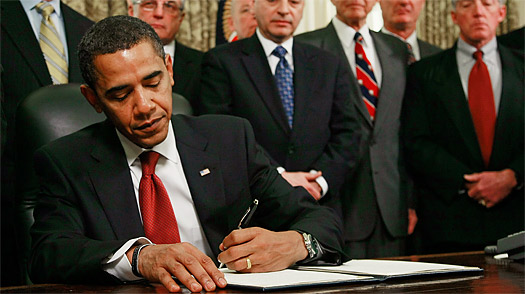
 Our leftist president has company: not only Bill Clinton, but Gerald Ford and George H.W. Bush can be counted among the lefties. Who knew? Ronald Reagan, too, can be included on the roster. He is rumored to have started life left-handed, but was forced to adopt right-handed ways. The King’s Speech has brought before the public the sinister effects of determined right-handers imposing their way of life on others — even George VI was forced to make the switch. Maybe it’s time we purge all the negative words associated with being left-handed — isn’t it bad enough we have shorter lifespans?


 Happy birthday, Richard Wilbur, on your 90th! Dan Rifenburgh reminded me of the poet’s birthday on Facebook a few days ago, but he didn’t know whether he’d be spending in Cummington, Massachusetts, or Key West. Either way, he will probably not be celebrating in NYC: I remember a characteristic passage in one his books where he described a brisk walk near his home with a guest: “But my friend from New York, an excellent abstract artist, walks through our Berkshire woods smoking Gauloises and talking of Berlin. It is too bad that he cannot be where he is, enjoying the glades and closures, the climbs, the descents, the flat stretches strewn with Canada Mayflower and wintergreen…”