Poet D.A. Powell: “Why not celebrate?”

February 8th, 2011
Share

D.A. Powell: Career as playwright nipped in the bud (Photo: Ken Fields)

Poet D.A. Powell didn’t begin as a poet.  Early on, he said, “I conceived of myself as a budding playwright.”  He told a noon gathering at Stanford today that he “has some sense of pride” in getting a “D” in his collegiate playwriting class — “but I may have gotten an ‘F,'” he admitted ruefully.

At that time, he was into “absurdist drama” — “plays where people sat around and talked about nothing — and talked about how nothing nothing was.”  The feedback: his plays lacked conflict.

Powell recalled that Sergei Eisenstein learned while editing and cutting his films that he needed to use first person, second person, and third person — something Euripides accomplished with a chorus. He recalled a portion of Eisenstein’s Battleship Potemkin that shows, in the first shot, meat full of maggots, in another shot men looking through the entryway at the chef, and in the third shot, a bubbling caudron, to show the meat “is being cooked for consumption of sailors who are angry.  It’s emotional equivalent is anger coming to a boil.”

“The poet needs something else that balances the drama,” he said.  “You have to be willing to be the scenery and the antagonist as well.”  He quoted Robert Hass saying “a good poem contains its opposite.”

Powell’s first three books —  Tea (1998), Lunch (2000), and Cocktails (2004) — have been considered a trilogy for the AIDS pandemic.  His most recent book, Chronic (2009) received the Kingsley Tufts Award and was nominated for a National Book Critics Circle Award.  He’s working on another, which he read from last night.  The photo comes to me courtesy of Ken Fields, who sent it to me after after Powell’s reading.  Alas, some other deadlines had consumed my evening, so I couldn’t attend, but I was able to catch a few minutes of today’s colloquium.  As I left, he was responding to a student who asked him about the distinction between art, popular culture, and camp in his work.

“When you’re being completely camp, you’re not completely aware of it,” he said.

He discussed the “doubt and mystery of one’s own aesthetics” and “finding note of authenticity within the detritus of society.”

Pay It Forward was a “terrible, terrible film,” he said — yet he recalled crying while watching it.  “Instead of being embarrassed by it, why not celebrate it?”

Elizabeth Bishop centennary: Dana Gioia, Thom Gunn, and my long-ago trip to Samambaia

February 6th, 2011
Share

The young Bishop

Feb. 8 marks the centennial of Elizabeth Bishop‘s birth, and her publisher Farrar Straus & Giroux, has put out a triple-hitter: a compilation of her letters to and from The New Yorker and a pair of companion volumes called simply Poems and Prose.

Dana Gioia reviews the trio in the Wall Street Journal, here.  He is too modest to say, except in passing, that he studied with Bishop at Harvard, but he’s wrote about it years ago for the New Yorker — an excerpt is here, and it’s definitely worth the read.  As always with Dana, it’s a good general introduction to Bishop and her oeuvre.

But on one point I must quibble:

In 1952, having embarked on a trip around the world, Bishop took ill in Rio de Janeiro. There she met Lota de Macedo Soares, an architect, who became her lover. Bishop quickly settled in Brazil, and the two women lived together for 15 years—the one extended period of domestic stability in Bishop’s life. Then in 1967 the Brazilian idyll was terminated by Soares’s suicide.

Some years ago, I made the trip to Samambaia — outside Petropolis, which is outside Rio — and wrote about it for the Times Literary Supplement on February 8, 2002:

Brazilians use the expression “toda vida” — for all life — where we would say, “continue to the end of the road”. On the narrow, bumpy brick roads around Petropolis, about sixty miles outside Rio de Janeiro, you may indeed feel you will reach life’s end before you reach your destination: Sitio Alcobacinha, the long-time home of the poet Elizabeth Bishop, in the outlying village of Samambaia. You have to stop every few minutes to question a resident, typically one of the ubiquitous men, shirtless and enervated by the Brazilian summer, drinking beer in the street-side cafes of this trendy, if slightly threadbare, former imperial capital. Continue down the left fork, they will tell you, “toda vida”.

Outside Petropolis ... Bishop's home for years

Bishop didn’t quite end her days here. But certainly a crucial era of her life concluded in Samambaia in 1967, when she left Brazil after a sixteen-year stay that began as a lark, endured as a deep and difficult love affair, and ended with a death. She was to return to Brazil, more particularly to the home she bought and refurbished in Ouro Preto, another 150 miles or so due north, but she never stayed long, and visited more and more sporadically, until she finally left Brazil for good in 1974.

Bishop occupied a marginal, even ostracized, place in Brazilian society at the time, and has done since; how odd, then, the current clamour about her life here. An acclaimed play, a spicy fictionalized “biography” and an excellent set of translations of her poems into Portuguese have all appeared in Brazil in the past few years, and a major film is planned. The poet who once described herself as “the loneliest person who ever lived” is hot.

The reasons for this enthusiastic reclamation, and for the original banishment, are many. The obvious one is that Bishop wrote in English, not Portuguese. Yet perhaps two dozen of Bishop’s small output of poems are about Brazil, and she was a cheerleader for Brazilian poetry, publishing her own translations in an influential anthology in 1972. Her feelings about Brazil were perplexed, puritanical, and patronizing. (“As a country I feel it’s hopeless not in the horrible way Mexico is, but just plain lethargic, self-seeking, half-smug, half-crazy, hopeless”, she wrote in a letter.) Brazilians also resent the fact that she never took the trouble to learn Portuguese properly. (“I must take Brazil more seriously and really learn the damned language”, she moaned.) Other reasons are interwoven with the explosive history of Brazil during the period of Bishop’s stay, and with the mercurial temperament of her aristocratic lover, Carlota de Macedo Soares, a self-trained architect and civic planner universally known as Lota. Lota dabbled, however peripherally, in politics, and another cause of Bishop’s banishment was her lover’s controversial friendship (and by association Bishop’s) with Rio de Janeiro’s Governor, Carlos Lacerda, the anti-Communist politician, orator, and sometime journalist.

Aterro: The park Lota designed in Rio

The story was a sad one, ending with Bishop’s affair with a younger woman (the woman she was to spend the rest of her life with, who would remain unnamed for many years) and Lota’s death:

The more active Lota became in civic affairs, as Lacerda appointed her to create Rio’s equivalent of Central Park, the less time she had for her beloved “Cookie”. The more Elizabeth drank, the more overwrought Lota became.

Lota had a breakdown — from the stress of her civic work as well as her fraying relationship — and turned to tranquillizers. … Lota, rejoining Bishop in New York in 1967, took an overdose of valium the morning after her arrival.

When I interviewed Thom Gunn in August 2003 (the interview was published in the Spring 2005 Georgia Review), he described her as an “extremely nice woman, delightful to know.”

TG: The only time I ever saw her drunk was the first time I met her. This was a meeting set up by a friend of hers in San Francisco. I think it was news to me that she’d moved to San Francisco. She wanted to meet me, which was flattering. So I spent an evening with her, and her friend, whose name I have forgotten. The woman she was living with. I guess I shouldn’t say her real name, because everybody calls her “X” or something.

CH: I think it’s come out.

TG: Roxanne. Anyway, whatever it was. She was out of it, she was out of it. I mean, she was so out of it she was not following the conversation, just making strange remarks that had nothing to do with anything. So I received a message—whether it was from this guy, or whether Roxanne phoned me. It said, “Let’s try over,” which was very nice to say. So we did try over and we got on excellently.  She gave the one good party for poets that I’ve ever been at.  Most of those can be obnoxious or boring or pretentious. She knew all these poets—like Robert Duncan—who were just poets. I think it was a Christmas party. We had a great time together.

Dana notes: “She published only five volumes of verse and a short illustrated book on Brazil.”  I have the work-for-hire that she wrote for Life’s “World Library” series on my bookshelf — not her best work, admittedly, but a dutiful tribute to the country she came to love.

Blogging: a folk art that ranks “somewhere between scrimshaw and tatting”

February 5th, 2011
Share

A distant second, I'd say...

Patrick Kurp‘s post over at Anecdotal Evidence is so filled with his characteristic charm that we couldn’t resist posting about his post — his 2,021st, he admits.  It’s Anecdotal Evidence‘s fifth anniversary today.

As an anniversary present, Anecdotal Evidence was named one of top 50 blogs for humanities scholars by Online Education Database.

But Patrick is not blogging for fame or glory, and is modest about his occupation:

Among the folk arts, blogging ranks somewhere between scrimshaw and tatting. Practitioners are harmless folk, furtive and deficient in social graces but trainable with patience, understanding and a firm hand. Some are gainfully employed and support families. Others remain editors and minor humorists.

Patrick appears to be a teacher — at least, he refers to teaching in some of his posts.  I actually have never met him face-to-face.  He’s one of a cyberspace network of literary bloggers.  He names a few other fellow travelers in today’s post, including humble moi.

One of the most rewarding ventures of my brief blogging life has been making a cyber-introduction between Patrick and Helen Pinkerton, a poet he has long admired, as proven by a number of his posts about her poems.  It was also an opportunity to introduce Ms. Pinkerton not only to a long fan, but to the joys of the blogosphere.  A fruitful friendship on both sides — and one which  both have thanked me for.

Patrick is one of the few bloggers with the discipline to post daily … actually, with 2,021 posts, it’s more than daily.  As he writes:

Some have been trifling. To most I lent all the seriousness a minor humorist can muster. If a day were to pass without a thought worthy of nurture, I would be a sorry writer. Arranging words in pleasing shapes, like a folk artist snipping tin for a weather vane, is what we do. As one of this blog’s tutelary spirits puts it:

“There is no use in indicting words, they are no shoddier than what they peddle. After the fiasco, the solace, the repose, I began again, to try and live, cause to live, be another, in myself, in another.”

Speaking of the Library of Alexandria … plus a new magazine, Big Read, and an ancient prophecy

February 4th, 2011
Share

Patrick Hunt brought Andrew Herkovic‘s article in Electrum to my attention (it’s here) and adds this comment about my recent Book Haven post: “Great idea about a librarian becoming president! Ismail Serageldin would be ideal.”  Ismail for president!

Electrum is a spanking new online magazine — launched in December — and Patrick is editor-in-chief.  I find its subtitle-cum-motto intriguing:  “Why the Past Matters.”

Serageldin for president. Please.

In the article, Andrew cites the vision statement of the library: “The Library of Alexandria seeks to recapture the spirit of the ancient Library of Alexandria and aspires to be: The world’s window on Egypt; Egypt’s window on the world; an instrument for rising to the challenges of the digital age; and, above all, a center for dialogue between peoples and civilizations.”

The library includes “a vast and complex suite of programs and facilities, including library-normal collections and services, four museums, exhibit spaces, information-technology R&D labs, the only external mirror site of the Internet Archive, cultural heritage programs and institutes, auditoria, a planetarium, publishing and grand open spaces.”

The stunning, multi-level main reading room of the library “plausibly claims it to be the largest reading room in the world.” Surprisingly, the library’s print collection has relied to a remarkable degree on donated books, in many languages and on many subjects.

The article is dated Dec. 15 — ancient history, given recent events in Egypt — and ends on an eerily prescient note, noting the problematic linkage between the library and the current political regime. He concludes:

“One wishes to believe that the brilliance of the Bibliotheca Alexandrina as a center of learning, knowledge, and education will assure its transcending of politics. But it is closely associated with the Mubaraks, and to the extent that its modernism, internationalism, and essentially secular vision may elicit antagonism from now-repressed anti-modern or anti-Western elements, one hesitates to assume it will always enjoy its current immunity from the hurly-burly of politics. The first Library of Alexandria famously perished (a process that took centuries and a series of catastrophic events, not a single holocaust as usually imagined), and it is not impossible that its successor might meet the same tragic fate.”

Let’s hope that this doesn’t illustrate another instance of “Après moi, le déluge.”

Postscript:   By the by, the post two days ago elicited an interesting response from Felicia Knight on my Facebook page.  She was on Dana Gioia‘s NEA team back in 2008 for Big Read/Egypt, which she called “the trip of a lifetime.”  The project focused on The Thief and the Dogs by Egyptian Nobel laureate Naguib Mahfouz.  We didn’t know Big Read had sunned itself in Egypt. You can read about that here, or in The Guardian here.

Human chain protects the Library of Alexandria: A report from “the most intelligent man in Egypt”

February 2nd, 2011
Share

Hey, now this is cool.

The first great Library of Alexandria was destroyed in successive stages, finally and definitively sacked by the Arabs in 642 A.D.  But the heirs of the rebuilt library are determined that it will not fall a second time.

He's smart.

Earlier this week, Bibliotheca Alexandrina director Ismail Serageldin — who has been called “the most intelligent man in Egypt” — reported that as violence in Egypt escalated, Egyptians surrounded the newly rebuilt Library of Alexandria to protect it from looters, joining hands to form a human chain.  He wrote:  “The demonstrations were large and peaceful, and at prayer times, people prayed in front of the library.”  The  video is here.  And we wrote about Serageldin and the library, with its fascinating history, when he visited Stanford in December 2009 —  here.

In an earlier message posted on the library’s website, Serageldin wrote:

“The world has witnessed an unprecedented popular action in the streets of Egypt.  Led by Egypt’s youth, with their justified demands for more freedom, more democracy, lower prices for necessities and more employment opportunities.  These youths demanded immediate and far-reaching changes. This was met by violent conflicts with the police, who were routed.  The army was called in and was welcomed by the demonstrators, but initially their presence was more symbolic than active.  Events deteriorated as lawless bands of thugs, and maybe agents provocateurs, appeared and looting began.  The young people organized themselves into groups that directed traffic, protected neighborhoods and guarded public buildings of value such as the Egyptian Museum and the Library of Alexandria.  They are collaborating with the army.  This makeshift arrangement is in place until full public order returns.

The library is safe thanks to Egypt’s youth, whether they be the staff of the Library or the representatives of the demonstrators, who are joining us in guarding the building from potential vandals and looters.  I am there daily within the bounds of the curfew hours.   However, the Library will be closed to the public for the next few days until the curfew is lifted and events unfold towards an end to the lawlessness and a move towards the resolution of the political issues that triggered the demonstrations.”

Ismail Serageldin
Librarian of Alexandria
Director of the Bibliotheca Alexandrina

Hey, any chance Serageldin could take over the government of Egypt?

Boris Pasternak: Family Correspondence: British praise, American silence … so far

February 1st, 2011
Share

Portrait of the artist as a young man: cover painting by Leonid Pasternak, the Nobel laureate's father

In general, Hoover Press isn’t known for its groundbreaking literary fare — its more usual titles embrace such topics as Social Security: The Unfinished Work and The Wave: Man, God, and the Ballot Box in the Middle East. So last summer, as I attended a reception for the appearance of Boris Pasternak: Family Correspondence, 1921-1960, I wondered how how much press attention the first English of the Nobel laureate’s family letters would get.

So here’s the upshot:  some reviews in top-notch British literary journals — The Times Literary Supplement and The Literary Review; zip in America. All the votes have not been cast, of course — the slower literary journals may yet make an appearance (perhaps they’re teaming it up with the new Peavear/Volokhonsky translation of Doctor Zhivago, but the surprise is that some of the more mainstream dailies on both sides of the Atlantic have ignored it.

Or rather, not a surprise.  The point is (and here is where I turn into a scold), that is exactly what the prominent reviewers and their editors used to do: ferret out the good from a basket of seasonal rubbish.  But book reviews have been shaved and then butchered; unemployed and hungry literary critics are feeding out of dumpsters.

That’s the bad news.  Here’s the good.  The book has received two awards: the American Library Association’s  Choice award for Outstanding Academic Title for 2010.  It also received the BookBuilders West prize.

One American has written about the book:  moi.  Here’s what I wrote about the book last summer (the rest is here):

The newly published correspondence is important: The Pasternak family was a close-knit one, and leading figures like Leo Tolstoy were family friends. Boris’ father, Leonid Pasternak, was an important post-Impressionist painter, and his mother, an accomplished pianist; they immigrated to Germany in 1921. After 1923, Pasternak was never to see his parents or two sisters again, except for one visit with a sister.

Slater said he originally began translating these letters out of a feeling of family loyalty. Pasternak did not write much about arrests, imprisonments and executions, but his intimate letters to his family have been considered works of art in themselves.

As the Nazis took power in Germany, Pasternak’s Jewish parents began to consider returning to Russia. According to Slater, “Boris found himself writing contorted letters in which he on the one hand assured his parents that he would love to have them living with him, and that they wouldn’t be a burden, but simultaneously tried his hardest to dissuade them from coming – since he knew, but couldn’t tell them, that their lives would be in danger if they came.

“I don’t think they understood his hints, and they probably did find him a bit inhospitable.” (They took refuge with Slater’s parents at Oxford instead.)

The book has, at least, gotten a few favorable reviews in the British press.  Peter France, writing in the Times Literary Supplement:

“It is not a complete translation, and one may regret the omission of certain passages discussing poems in detail, and above all the natural decision to focus on the letters of Pasternak himself. But the translator, Nicolas Pasternak Slater, the poet’s nephew, has done an admirable job, writing with enough freedom to bring across the meaning strongly, but enough faithfulness to convey something of the sheer oddity of Pasternak’s range: his exalted tone, his obscurity and his idiosyncratic eloquence. …
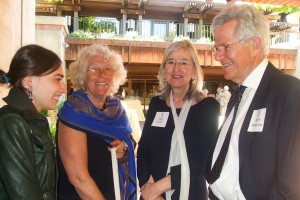
At Hoover reception: Anastasia Pasternak, great-granddaughter of the poet; Oxford scholar Ann Pasternak Slater, niece of the poet; Maya Slater, editor of the new volume, and her husband Nicolas Pasternak Slater, translator of the new volume and nephew of the poet. Anastasia Pasternak, great-granddaughter of the poet; Oxford scholar Ann Pasternak Slater, niece of the poet; Maya Slater, editor of the new volume, and her husband Nicolas Pasternak Slater, translator of the new volume and nephew of the poet.

Boris Pasternak has sometimes been seen as a happy man who survived miraculously when his fellow writers were meeting tragic fates.  What comes over most strongly here, however, is the sheer difficulty of his life: the anxiety, fear and depression with which he struggled for decades. … It was an increasingly hard place to be, with the arbitrary arrests, exiles, and executions, the horrors of collectivization, and, less tangibly, what Pasternak calls ‘the dark night of materialism.'”

And George Gömöri (one of the contributors, incidentally, to An Invisible Rope: Portraits of Czeslaw Milosz … couldn’t resist the plug for my book), wrote in the Literary Review’s “Prisoner of Peredelkino” that the new volume of letters “will remain an indispensable source of information for future biographers” writes that Pasternak’s fortunes worsened considerably after the trial and execution of Nikolai Bukharin (we’ve written about that here, following the publication of Paul Gregory‘s engrossing book on the subject, The Story of Nikolai Bukharin and Anna Larina, last year).

One American had some nice words to say about the kudos drifting in from awards committees — even if from the very farthest corner of America, the far-flung islands to the west. John Stephan, professor emeritus of the University of Hawaii wrote:

“The Pasternak book richly deserves the awards. It’s a pleasure to see intellectual integrity and scholarly quality win public recognition.

It’s a marvelous work, rich in literary and historical insights, meticulously edited and handsomely produced.  Its utility for researchers is enhanced by an excellent index–notable not only for completeness and accuracy but for bio info (years of birth & death–and in some cases manner of death) of each individual mentioned in the text.  A standard all editors should emulate.”


<<< Previous Series of PostssepNext Series of Posts >>>
