Orwell Watch #5: Before we shoot off our mouths again…
January 24th, 2011
Posting error for Jan. 30: Go here instead!
Posting error for Jan. 30: Go here instead!
 Last year was the 70th anniversary of the birth of Joseph Brodsky.
Somehow I missed the Mount Holyoke symposium, the party at New York’s Russian Samovar, and last month’s exhibition of his drawings at the Russian National Library in St. Petersburg.
So this short piece in the Philadelphia News is my only chance to make amends with a belated birthday card for Joseph. I was his student at the University of Michigan, his first academic port-of-call in exile. His comment on evil is worth repeating, always: “Evil takes root when one man starts to think that he is better than another.”
After his 1996 death, James Billington, Russian scholar and head of the U.S. Library of Congress, said this:
“Joseph Brodsky sustained and exemplified the mysterious power of poetry both in the repressive Soviet culture from which he was exiled and in the permissive American culture to which he came. … He will be remembered as one who lived and cared for language, who won a Nobel Prize for verse written primarily in Russian, and yet became over time both a master essayist and self-translated poet in the English language.”
But the best words were always his own. Here’s his translation of one of his poems, on the city of his birth:
 I was born and grew up in the Baltic marshland
by zinc-gray breakers that always marched on
in twos. Hence all rhymes, hence that wan flat voice
that ripples between them like hair still moist,
if it ripples at all. Propped on a pallid elbow,
the helix picks out of them no sea rumble
but a clap of canvas, of shutters, of hands, a kettle
on the burner, boiling—lastly, the seagull’s metal
cry. What keeps the heart from falseness in this flat region
is that there is nowhere to hide and plenty of room for vision.
Only sound needs echo and dreads its lack.
A glance is accustomed to no glance back.
I like to think that Daniel Pearl and I crossed paths while he was an intern working at the Palo Alto Weekly in the spring of 1984, where I was occasionally free-lancing a review. Certainly at Stanford I get enough reminders of his local sojourn. The Stanford commemorative Daniel Pearl World Music Days Concert is an annual reminder; his parents made a moving appearance at the one I attended. Also, Stanford announces the Daniel Pearl Journalism Internship every January — last week Alexandra Wexler was chosen as the 2011 winner.
 Given the proximity and the possible brush, it was even more distressing to learn that so many of his killers remain at large. Two days ago at the National Press Club, the Center for Public Integrity released its report, “after conducting hundreds of interviews, scouring hundreds of documents, and filing one lawsuit … against eight government agencies,” of what really happened to WSJ reporter Daniel Pearl, who was kidnapped and murdered in Pakistan in 2002. The report is here. The center’s “Pearl Project” was formed by journalists and students at Georgetown University. The lead author is Asra Q. Nomani, Pearl’s friend and colleague. Pearl had left her home in Karachi for the interview where he was kidnapped.
Nearly half of those implicated in his Pearl’s abduction-murder — at least 14 men with some alleged involvement — are thought to remain free. The list includes guards, drivers, and fixers tied to the conspiracy. Among the other findings:

Pearl and Asra Nomani
KSM told FBI agents in Guantanamo that he personally slit Pearl’s throat and severed his head to make certain he’d get the death penalty and to exploit the murder for propaganda. Some U.S. and Pakistani officials believe KSM may have been assisted by two of his nephews, Musaad Aruchi, whose whereabouts aren’t publicly known, and Ali Abdul Aziz Ali, KSM’s trusted aide, who is incarcerated in Guantanamo Bay.
More about the corruption, ineptitude and bungling in the way the murder was accomplished and how justice was mishandled afterward are here. It’s not pleasant reading.

Angry? Defiant, maybe...
William Byrd was an odd fellow, and I was reminded of that over a Faculty Club lunch yesterday with the composer’s biographer, Kerry McCarthy of Duke University. Kerry’s sabbatical peregrinations have dropped her into Palo Alto, and will soon deposit her in Cambridge, U.K., where she will be speaking about Byrd and the King James Bible, which is celebrating its 400th anniversary this year.
There’s really not too much to say about Byrd and the King James Bible, except that he appears to have been agin’ it. In 1611, the year the King James Bible debuted, Byrd issued a book of his own compositions of music set to Scripture. He used every translation of the Bible he could find. Except the King James Bible.

Not my kind of guy
We can only congratulate the composer on his taste — in refusing patronage, that is. The king made it his business to personally supervise the torture of women accused of sorcery, and launched Scotland’s first national initiative against witchcraft. And 1611 was only six short years since the Gunpowder Plot, which may have been a Jacobean sting operation.
Nonetheless, Mary Queen of Scots‘ son personally supervised the translation, borrowing heavily from William Tyndale, who deserves some of the credit. The final product became a cornerstone of the English language — one of those rare cases where a translated work becomes in itself a classic, distinct from its source. As the BBC notes of the ubiquitous translation:
… Tennyson considered Bible reading “an education in itself”, while Dickens called the New Testament “the very best book that ever was or ever will be known in the world.”
The US statesman Daniel Webster said: “If there is anything in my thoughts or style to commend, the credit is due to my parents for instilling in me an early love of the Scriptures.” Equally celebrated as a British orator, TB Macaulay said that the translation demonstrated “the whole extent of [the] beauty and power” of the English language.
Kerry once described Byrd as “probably the angriest Renaissance composer I know of.” Her opinion seems to have softened since then. We’ll know for sure when her biography is published by Oxford University Press — in late 2012, maybe, or 2013.
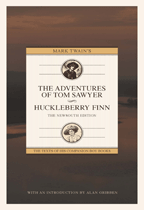 The nation, and even the world, is still talking about Alan Gribben‘s new edition of Huckleberry Finn, which eliminates the notorious n-word. The general public seems to be agin’ it — except for educators, who are showing an interest. Although the conversation is winding down, I expect it will continue for some time to come.

Ray: Prepare the students
The latest installment comes from Elaine Ray, journalist and cofounder of the Parent Network for Students of Color. (She is also, by the way, editor of My Father’s Posts, an intriguing exploration of the writings of her Barbados-born father, also a journalist.) Here it is:
Imagine being a 12 or 13-year-old Asian-American middle school student in our pre-“post racial society.” You are in a school in which there are only a handful of black students and race is rarely dealt with in a direct or constructive way, though racially tinged adolescent jokes and taunts are common. Now imagine being a black girl in that class watching your Asian friend squirm as he is asked to read passages from Huckleberry Finn aloud to the rest of his mostly white class.
I am the parent of that black girl who came home from 7th grade that day horrified at her friend’s embarrassment. Of course, my daughter probably felt her own anguish, but it was easier to project her discomfort on to her friend.
When her father and I approached the teacher about that discomfort, the teacher’s best defense was that she didn’t believe in censorship. I tried to explain to the teacher that I was with her on that, but it was not “whether” she taught the novel that I was concerned about, but “how” she prepared her students for what they were being asked to read. I suggested that she review the work of scholars who had devoted their life’s work to exploring effective approaches to teaching the book.
She didn’t seem to get it, but I trust that in the intervening years, she’s gained some experience as a teacher and has a better understanding of the issue. Perhaps she’s reading the current debate.
My argument has always been that the novel should be taught as it is, but that the adult who is responsible for introducing it to students better damn well know what he or she is doing. Not only do these teachers need to understand and have the skills to articulate the context in which the novel was written, they also need to understand who their students are and the racial context of their lives. Internalizing Jim’s humiliation might be far different in a classroom with a critical mass of black students than it would be in a room in which there is only one.
My daughter’s friend likely was no stranger to the N-word, which by then had pervaded popular culture, but he was sophisticated or intuitive enough to understand the difference between the word’s use in a bravado-filled rap song and its use as a tool of derision in the mouth of Huck.
In a Jan. 16, op-ed piece in the New York Times, author Lorrie Moore writes that the novel is best saved for “college — or even graduate school — where it can be put in proper context.”
She argues that at a time when people are asking themselves how to get boys, particularly black American boys, to read, Huckleberry Finn is likely to turn them off.
“The young black American male of today, whose dignity in our public schools is not always preserved or made a priority, does not need at the start of his literary life to be immersed in an even more racist era by reading a celebrated text that exuberantly expresses everything crazy and wicked about that time . . ..” Moore writes.
What impact the 7th grade experience had on the members of my daughter’s class, I’ll probably never know. But there is no doubt that her teacher’s cavalier approach to the novel made the prospects for an honest discussion about race in America ever more unlikely.
In “Send Huck Finn to College,” Moore also points out that the remedy is not to replace “nigger” with alternative terms like “slave,” since “the latter word is already in the novel and has a different meaning from ‘nigger,’ so that substitution just mucks up the prose — its meaning, its voice, its verisimilitude.” She writes:
Moore: Teach it in college
“Huckleberry Finn is suited to a college course in which Twain’s obsession with the 19th-century theater of American hucksterism — the wastrel West, the rapscallion South, the economic strays and escapees of a harsh new country — can be discussed in the context of Jim’s particular story (and Huck’s).
An African-American 10th grader, in someone’s near-sighted attempt to get him newly appreciative of novels, does not benefit by being taken back right then to a time when a young white boy slowly realizes, sort of, the humanity of a black man, realizes that that black man is more than chattel even if that black man is also full of illogic and stereotypical superstitions.”

Fishkin: Give teachers tools (Photo: L.A. Cicero)
Shelley Fisher Fishkin, incidentally, agrees with Elaine. In an article about the controversy in The Scotsman, she said: “Huckleberry Finn is a very challenging book to teach, and if teachers are not prepared to engage in the history of racism in America then they probably shouldn’t teach it,” says Fishkin. “But I think a better strategy than bowdlerisation is to give teachers the tools to teach it effectively. For the last three decades I have been involved in doing that.”
(Incidentally, the journalist, Dani Garavelli, wrote about the n-word: “Indeed, even writing this article presented a dilemma, as it is has long been the editorial policy of Scotland on Sunday that the word be printed with asterisks, one of only three words that fall into that category, the others being two commonly used swear words.”)
Postscript on 1/20: From Frank Wilson over at Books Inq.: “Here’s an idea: Start the class by playing some rap tunes in which the dreaded word appears. Then ask if anybody found the use of the word in those songs offensive. Then read a passage from Huck in which the word also appears. Then ask the same question.”
Postscript on 1/21: Over at Bill Peschel‘s blog — “Would Mark Twain have removed n***** from Huck Finn? Hell, yes“:
“…Twain had a history of censoring his works, even on “Huckleberry Finn.” He was a working writer, supporting his growing family, his big house in Hartford and his investment in an invention that would have revolutionized newspaper typesetting if it had worked. He worked for a living, and he shaped his writing and his opinions accordingly.”
Bill tells the story about how Twain had three people “patrolling the pages of Huck Finn for outrages against public taste.” It’s here.
 Happy birthday, Martin Luther King Jr. But where’s all your stuff?
The answer is a complicated one, and “a cautionary tale,” according to Elena Danielson, author of The Ethical Archivist and sometime contributor to the Book Haven.
Principally, problems arise when collections are seen as windfalls and brain bling, rather than social and cultural responsibilities.
 Here’s Elena’s story: MLK got his PhD from Boston University and met his future wife Coretta in Boston. The transfer of his papers to Boston University began “by an exchange of letters, a once-common practice.” King intended to make a loan or deposit, that would evolve into a gift. The terms were never finalized.
After his assassination in 1968, the family established the King Center in Atlanta. Most pre-1961 are in Boston; most post-1961 papers are in Atlanta.
The problem is, Boston University isn’t a hotspot for academic research on civil rights. Its special collection is famous for collector the papers of Hollywood figures, who jostle with King on its website.
That’s not all, of course: hundreds of letters and bits of paper are all over the country, many held privately. For example, Harry Belafonte had several major King documents. He tried to sell them at public auction in 2008, but withdrew them under protest.

Martin and Coretta in 1964
Coretta King tried to get Boston’s papers back, beginning in 1987. Could a lawsuit be far behind? James O’Toole, an expert archives witness, recommended consolidating the collection in Atlanta, and testified that at least one item had been lost in Boston, and that the university had not provided the appropriate levels of professional care.
Boston University won the case. “The decision was narrowly based on property law that treated archives as objects, no different from a dispute over the ownership of furniture,” Elena writes.
The situation worsened with Coretta King’s death in 2006. The estate put a large collection of King papers up for auction at Sotheby’s – “The commodification of the King legacy directly threatened its integrity,” Elena writes. Public outcry resulted in a $32 million fund to keep the papers in Atlanta, housed at Morehouse College.
Believe it or not, this tangled story has kind of a happy ending. There was another strand of activity: In 1985, Coretta King asked Clayborne Carson of Stanford to edit King’s papers for publication. The multi-volume edition brings together the scattered texts for researchers – volume 1 came out in 1992, and several more have been published since (14 in all are planned).

Coretta and Clay at Stanford in 1986
Carson turned the limited funding to good use by hiring a regiment of student research assistants – that is, a new generation of researchers. Technology has reunited the the collection with high-tech images. The “virtual collection” at Stanford augments the published volumes.
Clay is an affable kind of guy, a natural uniter. Maybe peace and reconciliation are contagious: “After decades of divisive competition, threats of auctions, and obstructed access, curators in Boston and Atlanta are cooperating, as envisioned by the archival code of ethics. If the program proceeds according to this vision, the results could be remarkable,” she writes. “This kind of documentation gets to the core of history as it happened.”
Elena’s point: Archival ethics are about more than academic nitpicking. “When papers preserve the shared remembrance of society, they become a shared cultural heritage. In these cases the traditional archival concept of respect for the integrity of the collection is something more than a professional technicality. Remembering is a core value.”
Happy Martin Luther King Day, everybody.

Postscript: Just found this video — Clay Carson speaking on what MLK would say about the USA today. Enjoy.
The Book Haven is proudly powered by
WordPress
Entries (RSS)
and Comments (RSS).
© Stanford University. 450 Serra Mall, Stanford, California 94305. (650) 723-2300. Terms of Use | Copyright Complaints