NYT: “Do colleges need French departments?” Josh Landy thinks they do.

December 10th, 2010
Share

My recent article on Joshua Landy‘s rousing defense of the humanities built on an earlier New York Times article:  “Do Colleges Need French Departments?”  The Proust scholar addressed the question with his students in the video above, and to the rest of the world here.  The NYT focus is once again the Albany Massacre, which we wrote on the Book Haven here and here.

Josh told me that he’d made a similar spirited defense on Arcade, “SUNY Albany, Stanley Fish, and the Enemy Within.” It’s worth a look.  Inevitably, perhaps, Josh also attacks Stanley Fish‘s much-blogged post, “The Crisis of the Humanities Officially Arrives“:  “Let’s put it this way: if the most prominent humanists are publicly proclaiming their belief in the utter uselessness of what they do, what reason could a cash-strapped administrator possibly have for not shutting down their departments?” he asks.

Fortunately—as many excellent Arcade posts, among other things, have shown—not all of us feel the same way our “friend” Stanley does.  But it’s time for all of us to get just as vocal as him.  Yes, it may be embarrassing for us to make positive claims for what we do (we’ve specialized for quite a while in making negative claims about more or less everything), but we may just have to accept a little embarrassment.  Perhaps it’s the price we’ll have to pay for heading off future Albanys.

What can we say? Plenty. Here are his talking points:

  • Yes, the humanities do enhance our culture. … In fact, it’s hard to know what culture is if it’s not things like Picassos and Pink Floyd albums and Toni Morrison novels.  Not to mention the people, like Henry Louis Gates and Michael Fried and Helen Vendler (or for that matter Sister Wendy or Benard Pivot or the makers of Art21), who help us to love those works even more.  This may not be an exciting thing for us humanists to say to each other, but it’s straightforwardly true.

    "Has he not read his Bakhtin? Has he not read, well, anything?" (Photo: L.A. Cicero"

    "We need every voice we've got." (Photo: L.A. Cicero)

  • Yes, some of those books that people teach do contain “the best that has been thought and said.”  It should be remembered here that Fish has a very hard time distinguishing between the humanities in general and literary study in particular.  But the rest of us, I think, understand that the humanities also include, among other disciplines, that of philosophy.  Who wants to say that W. E. B. DuBois’s The Souls of Black Folk, to take just one example, is not among “the best that has been thought and said”?  I’m not in any way arguing for a core curriculum (it’s part of Fish’s polarizing thinking that you’re either a hip value-denier or a pathetic canon-defender; let’s resist that false dichotomy).  I’m just saying that people who teach DuBois (and Lao-Tsu, and Nietzsche, and de Beauvoir…), in whatever context, are doing everyone a favor.multidisciplinary minds and a broad spectrum of experiences.” (qtd. in Daniel Pink, A Whole New Mind, 132.)  These are not humanists.  These are business people.
  • What is more, the humanities expose us to—and, very often, cause us to fall in love with—other cultures, both within our country and outside it.  Is it embarrassing to say this out loud?  Certainly.  Does it need to be said?  Apparently so.
  • And then there’s the fact that exposure to the humanities changes us, enriches us, expands our imagination, clarifies our thinking, gives new depths to our being.  Yes, even the literary humanities manage this.  Fish appears to believe—stunningly!—that great literary works could help us only if they provided examples for emulation in the form of heroic characters.  Has he not read his Bakhtin?  Has he not read, well, anything?

Josh concludes:  “There’s much, much more to be said; please help me in saying it.  We need every voice we’ve got.”  A lively discussion follows — check it out.

The empty chair, a presidential statement: “Mr. Liu Xiaobo is far more deserving of this award than I was.”

December 10th, 2010
Share

While he was named as this year’s Nobel Peace Prize recipient, Liu Xiaobo was incarcerated, probably working in the prison factory that makes electrical switches.  In Oslo — an empty chair represented him.

Some Twitter users who listed their location as Beijing had changed their profile pictures to an empty chair.

In light of the refusal of one-third of the invited nations to attend in the face of Chinese threats — China, Russia, Saudi Arabia, Pakistan, Iraq and Iran — it is gratifying to know that President Obama sent out this graceful statement of support today:

One year ago, I was humbled to receive the Nobel Peace Prize – an award that speaks to our highest aspirations, and that has been claimed by giants of history and courageous advocates who have sacrificed for freedom and justice. Mr. Liu Xiaobo is far more deserving of this award than I was.

All of us have a responsibility to build a just peace that recognizes the inherent rights and dignity of human beings – a truth upheld within the Universal Declaration of Human Rights.  In our own lives, our own countries, and in the world, the pursuit of a just peace remains incomplete, even as we strive for progress.  This past year saw the release of Nobel Laureate Aung San Suu Kyi, even as the Burmese people continue to be denied the democracy that they deserve.  Nobel Laureate Jose Ramos Horta has continued his tireless work to build a free and prosperous East Timor, having made the transition from dissident to President.  And this past year saw the retirement of Nobel Laureate Desmond Tutu, whose own career demonstrates the universal power of freedom and justice to overcome extraordinary obstacles.

The rights of human beings are universal – they do not belong to one nation, region or faith.  America respects the unique culture and traditions of different countries.  We respect China’s extraordinary accomplishment in lifting millions out of poverty, and believe that human rights include the dignity that comes with freedom from want.  But Mr. Liu reminds us that human dignity also depends upon the advance of democracy, open society, and the rule of law.  The values he espouses are universal, his struggle is peaceful, and he should be released as soon as possible. I regret that Mr. Liu and his wife were denied the opportunity to attend the ceremony that Michelle and I attended last year.  Today, on what is also International Human Rights Day, we should redouble our efforts to advance universal values for all human beings.

Orwell Watch #2: Murder in Yeovil

December 8th, 2010
Share

Thank you, George.

Last month, I jeered at the cliché “soaring rhetoric” (already on the wane by the time I whacked at it), challenged the liberals’ rebranding of themselves as “progressives,” and, to be an equal opportunity offender, in the comments section I questioned the right-wing highjacking of the meaningless, self-congratulatory term “values.”

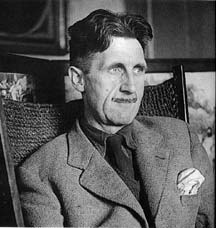
It seems timely to launch the second installment of the Orwell Watch, in honor of George Orwell‘s immortal essay, “Politics and the English Language” — especially after Books Inq. alerted me to a blog post datelined from the odd little burg of Yeovil, a few miles from my own ancestral village outside Glastonbury.

While Orwell’s rule “Never use the passive where you can use the active,” should, like everything else, be used in moderation (in this sentence, for example), it’s a pretty good yardstick to measure the intent to obfuscate.  In this squalid murder case, reported by Theodore Dalyrimple, the prosecutor has pretty effectively distorted a straightforward narrative.  The prosecutor’s through-a-glass-darkly verbiage attempts to describe the murder of 38-year-old Glynn Rowlands, over some stolen gold.

For simplicity (Dalyrimple’s phrasing is rather ornate), the prosecutor’s words from the Western Gazette are italicized below.  The journalist’s queries are indented.

Ben [one of his co-accused] started tying up his [the victim’s] arms and legs. Steve [another of the co-accused] picked up a brick and let it go in his face.

Let it go in his face? Do bricks, then, fly spontaneously into people’s faces like poltergeists, unless diverted from their course? Why did the young man not write that Steve threw, or smashed, the brick into the man’s face?

Glynn Rowlands had fallen into an ugly dispute with [the accused].

By the force of what social (or antisocial) gravity does one “fall into” ugly disputes? Of course, it is possible that the accused picked a quarrel with the victim completely at random: some people behave like that, though it is unlikely in this case, and in fact the prosecutor did not believe it. But an ugly dispute? One does not fall into ugly disputes as into cunningly-disguised elephant-traps.

Retribution was required.

But required by whom or by what? By the laws of the universe? Clearly the prosecutor meant by the accused; but then why not say “The accused sought retribution”?

He was to tell good friends who went to see him in hospital the reality of how gold was missing…

How gold was missing? Did it go missing spontaneously, of its own accord and volition? … Or did someone take the gold? If so, why not say so? Why the passive construction? Since the prosecutor soon went on to say that Rowlands “returned nothing”, he clearly believed that Rowlands had stolen the gold. Why did he not say “Rowlands confessed to stealing the gold”?

It was to get worse …

What was to get worse? The situation, that presumably acted like a demiurge independent of how the participants in it acted? What the prosecutor meant was that the accused allegedly behaved more and more threateningly towards the victim until they actually killed him.

At 3.17 pm on Thursday, December 3, hours before Glynn Rowlands was to lose his life…

Glynn Rowlands was to lose his life? In a fit of carelessness, perhaps, in the way that I sometimes mislay my keys because I am preoccupied by something else? Or by the spontaneous development of a head injury and multiple fractures of the ribs, as some — including Dickens — once thought that people could die by spontaneous combustion? Someone, whether the accused or others, killed Glynn Rowlands.

Does it matter?  I think it does.  As Orwell points out, fuzzy language leads to fuzzy thinking. Here a brutal murder by brutal people has been treated as a sort of inevitability, like leaves falling in the autumn. Human agency has been blanketed by a soft carpet of moral snow.

Legal pomposity is commonplace, and the journalist reacted to it with understandable derision.  Still, some active, Anglo-Saxon verbs — “beat,” “hit,” “stab” and “kill” — would have gone some way to describing the reality of the wretched man who was kidnapped, bound, stripped naked, brutally assaulted and left dying in a cold and muddy on a remote country lane.

Postscript on 12/10:  Of course in my perambulations around the internet, I ran across a photo of Glynn Rowlands; it seemed exploitative to use it on a blog post that is essentially about the use of language. So I settled for a generic “Lady of Justice” image instead. On reflection, however, it seems wrong and indecent not to use it.

Giving voice to the voiceless: Katyń — Massacre, Politics, Morality

December 7th, 2010
Share

“Both my grandfathers were Polish officers,” said Nicholas Siekierski. As I stroll through the new exhibition at Hoover Institution with the personable young archivist, he adds, “They were lucky to be taken prisoner by the Nazis rather than by the Soviets.”

What happened to those not so lucky is Katyń.

Nick is the assistant archivist for exhibits and outreach at Hoover Institution; his father, Maciej Siekierski, is the curator of the East European Collection at the Hoover Library and Archives.  Father and son worked together on the current exhibition at Hoover:  a grim, impressive, dignified reprise of an atrocity, Katyń: Massacre, Politics, Morality.

We’ve written about Katyń before — here and here.  It’s hard to write much about Poland in the 20th century without running head-on into Katyń, either as a symbol or as a reality. It was the central, inescapable monstrosity in Polish life, but a silent one; they were not allowed to speak of it openly for decades. When the Soviet Union occupied Eastern Poland in September 1939 tens of thousands of Polish professional military officers and reservists, policemen, landowners, lawyers, doctors, educators, and civil servants were arrested.  In short, Poland’s political, social and intellectual elite were made prisoners. The following spring, the Soviet Communist Party Politburo ordered the execution of about 22,000 of them.

The Germans investigated in 1943 (Photo: Polish Ministry of Information and Documentation records, Hoover Institution Archives)

The mass shootings carried out in the spring of 1940, some of them in the Katyń forest near the Russian city of Smolensk, are remembered as the Katyń Forest Massacre.  For the next half-century, Communist leaders lied, evaded, and attempted to pin this crime against humanity on the Nazis. The touring exhibition, produced by Poland’s Council for the Protection of the Memory of Struggle and Martyrdom, documents the murder of Poland’s elites carried out by the Soviet security service.  The exhibition was launched at the EU headquarters in Brussels and then moved to the Library of Congress, but its most extended stay will be here, at Stanford, from Nov. 30 to January 29, 2011 (it’s closed during winter break, Dec. 18-Jan. 3, but otherwise open Tuesday through Saturday, 11 a.m. to 4 p.m.).  The exhibition is augmented by documents and photographs from Hoover Archives.

An unknown Katyń victim, probably from an identification card

If the Polish army coats at the entrance of the exhibit look familiar to those who have seen Andrzej Wajda’s acclaimed film, Katyń, it’s more than coincidence.  These two coats were recreated for the film, says Nick. “I saw them in the Warsaw Uprising Museum while I was a volunteer there in September, after they had been used in their exhibit on Katyń,” said Nick. “They offered to loan the uniforms to us for free once they heard about our exhibit.”  The grave, gray coats, like the exhibit, are impressive:  a softer look than you’d expect for an army uniform, yet relinquishing none of the impression of strength. As we all know, Katyń was followed by another horror this year, 70 years later — the airplane crash, en route to a memorial, that killed killed Poland’s President Lech Kaczyński and first lady Maria Kaczyńska, along with Poland’s deputy foreign minister and a dozen members of parliament, the chiefs of the army and the navy, church leaders, the president of the national bank, and others.  At the entrance to the exhibit, I am handed a flier, a speech titled “Freedom and Truth,” dated April 10, 2010.  Perhaps the words Kaczyński never had a chance to speak are also a fitting memorial:

***

It happened 70 years ago. They were tied up and killed with a shot to the back of the head, so there would be little blood. Later, the bodies – still with the buttons of their uniforms depicting eagles on – were placed in deep ditches. Here, in Katyn, 4,400 people died this way. In Katyń, Kharkiv, Tver, Kiev, Kherson, and Minsk a total of 21,768 people died.

"Tied up and killed" (Polish Ministry of Information and Documentation records, Hoover Institution Archives)

The murdered were Polish citizens, people of various denominations and professions; military men, policemen, and civilians. There were generals and regular officers, professors and village teachers. There were military chaplains of different denominations: Catholic, the main Rabbi of the Polish Army, the main Greek Catholic chaplain, and the main Orthodox chaplain. …

These people were killed without trials or court decisions, murdered in violation of the laws and conventions of the civilised world.

What can one call the death of tens of thousands of people – of Polish citizens – without trial? What else can one call it than genocide? If that was not genocide, then what is genocide? …

The crime was a key constituent of a plan aimed at destroying free Poland: a country which – ever since 1920 – had stood in the communist regime’s way to conquering Europe.

This is why the NKVD tried to re-educate the prisoners: they were to support the plans of conquest. Officers of Kozielsk and Starobielsk chose honour and remained faithful to their Fatherland.

Stalin and the Politburo wreaked vengeance upon those who would not yield: they ordered them killed. The murdered were buried in ditches in Katyń, near Kharkiv, and in Mednoye. These hollows were intended to be the grave of Poland, the free Republic of Poland. …

Let us recall some facts: it was we Poles who first opposed Hitler by force of arms. It was we who fought Nazi Germany from the beginning of the war until its end and, by the end of the war, ours was the fourth most numerous army of the anti-Nazi alliance.

Memorial outside St. Idzi's in Kraków (Photo: C. Haven)

Poles fought and died on all fronts: at Westerplatte and near Kock, in the Battle of Britain and at Monte Cassino, near Lenino and in Berlin, and also as guerrillas and in the Warsaw Uprising. Among our soldiers, there were brothers and children of the victims of Katyń. …

The world was never supposed to know the truth – families of the victims could not mourn them in public, could not grieve them or pay them a decent last tribute. The lies were supported by the power of the totalitarian empire and by Polish communist authorities. People telling the truth about Katyń, even students, paid for it dearly. In 1949, Józef Bałka, a twenty-year-old student from Chełm, was sentenced to three years in prison by a military court for daring to speak the truth about Katyń during a class. It seemed that – as the poet said – the only witnesses of the crime would be “the unyielding buttons” found at the Katyń graves. There are, however, also people who would not yield and – after four decades – the totalitarian Goliath was defeated. Truth – the ultimate weapon against violence – triumphed. The People’s Republic of Poland was based on lies about Katyń and now the truth about Katyń constitutes the foundation of a free Poland. This is a great achievement of the Katyń Families and their struggle for the memory of their beloved dead – this was also a struggle for the memory and identity of Poland at large. This is also an achievement of the youth, of students such as Józef Bałka, and of teachers who – in spite of being forbidden to do so – told children the truth. We should also be thankful to priests, including Prelate Zdzisław Peszkowski and Rev. Stefan Niedzielak who proposed that a cross in memory of the Katyń victims be placed in the Powązki Cemetery and who was murdered in January 1989. We should be thankful to publishers of underground publications and we also owe much to independent initiatives, the Solidarity movement and to millions of parents telling their children about the real history of Poland.


Nobel laureate Gao Xingjian in Paris: “I hate Chinese food most.”

December 6th, 2010
Share

A "global citizen" who eats Japanese

Liu Xiaobo‘s Nobel Prize in literature is not the first award to a Chinese writer.  That honor went in 2000 to novelist, playwright, critic, and painter Gao Xingjian, who emigrated to Paris as a political refugee in 1987.  Now, he says, “I live in Paris, but eat Japanese food almost every day for my health.”  The 70-year-old writer adds, “I hate Chinese food most.”

Excerpts from Akihiko Shiraishi‘s interview in today’s Asahi:

On nationalism and the writer:

Nationalism isn’t necessarily pushed on the people by the powers that be. Nationalism can bubble up from among the people themselves, as did Japanese militarism during World War II. That war was not caused by the emperor alone. The Japanese people themselves were caught up in their nationalistic frenzy. Mao Tse-tung was responsible for the horrors of the Cultural Revolution, but the Chinese masses were also guilty of irrational behavior. We all need to become more aware of this sort of insanity inherent in human nature. And perhaps literature can help there.

On his play, Escape:

Q: You then dashed off the play Escape. The story revolves around a young man, a young woman and a middle-aged intellectual who escape the massacre at the hands of the military and hide in an urban warehouse. But in the end, they are all killed, aren’t they?

A: I wrote it at the request of an American playhouse. But when I sent my finished manuscript, they asked me to rewrite it and include an “American hero” in the story. I refused. Even some of my pro-democracy activist friends in China got on my case because I didn’t give them the hero they wanted. After the publication of “Escape,” I was dispossessed of my home in China, purged from public office, and expelled from the Chinese Communist Party. I became a bona fide fugitive.

Q: But your play wasn’t a denunciation as such of the Tiananmen protests. It dealt with a theme that is universal–how people act in extreme circumstances.

A: I wrote a tragedy of contemporary people, not a political drama. There is no mention of China or Tiananmen. Just like in any classic Greek tragedy, I tried to depict the difficulties of human existence itself. The play has since been performed around the world, including Japan. When it was recently staged in Slovenia, one local reviewer said, “This play is about our very history.”

On Chinese culture:

Q: Soul Mountain, which you published in 1990, chronicles your spiritual odyssey when you traveled deep into the Chinese hinterland. The work left a lasting impression on me, especially your depictions of quaint villages of ethnic minorities and sensuous folksongs sung by village elders. Am I correct to assume that China, in your mind, is a conglomeration of these diverse cultures, rather than a nation-state?

A: That is exactly my understanding of Chinese culture. In China, the history of emperors has been recounted as China’s legitimate history. But aren’t there also other histories? I always asked myself. While traveling along the Yangtze river, I collected many old local poems and mythical folk tales, including those of the ethnic minorities. This made me realize that there is no single source of Chinese culture, but that Chinese culture is a composite of diverse ethnic and regional cultures. This revelation deepened my understanding of ethnic and cultural diversity, and freed me from thinking of China as a monolithic state.

“Non-consumptive research”? There must be a catchier word for it.

December 6th, 2010
Share

Jockers: Definitely "non-consumptive" (Photo: L.A. Cicero)

Patricia Cohen ran a post on the “Arts Beat” at the New York Times spotlighting my recent piece on Matt Jockers‘s and Franco Moretti‘s “non-consumptive research” — that is, they shovel books into a computer, which allows researchers to make more empirical judgments on books, if you ask the right questions and look in the right directions.  It’s “non-consumptive” because the researchers don’t actually read the books — heaven help anyone who tried to read thousands of Victorian novels; it would do something to the brain. It’s a fascinating line of research — though not quite my thing.  I’m interested to see what they turn up.

Cohen’s beef?

Did the folks at the Literature Lab try to come up with a particularly un-catchy phrase? Readers, I’m sure you can do better. Send in your suggestions for a more felicitous phrasing.

For those of us who have read a lot of Victorian novels, the word “consumption” certainly does have other connotations.  Jockers is a strapping young man — definitely not “consumptive.”


<<< Previous Series of PostssepNext Series of Posts >>>