Getting ready for Halloween: Dana Gioia’s ghost story

October 25th, 2010

Share

“I don’t believe in ghosts,” he said, “such nonsense.
But years ago I actually saw one.”
He seemed quite serious, and so I asked.
That time of year...

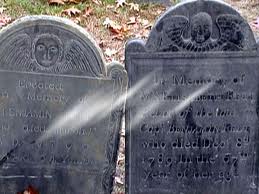
So opens Dana Gioia‘s new ghost story. A fitting topic as we draw closer to Halloween.  (And to All Saints’.  And to All Souls’.)

I wrote earlier about visiting Dana in Santa Rosa last August, when he read his then-unpublished poems to me, which included the “Haunted,”  a short story in verse.  It’s unpublished no more: so I was delighted  when the Hudson Review arrived in my mailbox, courtesy of Dana.  The Hudson Review comes with a CD, including an introduction, a reading, and a short interview.  Dana refrained from publishing new literary work during his six years as NEA chairman — so this publication marks a comeback after long absence.

The 200-line poem (the same length as Robert Conquest‘s “Getting On”) is in blank verse, but with so much chiming — internal rhyming, assonance, and other tricks of the trade — that there were times I would have sworn it was rhymed verse.

Dana tells a short story in verse (Photo: L.A. Cicero)

Dana is a strong advocate for narrative poetry.  “There was a time when you wanted to tell a story, you told it in verse,” said Dana.  Look at Homer.  Or Shakespeare.  Poetry is now mostly confined to short, lyric utterances.  People who want stories turn to novels and drama instead.  “When poetry lost that audience, it lost something that was absolutely essential to its vitality.”

That said, “It’s really hard to write a good narrative poem,” said Dana, adding that he has abandoned a number of efforts over the years.  “You have to have a compelling story, a narrative that moves forward,” all the while “condensing this into essentially lyric medium.” A ghost story requires even more:   Atmosphere is imperative for ghost story, said Dana, noting that Edgar Allan Poe‘s “The Raven” is composed almost entirely of atmospheric effects.  Dana said he had to “build the setting room by room.”

When a narrative poem fails, it’s because “either the story is just not good, they cannot create forward momentum” or else “the language is not good, it’s prosaic.”

Dana says “Haunted”  is somewhat “Jamesian,” and that may be something of a weakness.  His plots, like Henry James’s, consist largely of the states of mind of the characters, rather than in dialogue or a series of events.  This was true also in “Counting the Children,” one of Dana’s best-known poems from Gods of  Winter — another narrative poem.  Of the two, I prefer this new poem, certainly because it reflects (oddly enough) a more familiar range of experiences and states of mind — from the experience of evil (a more intense brush than the one Dana describes, I’m afraid), to the experiences of ghosts, to the illusion that “We thought we could/create a life made only of peak moments” (did anyone not think that at 25?)

The poem’s antagonist is Mara, launching the poem’s curious series of reversals, the equation of light with darkness:

Do you know what it’s like to be in love
with someone bad?  Not simply bad for you,
but slightly evil?  You have to decide
either to be the victim or accomplice.
I’m not the victim type. That’s what she liked.

Young Marian Seldes would have been "magnificent" as ghost, said Dana

Yet, the unnamed protagonist said, “She seemed to shine/as movie stars shine, made only of light.”

And later, of his ghost, he recalled:  “She seemed at once herself and her own reflection/shimmering on the surface of clear water/where fleeting shadows twisted in the depths.” and “Her pale skin shined like a window catching sunlight,/both bright and clear, but chilling to the touch.”

Is the poem autobiographical? “These things did not happen to me autobiographically,” he said, “a bit of this, a bit of that happened, a person I met a house I saw, all worked its way into the story” — even the ghost, though Dana said he doesn’t believe in them.

A suitable theme for Halloween.  But a day after the arrival of the Hudson Review in my mailbox, I received an American Opera Classics CD of Paul Salerni‘s Tony Caruso’s Final Broadcast — called “Opera in ten short scenes on a libretto by Dana Gioia.”  I haven’t listened to it yet.

Dana has been busy indeed.  But then, he always is.

C.S. Lewis, “carny classics,” Joy Davidman … it all comes together

October 22nd, 2010
Share

Notable poet, feisty communist, and free spirit

Books Inq made a reference to Daniel Kalder’s recent Guardian article on the carny world — “that strange parallel world of mutants, outcasts and misfits living according to their own code.”

Since the article had an ostensible literary purpose, perhaps it was inevitable that William Lindsay Gresham‘s Nightmare Alley came to the fore — “a violent and disturbing voyage through tarot, mind reading, carnival life, psychoanalysis and spiritualism, as cold reader Stan Carlisle graduates from sideshows to fake religion, seeking wealth.”

Normally the worlds of William Lindsay Gresham and C.S. Lewis don’t join up — but they should.  The two men married the same woman — Helen Joy Davidman Gresham Lewis.

I wrote about her in 2006 for the San Francisco Chronicle here — “ESSAY: Lost in the shadow of C.S. Lewis’ fame, Joy Davidman was a noted poet, a feisty Communist and a free spirit.”

If I do say so myself — and I do — it’s a good read.  Not because I am so clever, but because Joy is a fascinating and much-disparaged figure in literary history:

“Most references to her either neglect or gloss over the fact that she received the most prestigious award a new poet can receive — the Yale Younger Poets Series Award — for her 1938 poetry collection, “Letter to a Comrade.” …

A year later, Davidman was named joint recipient — with Robert Frost — of the $1,000 Loines Memorial Fund. She went on to write two novels. Her final work, “Smoke on the Mountain,” is a vivid, provocative interpretation of the Decalogue still in print after half a century. She inspired what some critics see as Lewis’ greatest work, “Till We Have Faces,” as well as being its dedicatee (as he was hers in “Smoke”). Some say she is even the model for its tough and invincible heroine, Orual.”

I can’t summarize it.  Read it yourself.  Women have the historic role of being eclipsed by their husbands.  Joy Davidman, however, had the unusual experience of having that misfortune happen to her twice.  One thing bugs me, however, in the Shadowlands version of her story (where she is played by Debra Winger), and in the usual biographical accounts.  Normally, her wish to remain in England is portrayed as some sort of groupie fandom or attempt to manipulate C.S. Lewis into a relationship.  I’ve advanced the best theory:

Her 1953 emigration to England has usually been attributed to her breakup with Gresham and her subsequent flight into the arms of a stable, stoutish Oxford don. No one has suggested another possibility: The House Un-American Activities Committee hearings were in full swing.

Davidman had been a strident associate editor of New Masses and active in the pro-communist League of American Writers. She had also had an unsuccessful stint in Hollywood as a scriptwriter. Did she see herself and Gresham summoned to squeal on former colleagues before Sen. Joe McCarthy? At the time of her first flight to England in 1952, Congress was issuing subpoenas to another volatile husband-and-wife writer team with Hollywood links, Dashiell Hammett and Lillian Hellman. (Hammett served five months in jail for refusing to testify before McCarthy’s Senate subcommittee; Hellman was hauled before HUAC.)

This anxiety is not likely to surface in any of her letters, and could not have been discussed openly. Such were the times. It’s hard now to comprehend the red scare unleashed by the hearings, especially among those who might have had a song to sing. (As the daughter of a “red diaper baby,” this writer remembers being earnestly warned never to mention that grandparents had been rank-and-file Party members in the ’30s — even a decade and a half after the congressional hearings finished.)

I responded to Frank Wilson‘s Books Inq. post — and Frank responded to me by posting a link to my San Francisco Chronicle story.  And I responded by posting it all here.  Once again, the endlessly self-reflexive nature of blogdom.  The Land o’ Lakes butter box once again.

Postscript on Oct. 23:  By the by, I neglected to mention that I found evidence to support my theory.  I mentioned it in my 2007 Washington Post review of Lewis’s letters here:

Although many have impugned the motives of Davidman, the [initial reason for their marriage] is revealed in a footnote: Lewis confided to his friend Sheldon Vanauken that he had married “to prevent the Government deporting her to America as a communist.” She had been a prominent party member, and the congressional red scare was in full swing when she fled the United States.

Now this is good news — James Marcus at Harper’s!

October 21st, 2010
Share

Risen to glory

Writer, translator, critic, and editor James Marcus will join Harper’s Magazine as deputy editor next month.  This is great news indeed.

James has been an intelligent, genial presence in my life for some time now. I can’t even quite remember how we met … well, “met” … we’ve communicated by phone and by email for years, but have never had an actual face-to-face.  I suppose it was way back when I was working on Joseph Brodsky: Conversations.  Something bonds all former students of the Nobel laureate — in some cases, epiphany, in other cases, trauma.  In still other cases, both.

I quoted James’s description of his experience in my introduction:

James Marcus, while attending Columbia University, heard rumors of a student in the previous term whose work Brodsky had ridiculed so mercilessly that she burst into tears in class.  In a short reminiscence posted on amazon.com, Marcus recalls Brodsky’s first day of class: Brodsky, wearing a corduroy jacket, had “thinning reddish hair and the sort of pale skin, stippled with freckles, that seemed never to have been out in the sun…” He lit a cigarette–the first of many.  “Throughout the seminar he would bum cigarettes from the few addicts in the class, tearing the filters off with his teeth before applying a match.” Brodsky explained his worldview to his students: “Poetry, in his estimation, was the glue of civilization, and language the repository of time itself.” Later in the semester, after assigning a short page for class, he warned them, “Assume that this may be the last thing you write … Don’t forget, you could get hit by a car after you hand it in. Keep that thought in mind.” While it may have been “grandiose nuttiness” from anyone else, Marcus concludes that Brodsky was merely extending his own “high seriousness about writing to his students” — few of whom deserved it.

We connected next when I was doing the Czesław Miłosz: Conversations — I reprinted his short, lively email interview with the the Polish Nobel laureate, from the days James was working as resident critic for amazon.com.

Forgiven

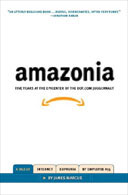
After the Amazon experience, he wrote Amazonia: Five Years at the Epicenter of the Dot-Com Juggernaut, but they’ve forgiven him. He is a noted translator of Italian, particularly Calvino, as I recall.

He is also an editor-at-large at the Columbia Journalism Review; his writing has appeared in The New York Times, The Nation, The New York Review of Books, and Salon.

More good news: He started blogging again a few days ago with this post at House of Mirth: “Just as there is no reason to start blogging, there is no reason to stop. So I’ll get rolling again with two savory snippets. First, an observation: there are moments when the writing life seems like a parade of small degradations. Can any other profession take such a toll on the ego?”

(Here’s even more good news:  Mark Sarvas’s Elegant Variation has also been revived, after a more sporadic absence. Does life get any better than this?)

Postscript on Oct. 24:  Coincidentally, James’s current (Oct. 21) post over at House of Mirth is on Brodsky, his interview with Sven Birkerts, and Watermark.  Scroll down if James refreshes the page — I can’t provide a link to just that post.

Ian Morris: The man who has an answer for everything

October 20th, 2010
Share

Ian Morris has an answer for everything.  And you’ll be able to hear it all tonight at Kepler’s at 7 p.m.  Or, for the Cliffs Notes version, see my video interview above.

I wrote about Ian some time ago, well before the launch date of his new book, Why the West Rules — For Now — which is out this month.  In a world of cautious scholarship, Ian is going way, way out on a limb with his grand récit, a story about how everything came to be in the history of the world.  Remember crazy James Burke in The Day the Universe Changed, the man who could somehow connect the drift of continents with the invention of spaghetti?  Ian Morris grabs the other end of the telescope.

It’s an unusual publishing choice for Farrar, Straus & Giroux, who usually publishing premiere literary works.  I understand the top publishing house wants to expand its repertoire.

Friedrich Keyl's painting of Looty. The collar with bells in the foreground is the only remant of his earlier royal life.

When I wrote my own article, I began it with a small dog that has a big story:  a yapping Pekingese named Looty.  (It guaranteed me a readership among Pekingese fanciers.)

I wrote:

After the sacking and destruction of Beijing’s summer palace in 1860, the Chinese empress’ Pekingese – the appropriately named Looty – was whisked to the royal family at Balmoral, bringing the previously unknown breed to the West.

But why Looty to Balmoral, instead of the other way around, with Queen Victoria’s beloved Skye terrier, Islay, going to the emperor in Beijing?  Why was it the British, and not the Chinese, who dominated?

Stanford Classics and History Professor Ian Morris puts forth some bold answers in his ambitious new 750-page book, Why the West Rules – For Now (Farrar, Straus & Giroux).  And that places Looty in a longer story going back to the last ice age.

Looty’s story is sadder than I made it sound.  Though he lived a long and contented life in Victoria’s lap, after an initial period when he was beat up by the British dogs, here’s his unexpurgated story, as told in Jolee magazine:

One British soldier who arrived too late to share in the plunder of the Palace, discovered in a corner of the Garden of Clear Ripples four little dogs and their attendant, a lady of the Court who had committed suicide rather than be taken prisoner by the barbarians. Gathering up the four little dogs, he put them in his gunnysack and later whilst rejoining his regiment at muster prior to embarkation on Her Majesty’s ship “Odin” for the return to England, the four dogs would not stay still. One of the officers noticed movement in the soldier’s gunnysack, and was ordered to disgorge the contents of his sack – and out poured the four dogs which were immediately confiscated from the aberrant soldier by his officers.

The dogs should have been returned to the Summer Palace but were not.  One dog and a bitch were taken by Lord John Hay and later given to his sister the Duchess of Wellington. The other dog and bitch were taken by Sir George Fitzroy and given to his cousin the Duchess of Richmond. And of course “Lootie” was given to Queen Victoria by Captain Dunne.

After reviewing my own paragraphs, copyeditor Barb Egbert came back and cheerfully corrected me, “Shouldn’t we say the last ice age?”  Silly me.  I was confusing the last ice age with all those other ice ages.

Now that’s an editor.

Barb Egbert took away the 800-page book (with index) — otherwise I would include an excerpt.  Soon she will know everything about everything.  Sometimes I think she already does.

A word about Yoko Ono, and then we return to our regular programming…

October 19th, 2010
Share

Yoko and historian Gordon Chang (Photo: L.A. Cicero)

The Dalai Lama, Condi Rice, now Yoko Ono.  What has gotten into us? Okay, okay, a quick word about Yoko, and then we return to our regular programming.  Maybe a word or two about Leszek Kołakowski, or maybe a thought about Fulke Greville‘s influence on Thom Gunn and Robert Pinsky.

Tonight’s CNN interview headline: “Ono: ‘I was used as a scapegoat’ in blame over Beatles breakup.”

This is not news.  I interviewed Yoko in January 2009 here.  An excerpt:

HAVEN: You’ve gone from one of the most reviled public figures—the one that was blamed for breaking up the Beatles—to a celebrated international icon. How did you weather the storms?

ONO: I think that I was very lucky. I went through the most horrible situation where I could have been killed. There were people who really wanted me dead. I don’t know how I survived that. You can’t advise people. It’s such a severe situation when people go through it, I don’t know what they can do. All we can do is do our best, whatever that is—our best to survive.

Kołakowski anyone?

HAVEN: Of course, when you burst on the world stage with John Lennon in the 1960s, World War II was only two decades in the past, and the women’s movement had not yet been launched.

ONO: Exactly. [laughs]

HAVEN: Do you feel sexism and racism played a role in your treatment?

ONO: Definitely. It was very upfront, very clear. I think maybe I was used as an example of something—to make people understand what one goes through. Maybe in that sense it was beneficial—beneficial to society, maybe.

You heard it first here.

Whew!  We’re glad we got that out of our system.

The cover says it all: Roz Chast’s “Shelved”

October 19th, 2010
Share


<<< Previous Series of PostssepNext Series of Posts >>>