Lawrence Ferlinghetti’s editor remembers: “it was a thrill to get to work on his stuff.”

February 23rd, 2021
Share
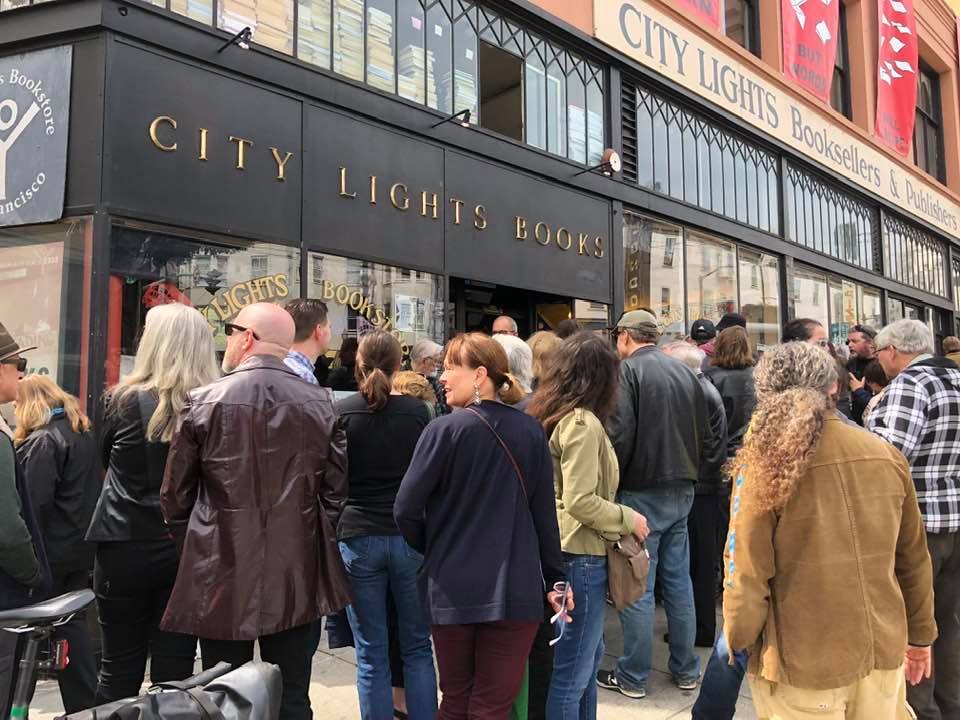
For his 100th: a poet reading outside Caffe Trieste (Photos: Regan McMahon)

Lawrence Ferlinghetti is dead at 101. As someone said on Facebook, we thought he would go on and on – like Keith Richards. Many voices have been heard today memorializing the City Lights legend, but one aspect of the poet’s career has been forgotten: he once wrote a regular column for the San Francisco Chronicle. It was during the time David Kipen was the valiant book editor of the paper’s book section … back in the days when it had a standalone book section, and back in the days when I was writing for the section regularly, too. David signed up the poet and activist to write some time after Ferlinghetti was named San Francisco Poet Laureate in 1998.

Former Deputy Editor Regan McMahon (now books editor at Common Sense Media) remembers: “I was privileged to get to edit the column Ferlinghetti wrote in the San Francisco Chronicle’s Books section for a while. Loved when he’d reminisce about his early days in San Francisco in the early ‘50s. A man of integrity, artistic vision, and wit. City Lights has always been a touchstone. Think how many travelers saw Ferlinghetti’s bookstore as a destination and walked away with a book of poetry. That alone should earn him sainthood.”

“I had to fret over it coming in late, as I recall. I basically copyedited it, and of course wanted to let his voice shine through, even if I had to make a few schoolmarmish fixes. He took ’em in stride. I forget how long he wrote for us or how or why it ended. I think he got tired of meeting deadlines. But the pieces were full of charm, wit, and wisdom. And it was a thrill to get to work on his stuff.”

She also remembers “the great day we had in North Beach for his 100th birthday celebration in 2019.” And she took some photos.

“Slid by Caffe Trieste, where a poet was reading outside on the sidewalk, natch, then walked down to Mario’s Bohemian Cigar Store, a family tradition.”

This image has an empty alt attribute; its file name is Ferlinghetti1.jpg
This image has an empty alt attribute; its file name is Ferlinghetti2.jpg
This image has an empty alt attribute; its file name is Ferlinghetti3.jpg

Is Thornton Wilder’s “Our Town” America’s Shakespeare?

February 22nd, 2021
Share

Bet I got your attention with that headline. But the argument is not mine, but rather made by Howard Sherman over at The Guardian here.

Here’s what he says:

“It may sound fulsome but I’m prepared to take a leap and suggest that Our Town is very likely on its way to being America’s first Shakespearean play. I’m not speaking of its language or scale, but rather the likelihood that it’s going to remain in the international repertoire for more than a hundred years – and beyond.”

He continues: “Our Town has lasted as one of the most produced US plays in the global modern repertoire. This is not for its statement on the American character or as a flag-waving paean to a simpler time, but because its true concerns transcend the specifics of turn-of-the-20th-century Grover’s Corners, where the play is set. That’s quite surprising for a play with a rather slim plot and no conventional conflict, which alternates between long narrated passages and select scenes of two families in small-town New Hampshire.”

I’ve always argued that the 1938 play has been consistently underrated. Too many low-budget high school productions, too many amateur performers. Thornton Wilder was a sophisticated man, at home in Shanghai and Rome. Gertrude Stein‘s The Making of Americans (1925) and Dante‘s Pugatorio inspired his writing of the play.

More radical than people remember.

An excerpt:

“That’s because the play is about mortality, about the brevity of human life and Wilder’s charge to the audience to appreciate what they have while they have it. It’s not about stoves and walls. For a play that many remember for its sweet romantic scene with two teenagers in Act II, or for the homespun charms that clung to it for so many years, this is a play that starts talking about death in its first few paragraphs, giving way in its third act to a scene of the aftermath of a tragedy from an atypical perspective.

“I spent 18 months conducting more than 100 interviews with theatre artists for a book about the play and it felt like I’d been running an Our Town focus group. Given the conventional wisdom that the play is old hat, I was surprised to find how many of the people I interviewed, in the US and the UK, either had already fallen for its message – or, in roughly equal number, had never previously seen or read the play, yet had formed definite and typically dismissive opinions about it. However, after working on a production, everyone seemed ready to proselytise others into the fold of Our Town.

“For a play as seemingly simple and plotless, there are depths to plumb in how to approach the play. Wilder may have written explicitly about what he wanted audiences to learn but he didn’t provide a precise map of how to get there. The largest role in the play is a narrator called only the Stage Manager, who has no personal story or even identifying details of character. We see mostly minor events in the lives of a few primary people. And yet, if one looks closely, topics like the extermination of indigenous peoples and immigration from eastern Europe are fleetingly recognised in a very homogeneous town, and the march of technology is transforming people’s lives.”

Read the whole thing here. Make your rejoinders in the comments section below.

Novelist Carol Edgarian comes home to Stanford for Another Look’s Feb. 26 discussion of “Billy Phelan’s Greatest Game.”

February 11th, 2021
Share
Carol Edgarian: “a remarkable writer of intelligence and compassion.”

Stanford’s Another Look book club will hold its long-postponed discussion honoring author William Kennedy, a Pulitzer-prizewinning, MacArthur “Genius” Fellow, at 3 p.m. (PST) on Friday, February 26. The Zoom event is free and open to the public – register HERE. Read more about the event here.

The discussion will be led by National Medal of Arts winner Tobias Wolff, with panelists Carol Edgarian, novelist and a founding editor of Narrative Magazine, and Robert Pogue Harrisonan acclaimed author and host for the popular radio series, Entitled OpinionsWolff and Harrison are, respectively, the founding and current directors of Another Look.

Edgarian is a newcomer to Another Look, but no stranger to Stanford. She graduated from the university in 1984 – so she’ll have a Zoom homecoming with the Another Look event. Amy Tan, another celebrated local author, called her “a remarkable writer of intelligence and compassion.”

Her newest book, Vera, will be out on March 2 with Scribner. It’s a novel set against the 1906 San Francisco earthquake,

It’s already getting praise: “A novel of resilience in the face of disaster, just what we need right about now,” wrote fellow novelist T.C. Boyle. “Edgarian’s tale couldn’t have come at a better time.”

Her previous books include the New York Times bestseller Three Stages of Amazement and the international bestseller Rise The Euphrates, winner of the ANC Freedom Prize.  Her work has been described by The Washington Post as notable for its “generosity of spirit, intelligence, humanity, and finally ambition.”  

Her articles and essays have appeared in The Wall Street Journal, NPR, and W, among many others. But she is perhaps best known as co-founder of the Narrative (www.NarrativeMagazine.com), which publishes fiction, poetry, and art. It also sponsors Narrative in the Schools, which provides free libraries and writing resources for teachers and students around the world. Over the years, the online magazine has published  Ann BeattieT. C. BoyleJoyce Carol OatesJayne Anne Phillips and our own Tobias Wolff.

“When we started the magazine,” she told Ron Charles of The Washington Post in 2014, “the thinking about online reading was that readers would not sit still for more than 1,000 words. We set about working against that grain, and from the first, we published long-form work: stories, novellas, novel serializations. One of the great things about digital publication, in our view, is that we can go long.”

To bring you up to speed on our upcoming event: Pulitzer prizewinning novelist William Kennedy has been called the Bard of Albany, but he began his career as a reporter. After a stint in the military and in Puerto Rico, he returned to his hometown, and saw the city of his birth with new eyes: “Without a sense of place, you don’t, as a writer, have very much. Place is all those forces of a given society impinging upon and determining character. Without it, a book becomes bloodless.”

Tobias Wolff will lead the discussion

Billy Phelan’s Greatest Game belongs to William Kennedy’s celebrated Albany sequence of novels. According to Stanford’s Tobias Wolff, “Set during the Depression, it concerns a young gambler and bookie, the Billy of the title, who suffers a setback that compels him to embark on an odyssey – and I use that word advisedly – through the demimonde of his city, during which he encounters temptations and dangers that test his resolve to the limit. There are gangsters, there is a kidnapping, but at its core this novel is about character, and what this man will do and endure to preserve his honor.”

Like all our events, it is free and available to the public. Register HERE, and welcome Carol Edgarian back to Stanford … virtually speaking.

Regina Derieva: a posthumous birthday, a new book of poems for the woman Brodsky called “a great poet”

February 7th, 2021
Share

Brodsky to Derieva: “You are a great poet.”

Alexander Deriev  reminds me, “Today would have been the 72nd birthday of Regina Derieva. Сегодня Регине Дериевой исполнилось бы 72 года.” The Russian poet Regina Derieva, who died in 2013, would have been 72.  We’ve written about her death here, and her life and work here and here and here. Her papers are now held at Stanford Libraries. I wrote about her for the Times Literary Supplement here.

Her epistolary friend (they never met) Joseph Brodsky wrote to her in 1990: “There is a point – literally the point of view – which makes it all the same how one’s life is going, whether it is happy or nightmarish (for a life has a very few options).  This point is over the life itself, over the literature, and it becomes accessible by a ladder, which has only sixteen steps (as in your poem titled “I Don’t Feel at Home Where I Am”).  For a poem is composed of other things than life, and the making of verses offers more choices than life does. And the closer one is to this point, the greater poet he, or she, is. …

“You, Regina, are indeed this case – a great poet. …The real authorship belongs here to poetry itself, to freedom itself. For a long time, I have not seen anything on a par with your poetry either among our fellow countrymen or among the English-speaking poets. And I can guess more or less – I can hear – what it cost you to reach this point, the point over the life and over yourself. This is why the joy of reading your poetry is also heartbreaking. In this poem, you exist in the plane where no one else exists, where no one else can help:  there are no kin and, a fortiori, there are no equal to you.”

The occasion of her birthday reminds me that I haven’t written about her new book, Earthly Lexicon: Selected Poems and Proseout with Marick Press a few months ago. Now is the perfect occasion for its Book Haven debut.

Many poets seem to have suffered a primal deprivation, for Derieva, it was her birthplace Odessa. As she writes in Quarter to Paradise (trans. Alex Cigale): “At so early an age, I was deprived of everything, all at once: the sea, the fruit gardens, the chestnuts and acacias, the alleyways and streets of Odessa. And I found myself in the Kazakh steppe. The wind there was always marauding, never allowing for a cultural layer to form on the barren spot. There was neither spring nor fall: with the end of the infernal winter began an infernal summer. It is not incidental that Stalin chose precisely this part of the country for his prison camps, where a human being had no time to live, thinking only of how best to survive … there, where fate offers to place its period.”

I haven’t had a chance to explore the volume fully, but so far her American poems are among my favorites, written during a brief sojourn in the States.

Below, two of them, translated by Alan Shaw:

WORCESTER, MA

A bird is crying out at dawn,
and at dusk grows still again:
“Little enough under the sun
have I and all my siblings seen.

“Golden sky at break of day,
growing azure towards the dark.
The voice is lost, which is to say,
time is emptiness’s mark.”

The voice fades out, just as if all
hint of bird were gone there too,
besides the readiness of a soul
to lose itself in heaven’s blue.

EAST NORWALK, CT

The hawk goes corkscrewing into the sky,
drawing with hard quill in three dimensions
on three-ply eternal paper his cry,
his whisper, a faithfulness that’s endless.

I see the whole thing, as the neighborhood darkens
and players come in from the playing field –
He cradles the ball like the nape of a girlfriend,
being so strong, and new, and thrilled

with this amorous ruckus, this game, this spat,
this trial and torture of wings, his calling.
The hawk drops down, having built his estate;
a heavy drop of sweat is falling.

Come then, since I have put lips into play,
search out and storm me, unleash a rushing
rain of heavy rough feathers; away,
you stoic of in- and exhalation,

historian of air, soul-striking lightning,
come, take me and lift me far out of sight
of the awful chance that an oath will be broken,
the secret be known of what madness can write.

(From Alexander Deriev on the photo above: “This photo of Regina was taken at the Karaganda TV studio sometime in the early 1970s. This was the only telecast of a series of poetic TV programs that Regina ever agreed to do. The program was devoted to Nikolay Zabolotsky who was forced to spend several years in Karaganda. The broadcast took place, but then the TV editor decided to claim authorship of the program and did not pay a dime to Regina. After this, Regina staunchly refused to participate in any TV projects.”)


Dana Gioia remembers a week with John Cheever at Stanford: “I was stunned by his voice.”

February 1st, 2021
Share

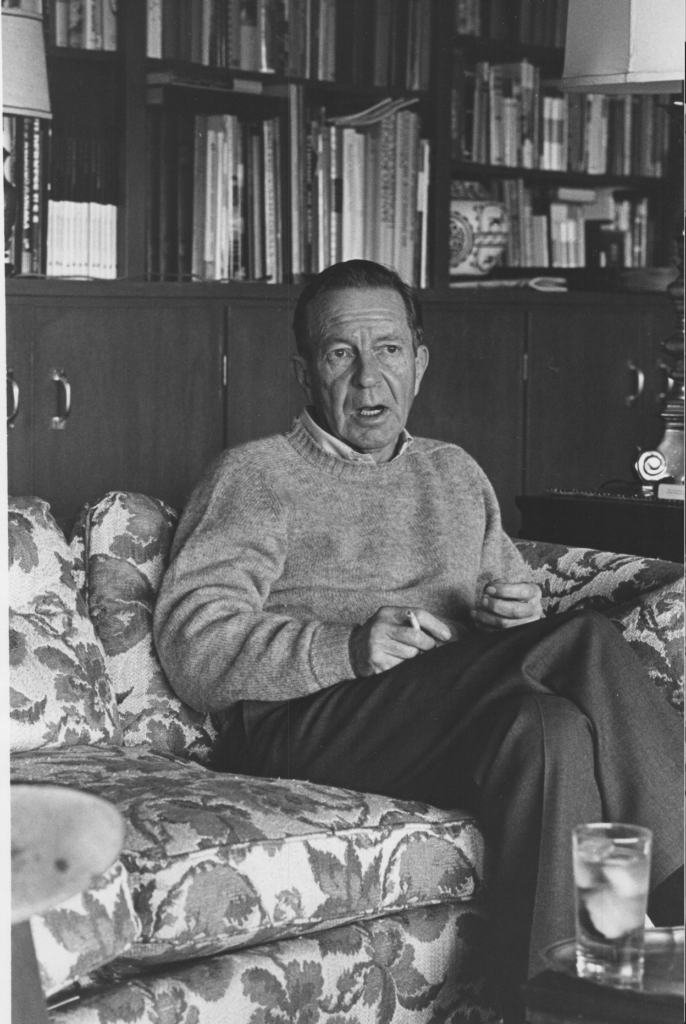
Cheever at Stanford, 1975 (Photo: Stanford News Service)

Poet Dana Gioia met John Cheever when the author was at a lowpoint of his literary reputation. His 1969 novel Bullet Park was received poorly, and a subsequent novel in 1973, The World of Apples, did not stop the decline. His work no longer appeared in The New Yorker. The occasion of the encounter was Stanford. Dana was a graduate student in Stanford’s Business School (he eventually became one of the few poets to have an MBA), and camped out in “FloMo,” more formally known as Florence Moore Hall. The occasion of Cheever’s arrival at campus was his son, who was thinking of enrolling at Stanford – and eventually did.

In his new book of recollections: Studying with Miss Bishop: Memoir’s from a Young Writer’s Life, the former National Endowments for the Arts chairman recalls his all-too-brief week with Cheever. “I was dazzled by his talk which could make a mortgage or a report card shimmer like a sacred script.”

The book, published by Paul Dry Books, has the distinction of being one of the few books ever to go into a third printing before it was officially out, thanks to pre-orders. 

A couple excerpts:

“Although Cheever looked exactly like his dust jacket photographs, three things surprised me. First, he was so small. For some reason, probably connected with my mental images of his fictional protagonists, I had expected a magisterially tall Yankee gentleman. Instead I met a slight, boyish man who stood only a few inches over five feet. Second, Cheever was the most perfectly poised man I had ever met. Every gesture was so graceful that he scarcely seemed part of the clumsy everyday world. Even the way he sat still seemed as carefully composed as a portrait. Not that his presence was dramatic; just the opposite was true. His manner was relaxed and understated. Nevertheless he had a style that captivated one’s attention the way a great actor can steal a scene without speaking a word. Finally, I was stunned by his voice.

“Cheever spoke a brand of patrician Massachusetts English that I know suspect he invented, for I have never heard anyone else speak quite like it. Nevertheless, he used this suave, fictive dialect so convincingly that in his voice it carried the force of ancient authority. I had talked to men funnier or wiser than Cheever, more inventive or intelligent, more perceptive or likeable, but I had never met anyone who possessed all these qualities so generously in such deft balance. His wasn’t the pedestrian balance of an earnest earthbound mind but the equilibrium of an acrobat.”

***

“He had never bothered to grow old. He still seemed more bright young man than sagacious patriarch. No one who met him that week would have guessed his full age.

“As his staff host, I expected to see little of Cheever after taking him to lunch the first day. To my astonishment, I spent most of the next week with him. He had arrived at Stanford with the best of intentions but the vaguest of plans. Since [his son] Fred was busy following his friends, his father had nothing to do except wait several days for a hastily arranged class visit and public reading. Cheever knew no one at Stanford, and the people who might have sought him out were mostly unaware he was on campus. He accepted his idleness and neglect without comment.

“For the next few days, Cheever just hung around Flo Mo, treating this large, spider-shaped complex like a resort hotel. He lingered over meals until the last student left and then sat in one of the run-down and usually deserted lounges. Whenever I returned from classes, I would find hi sitting by himself smoking in one of the huge Naugahyde chairs. He agreed to almost any suggestion I made – a walk, a drive, a visit. Eventually I gave him a key to my room so he could borrow books or listen to records when I was in class. …

So much about Cheever surprised me. First, I remember his modesty as a writer. He did not lack self-esteem, but it was tempered by his recognition of the immensity of the writer’s task. Having already met a few self-absorbed literary mediocrities, I found John’s humility before his vocation pure and unaffected. It was a kind of innocence. He was proud of what he had written but without pretension. He appeared unconcerned with posterity, which he claimed would take no note of him. What he valued was his relationship with his audience.

The book also includes a 21-page interview with Cheever, never before published in full. The Q&A was recorded by Michael Stillman, who died last month, with Stillman, Dana Gioia, and writer Millicent Dillon (formerly of the Stanford News Service) in conversation with Cheever. 

Postscript on 2/5: Dana’s brother, the jazz scholar Ted Gioia, comments on Facebook:   I was a freshman in college back in 1975, and got to have dinner with Saul Bellow and breakfast with John Cheever on the same weekend(!) This all happened because my older brother Dana, a grad student back at the time, was their informal host during their campus visits. I was 17 years old, and a freshman at Branner, while Dana was 23 and a first-year-student at the Stanford Business School. But Dana seemed to know everybody and be everywhere on the literary scene, even at that young age. He and I only had one class together, when we both took the same intermediate Italian language course. One day, Dana brought as his guest to the class Ezra Pound‘s daughter, the Princess Mary de Rachewiltz—how did he make these connections, and pull these things off? He’s just a student and he brings a princess to our class? It’s a grand mystery to me. I still don’t know he got me at the dinner table with Saul Bellow, when there were a thousand other people at Stanford who would have liked to have my seat. He just always seemed to be at the epicenter of everything and anything.

I can’t stress this too much: There is no substitute for seeing people up close who are operating at the highest levels of their vocation. And that’s true whether you are a poet, musician, novelist, painter, manager, cook, lawyer, or in any other profession. These experiences reveal possibilities in life you could not grasp in any other way.


At last! At last! Stanford spotlights William Kennedy’s “Billy Phelan’s Greatest Game” on Feb. 26!

January 29th, 2021
Share

The Bard of Albany, Irish-American author William Kennedy

It’s happening! It’s finally happening! At 3 p.m. (PST) on Friday, February 26, Stanford’s Another Look book club hold its long-postponed Another Look discussion honoring author William Kennedy, a Pulitzer-prizewinning, MacArthur “Genius” Fellow. Our event for the 1978 book was one of the early COVID casualties at Stanford last spring. Now it will be rescheduled as a Zoom event (isn’t everything nowadays)?

From our announcement:

Pulitzer prizewinning novelist William Kennedy has been called the Bard of Albany, but he began his career as a reporter. After a stint in the military and in Puerto Rico, he returned to his hometown, and saw the city of his birth with new eyes: “Without a sense of place, you don’t, as a writer, have very much. Place is all those forces of a given society impinging upon and determining character. Without it, a book becomes bloodless.”

According to Stanford’s Tobias Wolff, who will lead the discussion: Billy Phelan’s Greatest Game belongs to William Kennedy’s celebrated Albany sequence of novels. Set during the Depression, it concerns a young gambler and bookie, the Billy of the title, who suffers a setback that compels him to embark on an odyssey – and I use that word advisedly – through the demimonde of his city, during which he encounters temptations and dangers that test his resolve to the limit. There are gangsters, there is a kidnapping, but at its core this novel is about character, and what this man will do and endure to preserve his honor.”

The discussion will be led by National Medal of Arts winner Tobias Wolff, with panelists Carol Edgarian, novelist and founding editor of Narrative Magazine, and Another Look Director Robert Pogue Harrisonan acclaimed author and host for the popular radio series, Entitled Opinions

Like all our events, it is free and available to the public. Register here.

And check out my Los Angeles Review of Books interview with Bill Kennedy, discussing his life and, in particular, Billy Phelan’s Greatest Game. An excerpt:

CYNTHIA HAVEN: Hemingway wrote: “Everything changes as it moves. That is what makes the movement which makes the story. Sometimes the movement is so slow it does not seem to be moving. But there is always change and always movement.” It’s a thought you echo more than once in Billy Phelan, for example, when you write: “We are only as possible as what happened to us yesterday. We all change as we move.” You’ve said, “The movement is what creates the action, and the action is what creates the story” — which in turn creates more movement. Clearly, you’ve thought about this a lot. Could you share a few more thoughts?

WILLIAM KENNEDY: I must’ve been deeply persuaded by Hemingway’s lines to have lifted them without crediting him; but I always listened to what he said about writing. In The Angels and the Sparrows, I created Francis Phelan, a wino in his 30s, a clever, obnoxious loner returning home for his mother’s funeral (she kicked him out), who stops at a neighborhood bar for a beer and is hostile to the bartender. It was a good scene. He was a sad, broken young guy, but I disliked him seriously, even as I was creating him, and didn’t want to carry him forward.

Then, maybe 15 years later I started to write Billy Phelan and I reinvented the Phelan family. I had to get rid of Francis as that antipathetic young wino. He still had to be a bum, but I aged him into a tortured figure at the bottom of the world who was Billy’s father, and his life immediately became an open-ended challenge to my imagination. It turned out that he had abandoned his family 22 years earlier after his 13-day-old son, Gerald, slipped out of a diaper while he was changing him, fell off a table, broke his neck and died. In the fall of 1938, Francis drifts back to Albany to vote in a Democratic primary election, knowing the machine will pay him $5 for this; so he votes 21 times, earning $105, and is put in jail. Billy, the gambler, hears he’s in town and bails him out. The new Francis, after living through 16 years of shame and guilt over dropping the infant and running off, became a pitiable but likable human being. I don’t know where Gerald came from. There was no such incident in my life, nor can I remember hearing of one; perhaps I forgot it. But years ago I decided it was a gift from my unconscious, a fruitful one. In Billy, Francis was so vitally real that he leaped onto my typewriter and demanded his own novel. So I wrote Ironweed for him.

Again, register for the event here.


<<< Previous Series of PostssepNext Series of Posts >>>