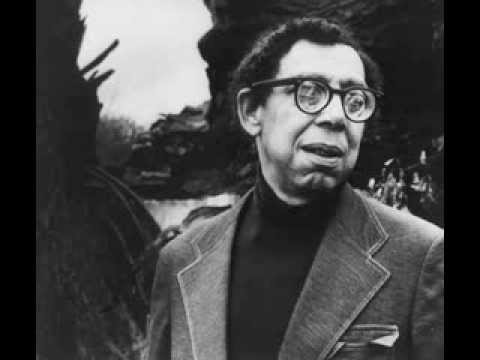
“He was so good at everything he did”: Robert Conquest and his poems of “elegant irreverence” in WSJ

August 23rd, 2020

Share

A literary scholar – and a very good one.

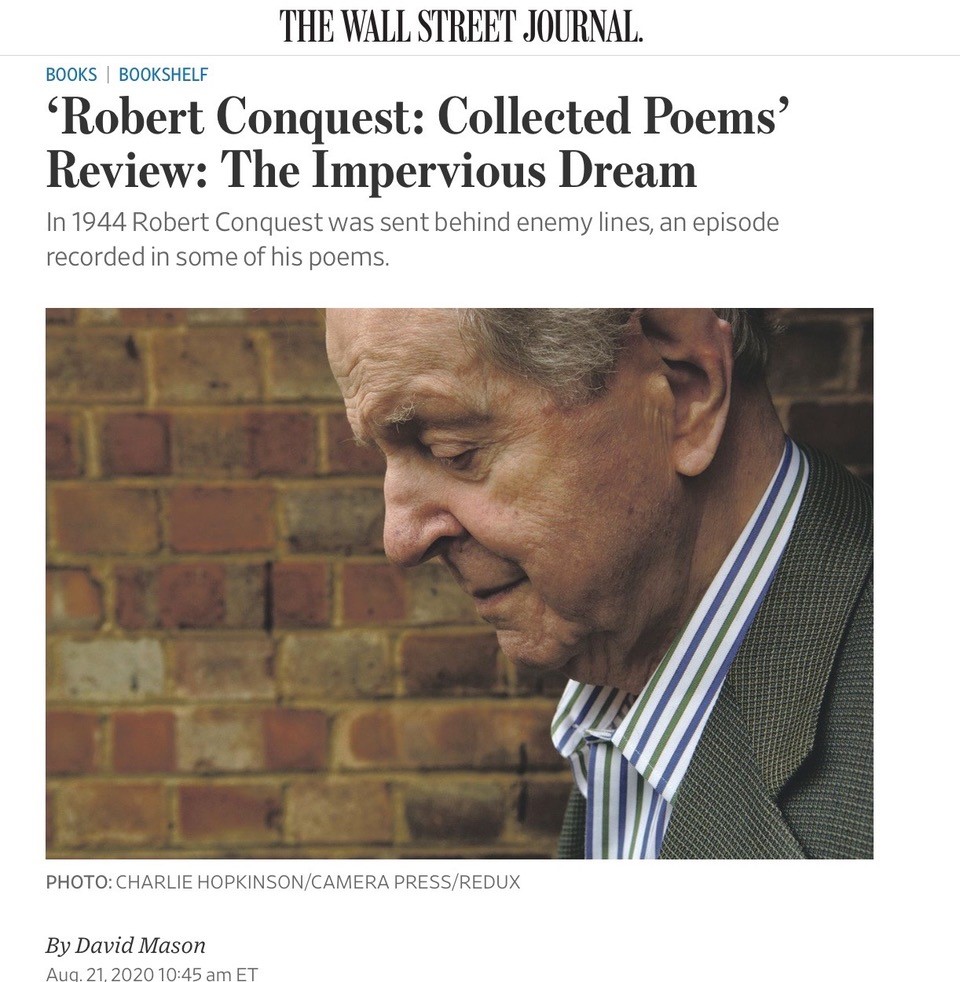
Robert Conquest‘s Collected Poems is out at last, thanks to the assiduous efforts of his widow, the literary scholar Elizabeth Conquest. And also to Philip Hoy of Waywiser, who is my publisher as well. But thanks especially, in the last few days, to David Mason, who has written a review, “The Impervious Dream,” in the Wall Street Journal. We’ve written about Stanford’s Bob Conquest, who died in 2015 at 97, here and here and here. among other places. We’ve written about Liddie Conquest here and here and herePhil Hoy is here, and David Mason here and here and here.

An excerpt from the review:

He was so good at everything he did—soldier, diplomat, historian and poet—that I wouldn’t be surprised to learn he also left behind a few sonatas and paintings in oil. His histories of the Soviet Union’s failures and atrocities include The Great Terror (1968) and The Harvest of Sorrow (1986), meticulously researched and humane investigations of a criminal state, surely among the major historical achievements of the 20th century. His television documentary series, Red Empire (1990), distills this work and makes grimly compelling viewing.

But Conquest first came to readers’ attention as a poet of sophistication and grace, and as the editor of two New Lines anthologies (1956 and 1963) that introduced a group of English poets known as The Movement, among them Philip Larkin, Elizabeth Jennings, Kingsley Amis and Thom Gunn. Though his poetry was pushed aside by his work as a public intellectual, we now have the opportunity to see it whole for the varied, remarkable accomplishment it is, a poetry praising “the great impervious dream / On which the world’s foundations rest.”

Mason: a poet himself

In her editor’s note for this new “Collected Poems,” the poet’s widow, Elizabeth Conquest, gives us a glimpse of his character: “Kingsley Amis, complaining to Philip Larkin of getting old, wrote: ‘Bob just goes on and on, as if nothing has happened.’ And so he did, walking a mile at light infantry pace until his 89th year, dying at age 98 in the midst of editing his 34th book, while also writing a poem.” Readers tempted to dismiss Conquest as a dinosaur for his lyric formality, his Old World erudition and his occasionally patronizing love of women would be too hasty. This is a civil voice, a man who in his poem “Galatea” praises both “passion and reserve.” An early poem about the Velázquez painting known as “The Rokeby Venus” begins, “Life pours out images, the accidental / At once deleted when the purging mind / Detects their resonance as inessential: / Yet these may leave some fruitful trace behind.” Conquest positioned himself between the life lived and its ideal expression, yet never lost the realism that chastened ornament.

I am particularly moved by Conquest’s poems about World War II. Another early work, “For the Death of a Poet,” echoes elders such as Eliot and Auden, while touching a nerve of its own: “But how shall I answer? I am like you, / I have only a voice and the universal zeals / And severities continue to state loudly / That all is well. / Even the landscape has no help to offer./A man dies and the river flows softly on. / There is no sign of recognition from the calm/And marvellous sky.”

Read the whole thing here (warning: paywall).
Rachel Hadas: “Poets and novelists have been writing about life under COVID-19 for more than a century.”

August 20th, 2020
Share

Rachel Hadas (Photo: Cynthia Haven)

There should be a word for it: a word for a passage or page of literature that anticipates, that seems to be written to address, a time that hasn’t happened yet. According to  of the New Yorker, “But good art is always prescient, because good artists are tuned into the currency and the momentum of their time.”

Poet Rachel Hadas gives a few examples over in The Conversation:

“Dipping a bit further back, into Henry James’ “The Spoils of Poynton” from 1897, I was struck by a sentence I hadn’t remembered, or had failed to notice, when I first read that novella decades ago: “She couldn’t leave her own house without peril of exposure.” James uses infection as a metaphor; but what happens to a metaphor when we’re living in a world where we literally can’t leave our houses without peril of exposure?

She continues:

In Anthony Powell’s novel “Temporary Kings,” set in the 1950s, the narrator muses about what it is that attracts people to reunions with old comrades-in-arms from the war. But the idea behind the question “How was your war?” extends beyond shared military experience: “When something momentous like a war has taken place, all existence turned upside down, personal life discarded, every relationship reorganized, there is a temptation, after all is over, to return to what remains … pick about among the bent and rusting composite parts, assess merits and defects.”

The pandemic is still taking place. It’s too early to “return to what remains.” But we can’t help wanting to think about exactly that. Literature helps us to look – as Hamlet said – before and after.

Read the whole thing here. It can be hard on deadline finding a photo that isn’t copyrighted. It was easy finding one this time over at Ablemuse. This photo was taken twenty years ago, when I met and interviewed the poet in NYC.

Lessons from the Iraq War: Scott Beauchamp on Antigone, Simone Weil, and “the unfathomable wickedness of murder.”

August 15th, 2020
Share

Painting by Sebastien Norblin (1825), Ecole Nationale Supérieure des Beaux-Arts.

It’s a busy weekend for me, busier than is reasonable, but I wanted to take a moment to point out “The Problem of Force: Simone Weil’s Supernatural Justice,” a moving and provocative essay by Scott Beauchamp in The Point. It weaves together his experiences as a soldier in Baghdad, with Sophocles‘s Antigone, with the words of Simone Weil, who writes, “In all the crucial problems of human existence the only choice is between supernatural good on one hand and evil on the other.” 

It begins:

Every human death feels unnatural. Even the peaceful passing of elderly relatives who’ve lived rich lives and completed the full circuit of experiences we all feel entitled to—work, marriage, children, vacations, holidays—are attended by a grief so massive that it slips our processes of rational cognition. It hits us obliquely, and never chronologically. I’m walking through the produce aisle of the grocery store and unexpectedly, while lifting a bag of apples into my cart, I feel the shocking lightness of my grandfather’s body as I bathed him while he was dying of cancer. Anguish so vast that it reaches you in fragmented details outside of time. A sack of apples becomes a spirit medium. How can the loss of a person be natural?

Soldier turned writer Beauchamp

Every human death feels unnatural, but murder even more so. The first murdered corpse I saw was in Baghdad during my initial deployment as an infantryman in 2007. In the middle of an otherwise uneventful patrol through the heavy stench of narrow streets, a group of smiling children gestured for us to follow them. They laughed and danced their way to a road which opened up into a spacious dead-end street a little wealthier than the rest of the neighborhood. Patriarchs smoked nervously in doorways, aloof but expecting us. The children, still laughing and asking for chocolate, had clustered around a body slumped over on its knees at the edge of the curb. The man had been bound, gagged, tortured, and killed. His skin bloated and shifted colors in the sun. Flies filled the air, buzzing with the same strange energy as the children. In my memory, I can’t recall the man’s face, only his wounds.

It had been a political murder. This was at a time of sectarian violence, when Baghdad neighborhoods were being consolidated by a long-oppressed Shia majority and Sunnis, some former bigwigs under Saddam Hussein, were being run out of the city in often violent fashion. To the Shia, it was retribution for decades of a criminal dictatorship. What did it matter to them that Saddam was gone if the Sunnis still had the best houses, the best jobs, and all the money? The body we found had been mutilated and conspicuously placed as a warning: leave now or this will happen to you. The corpse that had nauseated me and shocked me into a life-altering sense of disgust had been created by someone’s idea of justice. That’s the double scandal of a person murdered in the name of justice, whether it happens in a Baghdad street or in the middle of the road in Minneapolis: the unfathomable wickedness of murder is justified in the grim vocabulary of order and stability. It’s enough to make you question the legitimacy of any manmade definition of justice.

How does Weil and Antigone come into it? Here:

Supernatural love, always.

For Weil, when agents of the state resort to violence, they are always morally wrong. On the other hand, the supernatural conception of justice also demands that we extend compassion to those who have recently been perpetrators of violence. After all, Polynices hadn’t been merely a passive victim. He’d fought and killed and if he’d been successful in battle very well might have pillaged Thebes and sold its citizens into slavery. Nevertheless, Antigone honors him with a burial. Why? Creon, confused himself, asked the same question. “I was born to join in love, not hate—that is my nature,” she responds.

What sort of eyes does it take to see your enemy as more than your enemy? What sort of heart does it take to love them? In a 1947 essay called “Void and Compensation,” Weil wrote, “I also am other than what I imagine myself to be. To know this is forgiveness.” The line reflects her conviction that transcendent love begins in forgiveness, including the forgiveness of one’s own previous failures to transcend one’s tribal “role.”

Read the whole thing here.

Henry James’s “The Aspern Papers”: a story for the era of doxxing, “outing,” and our right to be left alone – Zoom discussion on Monday, August 24.

August 10th, 2020
Share

James: “the canals assume to the eye the importance of a stage…”

It’s two weeks to our special Zoom discussion of Henry James‘s short 1888 classic, The Aspern Papers. The Another Look book club will be hosting the event, in partnership with Stanford’s Distinguished Careers Institute, on Monday, August 24, 3-4:30 p.m. (Register for the event here.) If you haven’t read the short novel, you should – you really should. Those of you who associate Henry James with sentences that go on relentlessly for pages will be pleasantly surprised by this tight, yet psychologically insightful work.

The Aspern Papers was inspired Percy Bysshe Shelley‘s correspondence with Claire Clairmont, the stepsister of his wife Mary Wollstonecraft Shelley, the author of Frankenstein. (Shelley’s novel was featured in a January 2017 Another Look event.) Clairmont cherished the letters until her death. Of course, James transposes that into fiction – but it’s a lively and insightful read, and those daunted by James’s three-page-long sentences needn’t be afraid. The plot keeps a good pace in this psychologically insightful work, while treating us to the wonder that is Venice.

Himself

The story: an elderly invalid who once was the beloved of a renowned American poet, Jeffrey Aspern, lives in seclusion with her spinster niece in a Venetian palazzo. The unnamed narrator goes through elaborate machinations to gain access to her private papers and literary relics from the long-ago romance.

The story has new relevance for us today. “What James delivered, in 1888, was not some dusty antiquarian fable but a warning call against the cult of celebrity that was already on the rise, and against the modern insistence that artists and writers can – or should – be prized out of their work like cockles from a shell, for public consumption,” critic Anthony Lane wrote in The New Yorker. In the era of doxxing and “outing,” the story explores our right to be left alone, and our right to have secrets. At the heart of the book is the rapacious desire of one man to reach through time to possess another.

Tobias Wolff and Robert Pogue Harrison will lead the discussion. Acclaimed author Robert Harrison, professor of French and Italian, writes regularly for The New York Review of Books and hosts the popular talk show, Entitled Opinions. Wolff, a Stanford professor emeritus of English, is the recipient of the National Medal of Arts.

Elena Danielson, director emerita of the Hoover Library & Archives, will offer a few remarks as the author of The Ethical Archivist. And yours truly will have a few words to say on the occasion, too, as the author of the biography, Evolution of Desire: A Life of René Girard.

Again, register here. We’d love to see you!

“Poets form each other”: Hollis Robbins on the African-American sonnet

August 7th, 2020
Share

Sonnet fan Robbins.

We’ve written about Hollis Robbins before, here and here, but only in her connection with the late great Prof. Richard Macksey of Johns Hopkins University, who died last year. Now we have a chance to blow our ever-so-tiny horn about her new book, Forms of Contention: Influence and the African American Sonnet Tradition, published this summer with the University of Georgia Press. 

Robbins, the Dean of Arts and Humanities at Sonoma State University, writes in her introduction about this intriguing subject:

Ralph Ellison argues, “while one can do nothing about choosing one’s relatives, one can, as an artist, choose one’s ‘ancestors.’ African American sonnet writers have clearly seen in the sonnet tradition a literary past that speaks to the black experience, a past involving shackles, desire, protest, memorial, the possibility of play and subversion, and a long genealogy of practitioners… Few scholars ask why white poets write in the sonnet form; the answer comes best from sonnet-writers themselves: the sonnet is the valued coin; the sonnet is permanence; the dead leaves of the past are ever present to be overwritten, signified upon, contended with.

She notes that Harold Bloom, scholar of influence, claims that every poem “is a misinterpretation of a parent poem.” “Poets form each other, which means, in practical terms, that strong young poets must ‘wrestle’ with their poetic forebears in order to ‘clear imaginative space’ for fresh new poetry.”

Robert Hayden knew a thing or two about sonnets.

Here’s one example from the Jamaican poet Edward Baugh. He shares an ancestor with James Baldwin. Remember Shakespeare’s sonnet 127?

In the old age black was not counted fair,
Or if it were, it bore not beauty’s name.
But now is black beauty’s successive heir,
And beauty slandered with a bastard shame.

Here’s Baugh’s rejoinder, in his 1965 poem, “There’s a Brown Girl in the Ring”:

When I speak of this woman I do not mean
To indicate the Muse or abstract queen
But to record the brown fact of her being,
The undiluted blackness of her hair
And that I lightly kissed her knee
And how her feet were shy before my stare.
It may be that I praise her memory here
Because she is indeed but allegory
Of meanings greater than herself or me
Of which I am instinctively aware;
But may such meanings never be a care
For that fine head, and may my glory be
That blood and brain responded well to slim
Shy feet and smoothest knees and most black hair.

Another indispensible sonneteer and his poem: Robert Hayden’s sonnet “Frederick Douglass,” published in the Atlantic Monthly in February 1947:

When it is finally ours, this freedom, this liberty, this beautiful
and terrible thing, needful to man as air,
usable as earth; when it belongs at last to our children,
when it is truly instinct, brain matter, diastole, systole,
reflex action; when it is finally won; when it is more
than the gaudy mumbo jumbo of politicians:
this man, this Douglass, this former slave, this Negro
beaten to his knees, exiled, visioning a world
where none is lonely, none hunted, alien,
this man, superb in love and logic, this man
shall be remembered—oh, not with statues’ rhetoric,
not with legends and poems and wreaths of bronze alone,
but with the lives grown out of his life, the lives
fleshing his dream of the needful, beautiful thing.

Wynton Marsalis on race: “the solution can only be found outside of the game itself”

August 3rd, 2020
Share

Portrait of the artist, from the artist. (Photo courtesy Wynton Marsalis)

Jazz virtuoso Wynton Marsalis, a trumpeter, composer, teacher, and artistic director of Jazz at Lincoln Center, discusses racial injustice in the current July/August issue of Stanford Live. An excerpt from his essay, “All Rise: Wynton Marsalis’s Response to Racial Injustice”:

Just yesterday, I was walking with my 11-year-old daughter, and she asked me, “Did you see the video of the man in Minneapolis?” “Yes,” I said. I always talk to her about history and slavery and all kinds of stuff that she is not interested in—and probably overdo it for that reason.

She asked, “Why did the man just kneel on him and kill him like that in front of everybody?” Instead of answering, I asked her a question back. “If I went out of my way to squash something that was harmless to me, and stomped on it repeatedly and deliberately to make sure I had killed every drop of life in it, and then looked defiantly at you, as if triumphant, why would I do that?”

She said, “You hate bugs.” I laughed and said, “Let’s say it’s not necessarily a bug, just whatever I go out of my way to utterly destroy. Why would I?” She said, “Because you can.” “Yes,” and I further asked, “Why else?”

“Because you want to.” And then I said, “Yes, but can you think of another more basic reason?” She thought for a while and just couldn’t come up with it. I kept it going, saying and aggravating her, “It’s one of the most important ones.”

After a few minutes, she rolled her eyes and said, “Just tell me.” I debated with myself about telling her this last reason since it’s almost always left out of the national discussions when these types of repeated crimes by our peace officers are committed, but I figured, it’s never too early to consider the obvious. So I said, “Because he enjoyed it. For him, and for many others, that type of thing is fun. Like them good ole boys in Georgia chasing that brother through the neighborhood to defend themselves.” It’s no more complex than that.

She said, “Hmmmmm…,” unconvinced. And I said, “This type of fun is much older even than America itself.” I considered how different her understanding is of these things, if only just because of time, place, and experience.

During my childhood, raw racism and pure absolute ignorance was just a fact, but so was enlightened protest and determined resistance. It was the times, the 1960s going into the 1970s. With our Afros and the consciousness music of James Brown, Marvin Gaye, and Stevie Wonder, younger brothers were determined not to put up with any bullshit at all, unlike our ancestors, who we felt had willfully endured and accepted disrespect. And it was so easy to believe they were acquiescent in their own degradation because we didn’t know anything about the deep, deep sorrow and pains of their lives because they bore it all in silence and disquieting shame. Now, those old folks are long gone, and each passing day reveals the naïveté of our underestimation of the power and stubbornness of our opponent. Now, our ancestors loom much larger albeit as shadowy premonitions in the background of a blinding mirror that is exposing us all, Black and white.

He continues: “The whole construct of blackness and whiteness as identity is fake anyway. It is a labyrinth of bullshit designed to keep you lost and running around and around in search of a solution that can only be found outside of the game itself. Our form of democracy affords us the opportunity to mine a collective intelligence, a collective creativity, and a collective human heritage. But the game keeps us focused on beating people we should be helping. And the more helpless the target, the more vicious the beating. Like I was trying to explain to my daughter, something just feels good about abusing another person when you feel bad about yourself.”

Read the whole thing here.


<<< Previous Series of PostssepNext Series of Posts >>>