A happy Easter from New York City! Photographer Zygmunt Malinowski reports.

April 21st, 2019
Share

Defiantly pro-Easter for today’s parade. (Photo: Zygmunt Malinowski)

It’s been a sobering Easter – beginning with Monday’s castastrophic fire at Notre Dame, and concluding today, with the church and hotel terrorist bombings in Sri Lanka. But New Yorkers were, as always, ebulliently defiant. Photographer Zygmunt Malinowski writes: “It was unusually crowded at the morning service celebrated at St. Patrick’s Cathedral by Cardinal Dolan, with a joyful atmosphere on Fifth Avenue, which was closed to traffic to make way for the Easter parade. Folks dressed up with their own creations: women with colorful headgear with flowers, bunnies, eggs, or other seasonal themes; children in their very best outfits. Men were decked out, too – see above.”

A joyous Easter, and חַג כָּשֵׁר וְשָׂמֵחַ!

April 19th, 2019
Share

After Monday’s catastrophic fire at Notre Dame, I posted the drawing below on the social media. It’s received more than 500 hearts and 42 retweets on Twitter to date, and pushing 170 “likes” on Facebook, so I thought it might be worth a share here. The image was drawn by a teenage boy in about 1942 – let me dissemble no more, gentle reader, it was my father, the artist and cartoonist Richard Hill, as a 17 or 18 year old young man. It circulated in our family for years as his pen-and-ink drawing of Notre Dame de Paris. In the larger original, you can see the eyes of Quasimodo peering out from one of the darkened archways, and a doorbell at the entrance. Well … my father … He died twenty years ago this month, on April Fool’s Day. I suspect it was the date he would have chosen for himself.

The attribution is wrong, however: the cathedral is not the Notre Dame de Paris, but a lookalike, Notre Dame de Reims. That is the cathedral where Charles VII was crowned, as Joan of Arc looked on. There are more than fifty “Notre Dames” in France, and a grand one in Montreal as well.

Whether you are celebrating Easter or Passover this weekend, may it be rich and meaningful and memorable, in a good sort of way. A joyous Easter, and חַג כָּשֵׁר וְשָׂמֵחַ!

“Notre-Dame can be rebuilt, because it’s been rebuilt before,” says medievalist. “We take solace in looking ahead.”

April 17th, 2019
Share

From the Consul-General of France in San Francisco…


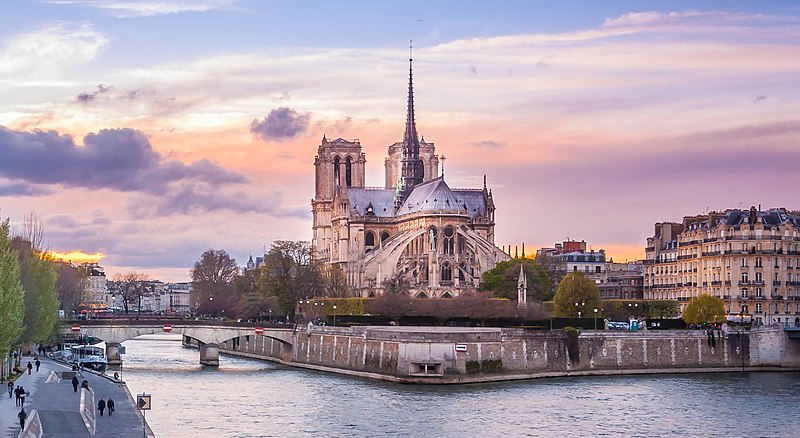
The Notre Dame has been saved, though the repair work is predicted to take decades.

President Emmanuel Macron apparently wants it tout de suite, in time for the Paris Olympic in 2024. Guess he has a learning curve ahead of him. French officials quickly declared it was a renovation mishap – even while the flames were still leaping over Paris. They all but ruled out arson completely. This is strange, because attacks on French churches (as well as Jewish and Muslim sites, to a lesser extent) have been rampant of late – hundreds vandalized or desecrated in the last year alone. It doesn’t matter if it’s a disgruntled teenager with a box of matches or a vast terrorist conspiracy, the millions for restoration will be money wasted if there’s no attempt to confront the causes. Let’s hope the officials know something we don’t – for example, other issues with lax precautions during the renovations. Let’s also hope they’re not looking for a scapegoat.

Sypeck

To some extent, the Notre Dame is a fiction of antiquity – we addressed that yesterday with Sara Uckelman’s heartening comments. Book Haven friend and medievalist Jeff Sypeck wrote on the same topic yesterday in his blog Quid Plura yesterday: “Notre-Dame can be rebuilt, because it’s been rebuilt before.” The spire that fell, for example, is not medieval. It was added in the 19th century. The cathedral been in dilapidated shape before: a 1840 daguerrotype shows “the great cathedral appears as a disintegrating patchwork pile,” according to author Michael Camille.

“The best known 19th-century additions to Notre-Dame are probably the 54 gargoyle-like creatures known as ‘chimeras,’ the most famous being ‘le Stryge,’ the bitter critter on the cover of Camille’s book. Within a few years, artists, photographers, and postcard-sellers were treating these new grotesques not as recent decorations meant to ‘look medieval,’ but as ancient survivors, timeless objects of melancholic contemplation, as if Notre-Dame had witnessed the centuries but had, through some miracle, remained untouched by them,” Sypeck writes.

Later additions … much later …

“When tourists at Notre-Dame in 2100 hear about the devastating fire of 2019, they won’t comprehend it. Even if docents point out a scorched pillar or emphasize the relative newness of the roof, visitors will know in their bones that they’re standing in a sacred place that hasn’t changed since the Middle Ages, as most tourists felt before yesterday’s fire. They’ll rightly look backwards, blind to the fire and smoke; so we now take solace in looking ahead.”

A Google search turned up Dwight Longenecker, who offered some orientation for those among us who were confused by exactly what happened:  “This is down to the way the church is designed. The whole building, except for the roof is constructed from stone. The ceiling of the nave is a vault designed by interlocking arches all built from stone. This acts like a cap covering the nave. To protect the vaulting, on top of that is the comparatively lightweight wooden roof structure which is invisible to anyone in the interior. It is this wooden roof which went up in flames, and the fire apparently started there in what is essentially attic space.

“If a fire started at floor level it could have gutted the interior, but it would have been almost impossible for the flames to reach the height of the roof beams, and even if the fire went that high it would have to burn through the stone vault to reach the roof beams.

“This design element explains why most of the interior was spared and why the restoration will not be that long or that expensive. They will have to repair the damage to the vault where, I believe the central spire crashed through the stone vaulting, and they will have to design and build a new roof, at least that’s how it looks this morning.”

In 1840: “a disintegrating patchwork pile”

Rolling Stone quoted Jeffrey Hamburger, a professor of art history at Harvard University whose research focuses on the art of the High and later Middle Ages: “The fact that the building did not collapse — a concern in the hours immediately following the blaze — serves as a ‘powerful testimony to the skill of medieval builders,’ Hamburger says. He credits the survival of the structure to the building’s iconic rib vaulting and flying buttresses, which prevented collapse. ‘It’s worth remembering why they went through the trouble building it this way — it wasn’t for aesthetic reasons, it was for fire-proofing,’ Hamburger says. ‘In a way, what we have here is proof of concept.’”

Other observations from around the web:

Douglas Murray writing “The Notre Dame’s Loss is Too Much to Bear” in The Spectator: “There will be recriminations, of course. There will be disputes about budgets, and overtime and safety standards and much more. It is worth reading this piece from two years ago about the funding problems that existed around the cathedral’s restoration. But if Notre Dame can burn then all this is as nothing, because it tells us something too deep to bear. As I said a couple of years ago in a book, in some ways the future of civilisation in Europe will be decided by our attitude towards the great churches and other cultural buildings of our heritage standing in our midst. Do we contend with them, ignore them, engage with them or continue to revere them? Do we preserve them?

“Though politicians may imagine that ages are judged on the minutiae of government policy, they are not. They are judged on what they leave behind: most of all on how they treat what the past has handed into their care. Even if today’s disaster was simply the most freakish of accidents, ours would still be the era that lost Notre Dame.”

Pamela Druckerman in “Were the Caretakers of Notre Dame. We Failed.” in the New York Times: “Though most Parisians don’t visit often — and some never do — Notre-Dame is more than just a tourist attraction or a historic monument. It sits in the middle of the city, walking distance from practically everywhere, on the bank of the river that divides the city. Residents might not have fully realized it until Monday, but I think it reassured them to know that at the heart of their highly planned city was someplace entirely non-rational and non-Cartesian. Notre-Dame’s hulking, Gothic presence has long suggested that there is something mysterious and unknowable at the center of it all … In his address to the nation, Mr. Macron described what Parisians are feeling as a ‘tremblement intérieur’ — an internal trembling. That’s an accurate description of our sense of emptiness and loss. There’s also a shared sadness and disappointment that, with the extensive damage, we’ve failed, as a civilization, to be the caretakers of something priceless. A hundred years from now, people will still be talking about the fire of 2019.”

She was taken to task by the inevitable combox harpies. Philistines and utilitarians grumbled about the money. But one woman named “Diane” had a reasonable bone to pick: “‘Notre Dame’s hulking, Gothic presence’? Some buildings hulk, but Notre Dame looks like it’s about to take wing.”

Over at Spinditty, a blogpost about the school of early music that started at Notre Dame.

Perhaps the most witless remarks were those quoted in The Rolling Stone. Take this paragraph: “’The building was so overburdened with meaning that its burning feels like an act of liberation,” says Patricio del Real, an architecture historian at Harvard University. If nothing else, the cathedral has been viewed by some as a stodgy reminder of ‘the old city — the embodiment of the Paris of stone and faith — just as the Eiffel Tower exemplifies the Paris of modernity, joie de vivre and change,’” Michael Kimmelmann wrote for the New York Times.”

Some folks get their joie de vivre in some places, some of us elsewhere. And some of us thought it had plenty of joie de vivre already. I guess it’s what you bring to it. Hey, Notre Dame! Lighten up! (Some ideas below.)

E.J. Dickson continues: “Now that the world has rallied in support of the rebuilding of the cathedral, however, and donations have started pouring in from all over the world, there’s likely to be renewed interest around the cathedral as an emblem of French history and culture.” And, of course, religion.

The Associated Press article except is here. Said Titus Tichera on Facebook: “So if French Catholics want to not be the laughingstock of whoever the hell even cares anymore, they should take a long hard look at this, reported by AP, think things through, and start organizing: ‘The cultural heritage envoy for French President Emmanuel Macron says it is realistic to reopen Notre Dame Cathedral to the public in five years. Following a meeting at the presidential palace about the cathedral’s reconstruction: Macron’s goal is to allow visitors coming for the 2024 Olympic Games in Paris to visit Notre Dame. Macron told the meeting that the new spire will hinge on the results of an international architecture competition.’ This is Philistinism of a very high order–I would rate it as high as desecration. One has to admire the drugged air of death on their breath.”


How Victor Hugo saved Notre Dame: “a thought written in stone … it is the freedom of architecture.” Plus a few words from a wise medievalist.

April 16th, 2019
Share

“This isn’t the first time Notre Dame has burned. I’m dead certain it won’t be the last.” (Wikimedia Commons)


“The church of Notre-Dame of Paris is without doubt, even today, a sublime and majestic building … a vast symphony in stone, as it were; the colossal handiwork of a man and a people.” So opens Victor Hugo’s The Hunchback of Notre Dame.

It began as Notre-Dame de Paris in 1829 – he had an axe to grind. He was tired of seeing France’s magnificent heritage of Gothic architecture neglected, defaced, destroyed, or “improved” by subsequent eras. It had just survived the depredations of the French Revolution, where its statues and artwork had been broken, plundered, mutilated, and destroyed. Twenty-eight statues of Biblical kings were mistaken for statues of French monarchs and so beheaded. The cathedral was eventually used as a warehouse for for storage of food and other non-religious purposes. In 1801, Napoleon restored the cathedral to the Church “as is.”

Twenty years later, Gothic was simply out of fashion. Hugo had published a paper entitled Guerre aux Démolisseurs (War to the Demolishers) specifically aimed at saving Paris’ medieval architecture. “A universal cry must finally go up to call the new France to the aid of the old,” he had written. He declared war on the “demolishers.”

The repairs and “improvements” had made the cathedral uglier. Medieval stained glass panels had been swapped for clear glass to let in more light. “And who put the cold, white panes in the place of those windows” and “…who substituted for the ancient Gothic altar, splendidly encumbered with shrines and reliquaries, that heavy marble sarcophagus, with angels’ heads and clouds,” he asked.

Notre-Dame de Paris would later become The Hunchback of Notre-Dame, and his preoccupations with the Gothic survived the transition. “There exists in this era, for thoughts written in stone, a privilege absolutely comparable to our current freedom of the press. It is the freedom of architecture,” he wrote in praise of these medieval builders and what they wrought.

He won, of course. He triggered a national effort to restore the cathedral. The Notre Dame we saw until yesterday was in part the result of his labors. Now we face an even greater challenge to restore the building that barely survived a catastrophic fire.

***

From Sara L. Uckelman, assistant professor of philosophy at Durham University and editor in chief at Dictionary of Medieval Names from European Sources, in a public post on Facebook:

While what has happened to Notre Dame today has shocked me and moved me to tears more than once over the course of the evening, I’m finding that my background and training as a medievalist means I’m, overall, finding it a lot less devastating than many people.

Why?

Because I know how churches live. They are not static monuments to the past. They are built, they get burned, they are rebuilt, they are extended, they get ransacked, they get rebuilt, they collapse because they were not built well, they get rebuilt, they get extended, they get renovated, they get bombed, they get rebuilt. It is the continuous presence, not the original structure, that matters.

The spire that fell, that beautiful iconic spire? Not even 200 years old. A new spire can be built, the next stage in the evolution of the cathedral.

The rose windows? Reproductions of the originals. We can reproduce them again.

Notre Dame is one of the best documented cathedrals in the world. We have the knowledge we need to rebuild it.

But more than that: We have the skill. There may not be as many ecclesiastical stone masons nowadays as there were in the height of the Middle Ages, but there are still plenty, and I bet masons from all over Europe, if not further, will be standing ready to contribute to rebuilding. Same with glaziers, carpenters, etc.

Precious artworks and relics may have been lost. There is report of one fireman seriously injured, but so far, from what I’ve read, no one else, and no deaths.

This isn’t the first time Notre Dame has burned. I’m dead certain it won’t be the last.

What’s Love Got to Do with It? Hayden White on Education and the Humanities

April 13th, 2019
Share

“I always tell my graduate students never work on anything you don’t love.”

.

Entitled Opinion radio show and podcast series is up at the Los Angeles Review of Books. You can listen to the whole episode here. Summary below.

THE HUMANITIES HAVE A GREAT DEAL TO TEACH US ABOUT THE RELATIONSHIP BETWEEN GENIUS AND WISDOM.” —HAYDEN WHITE

American “metahistorian” Hayden White disagrees sharply with those who argue that the humanities have no utility: “The humanities are eminently practical and belong to the practical life, by which I mean the ethical life,” he said. “The humanities have a great deal to teach us about the relationship between genius and wisdom.”

It was a subject that resonated with both men in this 2008 Entitled Opinions conversation on education and the humanities. In the introduction, Robert Harrison had explained that wisdom and genius are the two kinds of “sapientia” in the homo sapiens species: “One is the intelligence that invents, experiments, discovers, calculates and brings about wholesale change through innovation and manipulation of the external world,” he said. “The other is the understanding that gave birth to the gods, the graves of the dead, the laws and scriptures of nations, the memory of poets and the archaeology of scholars.”

“I tell my students we’re here to discuss the meaning of life,” Harrison said. But it’s tough to support an education about the meaning of life when “everything else in our society that is dominated by science and technology becomes a wasteland because it’s deprived of meaning.”

Harrison said that there is one element in education that no one mentions: love. “I think most of us have, at a certain point, fallen in love with a book or a way of thinking,” Harrison said. “Desire is so much of a vehicle for the acquisition of learning.” On that point they both concurred.

White continued the thought: “The idea was very common prior to the modern scientification of knowledge that you could only know that which you love, and conversely, you could only love that which you genuinely knew,” he said. “I always tell my graduate students never work on anything you don’t love.”

“People who, in their dissertations, begin to feel it’s heavy labor usually don’t last long or become embittered and feel that they have been, in some sense, betrayed by the materials,” he said. “They reach a certain age and they’ve forgotten why they went into this business.”

THE PAST MUST HAVE A PRESENT AND A FUTURE – AND THE HUMANITIES, FOR ME, ARE THAT MEDIUM.” —HAYDEN WHITE

An excerpt from this interview has been published, for the first time ever, as “We’re Here to Discuss the Meaning of Life” in the April 3, 2019 edition of  The Chronicle of Higher Education here.

POTENT QUOTES FROM HAYDEN WHITE:

“The humanities are eminently practical and belong to the practical life, by which I mean the ethical life.”

“I always tell my graduate students never work on anything you don’t love.”

“Many people who have studied the good effectively are not particularly good themselves.”

“I think Jesus was the greatest teacher of all time.

POTENT QUOTES FROM ROBERT HARRISON:

“The more one engages in the study of the past, the more one becomes an heir to it all.”

“I tell my students we’re here to discuss the meaning of life.”

***

Hayden White, who died in 2018, was a historian and literary theorist. He was a professor at the University of California, Santa Cruz, where he taught for many years in the History of Consciousness program, and was also a professor of comparative literature at Stanford University. His many books include Metahistory: The Historical Imagination in Nineteenth-Century Europe (1973), Tropics of Discourse: Essays in Cultural Criticism (1978), and Figural Realism: Studies in the Mimesis Effect (1999).

“Some died of fear, some of cold”: refugee massacres on the high seas

April 11th, 2019
Share

At the forefront of inhumanity

John Psaropoulos is an Athens-based journalist (he blogs here). Like his wife, the poet A.E. Stallings, he is on the forefront of the refugee crisis. I wrote about her work with the refugees for the Poetry Foundation here; illustrations by refugee children below are courtesy A.E. Stallings and the “True Colors” Facebook page.)

Psaropoulos, formerly an international reporter for CNN, has a disturbing essay in the current Sewanee Magazine (paywall alert). “How Refugees Die” opens with the story of Doa Shukrizan, a Syrian fleeing war with her fiancé on a fishing trawler bound for Italy, and then surviving a massacre on the high seas. “During the hour that we spoke, three coastguard officers sat at their desks not doing any work, transfixed by what she said.”

A few excerpts:

“On the fourth day after we set sail, between noon and two o’clock, we were met by another fishing vessel,” Doa said. “The people on it asked us to stop. They threw pieces of metal and wood at us and swore at our captain. Our boat refused to stop and they rammed us. They waited until we had sunk and they left.”

A child depicts a Turkish vessel firing a water cannon to try to sink a dinghy

Doa said the boat was submerged in ten minutes. She remembered hearing the screaming of women and children below decks. She survived along with about a hundred people because she had been on deck, but her fiancé did not. Over the next three days and two nights, all but five of those initial survivors would die of exhaustion and dehydration as they treaded water in the open sea. Doa and the other four were spotted by a Greek merchant ship south of Crete; a Greek coast guard helicopter airlifted them to Chania.

Only later, when I reviewed the video recording of our interview, did I realize that Doa wept quietly to herself during the breaks between answers …

***

[Hamad Raad, a Palestinian barber who had survived the same mass murder] explained how the breakdown of social bonds isolated each person and made them more vulnerable to the elements: “In the beginning people were in groups but each day the groups grew thinner. On the third day people lost their senses. Two people came up to me and told me I had taken their life vest and that it belonged to them, and tried to drown me. Many of us were afraid after that.”

An Afghan girl recalls drownings.

Hamad, dangerously disoriented, very nearly drowned himself. “I hallucinated that I had gone to a hotel and was asking for a room and food and drink,” he said. “I imagined that I was arguing with the hotelier, and I took off my life jacket and began to sink . . . the sinking brought me back to my senses.”

“Some people died of stress, others willed it to happen,” said Doa. “One man took off his own life vest and sank. Some died of fear, some of cold.”

“Those who had God beside them had strength, and those who didn’t began to end their own lives,” says Hamad.

***

In my article, “Crossing Borders,” for the Poetry Foundation, I include Stalling’s epigram, “From an autopsy report of an unknown drowning victim, Ikaria”:

Female. Nine years old. Found wearing a blouse,
And a pair of sweatpants patched with Minnie Mouse.

Here’s the story behind the poem:

A girl named Aqdas recalls those lost at sea.

My friend John Tripoulas, a general surgeon then at the Ikaria hospital, had to pronounce death on the body of a girl, perhaps six or seven years old, found bobbing off the north shore. She had spent so long underwater that her flesh had suffered what doctors call saponification — it had acquired a soap-like consistency. “It was a combination of sorrow and horror to see this young girl in an advance state of decay,” Tripoulas told me, his voice quiet and trembling. “I’ll never forget what she was wearing — pink sweatpants with a Mickey Mouse patch, white boots and a pink overcoat. Her facial features were not visible — they had been lost to the sea.”

The loss of facial features was a common observation. Kalliope Katte, a doctor at the Evdilos Health Centre on Ikaria’s north coast, described the body of an adult woman found washed up. “She was completely naked. It was an awful sight because although she had her arms and legs, her face was missing. There was no skin or flesh. It was just a skull.” When I asked about the missing faces, she said, “The bodies have been eaten by fish, they’re not just decomposing.”

John Psaropoulos concludes: “The combined population of the developed world – more than a billion people – could, in theory, absorb all the world’s refugees today – a manageable ratio of one refugee per fifty people.” He concludes, “With electorates divided on both sides of the Atlantic, Europe and the US are likely to continue to follow an incoherent and uncoordinated series of policies, aiming to salvage their self-definition as caring and open societies, while doing everything possible to keep the world’s unfortunates at bay.”


<<< Previous Series of PostssepNext Series of Posts >>>