“The beating heart of good prose”: Robert Alter on rhythm and translating the Hebrew Bible

March 24th, 2019
Share

Alter at Berkeley’s Heyday (Photo: Wendy Ruebman)

This week, Berkeley’s Robert Alter honored a lunchtime gathering at Heyday Books with his gentle presence and his scholarly wisdom – just in time for Purim. Alter is the translator of the surprise hit of the year: the new acclaimed 3,500-page Hebrew Bible (Norton). (We’ve written about his work here and here.) He’s also the author of Princeton’s The Art of Bible Translation.

I’ve been a big fan since I read his translation of Genesis more than two decades ago, and so I lugged my big-splurge purchase of 2019, the three-volume set, for his signature. (Gauche, I know, but I couldn’t resist – he only signed one volume before he rushed off to pick up his wife.)

The largely atheist/agnostic/”none” crowd was skeptical of the foundational masterpiece of Western civilization, but in a short hour or so, the amiable, learned Alter had them eating out of his hand. Rhythm, he said, is “the beating heart of good prose” and “not merely decorative.” He spoke about the iambic rhythm of Shakespeare, Milton, and Melville – “it wasn’t just icing on the cake for Melville” – and the intricacies of replicating the rhythm of ancient Hebrew. He decried “the dumbed-down modern versions – and they’re all dumbed-down.” He had to “scrape off the theological veneer” for “the detective work of language.”

I had a chance to chat with him for a few minutes before his talk. I mentioned that René Girard calls the Genesis story of Joseph the first representation of forgiveness, as something more than letting go of a debt or not clubbing an enemy, after all. Alter didn’t disagree, but he pointed out that the Old Testament also shows the first hero who changes over time, i.e., “character development.” To wit: the patriarch Jacob, who begins as a trickster on the make, ends by being tricked himself, and suffers cruel loss and bereavement. On his deathbed – humbled, broken, mourning – he says: “Few and evil have been the days of the years of my life, and they have not attained the days of the years of my fathers in their days of sojourning” (in Alter’s translation, of course). Ancient heroes like Ulysses don’t do that – when he gets back home to Ithaca after twenty years  he turns right back and heads for the sea again. (Dante condemned it, though Tennyson rendered it as an act of heroism.)

In his introduction, Heyday publisher Steve Wasserman called Alter “enviably erudite and lovely.” He is, he is.

Update: The future of books at “The San Francisco Chronicle”

March 21st, 2019
Share

Earlier meeting at Heyday: clockwise, from lower left: Frances Dinkelspiel, Andy Ross, Cherilyn Parsons, Calvin Crosby, Leslie Jobson, Praveen Madan, T.J. Stiles, Steve Wasserman, Ethan Nosowsky, Paul Yamazaki,

A few days ago we reported on John McMurtrie’s recent layoff at the San Francisco Chronicle. He was the paper’s veteran book critic and book editor. Many Bay Area book-lovers have feared a diminution and dumbing-down of coverage in one of America’s literary capitals. A meeting on March 13 at Berkeley’s Heyday Books discussed the outlook for book coverage in the Bay Area. On Monday, March 18, a group met with San Francisco Chronicle editors to discuss the paper’s intentions and direction. Here are the notes of that meeting (with suggestions from others attending) taken by Frances Dinkelspiel, an award-winning author and journalist and founder of Berkleyside.com. The other writers at the Chronicle meeting included Elizabeth Rosner, Wendy Tokunaga, Lucy Gray, Lucy Jane Bledsoe, Regina Marler, Marissa Moss, Donna Levin, and Marian Palaia.

I’m a long-ago reviewer for the San Francisco Chronicle myself, when the section was headed by David Kipen and Oscar Villalon, so the changes leave me with much to say, which I’ll keep to myself. But I’d love to hear from you, Book Haven readers. I welcome comments in the combox below.

Frances Dinkelspiel

A group of nine authors met on Monday, March 18 with Audrey Cooper, the editor of the San Francisco Chronicle and Kitty Morgan, who oversees all the arts and culture coverage. We had an amiable, broad discussion about the Chronicle’s books coverage in the light of the layoff of the books editor. The sound bite: Don’t expect many book reviews in the future but look for expanded coverage of the literary scene through more frequent author features, trend articles, and maybe even podcasts. Freelancers would do these things, most likely. The paper is not planning on hiring new staff writers or a new dedicated books editor.

Kitty and Audrey opened the discussion by talking about what the “Home and Garden” and “Food” sections looked like five years ago. They were not well read and the “Home and Garden” section was losing $1 million a year. They could not continue in that form.

Kitty, the former editor of Sunset magazine, was brought in to overhaul the “old-fashioned” sections. In the course of five years, the section was “re-imagined” and revitalized and was made more relevant. The new restaurant critic Soleil Ho is getting thousands of clicks on her reviews. The paper is excited about how she is writing about new places and is drawing in new audiences.

Like all newspapers in the country, the Chronicle is facing economic pressure. The paper edition still accounts for 50% of the readership and subscriptions and advertising produce the bulk of the revenue. The Chronicle is paid $1.74 for every 1,000 clicks on an ad. They also discussed how expensive it is to get the printed paper to each household. It costs $20 a week and the figure does not include staff costs, just the cost of newsprint, production and delivery expenses, which are increasing. [Note: Audrey Cooper has corrected some of these figures, in a note below.] Audrey said some in the organization think the printed Chronicle will eventually go away. She hopes that happens after she retires.

Given that, the Chronicle is looking hard at what gets audience “engagement” and what does not.

Audrey Cooper

Audrey compared the book review section of the Chronicle to the old food and home and garden sections. While they could not determine how many people read the book reviews in the Sunday paper, which has about 145,000 readers, one recent book review only got 25 clicks online. A recent review by Janet Napolitano only got 50 clicks, said Kitty. (She later said some reviews got 200 clicks). That level of non-engagement cannot continue, they said.

Northwestern University just completed a study where researchers looked at 13 terabytes of data about what people read online at the Chronicle. Audrey said there is commodity content, broadly available, and non-commodity content, which is unique. The Chronicle needs to produce unique stories that bring people to the site, keeps them for a while, and then converts them to subscribers. She emphasized several times that gaining subscribers is essential; a wider readership isn’t nearly as important as getting people to sustain the existence of the paper over time. Audrey said her goal as editor is to “get new readers and save the world through journalism.” (Note: A number of those at the meeting subscribed to the Chronicle in a show of support.)

Given those numbers Audrey said: “We need to differentiate reviews in a different way to get people to read them.” They felt that the Chronicle should not be reviewing big national books that are also being reviewed by the New York Times or the Washington Post. The Chronicle should be writing about interesting local books and what makes the Bay Area unique. Kitty pointed out that the Chronicle had not been writing enough about a number of emerging areas such as books about the environment, about LGBTQ writers, and stuff like the popularity of health and spiritualism to Silicon Valley bros. They have been missing trends.

How to do this?

There are no current plans to hire anyone dedicated to covering books, Audrey said. That could change in the future, though, if readership of literary topics picks up. The Chronicle needs to “fix its focus of coverage” and its “distribution of coverage” before additional hiring occurs. The Chronicle plans to continue to use a combination of reviews by local writers and reviews purchased from the wire. The number of reviews will definitely not go up; if anything they are likely to decrease.

Kitty Morgan

There are two editors in charge of book coverage: Robert Morast, a senior arts editor and Laura Compton, the former Style editor. She may actually have the most responsibility for the book coverage.

Since there no longer is one person in charge of knowing what is happening in the literary scene, Kitty has hired two “book whisperers” to work as consultants as she moves forward reshaping the book coverage. She would not name them but said they are getting paid. One, a male, is a former book publisher who is very good with data. The other is a woman. She called them “contributing books editors.”

The paper is considering hiring a freelance book columnist to write about the literary scene.

The rest of the stories will come from staff writers and freelancers. Kitty sees the paper doing “one good feature story a week.”

“I’m excited about how we can do this differently,” said Kitty.

Kitty said the Chronicle needed to better capitalize on opportunities. She was very excited about an idea of collaborating with T.C. Boyle who is coming to town. His new novel is about drugs and Kitty wanted to pair up Boyle and Michael Pollan, and then tape their conversation for a broadcast. The Chronicle could do a feature of the event. Pollan might not be available though. Someone suggested she ask Ayelet Waldman instead. Kitty liked that idea.

At this point a number of Womba (Word-of-Mouth Bay Area, a group of about 200 published female writers) writers talked about different ideas the Chronicle might do, like running features on “what is on my nightstand,” or other quick hits that will keep books in the public eye as well as make use of local/regional talent. Suggestions included using more multimedia, interviews, author profiles, and increased focus on the exceptionally rich saturation of writers in the Bay Area.

The authors also expressed a commitment to helping promote the “new look/approach” once the editors are clear on what they intend to do moving forward.

One writer said she follows the Chronicle’s art and theater critics because of their “voices” and the paper could build up a similar readership if there was a book critic with a distinctive writing style. There did not seem to be an appetite for this approach.

Audrey said the Chronicle wants to expand the literary listings and make “Datebook” the place online to come to look for events. This is being done for the benefit of subscribers, not booksellers. There will be a lag before this happens though. While it is easy to scrape music and art events from the web, it is not that easy to do so with book events. So the Chronicle has to build a better tool to scrape events.

Both Audrey and Kitty said no one should look at the coverage that has happened since the departure of the book editor in early March as an indicator of what the paper wants to do. It will take until at least mid-April before they are up to speed and even longer, perhaps, to work out a future plan.

We forgot to ask how many pages of book coverage there would be in the Pink “Datebook” section. Last week there were four, down from six when John was there. But Audrey wants to run more articles during the week. They do not see putting more content online than what runs in the paper.

Postscript on 3/21: San Francisco Chronicle editor-in-chief Audrey Cooper has written to correct the statement that the print edition is 50 percent of The Chronicle‘s readership: “Our total audience is (depending on how you count it) at most 35 million unique visitors a month and at the least about 7 million a month. The print circulation is a sliver of that. And while print is the bulk of revenue, it is also the bulk of the expense.”

“Secondly, to be clear, it’s not that The Chronicle gets $1.74 CPM for online ads. That’s an average value of a programmatic ad. Actual rates go up and down depending on how you manage ad yield. So it would be true to say the average online ad has a $1.74 CPM, but not correct to say that is the average Chronicle ad. It’s an internet-wide thing.”

Postscript on 3/25: We’re in Publisher’s Lunch today! (See below.) And our comment section made Books Inq.

“A poet of this world”: Jane Hirshfield remembers W.S. Merwin

March 20th, 2019
Share

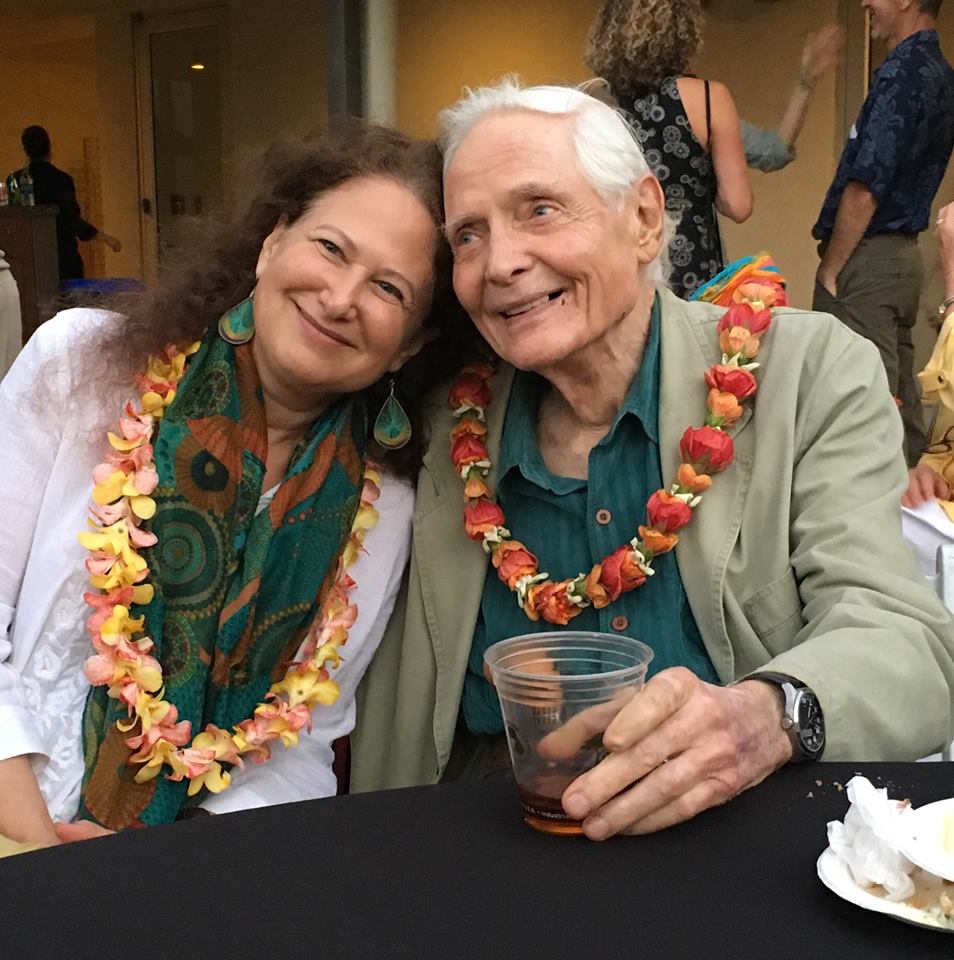
In Hawaii together: W.S. Merwin’s wife Paula Dunaway snapped the photo.

Former U.S. poet laureate W.S. Merwin died on March 15. He was 91. He was the recipient of two Pulitzer Prizes and a National Book Award, among other honors. I knew him slightly, so I have stepped aside for others to speak. Here’s one of them, Marin poet (and friend) Jane Hirshfield, who has provided today’s guest post, with attention to their common Buddhism outlook:

The last time I saw William Merwin was in late March-early April, 2016, when I went to read for the Merwin Conservancy’s Green Room series in Maui. His wife Paula was still alive, and I was able to see them three times in the house William had built decades before with his own hands; to walk through the palm trees he’d planted, now fully grown; to see the nursery with new, young palm trees waiting to be planted.

Famously handsome. (Photo: Dido Merwin)

One screen-walled outbuilding was William’s zendo, a meditation room that resembled the nearby toolshed, except that in place of trowel and shovel there were two very small Buddha figures, some rocks, a few incense bowls. A low block of rough-cut wood served as altar. A hand-made clay water pitcher was set just off to one end, as if the one-flavored water of the Lotus Sutra’s teaching might be poured from it whenever needed. As if confident that here, thirst could be simply, straightforwardly addressed, within gathered rain and the poet’s hand-created, permeable concentration.

William was almost completely blind by then, yet still poured the tea Paula had made, asking only for a little guidance to know where my upheld cup was. His superb memory allowed him to move through the long familiar spaces and our conversations’ various rooms with equal ease. One of his beloved chows was still alive, keeping near. The Merwins offered me a tin of organic bug balm to keep at bay the mosquitoes. What William’s eyes could no longer take in, it seemed to me, radiated instead outward from them: the world’s wonder, along with – and just outweighing – its suffering.

William’s poems and example have travelled with me all my life as a person and poet. His openness and his ability to bring into some of his poems what is felt as beyond any saying yet somehow is said. His rigor and his ability to bring into other of his poems his clear-eyed perceptions of the failings of our culture, civilization, and species. His translations were without border, and his compassion without limit. When we first met, at a Dodge Festival, we were sitting next to each other in the big white tent of those days, each of us unable to take our eyes off a nearby seeing-eye Golden Lab. In later years, William would sometimes phone me to talk about Zen and its unfolding in each of our lives—we both wanted practice to be a thing deeply background, not foreground, and perhaps I am wrong to mention it here; yet we both appeared in the PBS documentary, The Buddha, and so I do— as much as of poems, other reading, ideas. Paula was part of these conversations as well, bringing her own steady wisdom and practical affirmation of the centrality of love and human connection in their shared life.

William is sometimes described as a poet of the numinous and absence. But he was a poet of this world, which he loved, cultivated, and restored. The poems continue to hold it all, just as each planted tree in France and in Hawaii does, just as that small, empty, open, still-waiting-to-serve water pitcher does.

William, with so many others this first day of your death, an anniversary now knowable, I thank you.

“When Nietzsche Wept” – Irv Yalom’s book is still a fascinating read. The 2007 movie? Not so much.

March 18th, 2019
Share

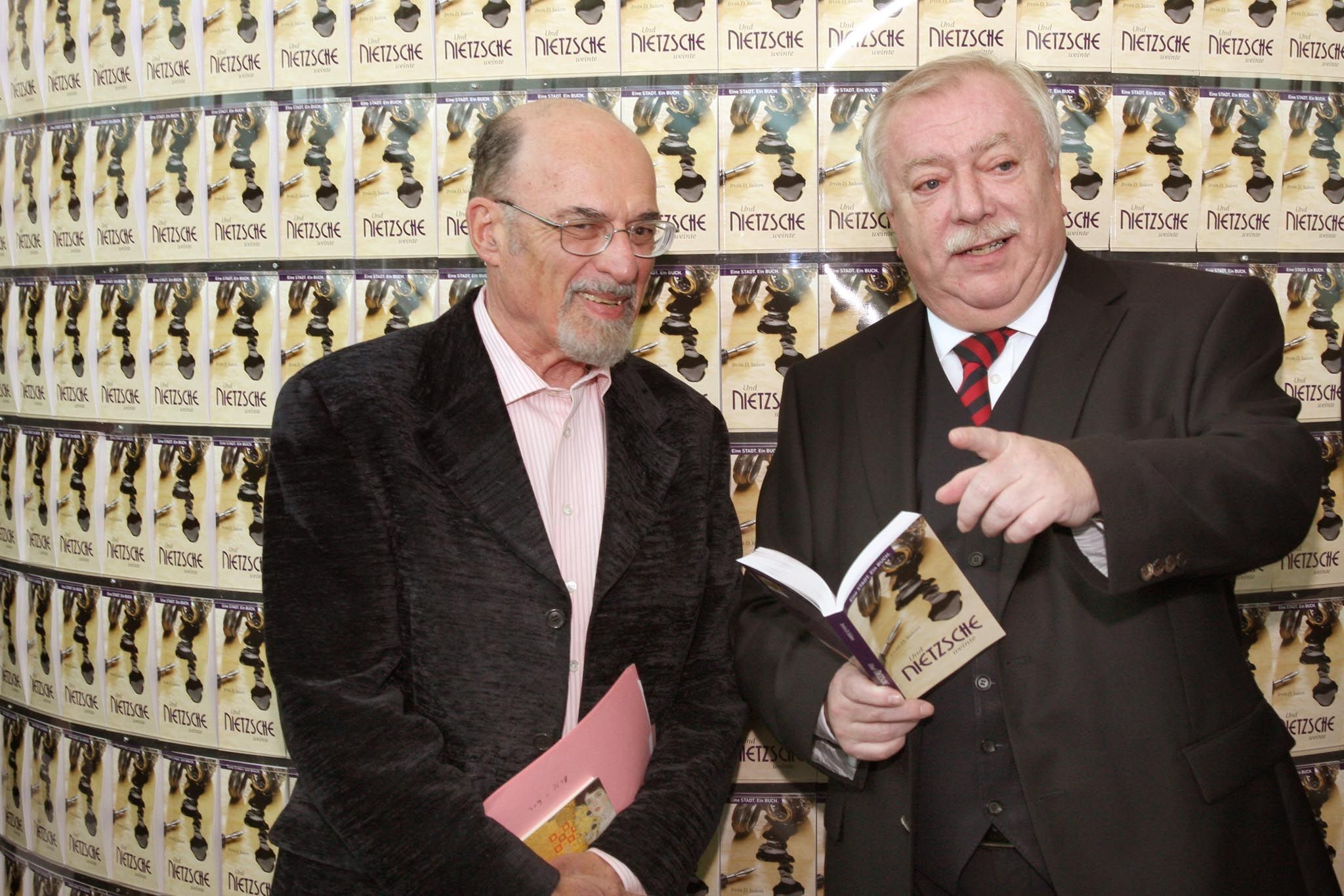
In Vienna ten years ago: Irvin Yalom with Mayor Michael Häupl for “Ein Stadt. Ein Buch.”

The stack of books I mean to read gets taller by the day. One of the volumes that has been there for quite some time is a book by a friend – Irvin Yalom‘s celebrated When Nietzsche Wept. It was the toast of Vienna for its annual Ein Stadt. Ein Buch event a decade ago – and also the subject of the second Book Haven post ever. (I discuss the retrospective on his career as a psychiatrist, Yalom’s Cure, here.) Yet the book itself remains right there, stubbornly atop of one of the precarious ziggurats that surround my desk.

Fun and games with Salomé in 1882: she had rejected proposals from both Rees and Nietzsche.

So, on a cheerless weekend night, imagine my surprise to find out the 1992 book has already been made into a 2007 film, starring Armand Assante and Ben Cross. Let me dissemble no more, gentle reader, I put aside my pressing deadlines to watch it online – and that returns me to Friedrich Nietzsche, Sigmund Freud, and the book. I didn’t know the beginnings of psychoanalysis with the “talk treatment” of Dr. Josef Breuer, nor the details of the overlapping lines of thought in fin-de-siècle Vienna.

The Stanford professor offers this disclaimer in his author’s note: “In 1882, psychotherapy had not yet been born; and Nietzsche, of course, never formally turned his attention in that direction. Yet in my reading of Nietzsche, he was deeply and significantly concerned with self-understanding and personal change.”

But history is a series of close calls and what-might-have-beens. This book was born in the discovery of a letter: an 1878 message where a friend tries to get Nietzsche to come to Vienna to see Dr. Breuer for treatment.

Author Yalom continues:

Friedrich Nietzsche and Josef Breuer never met. And, of course, psychotherapy was not invented as a result of their encounter.

Nonetheless, the life situation of the major characters is grounded in fact, and the essential components of this novel—Breuer’s mental anguish, Nietzsche’s despair, Anna O., Lou Salomé, Freud’s relationship with Breuer, the ticking embryo of psychotherapy—were all historically in place in 1882.

Friedrich Nietzsche had been introduced by Paul Rée to the young Lou Salomé in the spring of 1882 and, over the next months, had had a brief, intense, and chaste love affair with her. She would go on to have a distinguished career as both a brilliant woman of letters and a practicing psychoanalyst; she would also be known for her close friendship with Freud and for her romantic liaisons, especially with the German poet Rainer Maria Rilke.

On to better things…

Read more from Irv here.

As for the film, I don’t recommend it, but I do point it out. (The excellent youtube clip below is one of the films best moments.) In general, accents and orchestration are obtrusive (Brahms‘s Requiem, bits of Wagner here and there, and I can’t remember what else), the dream sequences clownish. The females are badly miscast and underfed, given the curvacious standards of the period. The casting is made with a modern eye to beauty, so the hairstyles and makeup concede too much to our own times and so are jarring. We shake what we’ve got: the women have no internal qualities, but are happy to roll their eyes and their hips. Someone should have looked at a real-life portrait of the time – Salomé’s, for example. If she could hold Rilke’s attention, I suspect that there was more to her than this manicured floozy. The exception to this rule is Breuer’s stiff, estranged wife, played by Joanna Pacula, who has a great final scene where a flicker of hope rekindles beneath the years of mistrust.

One of the best parts of the film are in the credits afterwards: we learn that Crazy Berthe, Beuer’s patient and Freud’s “Anna O.”, in fact becomes a groundbreaking social worker, while Salomé becomes an important early psychoanalyst. Breuer gives up his “talk therapy” – but Freud picks it up. Nietzsche takes the train to Switzerland where he will write Thus Spake Zarathustra. And Lou Salomé… well, we’ve all read Rilke’s letters…

Endangered species: book coverage in the Bay Area

March 15th, 2019
Share

It was a surprise for many of us to hear the news on Feb. 27: The San Francisco Chronicle told John McMurtrie, its longtime book critic and editor, that he was being laid off. He announced the news on Twitter, which is how I heard the tale. There will be no replacement, so what happens next? The San Francisco Bay Area is one of the literary capitals of the U.S. The idea that one of the nation’s top papers is stripping down its book section is bad news indeed.

I remember, in the long-ago days of the 2001, Bay Area-wide protests, spearheaded by the late great Diane Middlebrook, when the Chronicle folded its book section into the rest of the paper. From The Los Angeles Times:

…when word began leaking out a few weeks ago that the city’s major daily newspaper was reconfiguring its Sunday book review section, a howl went up from segments of the Bay Area literati. Books and the people who write and read them are taken seriously in San Francisco, home at various times to such venerable and disparate persons of letters as Mark Twain and Allen Ginsberg.

Accordingly, reports that the San Francisco Chronicle was revamping, and possibly even downsizing, its well-regarded Book Review section were treated in some quarters as a potential affront to the city’s literary self-esteem.

Middlebrook (Photo: Amanda Lane)

“You owe it to the citizens of San Francisco!” not to diminish book coverage, wrote Diane Middlebrook, a professor of English at Stanford University, in a recent letter urging Chronicle management not to “demote book talk to the status of infotainment.”

“You will embarrass yourselves along with every literate person in town,” wrote Middlebrook, who is spearheading a letter-writing campaign over the issue.

What is to be done? In such times, it’s good to have Steve Wasserman, my former editor at the Los Angeles Book Review, back in the Bay Area. He’s now publisher and executive director of Heyday Books in Berkeley. Steve and Ethan Nosowsky, editorial director of Graywolf Press, He called a meeting on March 13 at Heyday’s new headquarters to discuss how best to support continued coverage of books in the Bay Area in the aftermath of the news.

Good to have you back, Steve!

A photo commemorating the event, clockwise, from lower left: Frances Dinkelspiel, author, journalist, and founder of Berkeleyside,com; Andy Ross, literary agent and former owner of Cody’s Books, Cherilyn Parsons, founder and executive director of the Bay Area Book Festival; Calvin Crosby, executive director of the Northern California Independent Booksellers Association; Leslie Jobson, Field Sales czarina of the Ingram Content Group/Publishers Group West; Praveen Madan, owner of Kepler’s Bookstore and chairman of the Board of Directors of Berrett-Koehler Publishers; T.J. Stiles, author and historian and two-time winner of the Pulitzer Prize; Steve Wasserman, publisher and executive director of Heyday and former editor of the Los Angeles Times Book Review; Ethan Nosowsky, Editorial Director of Graywolf Press; Paul Yamazaki, Chief Book Buyer for City Lights Bookstore. On the phone but not depicted: Oscar Villalon, editor of Zyzzyva literary quarterly and former books editor of the San Francisco Chronicle; March 11, 2019, Berkeley) (Photograph by Emmerich Anklam, Publisher’s Assistant and Editor at Heyday.)

YOKO ONO … WHERE ARE YOU?

March 13th, 2019
Share

Becky picks a shard a decade ago. (Photo: L.A. Cicero)

Yoko, Yoko, where did you go? Yoko, Yoko, where are you? See all those little shards from a shattered Chinese vase in the photo above? I keep one of them in a box on my dresser. As I wrote a decade ago: “Audience members at Yoko Ono’s lecture Jan. 14 were invited to take home pieces of a ceramic vase that was smashed prior to the event. Ono invited everyone to return in 10 years to reassemble the vase.”

But wasn’t she going to join us? She spoke about the Imagine Peace Tower, she set up a “wish tree” in front of the Stanford post office, and she smashed a vase. And … and … and …

She broke her word! She never returned!

I have witnesses; plenty of them. The brown-haired woman with glasses in the photo above is Elizabeth “Becky” Fischbach, exhibition designer and manager for of Special Collections at the Stanford Libraries. She’ll remember, too, and vouch for me. So will the Stanford photographer who took the picture, Linda Cicero, who has snapped so many of the Book Haven photos.

“She’s one of the most original and creative artists of our times,” said Stanford history Professor Gordon Chang, who introduced Ono before her talk, titled ‘Passages for Light.’ Citing her work as a writer, artist, performer, activist, composer, musician and filmmaker, Chang said that “in each area, she has broken boundaries, expanded horizons.”

“Ono was once one of the most hated women in the world; now the effervescent and indefatigable 75-year-old activist is a celebrated icon,” I wrote. She just turned 86 on February 18. But that is no excuse. I’m not exactly a spring chicken, either.

With Gordon Chang. (Photo L.A. Cicero)

It all came back to me when I happened to stumble across my “Imagine Peace” button in a box recently, a reminder of our interview and her visit:

What do you hope to accomplish with the Imagine Peace Tower and the wish trees?

“It’s growing, and it is doing what I hoped that it would do. Many, many wishes are being made and they are being sent to the Imagine Peace Tower. There’s an incredible power of people’s wishes that are concentrated in the Imagine Peace Tower. Also, light has the same vibration as love. The light that’s in the Imagine Peace Tower—which is the Imagine Peace Tower—I think many people are enjoying it, somehow, feeling part of it.”

Together at last.

What would you say to critics who say these works are too—

“I know. People say it is too simplistic, or whatever. Some people say, “Oh well, maybe when you get older you want to do something simple.” I thought that was ageist. My work was always minimal. Minimalism—I believed in that. It was always very simple. I think it is as simple as breathing. Breathing is very important. I don’t feel that that’s bad. I was very surprised myself that the wish tree has become so important in people’s lives. I’m very honored that I was used for that, instead of some very complex, highfalutin work. Sometimes something simple gives more to people.”

Or did she make a silent incognito visit and we all missed it? Did she drift among us wordless and invisible like a shade. I’m sobbing and clinging to my shard as I think about it, tears dripping on my Imagine Peace button. I’ve waited for ten lonely years. Does everyone else still have their shard? Becky?

Yoko, Yoko, come back! We need you!


<<< Previous Series of PostssepNext Series of Posts >>>