Posts Tagged ‘Boris Pasternak’

Rilke’s last days: “…that someone, somewhere, in France or England, knows me, is translating me, mentions me…”

Thursday, August 14th, 2025

Share

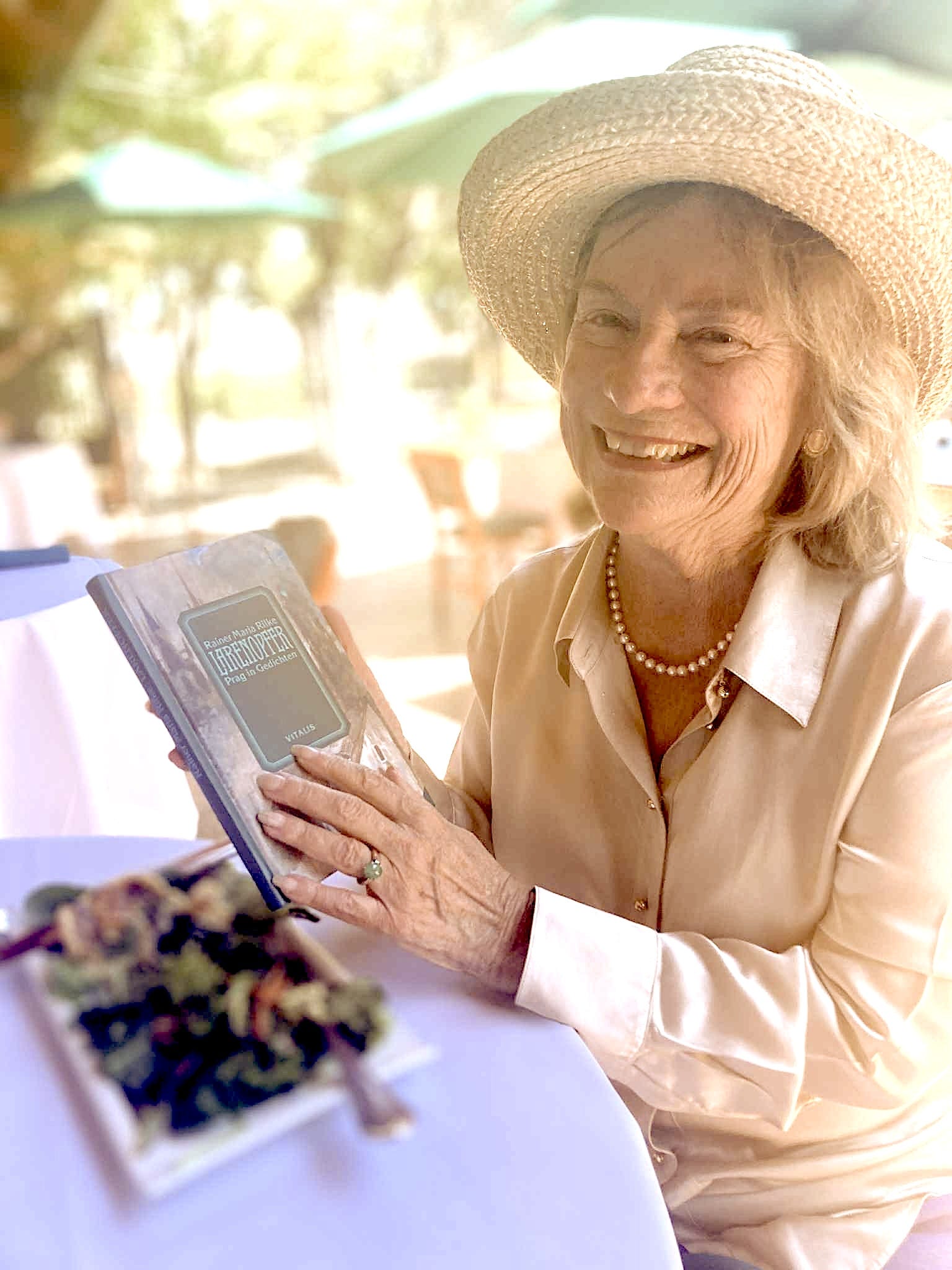
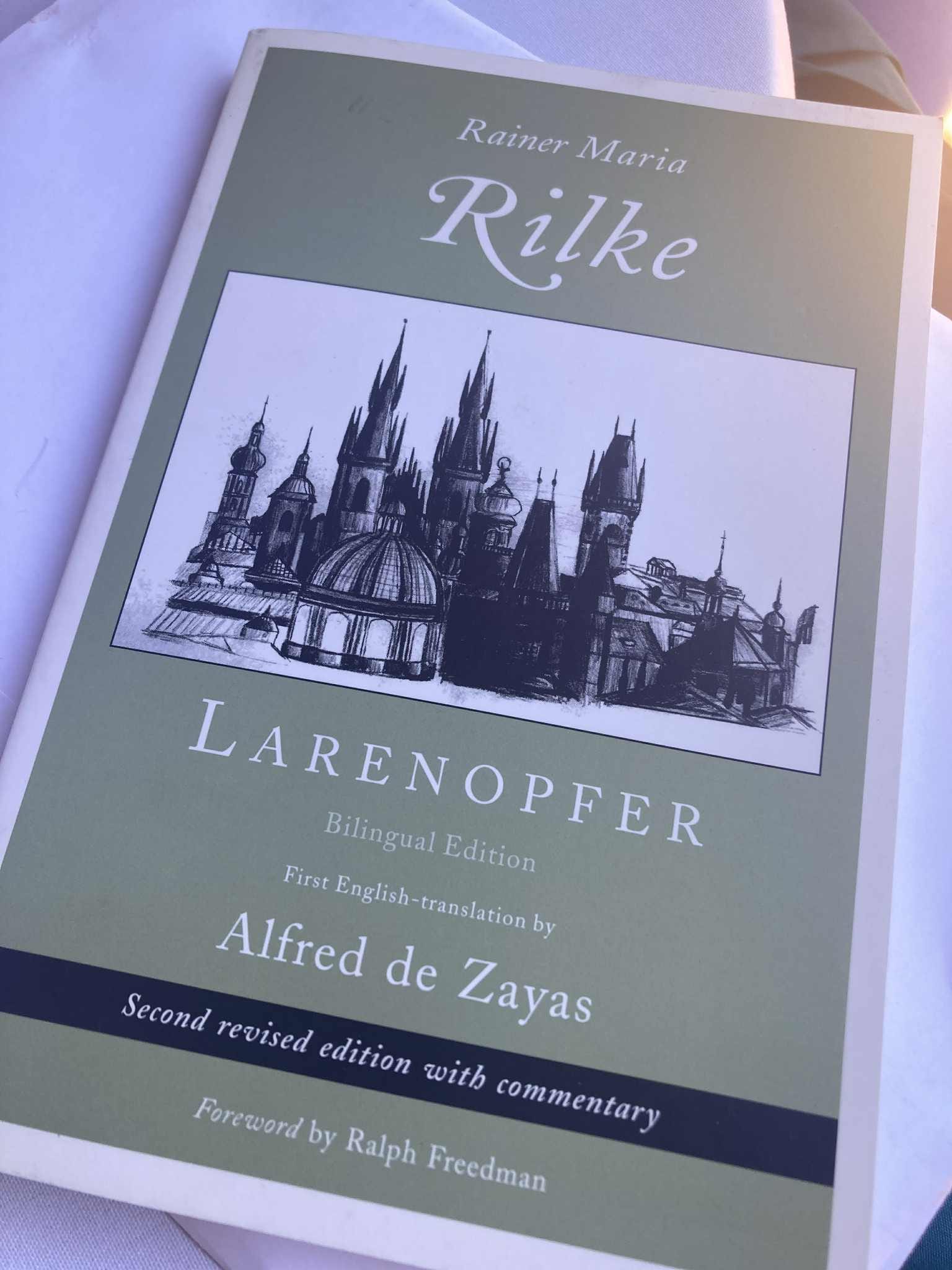
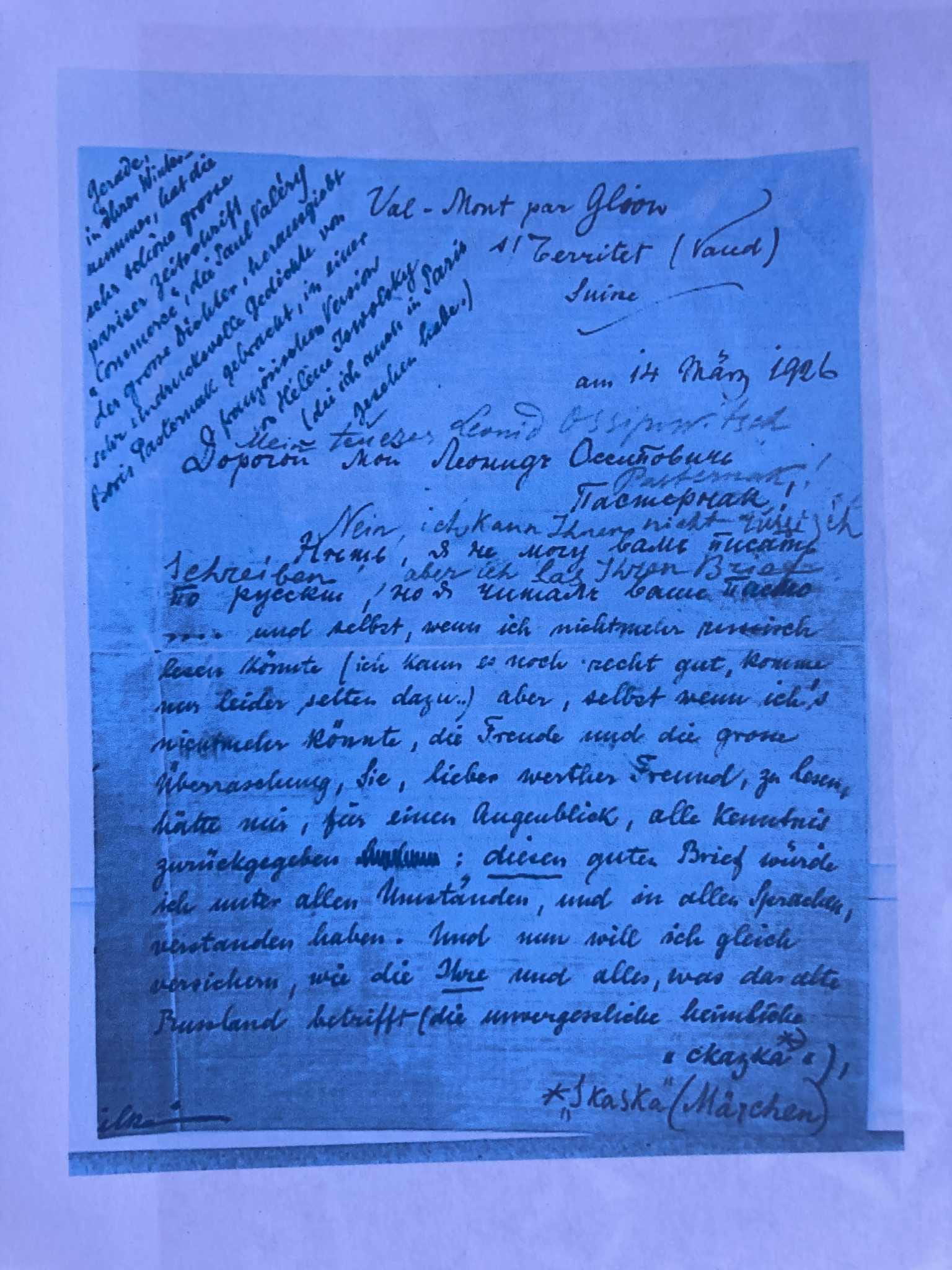
Archivist extraordinaire Elena S. Danielson (at right) kindly took me out to the Stanford Faculty Club for lunch last week. The kindness didn’t stop with the tiramisu. The former director of the Hoover Library & Archives also gave me a new edition of Rainer Maria Rilke‘s “Larenopfer” – to celebrate the 150th anniversary of the poet’s birth. The volume includes ninety of Rilke’s early poems from turn-of-the-century Prague, in German and English. Another treat, a copy of a 1926 letter from Rilke to Leonid Pasternak, the Russian poet’s father, an eminent painter.

In the letter dated March 14, 1926, the celebrated poet, already seriously suffering from the fatal illness that would end his life nine months later, wrote a lengthy, detailed, and graciously cordial letter to a Russian artist living in Berlin, Leonid Pasternak (1862-1945), the father of poet and novelist Boris Pasternak, who remained at that time in Moscow. Despite premature rumors of Rilke’s death, news reached Leonid that he was still alive, though ill, and celebrating his 50th birthday. Elated by the good news, the artist sent the great writer a birthday greeting by way of his publisher, since he didn’t have Rilke’s mailing address.

Rilke responded as soon as the letter finally reached him at the isolated medieval stone tower where he was writing his final masterpieces in an obscure corner of Switzerland. He starts out in Russian, which they had once used for their correspondence, but he switches quickly to German as his Russian skills had faded; he knew Pasternak, originally from multicultural Odessa, was fluent in German. (On the original paper, someone, possibly a family member, lightly penciled in a translation of the brief Russian phrases into German.) Rilke goes on to emphasize his continuing love of Russian culture and his faith that it will be restored, despite the chaos cause by war and revolution. And he renews their ties of friendship.

Before the Great War, Leonid had met the then unknown poet, just in his mid-twenties in Moscow in 1899, and once again by chance at a train station with the artist’s 10-year-old son Boris in 1900. A couple more brief encounters in Italy in 1904 and a few letters. That is all.

And yet they both remembered each other with great fondness. Both had a talent for lasting intellectual friendships. In his memoirs Leonid writes of the 1899 meeting: “Before me in my studio stood a young, very young, delicate, blond foreigner in a Loden coat … And already after the first short conversation we were like good old friends (which we later became).” (Die Familie Pasternak: Erinnerungen, Bericht, Geneva: Éditions Poésie Vivante, 1975, p. 62) The cordial feelings lasted even though they had no contact during the turbulent war years.
The 1926 letter in question – the first page shown here – had been published in German, but the original artifact with its still elegant handwriting, despite serious illness, conveys far more meaning than the copy in cold print. The Pasternak family carefully preserved this artifact for many years through the trauma of war, relocation, and exile. It was treated as something of a holy relic for the family. Starting in 1996, the Pasternak family began donating family papers to the Hoover Institution Archives at Stanford University for safekeeping. Among the many treasures in the collection is this original letter. In the published version, there is a brief postscript printed at the end. The original document shows this added afterthought displayed prominently in the upper left-hand corner of the first page. This brief note, crammed at the top, was even more important than either the writer Rilke or the recipient Leonid Pasternak realized at the time:

Gerade in ihrer Winter-nummer, hat die sehr schöne grosse pariser Zeitschrift “Commerce”, die Paul Valéry der grosse Dichter herausgibt sehr eindrucksvolle Gedichte von Boris Pasternak gebracht, in einer französischen Version von Hélène Iswolsky (die ich auch in Paris gesehen habe.)

Here is a translation of the note: “Just now, in its winter issue, the very beautiful, big Paris journal, Commerce, that Paul Valéry, the great poet publishes, are very impressive poems from Boris Pasternak, in a French translation by Hélène Iswolsky (whom I also saw in Paris).”

The full significance of the letter, especially the note in the corner, was not well understood in the English-speaking world until Nicolas Pasternak Slater translated and published the family correspondence in 2010. (Boris Pasternak: Family Correspondence 1921-1960, translated by Nicolas Pasternak Slater, Stanford: Hoover Institution Press, 2010. Reviewed in The Book Haven in 2011 here.) Leonid did not forward the original letter from Berlin to Boris in Moscow – he feared it might be lost – so he gave it to his daughter Josephine, who was also in Germany. Boris had previously written in August 1925 that he was devastated when he heard (erroneously as it turns out), that Rilke had already died.

When Boris learned about the letter from Rilke to his father, and got the news that Rilke was not only still alive and but had actually mentioned his poetry in the March 14, 1926 letter, Boris wrote to his sister from Moscow: “Our parents told me about Rilke’s letter, which has so thrown me that I haven’t been able to work today. What excited me wasn’t what probably pleased Papa and Mama, since after all I only got to hear of it by ricochet—that someone, somewhere, in France or England, knows me, is translating me, mentions me—but naturally I haven’t seen any of this with my own eyes…you need to know what Rilke was for me, and when this all started. This news was a short-circuit between widely separated extremes of my life. The incongruity of it shattered and devastated me, and now I don’t know what to do with myself.

Boris had told his sister that he had been dreaming, in fact quite unrealistically, of visiting Rilke – whom he had briefly encountered as a child 26 years earlier – in the poet’s medieval Swiss tower. At this point Boris was just trying to survive in Moscow after the devastations of the Great War and the catastrophic conditions precipitated by the Russian Revolution and Civil War while his father, mother, and sisters enjoyed the temporary safety of Germany. They would later be forced to leave Germany for England.

On top of everything else, you need to know who Valéry is—assuming this really is Paul Valéry, which is totally unlikely!” (Correspondence p. 43.)

(At right: the poet Rilke, painted by Leonid Pasternak)

Once Boris Pasternak in Moscow knew that Rilke was still alive, he and his dear friend, the poet Marina Tvetaeva, living in France, began a brief but passionately poetic three way-epistolary romance with Rilke in Sierre, Switzerland just before Rilke died. Rilke wrote something on the order of 17,000 letters in his lifetime, corresponding right up to the end of his life December 29, 1926. (The exact number of letters is not knowable, but it is certainly more than 10,000.) Of this remarkable correspondence, the last letters with Rilke in Sierre, Switzerland, Tsvetaeva in Paris, and Boris Pasternak in Moscow are among the most lyrical and most beautiful. And this remarkable exchange was initiated by the March 14, 1926 letter in question.

More on the two photos: “Rilke (1875-1926) in Moscow,” by Leonid Pasternk, an oil painting made in 1928, so a posthumous portrait based on earlier sketches depicting Rilke as a young man when he visited Moscow, prior to World War I, as an unknown poet. Apparently painted in Berlin some two decades later, the portrait is now in the Pinakothek Museum in Munich. A version in pastels is preserved at the Ashmolean in Oxford, in the UK where many family members live today.
On the centenary of the Russian Revolution: what was it like before it was a fait accompli?

Friday, October 13th, 2017
Share

Bolsheviks on the Red Square, 1917

Spiked Review has thrown a spotlight on 1917: Stories and Poems from the Russian Revolution, an anthology of prose and poetry, edited and often translated by Boris Dralyuk, executive editor of the Los Angeles Review of Books. 

His book “does something remarkable for an event seen all too readily in hindsight. As Dralyuk himself puts it, 1917 aims to capture the experience of the revolution among those for whom it was yet to be a fait accompli. We see that for some, it was a source of trepidation, to others, inspiration. But to all, it was unfolding, its destination uncertain.”

From the interview with Boris Dralyuk:

spiked review: Do you feel that many of these writers and poets – the big names like Mayakovsky or Pasternak excepted – have been unfairly neglected outside Russia? And perhaps even inside Russia, too? And, if so, why do you think this is?

Funny Girl: Nadezhda Teffi

Boris Dralyuk: You’re quite right: many of the authors in this anthology have been neglected. The reasons for this neglect are not too difficult to surmise. Writers who fled Soviet Russia out of hostility to Bolshevik rule – and, often enough, fear for their lives – preserved their freedom of expression, but at great cost. Literary stars like [Nadezhda] Teffi – a great humorist whose work had won the admiration of both Nicholas II and Lenin – found themselves writing almost exclusively for an isolated émigré audience. Paris became the capital of the Russian emigration, but many French intellectuals perceived members of the Russian colony as unfashionably conservative and retrograde; to their minds, the émigrés were, in Nabokov’s words, ‘hardly palpable people who imitated in foreign cities a dead civilisation, the remote, almost legendary, almost Sumerian mirages of St Petersburg and Moscow, 1900-1916’.

There was far more interest in translations of new Soviet works than in the melancholy scribbling of Russians who had split off from the march of history, consigning themselves to oblivion. I quoted Nabokov, who saved himself from oblivion by switching languages. Few of his fellow émigrés could manage that transition. They had to wait, on the one hand, for Soviet censorship to collapse, and, on the other, for translators to take up their causes. Teffi won back her Russian readers after 1991, and it is only in the past decade that Anglophone audiences were exposed to sparkling translations of her prose; Robert and Elizabeth Chandler, Rose France, Irina Steinberg, Anne Marie Jackson, and Clare Kitson have ushered in a proper Teffi renaissance in English, and I was grateful to feature two of this master’s pieces, in Rose France’s translation, in 1917. Anyone interested in the great variety of prose that Russians produced in emigration between the wars should pick up Bryan Karetnyk’s brilliant anthology Russian Émigré Short Stories from Bunin to Yanovsky, which was released by Penguin Classics earlier this year.

But it isn’t only émigré writers who have suffered from neglect. Ironically, some of the authors who were most enthusiastic about the October Revolution – the true believers – had been most thoroughly effaced from Russian literary history. I’m thinking of the poets associated with the Proletkult, or ‘proletarian culture’ movement, whose verse from the first years of Soviet rule radiates fiery conviction. In subsequent years, as Soviet economic and literary policy shifted, this conviction gave way to disillusionment. I include the work of three Proletkult poets in my anthology. The dates of their deaths – 1937, 1937 and 1941 – say a great deal. Mikhail Gerasimov and Vladimir Kirillov were both arrested and executed at the height of Stalin’s purges, and Alexey Kraysky died during the blockade of Leningrad. Their work was suppressed or simply forgotten for decades.

Read the rest here


Boris Pasternak on Doctor Zhivago and “this terrible lack of time.”

Thursday, July 16th, 2015
Share

sharif

A pretty good Zhivago?

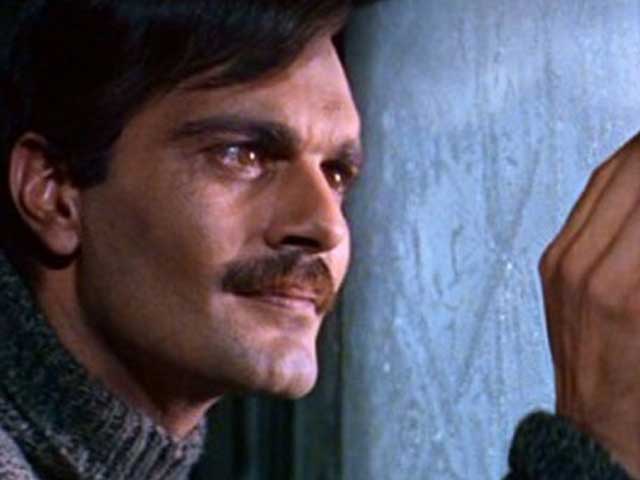
Omar Sharif, who died earlier this week, was a handsome man and an uneven actor. I was a girl when I first saw Doctor Zhivago, and it made an impression, although this is difficult to talk about in the years since because my Russian friends won’t stop laughing at me when I try. In any case, Lisa Lieberman over at 3quarksdaily put her finger on it:

“Omar Sharif plays a Russian and Doctor Zhivago was shot mostly in Spain by a British director, produced by an Italian. ‘Lara’s Theme,’ the schmaltzy leitmotif that evokes the Julie Christie character, can still be heard in elevators today. But the film has endured, in no small part due to the humanity of Omar Sharif’s performance.

“Let’s start with an early scene: it is 1912 and a group of workers are demonstrating in the streets of Moscow, led by the idealistic Pasha Antipov, a young social democrat. An equally young and idealistic Yuri Zhivago watches the scene from a balcony, and witnesses the violence as the workers are mowed down by Cossacks on horseback. Pasha is radicalized by the event and becomes a revolutionary, lashing out against the regime responsible for such brutality, but growing more ruthless as the story progresses. Yuri turns away, turns inward. Each new upheaval in Russia, each act of violence, reaffirms his determination to live, to love, and to create. Sharif registers pain in those soulful brown eyes. Unlike Pasha or the commander of the partisan unit that conscripts him later in the picture, his character never loses his humanity, never sacrifices his concern for individuals, their lives, their hopes, their needs in the name of ‘justice’ or some other abstract good.”

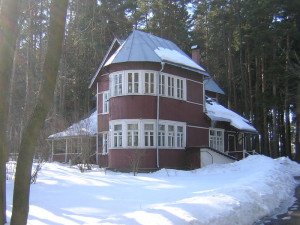
One could say the same for some of the other central characters of the Boris Pasternak‘s classic, but I wouldn’t have a chance to read the book until I went to university, and I didn’t visit Pasternak’s dacha outside Moscow in Peredelkino (the idyllic Varykino in the book is modeled on it) until many years after that. Sharif’s death did sent me back to the movie, but also back to Pasternak as well, and I was pleasantly surprised to see that, although he died in Peredelkino in 1960, the granddaughter of his friend, Olga Carlisle, managed to meet him a few months before his death, and managed to get a Paris Review piece, “The Art of Fiction No. 25” out about the experience. She describes her first visit to his home, with its “combined austerity and hospitality”:

peredelkino

The model for Varykino.

Pasternak’s house was on a gently curving country road which leads down the hill to a brook. On that sunny afternoon the hill was crowded with children on skis and sleds, bundled like teddy bears. Across the road from the house was a large fenced field—a communal field cultivated in summer; now it was a vast white expanse dominated by a little cemetery on a hill, like a bit of background out of a Chagall painting. The tombs were surrounded by wooden fences painted a bright blue, the crosses were planted at odd angles, and there were bright pink and red paper flowers half buried in the snow. It was a cheerful cemetery. [Pasternak would be buried in that cemetery within a few months. – ED.]

I paid the driver and with great trepidation pushed open the gate separating the garden from the road and walked up to the dark house. At the small veranda to one side there was a door with a withered, half-torn note in English pinned on it saying, “I am working now. I cannot receive anybody, please go away.” After a moment’s hesitation I chose to disregard it, mostly because it was so old-looking and also because of the little packages in my hands. I knocked, and almost immediately the door was opened—by Pasternak himself.

He was wearing an astrakhan hat. He was strikingly handsome; with his high cheek-bones and dark eyes and fur hat he looked like someone out of a Russian tale.

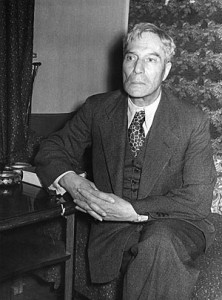
pasternak

Out of time.

The whole thing is worth a read, of course – it’s online here . The two had several Sunday afternoon meetings before she returned to Paris, and in that time he gave his opinions about a number of poets and authors, the play he was writing, poetry, music, and how old-fashioned Nietzsche seemed. And here’s what he said (well, some of it) about Doctor Zhivago: 

 “When I wrote Doctor Zhivago I had the feeling of an immense debt toward my contemporaries. It was an attempt to repay it. This feeling of debt was overpowering as I slowly progressed with the novel. After so many years of just writing lyric poetry or translating, it seemed to me that it was my duty to make a statement about our epoch—about those years, remote and yet looming so closely over us. Time was pressing. I wanted to record the past and to honor in Doctor Zhivago the beautiful and sensitive aspects of the Russia of those years. There will be no return of those days, or of those of our fathers and forefathers, but in the great blossoming of the future I foresee their values will revive. I have tried to describe them. I don’t know whether Doctor Zhivago is fully successful as a novel, but then with all its faults I feel it has more value than those early poems. It is richer, more humane than the works of my youth.”

International fame did not agree with him, at least not entirely: “… everyday life has grown very complicated for me. It must be so anywhere for a well-known writer, but I am unprepared for such a role. I don’t like a life deprived of secrecy and quiet. It seems to me that in my youth there was work, an integral part of life which illuminated everything else in it. Now it is something I have to fight for. All those demands by scholars, editors, readers cannot be ignored, but together with the translations they devour my time. . . . You must tell people abroad who are interested in me that this is my only serious problem—this terrible lack of time.”

News that’s not news: CIA funded Dr. Zhivago

Monday, April 7th, 2014
Share

pasternak

No trip to Stockholm. (Photo courtesy Hoover Institution)

The internet is all abuzz with the news that the CIA funded Boris Pasternak‘s classic Doctor Zhivago.

Except that this is not news. I wrote about Pasternak, who was awarded a 1958 Nobel Prize that the U.S.S.R. would not allow him to accept, here.  An excerpt from the 2007 article, featuring a Stanford conference on Pasternak’s famous book:

The Nobel lightning bolt came not a moment too soon for Pasternak. Dark political clouds had been gathering around him. Without the prize, the poet might have faced more obvious persecution—poet Osip Mandelstam died in a prison camp, poet Marina Tsvetaeva was hounded to her suicide. Both were friends of Pasternak.

Doctor Zhivago was published in Milan. Albert Camus, who won the 1957 Nobel Prize in literature, nominated it for a Nobel. However, the book required publication in its original language to be considered. There was little financial motive for a non-Russian publisher to publish a book in Russian, and huge disincentives for Russian publishers, who faced long imprisonment in a very cold place—or worse. In recent years, researcher Ivan Tolstoi has revealed details of how the CIA financed a Russian translation of the book. Tolstoi is one of the speakers at the Stanford event. He will be speaking in Russian on a panel. A discussion in English will follow.

Tolstoi told the Moscow News this year that “both sides during the Cold War used different methods, but as for ideological subversion of Soviet power, the Americans always used above-board methods. Instead of using poison, derailing trains and kidnapping, the CIA subverted the Kremlin by Russian culture, which the Soviets were prohibited to know or remember.”

“Thanks to the fact that Pasternak won the Nobel Prize, Pasternak wasn’t arrested,” Tolstoi told Radio Free Europe last year. “This deed by the CIA served to ennoble and save Pasternak. The actions of American intelligence saved a great Russian poet.”

The CIA similarly published Mandelstam, Akhmatova and others. “Such a reprehensible organization—and such nice deeds,” Tolstoi told the Moscow News. “How is that for thinking evil, but doing good.”

At the 1958 Brussels World Fair, copies of Doctor Zhivago were distributed by a Russian-speaking priest at the Vatican Pavilion. The ground nearby was reportedly littered with the dark-blue binding. Russians tore it off so the book could be divided in half, one for each pocket—it was a huge book, and Russians could assume they were being watched. With samizdat redistribution in the Soviet Union, it achieved fame on the underground book market.

Pasternak's_Doctor_Zhivago_-_Flickr_-_The_Central_Intelligence_Agency

Skip the movie. Read the book.

It would be 30 years before the book was published in its native land. Its launch heralded the collapse of the Soviet Union and of the “Warsaw bloc” of socialist countries.

[Nikita] Khrushchev, after his own fall from power, expressed regret for the hounding of Pasternak. He had entrusted the matter to others, he said, and only realized later, when he had had a chance to look through the book himself, that he had been misled.

“In connection with Doctor Zhivago, some might say it’s too late for me to express regret that the book wasn’t published,” Khrushchev wrote in his memoirs. “Yes, maybe it is too late. But better late than never.”

It was known that the CIA was underwriting other efforts, such as the YMCA Press in Paris, which published Aleksander Solzhenitsyn‘s astonishing Gulag Archipelago. That’s what made the work of Ardis so astonishing – it didn’t.

So what’s new?  The Washington Post article here makes use of 130 newly declassified CIA documents that detail the agency’s secret involvement in the printing, so it’s worth a read. It’s just not the lightning bolt it’s made out to be.

George Kline: scholar, translator, and chronicler of Soviet bugaboos

Wednesday, January 16th, 2013
Share

In 1974…

George L. Kline is someone you’ve likely never heard of, unless you have an interest in Russian philosophy,” writes Michael McIntyre over at “Extravagant Creation.”

Well, that’s not quite true.  Those of us who know Russian poetry will know his translations of Joseph Brodsky, and perhaps also of Boris Pasternak, Marina Tsvetaeva, and others.  The Eric Voegelin scholar Paul Caringella alerted me to McIntyre’s 2010 post, which celebrates my Bryn Mawr friend and correspondent:

What’s so great about reading Kline is that you are not only learning at the hands of someone who has thoroughly mastered his field, you are doing so via writing that is at once scholarly and accessible, that doesn’t take ten pages to explain what only needs one page.  Kline’s monographs are few in number – he seems to prefer writing articles and book chapters – and relatively brief in length.

In the academic world of publish-or-perish overproduction, that comes as a splash of sanity.  McIntyre is attuned to a side of my scholarly  friend that I had overlooked – for example, his 1968 book Religious and Anti-Religious Thought in Russia (University of Chicago Press).  To my shame, I didn’t know George had written such a book, but I immediately made amends by ordering it for $5.60 on Abebooks.

A “chamber of horrors”?

The history George describes is a fascinating one:

Some former churches – notably the former Kazan Cathedral in Leningrad – were turned into anti-religious museums that included “chambers of horrors” exhibits that graphically portrayed torture practices used during the Spanish Inquisition.  In 1960 alone, half a million people visited the anti-religious museum in Leningrad; many groups of children were sent there by their schools and they were treated to guided tours by museum staff who provided them with extensive anti-religious commentary.  Religious instruction for children was restricted to private homes only, in groups of three or less.  Since 1962, children could be baptized only if both parents applied for it, and both parents supplied a certificate from their workplace or place of residence (the issuers of these certificates were expected to do all they could to try to dissuade the “misguided” parents).

From the posts of some of my more virulently anti-religious Facebook friends, one would think that the “chamber of horrors” is overdue for revival.  In any case, one could see why Joseph Brodsky’s “Elegy to John Donne” was such a knock-out punch in the U.S.S.R., and why George was so swept away by it, as the Book Haven explained yesterday.  Take, for example, the concluding lines of the poem:

Man’s garment gapes with holes. It can be torn,
… And only the far sky,
in darkness, brings the healing needle home.
Sleep, John Donne, sleep. Sleep soundly, do not fret
your soul. As for your coat, it’s torn; all limp
it hangs.  But see, there from the clouds will shine
that Star which made your world endure till now.

I’ve benefited greatly over the years from George’s tireless generosity, scholarly precision, and remarkable experiences.  So have others.  From “George L. Kline: An Appreciation,” included in the 1994 book Russian Thought After Communism : The Recovery of a Philosophical Heritage (edited by James P. Scanlan):

In many ways as important as Kline’s formal teaching is the informal help he has provided to a multitude of students and colleagues in the field, not only in the United States but throughout the world.  Anyone who has sought George Kline’s advice or assistance on some matter relating to Russian philosophy is fully aware of his remarkable readiness to share information from his vast store of knowledge, go over a translation, review a paper, or comment on a research project – all with the most careful and patient attention, the highest scholarly standards, and the most humane sensitivity to the needs and interests of others.

It’s a joy to discover people like George L. Kline!

Couldn’t agree more.

Nabokov on Lolita: “I leave the field of ideas to Dr. Schweitzer and Dr. Zhivago.”

Monday, February 27th, 2012
Share

I had never heard Vladimir Nabokov speak, until I ran across this video while reading up my post a few days ago. In this late-1950s video, Nabokov discusses his novel Lolita – or appears to – with an unnamed moderator and the critic and author Lionel Trilling. I suspect much of what he’s saying is a leg-pull. If these comments and questions are typical of the kinds of interviews he faced, it’s no wonder he skived off to Switzerland with the cash he made on the appalling film version of Lolita with Sue Lyon.  (And the comments on the youtube video are a good indication of why he stayed.)

I learned a few things from these videos: According to Mr. Nabokov, I am a philistine.  I confess that I am, on occasion, “a user of cozies” – tea cozies, anyway.  Who knew it was so easy? On those who think his book is about sex? “But maybe they think in clichés. For them sex is so well-defined there’s a gap between it and love. They don’t know what love is, and perhaps they don’t know what sex is, either.” What does it all mean? “I leave the field of ideas to Dr. [Albert] Schweitzer and Dr. Zhivago.” He doesn’t miss a chance to get in a dig at Boris Pasternak.

Postscript on 3/8:  The Book Haven attracts a very broad readership, but never before have we attracted a fan from the tea cozy world.  This from a reader who identifies himself/herself only as FlockofTeaCosy: “This video is from Close Up, a CBC programme from the 1950s, and Nabokov is being interviewed by Trilling and Canadian author Pierre Berton.” There you have it. The name of the third man in the clips.  (And check out the avant-garde tea cozies here.) And from one of our more usual readers, Elena Danielson, “I think Nabokov would approve of your tea cozies – but not of Pasternak.” See their comments below.