Posts Tagged ‘Ilya Kaminsky’

Reading the “Inferno” in Ukraine: “a millennium-long class in surviving hell with poetry”

Saturday, January 20th, 2024

Share

How is the shelling of Kyiv akin to Dante’s Inferno? Ukrainian Poet Ilya Kaminsky (we’ve written about him here and here and here) calls it “a millennium-long class in surviving hell with poetry, through music, imagery, and poetry’s willingness to look without flinching at the details of both terror and wonder: in a strange way, this book is a call to courage.” He adds: “The poem is outside of history, like snow and rain and wind.”

An excerpt or two from his piece in
Asymptote Journal:

I have a friend who, before she ran from Kyiv as Russia bombarded the city in early 2022, spent weeks shivering in the bomb shelters as the city was shelled.

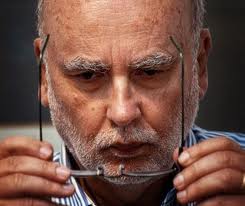
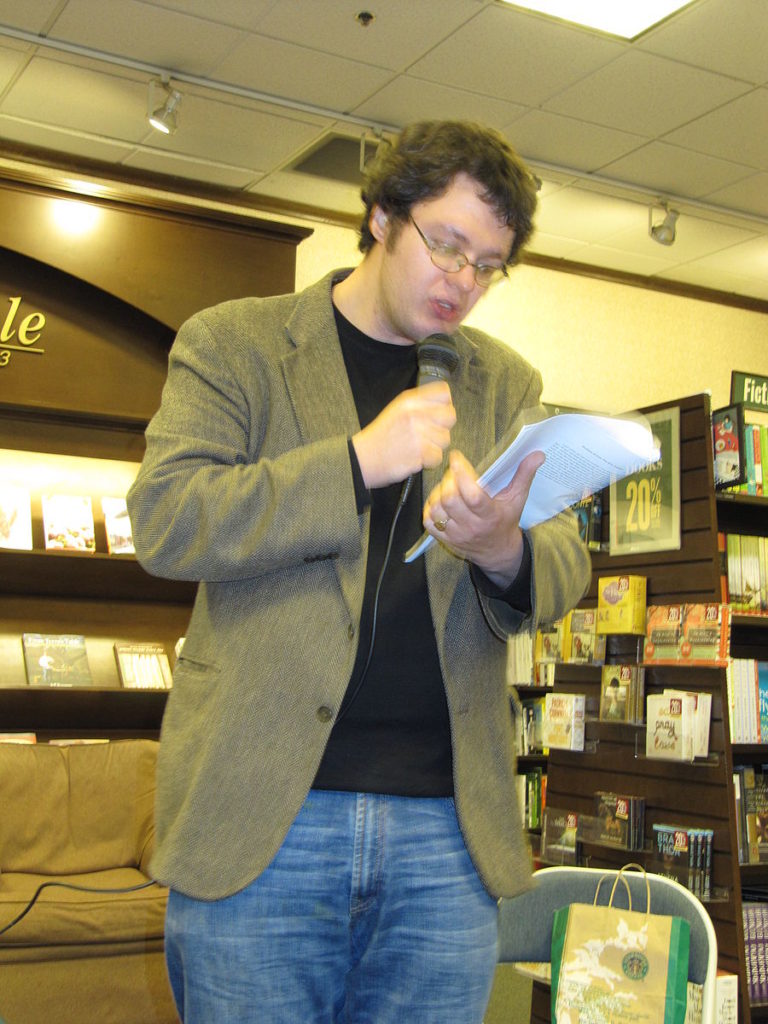
Ilya Kaminsky explains why poetry matters. (Photo by Slowking)

At first, she first recited poems by heart, and then she began to translate the poems she remembered.

That is how she got through the hours.

Who is to tell me after this that poetry doesn’t matter?

***

Somewhere in Ukraine right now, my friend who publishes books orders printers in the bombed out city of Kharkiv to produce thousands of copies of Inferno. The trucks deliver weapons into Kharkiv. And, going back, empty, they decide to pick up thousands of copies of Dante’s Inferno.

This is an image of war that happens as I write it: cars are bringing weapons into the besieged city that’s bombed daily, and they leave full of books.

***

Opening Dante’s Inferno enrolls the reader in a millennium-long class in surviving hell with poetry, through music, imagery, and poetry’s willingness to look without flinching at the details of both terror and wonder: in a strange way, this book is a call to courage.

***
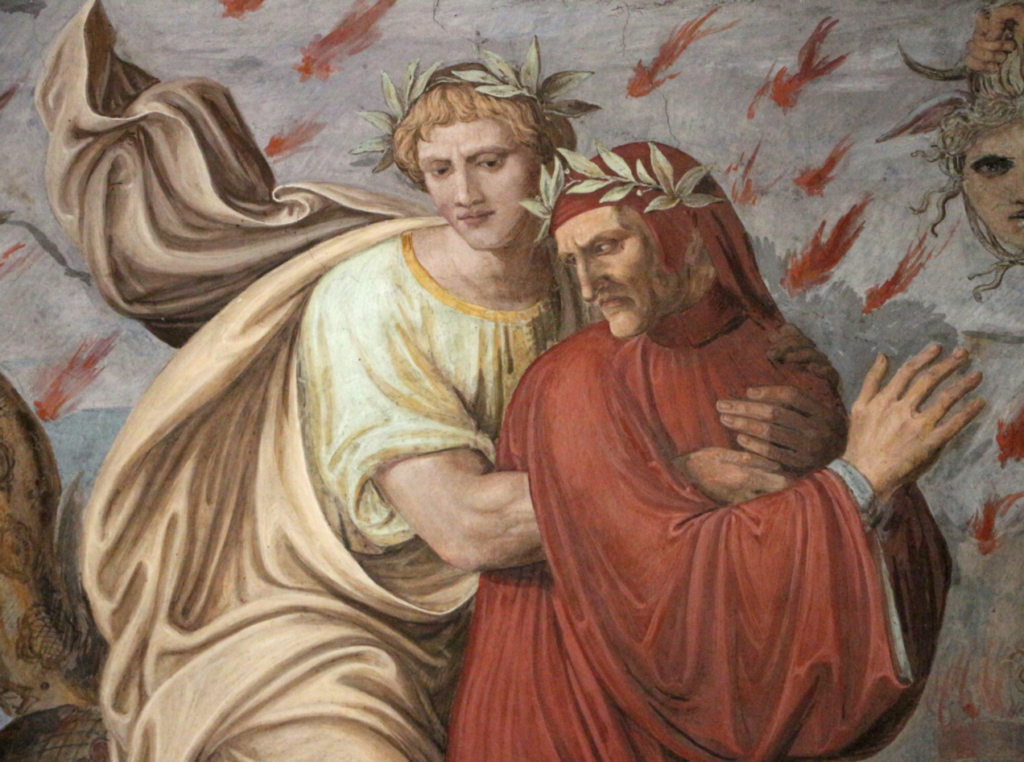
In the underworld Dante meets his enemies and heroes—great thinkers, murderers, poets, politicians—but no one is too monumental. They are all trying to stay relevant to a living man, all too human, fragile, grotesque, not unlike ourselves, trying to say something that still matters.

Read the whole thing here.

Meanwhile, the journal reminds us: as support for Ukraine wavers in the US, we at Asymptote have kept up our coverage of the region also through Elina Sventsytska’s devastating poetry, a review of Oksana Lutsyshyna’s latest award-winning novel in English translation, and a dispatch about the chilling aftermath of a Russian dissident’s self-immolation.
Ukrainian poet Ilya Kaminsky: “the wrecked word” confronts the wrecked world.

Thursday, March 10th, 2022
Share
Born in the Odessa, now in America.

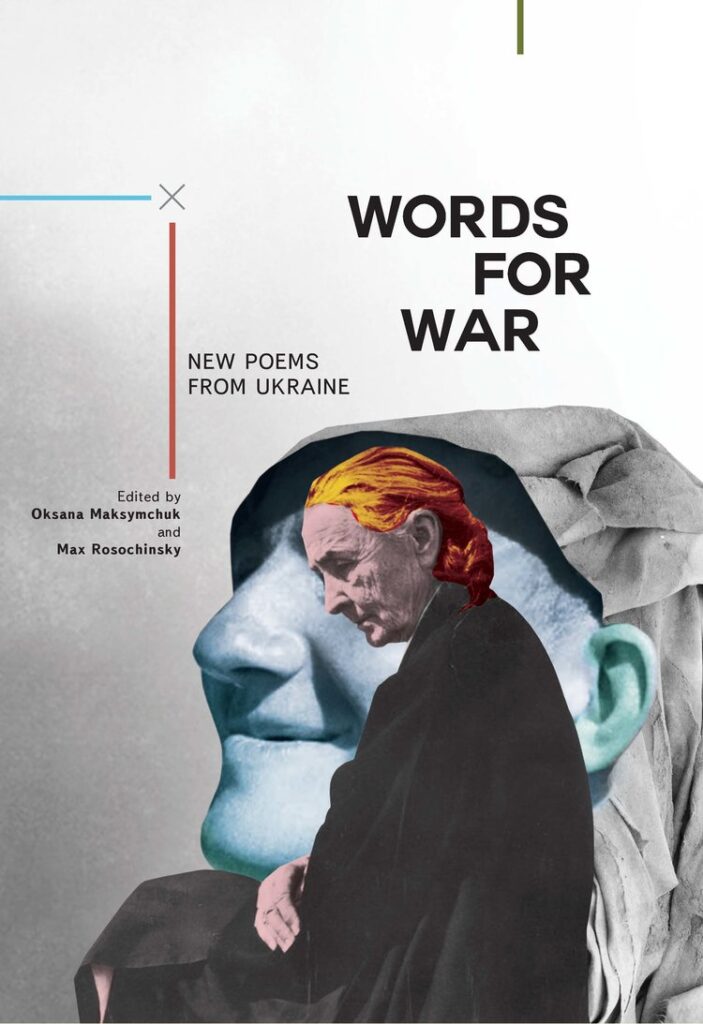
Ukrainian-American Ukrainian-Russian-Jewish-American poet, writer, critic, translator Ilya Kaminsky (we’ve written about him here and here and here) has been much in the news lately, which is often bad news for Ukrainians. Over at Lithub, you can read his 9-part essay on “Ukrainian, Russian, and the Language of War,” excerpted from Words for War: New Poems from Ukraine, published by Academic Studies Press.

Meanwhile, let us here focus on the essay’s section dedicated to the young poet Lyuba Yakimchuk:

In the late 20th century, the Jewish poet Paul Celan became a patron saint of writing in the midst of crisis. Composing in the German language, he has broken speech to reflect the experience of a new, violated world. This effect is happening again—this time in Ukraine—before our very eyes.

Here is the case of poet Lyuba Yakimchuk, whose family are refugees from Pervomaisk, the city that is one of the main targets of Putin’s most recent “humanitarian aid” effort. Answering my questions about her background, Lyuba responded:

“Literature is changed by war.”

I stare into the horizon
. . . I have gotten so very old
no longer Lyuba
just a –ba.

“I was born and raised in the war-torn Luhansk region and my hometown of Pervomaisk is now occupied. In May 2014 I witnessed the beginning of the war … In February 2015 my parents and grandmother, having survived dreadful warfare, set out to leave the occupied territory. They left under shelling fire, with a few bags of clothes. A friend of mine, a [Ukrainian] soldier, almost shot my grandma as they fled.

“Discussing literature in wartime, Yakimchuk writes: ‘Literature rivals with the war, perhaps even loses to war in creativity, hence literature is changed by war.” In her poems, one sees how warfare cleaves her words: don’t talk to me about Luhansk,’ she writes, ‘it’s long since turned into hansk / Lu had been razed to the ground / to the crimson pavement.’ The bombed-out city of Pervomaisk ‘has been split into pervo and maisk‘ and the shell of Debaltsevo is now her ‘debaltsevo.’ Through the prism of this fragmented language, the poet sees herself:

Just as Russian-language poet Khersonsky refuses to speak his language when Russia occupies Ukraine, Yakimchuk, a Ukrainian-language poet, refuses to speak an unfragmented language as the country is fragmented in front of her eyes. As she changes the words, breaking them down and counterpointing the sounds from within the words, the sounds testify to a knowledge they do not possess. No longer lexical yet still legible to us, the wrecked word confronts the reader mutely, both within and beyond language.

Reading this poem of witness, one is reminded that poetry is not merely a description of an event; it is an event.

You can read the rest of Ilya Kaminsky’s essay here. Ukrainian poet, screenwriter, and journalist Lyuba Yakimchuk’s poem “Crow, Wheels” is here.

Ukrainian writer Ilya Kaminsky: “Putins come and go.”

Tuesday, March 1st, 2022
Share

Ukrainian-Russian-Jewish-American poet, writer, critic, translator and professor Ilya Kaminsky shared two tweets on Twitter. I share them with you:

“Delicious…[it] evokes so much so vividly and so intelligently”: Leon Wieseltier, Ilya Kaminsky weigh in on “Czeslaw Miłosz: A California Life”

Sunday, February 6th, 2022
Share

The Book Haven has been pretty mum on our our newest offering, Czesław Miłosz: A California Life, just out with Berkeley’s Heyday Books (we wrote about its origins here). But we’ve been speaking about it – in Berkeley, in Chicago, in San Francisco, and on podcasts (listen to us at the Athenaeum here). Let’s end our blog silence now with the words from one of America’s most eminent literary critics, Leon Wieseltier:

“Cynthia Haven’s book is delicious. She evokes so much so vividly and so intelligently; for me her pages were a restoration of a richer and less lonely time. And her intuition is right: Czeslaw Milosz and California are indeed a chapter in each other’s history.” 

We’ve written about Ilya Kaminsky, author of Deaf Republic here and here. We’re honored that he chimed in, too: “Czesław Miłosz: A California Life asks about the meaning of exile, about the possibilities of a new home, about the transformation of a poetic perspective, about alienation and the building of literary bridges. But in the end, the book asks one big, nearly impossible question: How did the great Polish exile Miłosz change his newfound home—and how did California, after so many years, transform Miłosz’s own metaphysics? For it is a metaphysical question, after all: How does a place change the poet, and what does a poet do to shift our perspective on the place? On this unending journey, Cynthia L. Haven is an illuminating guide, one who brings knowledge, precision, and grace. There is much to learn from this book about Miłosz and California, yes, but also about poetry and the world.”

Kaminsky: “Knowledge, precision, and grace”

From Publishers Weekly:

“The irony is that the greatest Californian poet… could well be a Pole who wrote a single poem in English,” suggests journalist Haven (Evolution of Desire) in this detailed biography of Czesław Miłosz (1911–2004). California was crucial to Miłosz’s life and work, Haven argues, and notes that the Polish poet had a complicated relationship with the U.S.: “He longed for America yet loathed it, too.” The narrative follows Miłosz as he worked in U.C. Berkeley’s Slavic department starting in 1960 and taught Polish literature, during which he found American students “unreliable and undisciplined.” Haven also traces the poet’s relationship to his home country: when he returned for the first time in 30 years after he won the Nobel Prize in 1980, he had questioned “whether he still had any audience in his native land—after the censorship, after the years in exile—and so the crowds stunned him.” Much has been written about the poet, and Haven finds new ways into his life by inserting herself into the narrative—discovering Miłosz’s Bells in Winter in a Palo Alto Bookstore, visiting him in his Grizzly Peak home, attending his packed last public reading at Berkeley—and her examinations of the influence of place on his poetry are insightful. Fans of Miłosz’s work should give this a look.

More on Amazon here.

Ilya Kaminsky remembers Adam Zagajewski: “He was a very shy person, gracious, precise. He believed in the soul …”

Friday, May 7th, 2021
Share

We haven’t finished talking about Adam Zagajewski, who died last month. We never will. Now we have Ilya Kaminsky‘s amazing tribute in The Yale Review (We wrote about the Ukrainian poet and novelist here and here.)

His article, “Going to Lvov,” begins:

“…a world of books within him”

I will always remember how, on a street corner in Chicago, the late Polish poet Adam Zagajewski turned to me and breathlessly said, “Oh, how much I hate Dante!”

I kept laughing all the way to my train. But of course, like everything Adam said, it made perfect sense in context. He was teaching at the University of Chicago that semester, away from his hometown of Kraków. I saw him twice a month when I visited Chicago for work. On that occasion, as usual, our conversation began with a report of what we had been reading: in my case, Dante, in Adam’s, Kobayashi Issa’s haiku. He loved the short lyric, its self-contained inner life, and minimalists like Pascal and E. M. Cioran; the latter he quoted often. But he also struggled with Cioran’s pessimism: “I can’t tell you how many times I wanted to toss that book against the wall.”

“A skinny man who carried a world of books within him, Adam Zagajewski was the kind of person who would offer to drop you off at your hotel after a poetry reading only to pull over midway to better focus on a conversation about poetry.  He would email the next day to recommend some more poets he loved, without any of that Bloomian anxiety of influence. None of this was a performance: he was a very shy person, gracious, precise. He believed in the soul—that the soul must live in lyric poetry. That, most of all.

Poet, novelist Kaminsky at a reading

“What I love about his own poems is how, in the second half of the horror that was the twentieth century, knowing what happened to Gabriel García Lorca, César Vallejo, Marina Tsvetaeva, Osip Mandelstam, Paul Celan, and countless others, Adam insisted that a poem can be both an elegy for what happened and also a hymn to life. He gave us, if not a healing, then a way to go on, to give each other a measure of reprieve, music, and “gentleness.”

“To Go to Lvov” gives us context the poem, “a dream that refuses to end”: “Think of this poem, written in the 1980s, in a time when half of Europe was still under Soviet rule. Think of the joy it gives, composed in the shadow of a pained, disjointed requiem like Celan’s “Death Fugue.” Think of how much it took for a refugee and a child of refugees—for a man whose people died in exile—to stand up and imagine a way forward.”

In “To Go to Lvov,” the city’s rhythms are in the poem’s repetitions, line breaks, and sentence patterns. At the end of twentieth century, in a postwar poem about exile we expect an elegy, a protest, a dirge, but instead receive an ode’s joyful, impossible praise.

Much like “Late Beethoven,” this poem juxtaposes tonalities: humor, high lyricism, heartbreak. There is that same tension between description and invocation.

Oh! Oh! Oh! Go to the link to read Adam Z.’s matchless poem for the late Beethoven, called, justly enough, “Late Beethoven.” The poem, and Ilya’s tribute, are over at The Yale Review here.

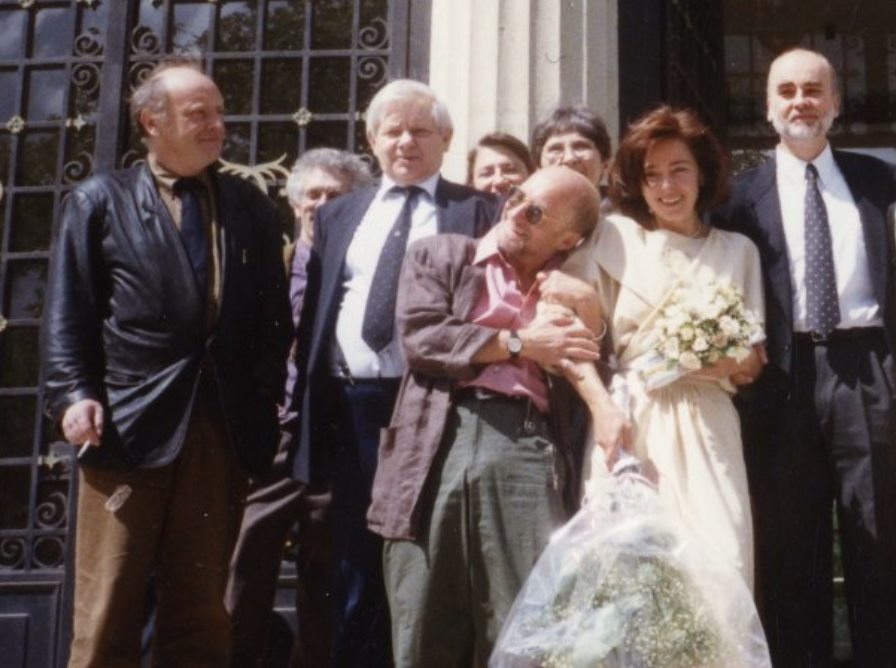
Postscript on May 11: Sculptor Jonathan Hirschfeld has identified the playful man in the pink shirt. It is Adam’s lifelong friend, the actor Wojciech Pszoniak, who passed away at 78 last October. (Some may remember that he played Robespierre in Andrzej Wajda‘s 1983 Danton.) Adam was grieving deeply for his friend. The Bulgarian-French thinker Tzvetan Todorov, who died in 2017, is in the back row on the left.  

Adam Zagajewski’s wedding to Maja Wodecka. Joseph Brodsky and Zbigniew Herbert at left.

“One of the most moving texts I have ever read” – the last letter to Osip Mandelstam

Monday, May 3rd, 2021
Share

A guest post from Ukrainian-American poet Ilya Kaminsky on one of the most famous literary marriages in history:

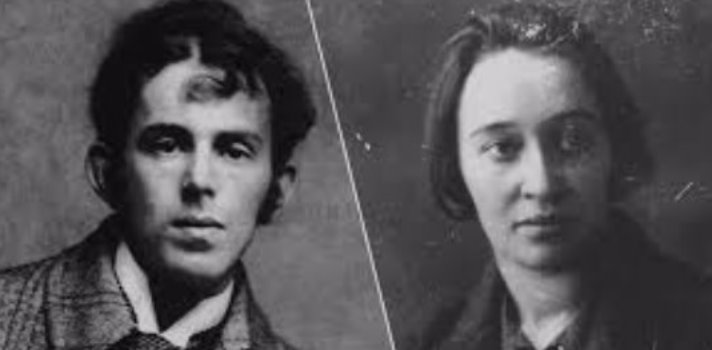
Exactly a hundred years ago, Osip Mandelstam met Nadezhda.

He was a great poet, wrote an epigram against Stalin, was sent into exile, returned, was sent to the camps in 1938 where he soon died.

She led a nomadic life for years, trying to dodge the expected arrest, moving from city to city, taking only temporary jobs (at least one time, in the city of Kalinin, police came for her the day after she fled).She was not allowed to return to Moscow until 1964.

She wrote memoirs which are considered among the most important texts of 20 century witness literature. Her name, Nadezhda, in Russian means “hope.” Her famous book is called Hope Against Hope.Here is the last letter she wrote to her husband – it is one of the most moving texts I have ever read:

22 October, 1938

Osia, my beloved, faraway sweetheart!

I have no words, my darling, to write this letter that you may never read, perhaps. I am writing in empty space. Perhaps you will come back and not find me here. Then this will be all you have to remember me by.

Osia, what a joy it was living together like children – all our squabbles and arguments, the games we played, and our love. Now I do not even look at the sky. If I see a cloud, who can I show it to?

Remember the way we brought back provisions to make our poor feasts in all the places where we pitched our tent like nomads? Remember the good taste of bread when we got it by a miracle and ate it together? And our last winter in Voronezh. Our happy poverty, and the poetry you wrote. I remember the time we were coming back once from the baths, when we bought some eggs or sausage, and a cart went by loaded with hay. It was still cold and I was freezing in my short jacket (but nothing like what we must suffer now: I know how cold you are). That day comes back to me now. I understand so clearly, and ache from the pain of it, that those winter days with all their troubles were the greatest and last happiness to be granted us in life.

My every thought is about you. My every tear and every smile is for you. I bless every day and hour of our bitter life together, my sweetheart, my companion, my blind guide in life.

Like two blind puppies we were, nuzzling each other and feeling so good together. And how fevered your poor head was, and how madly we frittered away the days of our life. What joy it was, and how we always knew what joy it was.

Life can last so long. How hard and long for each of us to die alone. Can this fate be for us who are inseparable? Puppies and children, did we deserve this? Did you deserve this, my angel? Everything goes on as before. I know nothing. Yet I know everything – each day and hour of your life are plain and clear to me as in a delirium.

You came to me every night in my sleep, and I kept asking what had happened, but you did not reply.

In my last dream I was buying food for you in a filthy hotel restaurant. The people with me were total strangers. When I had bought it, I realized I did not know where to take it, because I do not know where you are.

When I woke up, I said to Shura: “Osia is dead.” I do not know whether you are still alive, but from the time of that dream, I have lost track of you. I do not know where you are. Will you hear me? Do you know how much I love you? I could never tell you how much I love you. I cannot tell you even now. I speak only to you, only to you. You are with me always, and I who was such a wild and angry one and never learned to weep simple tears – now I weep and weep and weep.

It’s me: Nadia. Where are you?

Farewell. Nadia