
Posts Tagged ‘Jane Austen’

Can metaphysical ugliness promote beauty?

Monday, January 1st, 2024


Share
Proust lover Trevor Cribben Merrill

How do authors get away with shallow, shabby, venal, morally deficient characters who appall us … but nevertheless, we read on? Trevor Cribben Merrill, author of Minor Indignities, explains: “the ‘spirit of the author’ shields the reader from the characters, ‘drawing the poison’ from their negative qualities of arrogant stupidity, shallowness, and triviality.” He writes about it on Genealogies of Modernity, a project supported by the National Endowment for the Humanities to explain “how we became modern.”

Trevor writes: “This essay is about as close as I have come to articulating an artistic credo.” Excerpt from “Three Lessons in Beauty” below:

We would not want to spend time with Proust’s snobs. In their most honest moments, even his characters describe the fancy dinner parties they attend as boring and stifling. But to read about these soirées, and the people at them, is another matter. Similarly, if we were to encounter him in real life, Jane Austen’s Mr. Collins would be a bore; on the page, he is at once a bore, and, with his absurd boasts about the size of the chimney-piece at Rosings Park, a pure delight. In both cases the authors make us enjoy the sort of people we would try to flee at a cocktail party. It is not only that Proust’s prose and metaphors are exquisite, but that he turns the wretched maneuverings and deceit of his snobs into poetry. Out of pretense, dullness, and even malice, Austen, too, makes art.

The formal innovations of the great masters always have a certain discreetness about them,” he writes. [italics his]

His characters disgust us, and yet…

Recently while sick in bed I listened to Beethoven’s Piano Sonata 31, Op. 110 performed first by Rudolf Serkin and then by Glenn Gould. Composed in 1821, Op. 110 is the next to last of the composer’s piano sonatas, and falls squarely in his “late” period, during which he created many of his most beautiful and formally adventurous works. Beethoven is known for bridging classical and romantic styles. In his late years, however, he was also drawn to the contrapuntal music of the earlier baroque period.

The Op. 110 sonata is especially notable for its third movement, which employs musical structures from different moments in the history of music: classical homophony (a melody played by the right hand unfolding over chords played gently by the left); a more impassioned, stormy section expressing romantic emotion; and a fugue divided into two parts. In Serkin’s interpretation, and even more so in Gould’s, this fugue, built on a short, ascending theme, sounds very much like Bach. By paying reverent homage to the polyphony of Bach and Handel, Beethoven, as if by accident, created a novelty in the homophonic form par excellence, the sonata.
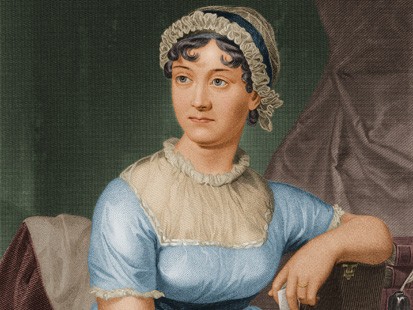
Can’t catch her in the act.

In one of his essays Milan Kundera praises this third movement of the Op. 110 sonata for “its extraordinary heterogeneity of emotion and form.” And yet, he adds, “the listener does not realize this, because the complexity seems so natural and simple.” From this beguiling naturalness Kundera draws the following lesson: “the formal innovations of the great masters always have a certain discreetness about them; such is true perfection; only among the small masters [petits maîtres] does novelty seek to call attention to itself.”

This observation calls to mind Virginia Woolf’s comment about Jane Austen: “of all the great writers,” she is “the most difficult to catch in the act.” One of Austen’s formal innovations occurs in Northanger Abbey, where she makes her “defense of the novel” as an art that gives “unaffected pleasure” while truthfully representing human nature in beautiful language. Austen admired Henry Fielding, who included mini-essays on the novel at the beginning of each of the eighteen books of Tom Jones.

When she shares her own thoughts on fiction half a century after Fielding, however, she makes them emerge seamlessly from her characters’ obsession with Gothic fiction, and—with the discretion of a great master—tucks them in at the end of chapter five. What in Fielding comes across as theoretical reflection added on to the fictional narrative is in Austen woven into the work’s fabric. In this way she keeps one foot in the aesthetic of the eighteenth-century novel, with its obtrusively playful authorial interventions, while bringing a new level of unity and polish to her chosen form.

To what other artists or works of art might Kundera’s insight apply? Because the kinds of formal innovations he singles out avoid drawing attention to themselves, it takes a certain amount of knowledge about a given art form to come up with good examples. And conversely, attempting to catch a glimpse of such shy novelties promotes a deeper appreciation for the habits of great artists as well as for the inner workings of artistic tradition. 

Read the whole thing here.

Jane Austen: Is “Mansfield Park” her most daring book?

Saturday, April 18th, 2020
Share

Henry Crawford leads Fanny Price to the dance.

Is  Mansfield Park  Jane Austen’s “most daring book”? Janet Todd thinks so, and argues in The Times Literary Supplement that the 1814 book “provokes the reader to address the difficult truth of stubborn integrity.” I, too, balked at the priggishness of Fanny Price. I, too, was repelled by her moralizing. On the other hand, I kind of wish I had listened. As for making “astonishingly foolish life-choices” under the influence of some those other great writers of the nineteenth century – oh, ’tis true, tis true. 

One of my earliest memories of literary embarrassment is being asked by a bookish neighbour if I’d read Jane Austen. I was eleven. “Yes”, I replied. But I was mistaken. I had in mind the fantastic Classic Comics version of Jane Eyre with its alluring panel of Mr Rochester.

By nineteen, at Cambridge in the 1960s, I’d uncoupled Jane Austen from Jane Eyre. I read the six novels which F. R. Leavis, the then guru, instructed us to find “great”. I couldn’t oblige. I was startled, then offended, by Fanny Price of Mansfield Park. Why would an author who’d made the robust, witty and self-assured Elizabeth Bennet then create so limp and teary a heroine as Fanny, a creeping killjoy who suffers sunstroke from cutting roses in temperate England and fears the “wilderness” of a tame country estate? Until the ending, I assumed her rival Mary Crawford would get the hero – if, bizarrely, she really wanted him.

Over the decades I became acutely aware that Elizabeth Bennet (in the later chapters) and Fanny Price were more appropriate, self-controlling, guides to life for a young girl than my chosen heroines from Tolstoy and Dostoevsky, the Grushenkas, and Natashas, under whose influence I made some astonishingly foolish life-choices. It wasn’t all the fault of the Russians, of course. It was also the exciting period of Second Wave Feminism, when the stress was on self-fulfilment and self-expression, on being authentic and free from constraining standards of “patriarchy”. Present-day Feminism – I’ve lost touch with what Wave we are now riding – has had half a century to grow more nuanced and diverse, but its emphasis on the individual self and authentic experience remains. So we still try to adjust Jane Austen to our way of thinking – unless we are in the cinema watching her novels as romance and costume drama.

Read the rest at the TLS here.

That feeling you got when the boy who left flowers at your locker was the creepiest guy in high school? Yeah, that.

Thursday, July 26th, 2018
Share

Not everyone’s cup of tea: the Prince Regent was widely reviled.

It was a love-hate relationship. He loved her; she hated him. But the man who was one of the more disgusting prince regents, the future George IV, was the first buyer of Jane Austen’s Sense and Sensibility

The story is told in The New York Times and The Guardian.

Austen sided with Princess Charlotte, the much betrayed wife of the prince. “Poor woman, I shall support her as long as I can, because she is a Woman, & because I hate her Husband.”

She wasn’t alone in her distaste. According to The New York Times: “The man’s reputational troubles began at birth, when a courtier in attendance announced that he was a girl. By the time of his death in 1830, he had spent so extravagantly, and entertained such a long string of mistresses, that an early biographer accused him of contributing more ‘to the demoralization of society than any prince recorded in the pages of history.’”

Yet she owed the man a debt: he was the first one to purchase a book of hers ever. According to The Guardian:

Nicholas Foretek, a doctoral student at the University of Pennsylvania, was delving through Windsor Castle’s Royal Archives as part of his research into 18th-century printing and publications when he came across a bill of sale revealing that the future King George IV bought a copy of Sense and Sensibility for 15 shillings from his booksellers, Becket & Porter. The purchase was made on 28 October 1811 – two days before the first public advertisement for the novel appeared. Published anonymously, Sense and Sensibility was not an immediate hit, only selling through its first print run by summer 1813 after positive reviews.

“[This] is perhaps the earliest known transaction of any Austen novel,” said Foretek, announcing his discovery.

Austen was also informed that if she “had any other novel forthcoming she was at liberty to dedicate it to the prince.” And so she did. She held her nose and did what had to be done. She wrote her dedication to the prince in her 1815 novel Emma: “To his Royal Highness, the Prince Regent, this work is, by His Royal Highness’s Permission, most Respectfully Dedicated by his Royal Highness’s Dutiful and Obedient Humble Servant.” One scholar called it “one of the worst sentences she ever committed to print.”

His passion never waned; hers never waxed. After he became king in 1820, he bought two copies of Pride and Prejudice in 1813, alongside a second copy of Sense and Sensibility, as well as Mansfield Park in 1814. He also owned a gift copy of Northanger Abbey – and a gift copy of Emma, with one of the most reluctant dedications ever written.

Happy birthday to Jane Austen, “the most unlearned and uninformed female who ever dared to be an authoress.”

Friday, December 16th, 2016
Share

austenIt’s Jane Austen‘s birthday, and time to revisit a National Endowment for the Humanities article by Meredith Hindley, celebrating the life of the author of Pride and Prejudice and Emma. I’ve only known the broadest outlines of Austen’s life – it always seemed rather dull to me –  so the piece in the NEH magazine Humanities was rather a pleasant surprise – and unpleasant, too, when one considers the wandering and dependent life even rather well-heeled spinsters endured.

Austen completed her formal education at age ten. She compared herself to someone “who like me knows only her mother tongue, and has read little in that … I think I may boast myself to be, with all possible vanity, the most unlearned and uninformed female who ever dared to be an authoress.” However, the article notes, Austen’s father kept “a sizable library—one bookcase reportedly covered sixty-four square feet of wall—which his children were encouraged to explore.” Sounds impressive, until you note that an 8 x 8 bookcase isn’t all that much. I have lots more than that.

Here’s a language note: “In Emma, she writes scathingly of schools that ‘professed, in long sentences of refined nonsense, to combine liberal acquirements with elegant morality upon new principles and new systems—and where young ladies for enormous pay might be screwed out of health and into vanity.’” I always thought the use of “screw,” in that sense, had its origins in a more vulgar usage, but hey, what do I know?

An excerpt on her literary roots:

The Austen household revolved around language. Henry once described his father as “a profound scholar, professing a most exquisite taste in every species of literature.” Mother Cassandra wrote humorous verses, while the brothers dabbled in essays and playwriting. We know that Jane read Samuel Richardson from cover to cover, plowed through Hume’s History, and marked up Goldsmith’s History of England and Dodsley’s Collection of Poems. She also read popular works, such as Fanny Burney’s Camilla. And, despite her protestations, Austen probably spoke passable French and knew enough Italian to translate opera, as she has Anne Elliot do in Persuasion.

But the thrust of the piece is, of course, on Pride and Prejudice, which, as the article notes, is considered the U.K.’s second best-loved novel, Pride and Prejudice, after J.R.R. Tolkien’s The Lord of the Rings, according to a 2003 BBC poll.

While marriage might be the central force of Pride and Prejudice—after all, the novel opens with the now-legendary line “It is a truth universally acknowledged, that a single man in possession of a good fortune, must be in want of a wife”—the novel has endured because of the other universals Austen captured: money woes, troublesome sisters, unwanted suitors, embarrassing mothers, meddlesome neighbors, snap judgments, the trauma of public humiliation, the agony of not knowing if your love is returned, and the desire for a happy-ever-after ending.

birthday cake“Also read again and for the third time at least Miss Austen’s very finely written novel of Pride and Prejudice,” wrote Sir Walter Scott in March 1826. Scott was known for sweeping historical romances, but he also valued Austen’s limited canvas. “That young lady had a talent for describing the involvements and feelings and characters of ordinary life which is to me the most wonderful I ever met with. The Big Bow-wow strain I can do myself like any now going; but the exquisite touch, which renders ordinary commonplace things and characters interesting, from the truth of the description and the sentiment, is denied to me. What a pity such a gifted creature died so early.”
Read the whole thing here.

What does it take to be a “cultured” person? Anton Chekhov tells us (with a few qualifying words from Jane Austen).

Tuesday, March 22nd, 2016
Share

Russian author Anton Chekhov (1860-1904) was apparently free with his advice. Maria Popova over at “Brainpickings” found Chekov’s 1886 letter to his older brother Nikolai, an artist. We can only imagine how well the advice was received. After all, the letter is written to an older brother, when Anton was 26 and Nikolai 28. In any case, the older brother died three years later of tuberculosis.

As for our humble selves, we can only quote Elizabeth Bennet, in the conversation with Mr. Darcy, Mr. Bingley, and Bingley’s sister Caroline Bingley, from Jane AustenPride and Prejudice:

jane-austen

Sensible lady

“It is amazing to me,” said Bingley, “how young ladies can have patience to be so very accomplished as they all are.”

“All young ladies accomplished! My dear Charles, what do you mean?”

“Yes, all of them, I think. They all paint tables, cover screens, and net purses. I scarcely know anyone who cannot do all this, and I am sure I never heard a young lady spoken of for the first time, without being informed that she was very accomplished.”

“Your list of the common extent of accomplishments,” said Darcy, “has too much truth. The word is applied to many a woman who deserves it no otherwise than by netting a purse or covering a screen. But I am very far from agreeing with you in your estimation of ladies in general. I cannot boast of knowing more than half-a-dozen, in the whole range of my acquaintance, that are really accomplished.”

“Nor I, I am sure,” said Miss Bingley.

“Then,” observed Elizabeth, “you must comprehend a great deal in your idea of an accomplished woman.”

“Yes, I do comprehend a great deal in it.”

1898_by_Osip_Braz

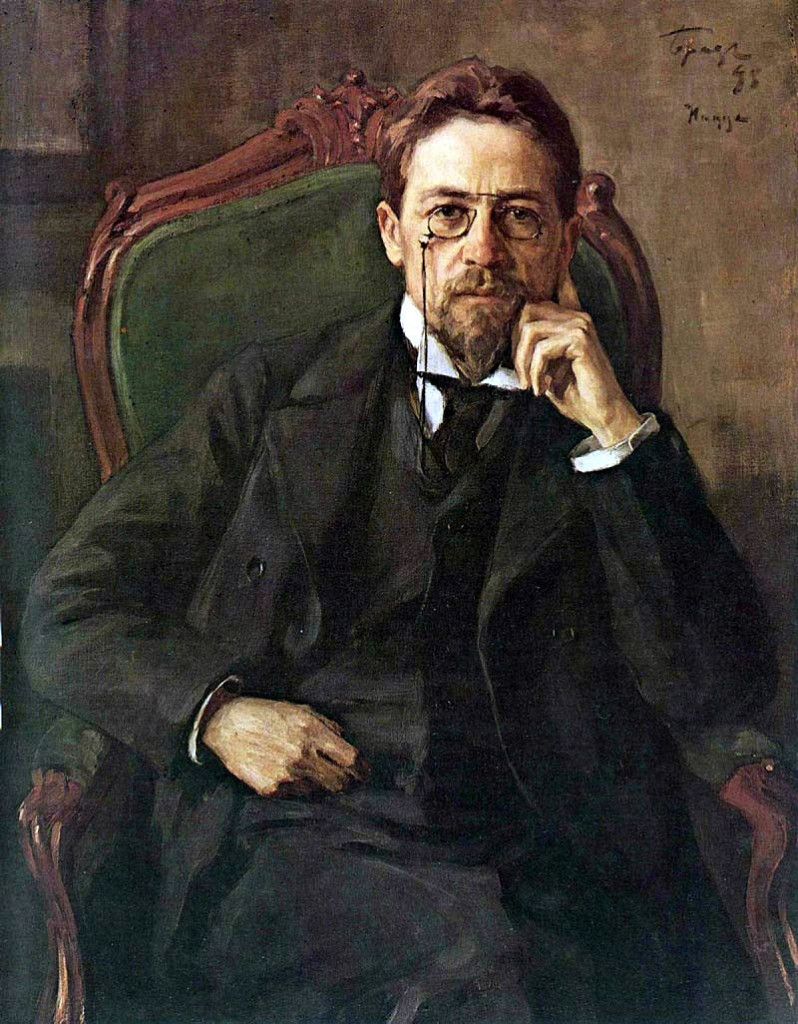
He looked the part. (Osip Braz portrait, 1898)

“Oh! certainly,” cried his faithful assistant, “no one can be really esteemed accomplished who does not greatly surpass what is usually met with. A woman must have a thorough knowledge of music, singing, drawing, dancing, and the modern languages, to deserve the word; and besides all this, she must possess a certain something in her air and manner of walking, the tone of her voice, her address and expressions, or the word will be but half-deserved.”

“All this she must possess,” added Darcy, “and to all this she must yet add something more substantial, in the improvement of her mind by extensive reading.”

“I am no longer surprised at your knowing only six accomplished women. I rather wonder now at your knowing any.”

Well, then. That’s almost as long as Chekhov’s letter from Moscow. He begins with the good news: “You have often complained to me that people “don’t understand you”! Goethe and Newton did not complain of that…. Only Christ complained of it, but He was speaking of His doctrine and not of Himself…. People understand you perfectly well. And if you do not understand yourself, it is not their fault.

“I assure you as a brother and as a friend I understand you and feel for you with all my heart. I know your good qualities as I know my five fingers; I value and deeply respect them. If you like, to prove that I understand you, I can enumerate those qualities. I think you are kind to the point of softness, magnanimous, unselfish, ready to share your last farthing; you have no envy nor hatred; you are simple-hearted, you pity men and beasts; you are trustful, without spite or guile, and do not remember evil…. You have a gift from above such as other people have not: you have talent. This talent places you above millions of men, for on earth only one out of two millions is an artist. Your talent sets you apart: if you were a toad or a tarantula, even then, people would respect you, for to talent all things are forgiven.”

Then the bad news: “You have only one failing, and the falseness of your position, and your unhappiness and your catarrh of the bowels are all due to it. That is your utter lack of culture. Forgive me, please, but veritas magis amicitiae…. You see, life has its conditions. In order to feel comfortable among educated people, to be at home and happy with them, one must be cultured to a certain extent. Talent has brought you into such a circle, you belong to it, but … you are drawn away from it, and you vacillate between cultured people and the lodgers vis-a-vis.”

Then the list:

Chekhovs

Anton and his artist brother in 1882.

Cultured people must, in my opinion, satisfy the following conditions:

  1. They respect human personality, and therefore they are always kind, gentle, polite, and ready to give in to others. They do not make a row because of a hammer or a lost piece of india-rubber; if they live with anyone they do not regard it as a favour and, going away, they do not say “nobody can live with you.” They forgive noise and cold and dried-up meat and witticisms and the presence of strangers in their homes.
  2. They have sympathy not for beggars and cats alone. Their heart aches for what the eye does not see…. They sit up at night in order to help P…. [here a mediocre poet is named], to pay for brothers at the University, and to buy clothes for their mother.
  3. They respect the property of others, and therefor pay their debts.
  4. They are sincere, and dread lying like fire. They don’t lie even in small things. A lie is insulting to the listener and puts him in a lower position in the eyes of the speaker. They do not pose, they behave in the street as they do at home, they do not show off before their humbler comrades. They are not given to babbling and forcing their uninvited confidences on others. Out of respect for other people’s ears they more often keep silent than talk.
  5. They do not disparage themselves to rouse compassion. They do not play on the strings of other people’s hearts so that they may sigh and make much of them. They do not say “I am misunderstood,” or “I have become second-rate,” because all this is striving after cheap effect, is vulgar, stale, false….
  6. They have no shallow vanity. They do not care for such false diamonds as knowing celebrities, shaking hands with the drunken P., [Translator’s Note: Probably Palmin, a minor poet.] listening to the raptures of a stray spectator in a picture show, being renowned in the taverns…. If they do a pennyworth they do not strut about as though they had done a hundred roubles’ worth, and do not brag of having the entry where others are not admitted…. The truly talented always keep in obscurity among the crowd, as far as possible from advertisement…. Even Krylov has said that an empty barrel echoes more loudly than a full one.
  7. If they have a talent they respect it. They sacrifice to it rest, women, wine, vanity…. They are proud of their talent…. Besides, they are fastidious.
  8. They develop the aesthetic feeling in themselves. They cannot go to sleep in their clothes, see cracks full of bugs on the walls, breathe bad air, walk on a floor that has been spat upon, cook their meals over an oil stove. They seek as far as possible to restrain and ennoble the sexual instinct…. What they want in a woman is not a bed-fellow … They do not ask for the cleverness which shows itself in continual lying. They want especially, if they are artists, freshness, elegance, humanity, the capacity for motherhood…. They do not swill vodka at all hours of the day and night, do not sniff at cupboards, for they are not pigs and know they are not. They drink only when they are free, on occasion…. For they want mens sana in corpore sano [a healthy mind in a healthy body].

And so on. This is what cultured people are like. In order to be cultured and not to stand below the level of your surroundings it is not enough to have read The Pickwick Papers” and learnt a monologue from Faust. …

What is needed is constant work, day and night, constant reading, study, will…. Every hour is precious for it…. Come to us, smash the vodka bottle, lie down and read…. Turgenev, if you like, whom you have not read.

You must drop your vanity, you are not a child … you will soon be thirty.

It is time!

I expect you…. We all expect you.

Happy birthday, Jane Austen! Here’s how she’s like the Beatles.

Wednesday, December 16th, 2015
Share

austenLos Angeles poet (and Stanford alum) Timothy Steele celebrates Jane Austen’s birthday today. Let’s join him:

If any writer put in the work, it was Jane Austen, who was born on this day in 1775. From age 11, she wrote tirelessly, trying out different genres and styles, coming at her subjects from every conceivable angle. But she didn’t break into print until she was 36, and her career as a published author was compressed into the six years between 1811 and her death in 1817. She may remind us of the Beatles, who spent countless hours rehearsing and performing in clubs, and then burst on the scene in 1962 and ran the table for eight glorious years before breaking up. Another parallel between Austen and her musical countrymen is that both drew heavily on available models while producing work that was utterly fresh and magical—work that sounded, as Ray Charles said of the Beatles, like nothing you’d heard before. (The Beatles absorbed such influences as R&B, the skiffle craze, music hall standards, Chuck Berry, and Brill Building Pop, while Austen synthesized the psychological intimacy of Samuel Richardson, the clever satirical plotting of Henry Fielding, and the watchfulness of Fanny Burney.)

Discerning readers recognized immediately that Austen had enlarged and transformed English fiction. Walter Scott, the reigning king of the novel, confided to his diary, “That young lady has a talent for describing the involvements and feelings and characters of ordinary life, which is to me the most wonderful I ever met with.” He added, “The big Bow-Wow strain [the novel of adventure] I can do myself like any now going; but [she has] the exquisite touch which renders ordinary common-place things and characters interesting from the truth of the description and the sentiment.”

Happy, birthday, Jane! (At right, a watercolor of Jane, at the age of 28 or 29, by her sister Cassandra.)