
A new poetry anthology for the fires, floods, earthquakes, tsunamis, and hurricanes that shape California life
Sunday, March 8th, 2020
 On Friday, a slim book arrived at my Stanford mailbox in a brown envelope with a neat, small, handwritten address written on it. I wasn’t expecting Molly Fisk‘s California Fire & Water: A Climate Crisis Anthology to be such a trim endeavor, but here it is, weighing in at a compact 190 pages for $15. It’s a reminder that an “anthology” need not always be a staggering door-stopper to make its point. The book was supported by a Poets Laureate Fellowship from the Academy of American Poets, funded by the Mellon Foundation, and packs 143 poets into, including some heavy hitters – Gary Snyder, Brenda Hillman, Jane Hirshfield, Kim Addonizio, Juan Felipe Herrera, and even a page for my humble self, as well as poet-teachers, poet laureates from all over, and students of all ages.
Editor Molly Fisk, an American Poets Laureate Fellow, explains the rationale behind the volume in the preface: “If you don’t experience a disaster yourself, it can be hard to imagine it. Photos and video are shocking, but they don’t hijack your nervous system the way reality does. And they only last a few minutes. One thing I’ve learned about disasters is how far-reaching the consequences are and how long the effects last.”
So when Molly was Nevada County’s poet laureate in the Sierra foothills, she took matters into her own hands: “When I saw a new grant that asked me to address something important to my community, of course I thought of wildfire.” So did most of the contributors, it appears – fire seems to dominate the table of contents. But not only.

Fisk: honored poet of the Sierra foothills
She continues: “Fire is not the only trouble we’re up against, so I broadened the lesson plan scope to include any kind of climate crisis our state has seen: floods, mudslides, smoke, drought, coastal erosion and sea level rise, refugee populations.”
UCLA’s SA Smythe in the foreword wrote that the book is a compendium of voices “working to make meaning of their lives and futures amid ongoing climate crisis … this book is a soothing gesture of solidarity, an outstretched arm in the wake of helplessness that can befall those of us confronting the harsh reality of a planet engulfed in flames. How can we continue to navigate a life in extremis? We bring together our memories and cobble together our defenses – ancestral and contemporary, coalitional and creative – to ward off the fires, floods, earthquakes, tsunamis, and hurricanes that persist and shape our lives today.”
I was very pleasantly surprised to see a poem by a longtime friend, Kate Dwyer – not a narrow escape from catastrophe, but a rueful take on a wet springtime in Nevada County:
Spring as Adversary
Mid-month it rained so hard
the daffodils lay down and did not get up again.
The apple trees pelted us with blossoms,
death by wet confetti.
I emptied the rain gauge 6 times in 3 weeks.
And a sinkhole the size of a battleship
swallowed the parking lot at the tire store.
It took no prisoners.
Still, after 5 years of drought,
we dared not complain.
I put on my rain suit for the 64th day in a row
and tried to be grateful that
I would be soaked through before
the dog walk was over.
– Kate Dwyer
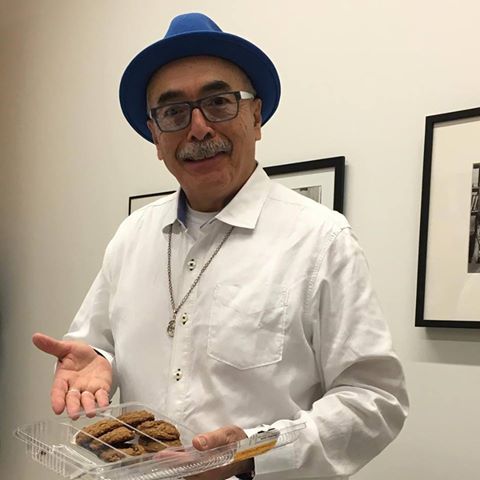
 It is the something else, perhaps, that makes us especially eager to hear him this evening. In an interview with NPR he recalled his childhood. As the son of Mexican farm workers, he followed them the San Joaquin and Salinas valleys,migrating as his parents did, seeking work. But when he remembered those years in an interview given to NPR he also spoke about their meaning. This is what he said:
 With funding from UCLA’s Mexican American Center, he set off to the Mexican lowlands with a classmate, an experienced videographer. They packed old Army fatigues, machetes, mosquito nets, anti-viper first aid kits, Vietnam tropical combat boots, plenty of 16mm Ilford film and top-notch camera equipment. “It was a great idea, a timely idea, a perfect idea. Conceptually, a triple A-plus. Did we know how to go about it? C-minus,” he says.