
Posts Tagged ‘Maxim Osipov’

As the world watches, one of Russia’s top writers exhorts Alexei Navalny: “Good man. Hold on…”

Monday, June 28th, 2021

Share
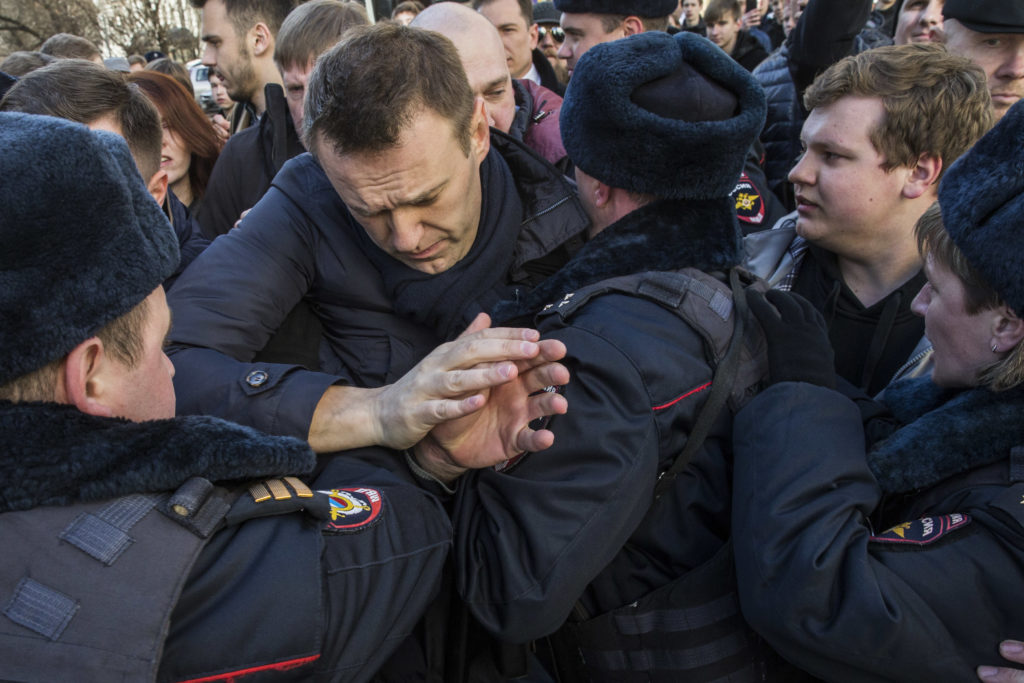
Navalny, when he was arrested in 2017 (Photo: Evgeny Feldman)

Some time ago I wrote about the remarkable award-winning novelist, essayist, playwright Maxim Osipov, who is also a cardiologist at a small-town hospital in Tarusa, 90 miles outside Moscow. I’ve also written about Russian activist Alexei Navalny, who is now in prison once again, after a failed government attempt at poisoning. Now the American government is considering sanctions. Last week, Navalny’s legal defense team made public for the first time the full text of a Russian court ruling that outlawed Navalny’s political network as “extremist.” Meanwhile, the world is amazed at his heroism and wonders: How long can he go on? Day after day, month after month in captivity?

So what does the famous Russian writer have to say the Russian hero? From The Los Angeles Review of Books, translated by its editor, the gifted poet and writer Boris Dralyuk (we’ve written about him, too, here.)

An excerpt:

The good doctor’s advice: “Hold on.”

On January 13, 2021, when I learned that Alexei Navalny intended to return to Moscow, I posted the following to my Facebook page: “Once, at the circus, I saw a highwire act. The orchestra fell silent, and the audience did too. High up above our heads, a teenage boy was making his way along a nearly invisible tightrope. I was so afraid for him that I grew dizzy. And then a child’s voice burst through the silence: ‘Good boy! Hold on!” Today’s news inspired the same sense of dizziness, as well as the urge to shout like that child. …

Heroism as a gift, as a form of genius that cannot be faked or imitated — this is what elicits such admiration from one segment of the population and such envy from another (mostly male). It’s strange to envy a gift for politics as one might envy a gift for music or poetry, but it’s quite natural to envy personal heroism — natural and shameful. People, including those who nominally belong to the political opposition but haven’t discerned this envy in themselves, are now writing manifestos, expressing their disagreement with Navalny’s views. They fail to understand that this is no longer a matter of views. “I’m going out!” countless brave young people posted on social media after the Navalny trial, and then immediately took to the streets of their cities. Theirs was the only healthy way to respond, though it could land them in serious trouble.

Now the cheerfulness has evaporated, ceding way to profound despair. Navalny is in prison, being tortured with sleep deprivation, refused medical assistance. Every day brings darker, more depressing news. The political world has turned black and white. It’s pointless to reason in terms of right vs. left, parliamentary vs. presidential republic, nation state vs. empire. The nature of the conflict is plain as day: life vs. its absence, light vs. darkness. Society has been plunged into a state of moral catastrophe, of impotence, once again especially pronounced among men. Neither immersion in our work, nor retreat into our private lives, nor emigration can save us. Sure, there’s your small circle of friends, there’s Facebook — which has taken the place of real social institutions and fostered the illusion that we’re among our own kind — but take a closer look and you see Russian life shrinking, growing faint. First one, then another decides to leave: but how will that help Navalny and hundreds (if not thousands) of other political prisoners? No, even if you leave, even if you distance yourself from the tragedy, you won’t stop watching it. “We’ve got to do something…” “Well, we lived through the Soviet era…” “What does the Soviet era have to do with it? If you’re going to draw comparisons, then let’s talk about Germany in the mid-’30s…” These are the conversations that make up the whole of Russian life.

He ends as he begins, quietly, under his breath, whispering: good man, hold on Read it at all at the LARB here.

Maxim Osipov: “You write a poem and a window breaks—such is the strength of your word.”

Thursday, May 23rd, 2019
Share

Translator Boris Dralyuk

Boris Dralyuk alerted me to Joshua Yaffa‘s “A Doctor’s Literary Calling,” in the New Yorker this month. The article is a profile of Russian writer and cardiologist Maxim Osipov. Boris’s enthusiasm is understandable: he is one of the early champions of Osipov’s  writing, and his translator as well. Osipov’s rueful reaction to his newfound fame and the controversy it’s caused in Tarusa, the small provincial town that is his home: “It’s any author’s dream … You write a poem and a window breaks—such is the strength of your word.”

According to Yaffa, “Osipov’s legend grew, and so did the inevitable comparisons to Chekhov, who, in the eighteen-nineties, at his estate outside Moscow, often treated peasants for free and helped contain a cholera outbreak. ‘Both anatomy and belles-lettres are of equally noble descent,’ Chekhov once wrote to his publisher, adding that they share ‘identical goals and an identical enemy—the Devil.’ Osipov bristles at the comparison. ‘All it illustrates is the inclination to typecast people,’ he said. But it is hard not to find something Chekhovian in Osipov’s precision and pitiless honesty.”

“Precision and pitiless honesty.”

More praise: “In the past two decades, Russian literature has been dominated by surreal, dystopian tales—an appropriate genre, perhaps, to describe the convulsions that followed the Soviet collapse. Osipov’s stories, by contrast, are quiet, almost documentary. ‘There’s something of the late nineteenth century in Osipov,’ Anna Narinskaya, one of Russia’s leading literary critics, told me. ‘He allows himself a certain moral judgment. He knows what’s right, in life and in literature.’”

Varya Gornostaeva, who has published Osipov’s books with Moscow’s Corpus Books, told Yaffa: “Russian society is sadly marked by a certain infantilism. Maxim isn’t so much a liberal—though he’s that, too—as he is an adult, a person who can answer for himself. He’s one of the few grownups.”

“A year and a half after his first essay appeared in Znamya, he published an elegiac follow-up called “Complaining Is a Sin,” in which he describes receiving an early-morning summons from the hospital. “Cold, fog,” he writes. “Ten minutes later, you run into the office, shove the plug into the socket, everything is noisy, you put on a robe, look at the canvas-colored twilight outside the window, and say to yourself, ‘One, it won’t get any better, and, two, this is happiness.’ ”

Yaffa’s profile includes the fascinating history of Tarusa, a city 101 kilometers outside Moscow, the nearest former prisoners were allowed to get near the capital. It became a refuge for dissidents:

“As the camps emptied out after Stalin’s death, in 1953, Tarusa became increasingly populated with former prisoners. In 1955, Konstantin Paustovsky, a mid-century Soviet Thoreau, who was an officially recognized writer and was not a dissident himself, sought to escape the distractions of the capital and settled in Tarusa. In his small blue house at the end of a dirt lane, he began hosting the kinds of cultural figures who were treated with varying degrees of suspicion by the Soviet authorities—among them Arkady Steinberg, a poet and a translator who spent eleven years in the gulag, and Bulat Okudzhava, a talented folksinger whose parents had been arrested as ‘enemies of the people,’ in the thirties.”

The town became a sort of “sanctuary city” for those out of favor, “including, in 1959, Nadezhda Mandelstam, the widow of the poet Osip Mandelstam, one of the great lyricists of the twentieth century, who disappeared into the gulag in the thirties. Nadezhda had spent years evading arrest, moving from one provincial town to the next. In Tarusa, she found a place of refuge. ‘It’s Heaven,’ she wrote in a letter inviting another poet to visit her. ‘It’s wonderful here. I live well.’”

“It was in Tarusa where she began to work on her memoir, which circulated in samizdat copies in the Soviet Union and was first published in the West in the nineteen-seventies. ‘I knew she was writing something,’ [translator] Viktor Golyshev … who is now in his eighties, recently recalled. ‘But at the time I was honestly far more interested in lying on the beach by the Oka and getting a suntan.” …

“A young, relatively unknown Joseph Brodsky came to visit; so did his fellow future Nobel recipient Alexander Solzhenitsyn, the chronicler of the gulag. Rumor had it that as many as eleven K.G.B. agents were assigned to the town to keep track of all the political undesirables.”

Read the whole thing here.