Archive for September, 2013

Congratulations, Robert Harrison, Chevalier de l’Ordre des Arts et des Lettres de la République Française!

Saturday, September 28th, 2013


Share
He deserves it. (Photo: L.A. Cicero)

He deserves it. (Photo: L.A. Cicero)

Robert Pogue Harrison had a surprise when he arrived back at Stanford after his Italian summer.  In his mailbox, an official-looking letter had arrived from the French Minister of Culture, Aurélie Filippetti,  awarding him the diploma and bestowing the honorific title of “Chevalier de l’Ordre des Arts et des Lettres,” one of the highest cultural honors France offers.

The award was established in 1957 to “recognize eminent artists and writers and those who have contributed  significantly to further the arts in France and throughout the world.” In the past, it has awarded  T.S. EliotVáclav Havel, and Seamus Heaney, along with George Clooney, Frederica von Stade, Bono, and Sean Connery.  Think of Robert maybe as a cross between Havel and Clooney.  We’ve written about him before here and here and here and here.  He is one of Stanford’s most prolific and eminent authors, contributing to the New York Review of Books, oh, here and here and here.

Robert is the author of The Body of Beatrice (1988), Forests: The Shadow of Civilization (1992), The Dominion of the Dead (2003), and Gardens: An Essay on the Human Condition (2008). All acclaimed and widely respected. His next book, Juvenescence: A Cultural History of Our Age, will be published by the University of Chicago in Autumn 2014. “It’s hard to characterize succinctly what it’s about,” he said to me. “What kind of age are we, culturally speaking, at this time? How old are we in this particular age?”

His esteemed books notwithstanding, he may be best known as the host (and founder) of Entitled Opinions, a weekly radio talk show that explores literature, ideas, ancient and modern history – all aspects of human experience, really. His guests are Stanford faculty and the scholars, writers and thinkers who visit the campus. (All the programs are available on the Entitled Opinions website.)

medailles

All three, please. Ta very much.

It’s not entirely a surprise that Robert, who is Rosina Pierotti Professor of Italian Literature, has come to the attention of France in recent years. Three of his books have been translated into French.  Moreover, in Paris two years ago, he gave a well-received series of lectures at the prestigious Collège de France, founded by Francis I in 1530, on “Le phénomène de l’âge – Littératures modernes de l’Europe néolatine.”

However it came about, the honor, which is competitive and selective, is quite a coup. He will get a fancy little medallion and ribbon (see photo at right), which will be pinned to his left breast during a ceremony at the French consulate in San Francisco later this year.

Robert has been an invaluable inspiration to many over the years, persuasive in his thinking, passionate in his convictions, wise in his insights.  One of my own cherished memories of him was when he opened up a rather staid workshop on Hannah Arendt with a talk on “passionate thinking”:

The “overwhelming question” in the humanities, he said, is “How do we negotiate the necessity of solitude as a precondition for thought?”

“What do we do to foster the regeneration of thinking? Nothing. At least not institutionally,” he said. “Not only in the university, but in society at large, everything conspires to invade the solitude of thought. It has as much to do with technology as it does with ideology. There is a not a place we go where we are not connected to the collective.

“Every place of silence is invaded by noise. Everywhere we see the ravages of this on our thinking. The ability for sustained, coherent, consistent thought is becoming rare” in the “thoughtlessness of the age.”

He  is known as a brilliant scholar  – but among insiders, he is also celebrated as a loyal friend and a generous colleague.  In an academic environment renowned for egotism, Robert has been tireless in promoting others – not only the work of the great (for example, René Girard and Michel Serres, immortels of the Académie Française, are his friends as well as colleagues at Stanford), but also students, younger colleagues, the humble and the obscure.  I sat in on his Dante class last year; I know he is a gifted teacher as well.

The Ordre des Arts et des Lettres was confirmed as part of the Ordre National du Mérite by President Charles de Gaulle in 1963, adding to the luster of the award, which is competitive and selective. The order has three grades:  commandeur, officier, and chevalier.  From chevalier, one can rise within a few years to officier, and then commandeur.

But so far, Robert likes the title he’s got. Is it Chevalier Robert or Chevalier Harrison? Either way, it has a certain ring to it.  “I’ve always had a chevalier gallant complex,” he joked.  Does he award bestow anything beyond a medal?  “I’m looking for a horse.”  So we thought we’d find him one, here at right.  It’s a white one.

Postscript on 9/30:  Look what we found online!  Robert’s talk on “passionate thinking.”  Enjoy.  I know I will.


More on Kofi Awoonor, killed in the Nairobi mall massacre

Thursday, September 26th, 2013
Share

Kofi Awoonor

More on Kofi Awoonor, widely considered Ghana’s greatest contemporary poet.  According to an article by Teju Cole, writing in the New Yorker, he was was a member of the literary generation that came of age in the 1950s and 1960s: “Many of these writers were published in the Heinemann African Writers Series, the tan and orange spines of which could be seen on the bookshelves of homes across the continent. The series, under the editorship of Chinua Achebe, was the first flowering of African literature in English. Awoonor shared with many of his illustrious contemporaries an intense engagement with both African tradition and African modernity. The influence of T. S. Eliot was strong, and Awoonor’s poems are often dense and mysterious. But, like Achebe, he also gave voice to a culture under rapid and destructive change from colonial influences, and he expressed a disillusionment with the violence that marred the post-colonial project.”

The photo I picked for my earlier post showed him wearing the traditional Ghanaian batakari and kufi. But I also like this photo, which I found over at Ron Silliman‘s blog here, which makes him look like an avant-garde film director in Paris.

More from Cole:

An impromptu memorial had been organized for Awoonor. Kwame Dawes, the Ghanaian-Jamaican poet, spoke warmly about the man he considered an uncle. On Friday, Dawes had shown me the first volume in a new series on African poetry. That book (which Dawes edited, and which will be published by the University of Nebraska Press early next year) was an orange-colored, handsomely designed hardcover of Awoonor’s The Promise of Hope: New and Selected Poems.

“It’s got to be good,” Dawes had said of the design. “It’s got to be good because it’s intended to last.” His pride in the finished project was justified. Now, at the memorial, I asked Dawes if Awoonor had seen the volume he showed me.

“I showed it to him for the first time here in Nairobi. I told him, ‘This is it.’”

“And what did he say?”

Dawes smiled. “He said, ‘This is good.’ That’s what he said. ‘This is good.’”

Read the whole thing here.

Hell’s future is bright (and hot), thanks to a new circle

Wednesday, September 25th, 2013
Share
hell

You are here. (See yellow ring.)

I’ve long had a fantasy of rewriting Dante Alighieri’s Divine Comedy, casting the three realms with characters from our own era.  I have the imagination – all I need is Dante’s genius.  But I had not envisioned adding a new circle, to accommodate hell’s population explosion.

Someone else beat me to it:  “After nearly four years of construction at an estimated cost of 750 million souls, Corpadverticus, the new 10th circle of Hell, finally opened its doors Monday.”  According to Inferno Antedeus, in recent years  a majority of the new arrivals possessed souls far more evil than the original nine circles could handle. “Demographers, advertising executives, tobacco lobbyists, monopoly-law experts retained by major corporations, and creators of office-based sitcoms–these new arrivals represent a wave of spiritual decay and horror the likes of which Hell has never before seen,” Antedeus said.

Frigax The Vile, one of the most vocal supporters of the new circle, agreed:  “In the past, the underworld was ill-equipped to handle the new breed of sinners flooding our gates–downsizing CEOs, focus-group coordinators, telemarketing sales representatives, and vast hordes of pony-tailed entertainment-industry executives rollerblading and talking on miniaturized cell-phones at the same time. But now, we’ve finally got the sort of top-notch Pits of Doom necessary to give such repellent abominations the quality boilings they deserve.”

It seems to be working:

“In life, I was a Salomon Brothers investment banker,” one flame-blackened shade told reporters. “When I arrived here, they didn’t know what to do with me. They put me in with those condemned to walk backwards with their heads turned all the way around on their necks, for the crime of attempting to see the future. But then I sent a couple of fruit baskets to the right people, and in no time flat, I secured a cushy spot for myself in the first circle of the Virtuous Unbaptized. Now that was a sweet deal. But before long, they caught on to my game and transferred me here to the realm of Total Bastards. I’ve been shrieking for mercy like a goddamn woman ever since.”

birthday cakeRead the rest here.

Postscript:  This post is a birthday present for fellow Dante-lover, Chris Bunje Lowenstein.  Read about her magic deck of Dante cards here.  Meanwhile, we’ve baked her a little cake.


The face of a massacre: eminent poet, diplomat Kofi Awoonor is killed

Sunday, September 22nd, 2013
Share
Kofi_Awoonor

Kofi Awoonor was the grandson of a Ewe dirge-singer.

The weekend atrocity at Nairobi’s Westgate Shopping Mall  has left scores dead, and though most of the hostages appear to have been rescued from the Al-Shabaab militant group, I’m sure we’ll have more surprises in the hours to come.

One prominent name has surfaced among the dead:  Kofi Awoonor, the widely translated and anthologized Ghanian poet and diplomat born as George Kofi Awoonor WilliamsThe Telegraph coverage is here; Wall Street Journal’s Speakeasy writes hereCapital News in Kenya reports here.

There’s not much I can do about this weekend of massacres – but let me spent a few words, and least, on this 78-year-old African poet.  Let him put a face and a name on this massacre of anonymous victims.

Kofi Awoonor was born in the Gold Coast (now Ghana) on March 13, 1935, in the small farming village of Wheta. He was the son of a tailor and a chieftain’s daughter. His grandmother, however, was a dirge-singer, and much of his early work is modeled on this type of Ewe oral poetry.  Awoonor’s poetry, rooted in the oral poetry of his history, has kept close to the vernacular rhythms of African speech and poetry. “It is for this reason I have sat at the feet of ancient poets whose medium is the voice and whose forum is the village square and the market place,” he has said.

According to the Encylopedia Britannica: “Awoonor sought to incorporate African vernacular traditions—notably the dirge song tradition of the Ewe people—into modern poetic form. His major themes—Christianity, exile, and death are important among them—are enlarged from poem to poem by repetition of key lines and phrases and by use of extended rhythms. Each poem in Rediscovery and Other Poems (1964), for example, records a single moment in a larger pattern of recognition and rediscovery.”

According to critic Derek Wright, the poetry “both drew on a personal family heirloom and opened up a channel into a broader African heritage.” In Rediscovery (1964) and Petals of Blood (1971), Awoonor uses the common dirge motif of the ‘thwarted or painful return’ to describe the experience of the Western-educated African looking back at his indigenous culture.”

awoonorThe “Western-educated” part came from the painful experience of exile, a theme in his work. Awoonor was associated to the first president of Ghana, Kwame Nkrumah, who was driven out by a coup in 1966.  During his exile abroad, he completed graduate and doctoral studies, receiving a Ph.D. in literature from the State University of New York at Stony Brook in 1972. He published a novel, This Earth, My Brother in 1971.  He was Ghana’s ambassador to Cuba and Brazil in the 1980s, and ambassador to the U.N. in the 1990s.

He was, apparently, controversial – enough so that Alhaji Abdul-Rahman Harruna Attah met him at the Ghana Association of Writers last year with a lot of negative preconceptions.  His anecdote about how he changed his mind is here.

His Promise of Hope: New and Selected Poems, with an introduction by fellow poet and scholar, Kofi Anyidoho, will be published next year with help from the African Poetry Book Fund, established by the editor of Prairie Schooner, Kwame Dawes, a poet and writer from Ghana.

Dawes described him as “a poet of witness, of great lyric grace and a remarkable capacity to combine his command of traditional Ewe poetics with a modernist lyric sensibility … one of the great African poets to have appeared in the twentieth century.”  At the time of the announcement last year, he added that “his agreement to be a part of this series is a tremendous coup.  We are extremely pleased.”

He was in Nairobi for the Storymoja Hay Festival, a four-day event that celebrates writing and storytelling.  “I had asked him to attend the festival to help celebrate some new initiatives in African poetry that I was spearheading, and his new book, Promise of Hope: New and Selected Poems, is to be the lead book of the new African Poetry Book Series to appear early next year,” Dawes wrote in The Wall Street Journal.

According to news reports, the terrorists invited Muslims to leave the mall with their hands up, and escape to safety.  Apparently Awoonor decided not to try and fake it.

I found this poem at the Africa Fund website.  (More of it is here.)

Excerpt from “This Earth, My Brother”

…He will come out of the grave
His clothes thrown around him;
worms shall not have done their work.
His face shall beam the radiance of many suns
His gait the bearing of a victor,
On his forehead shall shine a thousand stars
he will kneel after the revelation
and die on this same earth.

And I pray
That my hills shall be exalted
And he who washes me,
breathes me
shall die.
They led them across the vastness
As they walked they tottered
and rose again. They walked
across the grassland to the edge of the mound
and knelt down in silent prayer;
they rose again led to the mound,
they crouched
like worshippers of Muhammed.
Suddenly they rose again
stretching their hands to the crowd
in wasteful gestures of identity
Boos and shrieks greeted them
as they smiled and waved
as those on a big boat journey.
A sudden silence fell
as the crowd pushed and yelled
into the bright sharp morning of a shooting. …


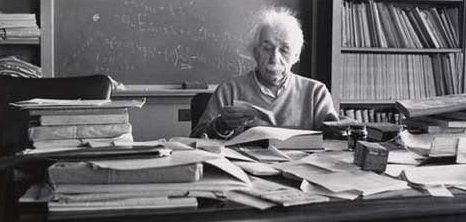
It’s easier to think outside the box when you can’t find the box.

Saturday, September 21st, 2013
Share
einstein-desk-1

He knew.

If a messy desk is a sign of a messy mind, what’s an empty desk a sign of?

Finally, there are a few studies to back me up. While working on several projects at once this weekend, I ran across this article in Time Magazine:

In the dystopian future, there will only be two tribes: those with messy desks and those with orderly ones. The messy desk people will live unhealthy and inefficient lives but come up with interesting new ideas. The organized desk people will be fit and get all their work done. At least, that’s one possibility if the results of a new study hold up.

In the study, researchers wanted to discover not whether people are inherently messy or tidy, or whether the thinking is different between the two.  They wanted to find out how people react to cluttered versus clean desks:

chocolate“In a series of experiments, the researchers plopped a set of volunteers down in front of messy desks and a different set in front of tidy ones and tested how they behaved. In one trial, participants had to do some busy-work, then choose between a chocolate bar and an apple when they left. In another they had to devise new uses for a ping pong ball. In a third, they had to look at a menu and choose whether they wanted a vitamin boost in their smoothie, and whether that boost should be ‘classic’ or ‘new.'”

Read the results here.  Meanwhile, pass the chocolate.

Why does my library … whiff? (Part Deux)

Thursday, September 19th, 2013
Share

Old-BooksA year-and-a-half ago, I asked the perennial book-lover’s question:  Why does my library … whiff?  And I got some answers, incomprehensible as they were.  I wrote about that here.

Now PopSci is taking up the question.  Here’s what it has to say in “FYI: Why Do Libraries Smell?”

The musty smell is most likely cellulose decay. Since the mid-19th century, when papermakers began using groundwood pulp in place of cotton or linen, most paper has contained an unstable compound called lignin, which breaks down into acids and makes paper very brittle. Since 2001, the Library of Congress has treated at least 250,000 books every year with magnesium oxide. The chemical deacidifies paper and slows decay.

librarycatRead the rest here.  One reader offered his own article on the Heritage Smells Project here. Another reader complained:  “This article was so small, it neglected to mention why paper makers started using groundwood pulp. Furthermore, it neglected to mention that it also replaced hemp paper, even though it doesn’t suffer from the same problem over a comparable amount of time since it contains only a fraction of the lignin.  Can we get a further explanation on the costs of this sniffing/restoration vs simply changing the format it’s stored in?”

I’m not a chemist, and I don’t have much of an opinion.  Cellulose, shmellulose.  Still smells like cat urine to me.