Posts Tagged ‘René Girard’

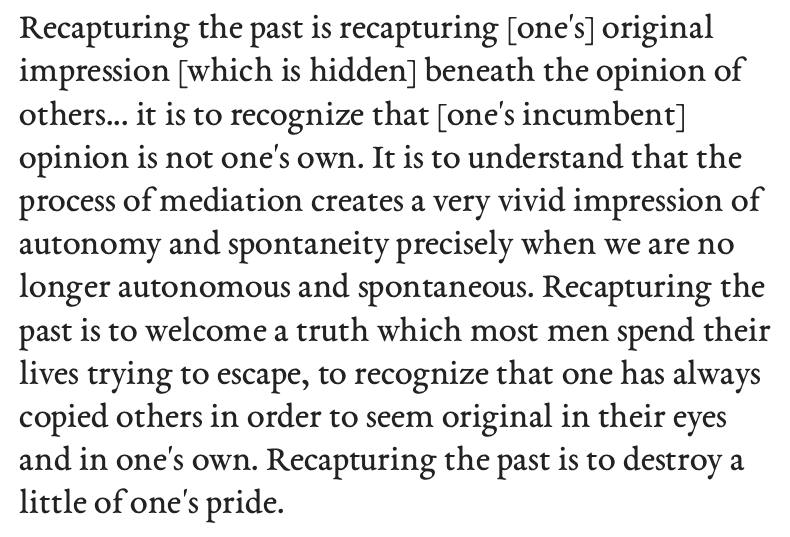
How to destroy “a little of one’s pride”

Friday, December 5th, 2025
Share

From René Girard’s Deceit, Desire, and the Novel: Self and Other in Literary Structure

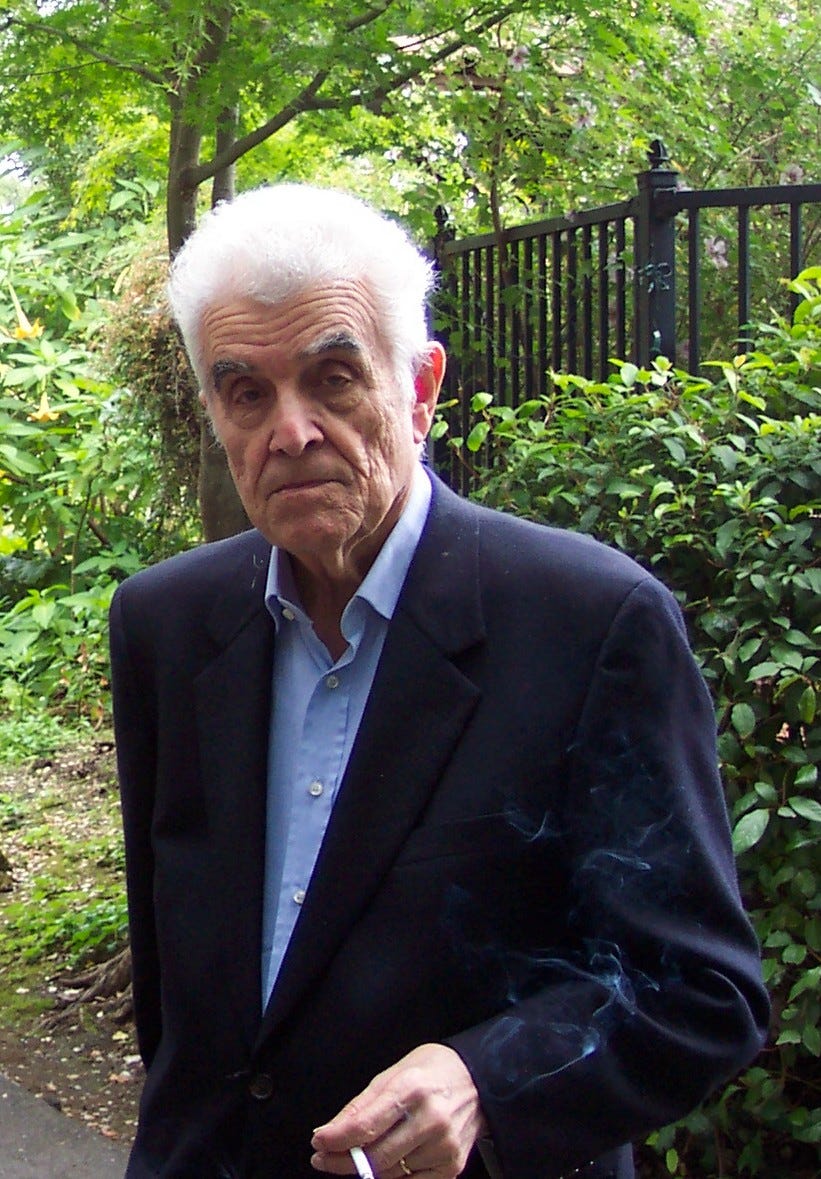
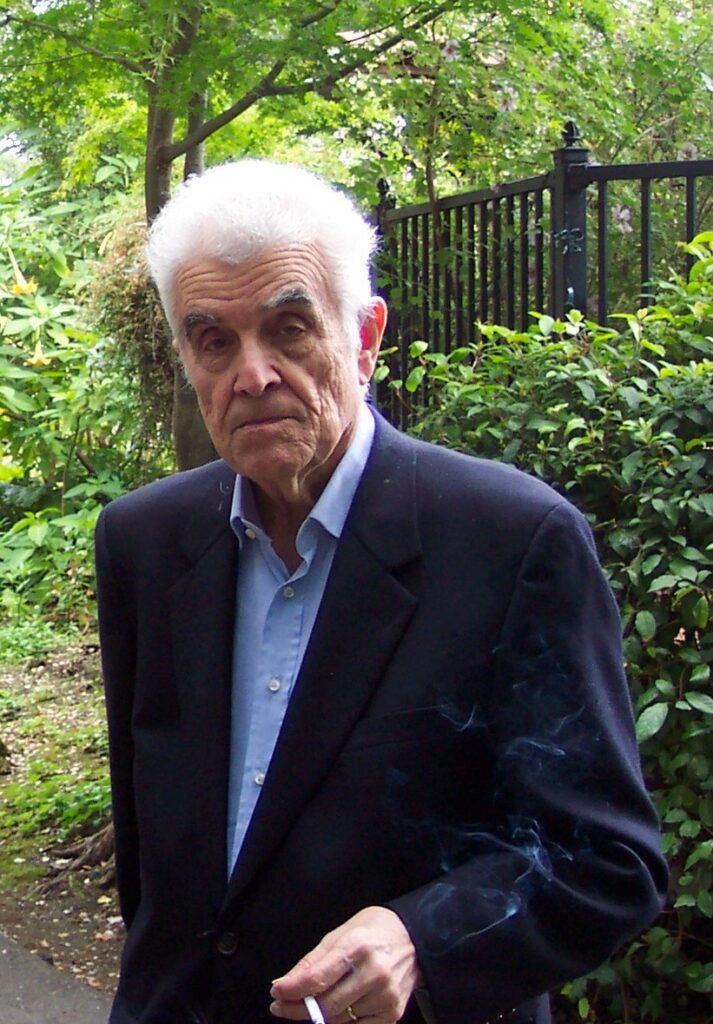
René Girard, photo by Ewa Domańska

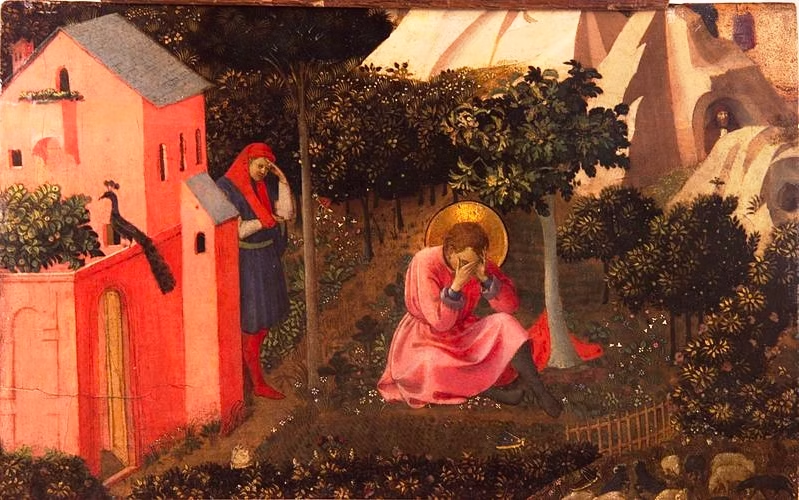
Saint Augustine, pears, and “mimetic cascades”

Saturday, November 8th, 2025
Share

What did a fourth/fifth century saint from north Africa have to teach us about René Girard‘s mimetic theory? Philosophy professor Alexander Douglas of the University of St. Andrews has kindly allowed us to publish an excellent excerpt from his new and acclaimed book, Against Identity: The Wisdom of Escaping the Self, Penguin). Here it is:

“Three quarters of what I say is in Saint Augustine,” René Girard said in an interview some years ago.1 To understand Girard’s view of the human predicament, we can look at the Confessions of this early saint. One story that Augustine tells of his youth, with much contrition, is about how he and his friends stole some pears:

“Close to our vineyard there was a pear tree laden with fruit. This fruit was not enticing, either in appearance or in flavour. We nasty lads went there to shake down the fruit and carry it off at dead of night, after prolonging our games out of doors until that late hour according to our abominable custom. We took enormous quantities, not to feast on ourselves but perhaps to throw to the pigs; we did eat a few, but that was not our motive: we derived pleasure from the deed simply because it was forbidden.”2

At first it seems odd for Augustine to make so much of what seems like a minor teenage prank. But the imagery – the fruit that is enticing because it is forbidden – makes it clear that Augustine is using this episode as an allegory for the Fall of humanity.3

What Augustine wants to do with this story is probe into the mystery of our fallen condition. He is troubled by the fact that “there was no motive for my malice except malice”; his petty crime “lacked even the sham, shadowy beauty with which even vice allures us.”4 The object was not to eat the pears, nor to upset the owner of the vineyard, nor even entertainment – the theft was not challenging enough to constitute an exciting heist. It was simply to demonstrate his ability to act however he willed. Responding to no reasons, done to no conceivable purpose, this wanton act was meant to express his radical freedom. To conjure an action out of nothing, for no reason at all – what could be more radically free?

However, as Augustine looks back on the act, he realizes that it was not as original as he thought. In two ways, it was imitative, not original. First, his urge to express his own radical freedom was less a self-expression than an imitation of God’s omnipotence: a crippled sort of freedom, attempting a shady parody of omnipotence by getting away with something forbidden.”5 Secondly, he engaged in the act only because his friends did it too: “as I recall my state of mind at the time, I would not have done it alone; I most certainly would not have done it alone.”6 Augustine struggles to work out the reason for this. It is not simply that he did it for the sake of camaraderie. Nor was it only to share a joke. It was simply that “to do it alone would have aroused no desire whatever in me, nor would I have done it.”7

The theory of mimetic desire is very close to the surface of what Augustine writes here. His desire to act was prompted, or at least enhanced, by the apparent desire of his friends. Yet they were in the same position – only wanting to do it because the others did. This might look like a circular explanation, but in fact it shows how desire can emerge from nearly nothing, creating the illusion of the spontaneous will. We are prone to desire what others around us appear to desire, and this appearance can be a matter of a misread signal, a rumor, an accident mistaken for a ploy.8 Once an imitator has taken on a desire from the apparent desire of a model, however, she immediately becomes a model to others, and the mimetic cycle begins. Desire really does emerge where there was none before. It is never conceived by a radically free subject from nothing. Instead, it can emerge from a mimetic cascade, seeded by misperception.

Augustine’s story brings out two crucial aspects of Girard’s theory of identity. The first is that we readily believe ourselves to be little centres of omnipotence: freely deciding what to do, breaking rules, overcoming constraints and resisting impulses. The second is that the more we entertain this myth, the more profoundly we are in fact influenced by the examples of others. The radical egoist is an avid imitator in denial. This combination of prideful egoism and unconscious mimesis is the formula for the fallen condition in Augustine, and in Girard.

1 René Girard, When These Things Begin: Conversations with Michel Treguer, 133.

2 Augustine, Confessions, 1997, 2.9, 67-68.

3 Ibid., 68n32.

4 Ibid., 2.12, 70.

5 Ibid., 2.14, 71.

6 Ibid., 2.16, 72.

7 Ibid., 2.17, 73.

8 Jean-Pierre Dupuy, Le Sacrifice et l’envie – le libéralisme aux prises avec la justice sociale, 268.

Stanford’s William Mahrt, the champion of chant, dies at 85

Wednesday, January 1st, 2025
Share

Stanford’s William Mahrt, a leading scholar in early music, died today at 85. He conducted Gregorian chant for more than 60 years and inspired and guided generations of scholars. He directed Stanford’s Early Music Singers and St. Ann Choir, a Gregorian schola. He was also a personal friend. This is an article I wrote for Stanford Report about Bill Mahrt on October 2nd, 2007.

For nearly two millennia, the sound has been a regular pulse beneath the skin of Western civilization. It reverberated through Dante’s mind as he scratched out the cantos of the Purgatorio. It was the inaudible vein of thought running beneath the chords of Mozart’s Requiem. Crusaders trudged to the East with these melodies in their heart, but they were too late – Jerusalem had echoed with it centuries earlier. It was ubiquitous, universal – that is, until about 40 years ago.

William Mahrt directs the St. Ann Choir, which he says has had a “fruitful interaction” with Stanford’s doctoral students of musicology, who find it “a very wonderful laboratory for the study of the music of history.” 

The tide may be turning, and, if so, it will be William Mahrt’s moment in the sun.

The origins of Gregorian chant are enigmatic. It appears to have its roots in fourth-century Jerusalem. The link with Pope Gregory the Great (590-604) is the byproduct of early spin, based on what is probably an erroneous assumption that he composed and collected early chant.

The otherworldly effect of the music is hard to describe, but Mahrt, an associate professor of music at Stanford, recently gave it a try: “It is what we call monophonic – that is to say, it’s a melody that’s unaccompanied,” he said. “A free rhythm has an ability to evoke eternal things, more than passages tied down to regular time. It’s a sprung rhythm that has a freedom to it – like Hopkins’ poetry.”

Mahrt has conducted Gregorian chant for more than 40 years without a break. He is the director of Stanford’s Early Music Singers and of the St. Ann Choir, a Gregorian schola at St. Thomas Aquinas Church in Palo Alto. He instructs singers in the mysteries of “the chant,” as well as the glorious polyphonic music that came after it. In fact, it’s possible that there is more chant sung in Palo Alto than anywhere else in the country, with the possible exception of monastic communities. Mahrt has inspired and guided generations of scholars and singers.

One of his star students, Kerry McCarthy, now an assistant professor of music at Duke University, is the author of Liturgy and Contemplation in Byrd’s Gradualia and one of the world’s leading scholars on William Byrd, the preeminent English composer of the Renaissance.

“One of the best decisions I’ve made in my life was to come to Stanford and work with Bill,” McCarthy said. “The things I learned from him here I could not have learned anywhere else. Not just in the classroom, but in performance. Especially in performance.”

Acclaimed music writer and jazz scholar Ted Gioia recalls going to hear the St. Ann Choir, composed of students and members of the community at large, when he was studying for an MBA at Stanford. Often he found only a few fellow listeners in the pews.

“The thing I most miss about Palo Alto is going to those Gregorian Masses,” he said. “It’s so energizing. That was the best-kept secret in Palo Alto. Bill was the person who really opened my ears to that. He had a profound influence on my conception of music – through the force of his example.”

Mahrt’s work has indeed been quiet. Furthermore, he has encountered resistance from a church that has not always valued its own heritage.

“There’s a huge resistance from the clerical establishment to doing any of this,” said Stanford alumna Susan Altstatt, who has been a member of the St. Ann Choir since 1967. “Bill has lived a charmed life in this regard. Bill has managed to do what he’s doing by talking to bishops and priests and knowing what he’s talking about. He’s a hero, as far as I’m concerned.”

Mahrt explained the resistance: “Gregorian chant went out of style when the language was changed” – that is, when the universal Latin was changed to the vernacular English. “In the absence of any good solution about what to replace the chant with, I would say commercial interests stepped in and hawked a progressively cheaper and cheaper music, and the commercial interests still prevail today.”

For example, one of the leading publishers of “missalettes,” the flimsy and disposable paperbacks that include “new” church music, distributes 4.3 million of the quarterly copies a year and owns 10,000 music copyrights. That’s a lot of commercial interests.

The result was summarized by one disgruntled reviewer on Amazon.com: “The Roman Catholic Church, seeking to be more ‘relevant’ to its flock in the antispiritual climate of the second half of the 20th century, abandoned its ancient Latin liturgy and dignified music in favor of poorly worded vernacular texts and worse music. This music usually tends toward banal couplets set to insipid tunes strummed on ill-tuned guitars and whined into a microphone to the banging of a tambourine.”

Mahrt said there is a reason for the ill-tuned guitars and whining: “The standard of performance in recorded pop music is very high. A little combo in a church can’t possibly keep that standard. There isn’t the same standard for chant. Its whole criteria are different. Singers can master it in a different way.”

Unlike other kinds of music, McCarthy said, “You don’t have to have to have wonderful technique and learn to breathe from your diaphragm and so forth and have 20 years of voice lessons. It’s on a very human scale. It’s really self-regenerating. You can sing especially psalms for hours without getting tired, and there aren’t many kinds of music you can say that about.”

According to Mahrt, the St. Ann Choir has created a “fruitful interaction” with Stanford’s doctoral students of musicology, who find it “a very wonderful laboratory for the study of the music of history.” Members of the choir, which performs the year-round cycle of chant, are perhaps the staunchest advocates of the music anywhere: “This is one of the major cultural landmarks of Western society,” Altstatt said. “Its preservation is very important. It has to be sung – it has to come through the human voice. You have to be taught, in a living tradition. You can’t get it through a book. You get hooked on it, you internalize it and need to do it. It’s a splendid thing.”

In recent years, a younger audience, seeking music with a little more history and meaning than its usual fare, has become hooked in a different way: A generation has snapped up Gregorian chant and made recordings into crossover hits. In the last decade, the Benedictine monks of Santo Domingo de Silos’ Canto Gregoriano would become one of the world’s biggest-selling classical compact discs, with worldwide sales topping 6 million.

But the commotion and hoopla miss the point, Mahrt said. “Chant does arise out of silence, and it goes back to silence,” he said. “In our own culture, we sometimes don’t have any silence. I think among students, for instance. They go into the dorms and the walls are thumping 24 hours a day. There is never a chance to be alone, in silence, within your own residence. But the fact is, I think, myself, the best location for the contact with God is in silence.

“When silence occurs, then you can look interiorly and find an order and a purpose that the noise of the media running day and night obscures. So, likewise, the chant, which is pure, a single melody, is not complicated, arises out of silence and goes back into it, as a way of returning to that interiority.” (At right, Mahrt in 1985)

Early interest

Mahrt grew up in a small farming community in eastern Washington – a place where “church music” meant sentimental hymns sung by a “little choir of ladies who sang to a harmonium.” His University of Washington master’s thesis as a pianist was the work of Robert Schumann. Mahrt discovered the chant at the University of Washington. Dominican friars, who were Catholic chaplains at the university, desperate to augment their choir, told him, “You have to sing chant for Holy Week.”

“It’s the hardest chant of the year in some ways. So we did it,” he recalled. “And I said this is what I’ve been missing. This is what I’ve been waiting for. I joined the Cathedral Choir and sang chant there for the next two-and-a-half years.”

He headed to Stanford to study Mozart and also joined the St. Ann Choir, which had been launched by one of the university’s mathematics professors in 1963. A year later, the professor departed for another university and handed the reins to Mahrt. The year was a landmark in chant in another way: That was the year the Catholic Church began using local languages in the liturgy, and the chant was all but abandoned.

“Our choir was started one year before the language changed – if we had tried to start one year later, we might not have been able to do it,” Mahrt said. “I saw this music becoming less and less popular with people who were entranced with folk music.”

The leap from Mozart to the chant was not as radical as might be supposed; Mahrt points out that “certainly Mozart grew up knowing chant – a very 18th-century chant.”

“Most composers through the 19th century – in Austria, France, Italy – simply had chant in their background, and in their daily experience of church. It’s something the history books don’t tell you,” Mahrt said.

Mahrt carried on for the next 40 years largely alone. He said he knew his decision to dedicate his life to chant’s preservation would meet conflict, struggles and disappointments. “It’s worth it. Somebody’s got to keep it. It has to be kept alive in various places throughout the world. So we’ve got to do it.”

His persistence may be paying off. Pope Benedict XVI, himself a musician, has taken an interest in restoring musical traditions, as well as encouraging the Latin Mass. The 1,700-year-old Gregorian chant might be an idea whose time has come again. In fact, it might be an idea rather hard to kill.

“One wonderful thing about chant is it’s almost viral,” said McCarthy, who has started her own chant group at Duke. “People who learn it tend to go somewhere else – academics, especially, tend to be migratory birds. When we move to the new place, we start a chant group ourselves. I calculate that in about 60 years, we’ll have taken over the world.”

Mahrt’s group has spawned spinoffs across the United States, besides the one at Duke. Alstatt’s daughter Alison, who is doing doctoral work in medieval music at the University of Erlangen in Germany, joined the St. Ann Choir when she was 11 and has started a group in Berkeley, where she had been a student at the University of California. There are now groups in Los Angeles, Cleveland and Arkansas.

Mahrt has even found a substitute to direct the choir – finally allowing him to take a more active role in promoting chant nationally and internationally, given the recent renewal of interest. Does he feel free at last, after four decades of being tethered to the annual cycle of chant? Mahrt looks up in wonderment at the question: “It’s a fulfillment, not an oppression. I miss it when I go away. It is a routine, but the music and liturgy are all part of the rhythm of life.”

Postscript from jazz scholar and Substacker Ted Gioia on January 1, 2025: “Not many knew that Gregorian chant and medieval/Renaissance polyphony flourished in Palo Alto — but I’d be there, and I’d see René Girard there too. It was all because of William Mahrt—a beatific soul (who also encouraged my jazz teaching at Stanford, at a time when some were skeptical about its legitimacy). He we beloved by those who knew him.”

The tributes continue to pour in:

From David A. Lawrence: “Bill’s unprecedented accomplishments as both a scholar and the leader of the St. Ann’s Choir are well-documented. What I feel compelled to add, in the wake of my shock at the news of his passing, is what an entirely sweet human being he was. In a profession that does not lack competition for awards, accolades and promotions, Bill was kind to everybody. In my 50 years at Stanford I never once heard anyone mention a harsh word about him. In addition, he was a superb teacher. In my early years on the faculty I would disguise myself as a student and sneak into his classes. Of course Bill knew about it, and had absolutely no problem with it. I was particularly struck by the fact that, while his primary focus may have been on a composer like Guillaume de Machaut, nobody taught the music of Johannes Brahms with greater insight and sensitivity than Bill. I will miss him terribly—both professionally and personally. Rest in peace, dear man.

From Patrick Hunt: “As usual, Cynthia Haven’s insight, gentle appreciation and honed writing go to the heart of a matter, in this case Mahrt’s beloved legacy on medieval chant. I was always struck by Mahrt’s meditative quietude and humility, never one to seek attention even when so well deserved. Well done, Cynthia!”

From John O. Robison: Bill came to Stanford as a young professor in September 1972, when I had just finished my MA and was beginning the doctoral program. I always thought that hiring Bill was one of the Stanford Music Department’s greatest accomplishments! He was such a tremendous teacher and mentor during my doctoral years at Stanford, and most of my research projects were done under his guidance. Whenever it was time to delve into a new research project, he would simply say “Okay, what do you want to do next?” and let me pursue that topic (anywhere from c. 1000 to 1800) to its fullest potential. I flew out to California for his 80th birthday party in March 2019, gave him one of my Ralph Marlin fish ties as a small present (which I am sure he never wore), and had a nice time explaining how important his mentorship has been to me as a performing musicologist working in vastly different areas of research. He was a very kind person, one who was incredibly dedicated to chant and Catholic church music, and whose presence will live on through all who were fortunate enough to know him. – John O. Robison, Prof. of Musicology, University of South Florida

Playwright Matthew Gasda: “We are all Girardians now—whether we know it or not.”

Tuesday, July 30th, 2024
Share
René Girard on the Stanford campus.

Interest in René Girard from an unexpected source: the current issue of Air Mail, which describes itself as a “mobile-first digital weekly that unfolds like the better weekend editions of your favorite newspapers.” Dramatist, novelist, and poet Matthew Gasda writes: “We are all Girardians now—whether we know it or not. The concepts minted in the early 1960s by the late French literary critic and philosopher René Girard explain the pathologies of the smartphone age as elegantly as Freud’s explained bourgeois neuroses at the turn of the last century.”

Gaspa is a voice worth listening to. Two years ago, the New York Times noted: “Matthew Gasda spent years writing plays on his electric typewriter, and almost no one seemed to care. With Dimes Square, his depiction of a downtown crowd, he has an underground hit.” And so he’s been a voice worth listening to ever since.

Which is especially good for All Desire is a Desire for Being, just out with Penguin Classics U.S. (The U.K. edition was published last year.) You can buy the book here. Meanwhile, read Gasda’s review of the book.

He continues: “While Freud was renowned in his own time, Girard, who died in 2015, is still far from a household name. A distinguished scholar and the author of nearly 30 books, he never broke through to a mass audience like his contemporary Harold Bloom, who transitioned from high theory to cultural critiques in the 1990s. Girard was not a public intellectual; he was a quietly influential, if recondite, academic: the Velvet Underground, not the Beatles.”

“Just as you don’t need to be a Marxist or a Freudian to find class struggle or the Oedipus complex useful, you do not need to be a Girardian, or a Catholic, to find Girard useful. Girard’s dogged attention to what he calls, echoing Nietzsche, the ‘eternal return’ of the scapegoat mechanism (the cruelty and stupidity of the mob) deserves our attention. Girard warns us, with moving pathos, that we are always on the verge of reprising the horrors of history; we are still prone, especially in times of crisis and change, to retribution and revenge (digital or physical).”

He continues: “All Desire Is a Desire for Being is not a reissue but a new collection of essential essays and aphorisms selected by [Cynthia] Haven. It’s the ideal way to read Girard, who only ever had one big idea. He was the kind of thinker Isaiah Berlin would have called a hedgehog, not a fox. But what an idea. Mimetic rivalry is a profound and disturbing discovery, and Girard dedicated his long and distinguished career to its explication. If he is right, we have to question whether the world we are actively creating—or perhaps passively re-creating—is not very, very wrong.”

Read the whole thing here. The bad news: it’s behind a sort of a paywall. The good news: all you have to do is include your email address at the bottom of the page to get access. Enjoy.

Man on the rise: Matthew Gaspa (Photo: Air Mail)

Oedipus is guilty of…what exactly?

Tuesday, October 17th, 2023
Share
An expert on Oedipus

Oedipus was one of René Girard‘s ongoing interests, and his interpretation of the Greek myth was controversial and groundbreaking. Hence, one of the liveliest presentations during last summer’s Paris conference for the French theorist’s centenary was anthropologist Mark Anspach‘s short talk on the subject. Anspach is the editor of 2020’s The Oedipus Casebook: Reading Sophocles’ Oedipus the King. (You can read previous posts by and about him here and here and here and here, among other places.) He began this way:

Last year, French television broadcasted a noteworthy debate between two eminent figures. On one side, a 1960s student activist who later served in the European parliament. On the other, a philosophy professor and former minister of education known for his critiques of French theorists of the ‘60s. I will quote highlights from their debate in the original French to avoid losing any nuances, and then I will attempt an English translation.

And then there will be a quiz.

First in French:

––Tu dis que des conneries.
––Ta gueule!
––La tienne, pauvre crétin.

Now in English:

––You’re spouting pure BS.
––Shut your face!
––You shut yours, you pathetic dumbhead.

When I saw media accounts of this dialogue, I immediately thought of… Sophocles! That is because my view of the Greek playwright was shaped by the late, great Stanford thinker René Girard. As we will see, the quoted lines illustrate the same dynamic of conflict that Girard uncovers in the dialogues of Sophocles’ Oedipus the King.

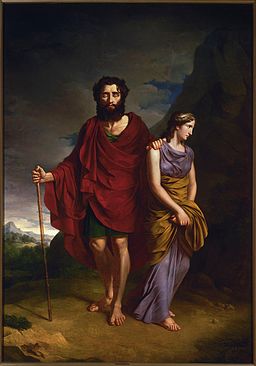
Antoni Brodowski ‘s “Oedipus and Antigone,” 1828

So now the quiz. The first question is: what was the debate between the former student activist and the philosophy professor about?

Well, based only on the above excerpts, there is no way to know. I quoted from the most heated moment of the dispute, when passions ran highest. But in that moment, the original theme of the debate was forgotten. As Girard tells us, when a conflict escalates, the rivalry itself comes to the fore and the original object of the dispute is lost from view.

That doesn’t mean that the dispute is not originally motivated by real differences in political ideology or conceptual outlook. This brings us to my second question: which of the lines quoted were spoken by the activist and which expressed the Weltanschaung of the philosopher?

Once again, there is no way to know. Even if you studied for this quiz by reading every book either of them ever wrote, it would still be impossible to guess who said “Shut your face” and who replied “You shut yours.” No matter how far apart the antagonists were at the outset, their differences dissolve at the height of their rivalry. As Girard holds, the more a rivalry intensifies, the more the antagonists resemble each other.

Yet the more they resemble each other, the more each is convinced he is right and the other is wrong. As it happens, it was the philosophy professor who said “You shut yours.” At the moment he spoke, he had good reason to believe he was right. Was not his rival wrong to insult him by saying “Shut your face”? He should have kept his big mouth shut!

What the philosopher may not see in the heat of the moment is that, by opening his own mouth and saying “You shut yours,” he is behaving exactly like his antagonist. In fact, he is imitating him. Rivalry fueled by imitation is what Girard dubs mimetic rivalry. As Girard shows, conflicts intensify through mutual imitation, moving toward ever greater reciprocity and symmetry.

The more symmetrical a conflict is, the harder it is to say who’s right and who’s wrong. Indeed, if you look at the reasons invoked by each side, you will often find that both parties are right. The philosopher was right in that his antagonist should not have said “Shut your face.” But his rival was equally right in that the philosopher should not have said he was spouting BS.

Each party sees half the truth: the half that applies to the other. To speak the truth about the other’s role in a dispute without recognizing that the same truth applies to ourselves amounts to scapegoating the other. It amounts to scapegoating even if the other is guilty as charged.

This is a key point. A scapegoat does not have to be innocent. To single out one of the rivals as uniquely responsible for the rivalry is itself a form of scapegoating. If each of two antagonists is guilty, if each speaks only half the truth – the half that applies to the other – then the scapegoating is mutual or reciprocal. This kind of reciprocal scapegoating is typical of mimetic rivalry. It is part of the symmetry that characterizes the rivalry.

Tit-for-tat escalation

But symmetry is not the whole story. There is also a tendency to escalation. Each party tries to get the better of the other by launching a bigger insult, a bolder accusation, a stronger blow. This can be understood as an attempt to break free of the symmetry by establishing what Girard in Oedipus Unbound calls a “dissymmetry” capable of re-differentiating the antagonists.

The philosopher does not merely respond in kind to the phrase “Shut your face” by replying “Shut yours.” Responding in kind would leave both parties on the same footing. He also adds a new observation designed to transcend the tit-for-tat exchange. It is as if he were saying: “You tell me to shut my face. I tell you to shut your face. It may look like we are the same. But there is a difference between us. And that difference is that you are a pathetic dumbhead.”

The precise term used was “cretin.” Strictly speaking, cretinism is a form of mental disability caused by thyroid insufficiency. Now, our philosopher is a lucid and intelligent man. Do we take him at his word when he asserts that his adversary is suffering from cretinism? Of course not. We assume that he is speaking out of anger. We react as the chorus in Oedipus the King reacts amidst the debate between Oedipus and Tiresias. “It is anger, I think, that inspires Tiresias’s words,” says the chorus, “and yours too, Oedipus.”

The sage of Stanford: René Girard

The debate between Oedipus and Tiresias is at the heart of Girard’s analysis. Oedipus hopes Tiresias will shed light on the murder of the previous ruler, Laius. According to Creon, the oracle blames the plague in Thebes on the fact that this crime was left unpunished, and Oedipus has vowed to hunt down whoever is responsible. But when Oedipus questions Tiresias, the renowned prophet stubbornly refuses to answer.

Oedipus grows increasingly exasperated. Finally, he declares that Tiresias must be guilty himself. Tiresias retorts that it is Oedipus who is guilty. In Violence and the Sacred, Girard interprets Tiresias’s words as “an act of reprisal arising from the hostile exchange.” By accusing Tiresias of being behind the murder of Laius, Oedipus prods him into “hurling the accusation back at him.”

Oedipus dares Tiresias to repeat the accusation. Not only does Tiresias repeat it, he tops it with a new, more terrible charge, insinuating that Oedipus is the son of the man he killed and of the widow he married. It is as if Tiresias were saying: “You accuse me of killing Laius. I accuse you of killing Laius. It may look like we are the same. But there is a difference between us. The difference is that you, Oedipus, are a patricidal motherlover!”

Is Tiresias right? Is Oedipus guilty?

From hunter to hunted

Violence and the Sacred suggests that Oedipus is not guilty. In that book, Girard uses Sophocles’ tragedy to introduce the concept of the surrogate victim or scapegoat. Oedipus, an outsider with a lame foot, is a scapegoat made to bear sole blame for the plague in Thebes. The accusations of patricide and incest leveled against him are typical mythic accusations. As crimes that abolish the most fundamental kinship distinctions, patricide and incest are signifiers of raging undifferentiation.

The plague itself, an illness that strikes everyone without distinction, has the same meaning. The real plague, the gravest crisis afflicting Thebes, is the breakdown of distinctions, the plague of undifferentiation to which the protagonists contribute by hurling back and forth the same accusations. Each accuses the other of being responsible for the crisis.

The question is who will succeed in making the accusation stick. When Oedipus ultimately accepts the charge of patricide and incest, he becomes the monstrous embodiment of undifferentiation. The loss of difference is laid at the door “not of society at large, but of a single individual.” The social crisis is resolved at the expense of a lone victim. The mythic nature of the accusations of patricide and incest suggests that Oedipus is innocent. In his later works, Girard emphasizes the scapegoat’s innocence.

But in Violence and the Sacred, Girard also highlights the role played by Oedipus himself in the scapegoating process. In Sophocles’ play, Girard writes, the “entire investigation is a feverish hunt for a scapegoat, which finally turns against the very man who first loosed the hounds.” Oedipus is the man who loosed the hounds. He tried to pin the blame for the crisis on Tiresias and Creon. He took part in the game of reciprocal accusations that was one with the crisis afflicting Thebes.

Oedipus and the Sphinx

If Girard is right, Oedipus may well be an innocent man wrongly accused of patricide and incest. As shown in The Oedipus Casebook, the evidence against him is not as solid as one might think. But Oedipus is not wholly innocent. He accuses others of responsibility for a crisis in which he himself shares the blame.

What is important for Girard in his early writings is not the substance of the accusations of incest or patricide or murdering Laius. It is the fact that Oedipus accuses others of guilt only to discover that he himself is guilty. That is the feature of Sophocles’ tragedy that first drew Girard’s attention and ultimately led him to his famous scapegoat theory.

In an early essay in Oedipus Unbound, Girard compares Sophocles’ hero to the Proustian snob: “The snob has no other model than the snob. He therefore has no other rival.” That is why the snob trumpets “his hatred of snobbery.” Seen in this light, “Oedipus’s excessive indignation, his zeal to track down the culprit, are revealing.” They call to mind the passion with which the Proustian snob denounces snobs. So it is that Oedipus “accuses Creon and Tiresias of the crime he himself committed.”

To use the language of Girard’s later writings, Oedipus scapegoats his rivals. To single out one’s rival as uniquely responsible for the rivalry is itself a form of scapegoating. This type of scapegoating is taking place all around us today. The degeneration of public debate into exchanges of insults is a clear sign of crisis. In this sense, the situation we are living through now is not unlike the one portrayed in Oedipus the King. If we see Oedipus purely as an innocent man accused of patricide and incest, then his experience will seem distant from our own. But if we see him as a person who accuses others before realizing that they are not free of blame themselves, then perhaps Sophocles’ play can help us navigate the present crisis.

A hot fire on a cold night: Peter’s denial and “Mitsein”

Wednesday, September 27th, 2023
Share
“Saint Peter’s Denial” by Caravaggio

It’s hard to pick a favorite essay from my new anthology, All Desire Is a Desire for Being: Essential Writings – all of the pieces by French theorist René Girard are exceptional, otherwise I wouldn’t have picked them – but the essay on Peter’s Denial is certainly high on the list. So I was very pleased when the University of Notre Dame decided to publish the piece in its eminent Church-Life Journal, under the editor and friend Artur Sebastian Rosman, who is also a Czesław Miłosz scholar.

An excerpt from “The Question of Mimesis and Peter’s Denial“:

After Jesus had been arrested, the disciples fled in all directions, but Peter alone or, according to John, Peter and another disciple, followed at a distance right into the courtyard of the High Priest’s palace, and, I quote: “there he remained, sitting among the attendants, warming himself at a fire.” John says that “the servants and the police had made a charcoal fire, because it was cold, and were standing round it warming themselves.” And Peter too “was standing with them, sharing the warmth.”

The text shifts to inside the palace, where a hostile and brutal interrogation of Jesus was taking place. Then we shift back to Peter and, again I quote:

Meanwhile Peter was still in the courtyard downstairs. One of the High Priest’s servant girls came by and saw him there warming himself. She looked into his face and said, “You were there too, with this man from Nazareth, this Jesus.” But he denied it: “I do not know him,” he said. “I do not understand what you mean.” Then he went outside into the porch; and the girl saw him there again and began to say to the bystanders, “He is one of them,” and again he denied it.

Again, a little later, the bystanders said to Peter, “Surely you are one of them. You must be; you are Galilean.” At this he broke out in curses, and with an oath he said: “I do not know this man you speak of.” Then the cock crowed a second time; and Peter remembered how Jesus had said to him, “Before the cock crows twice you will disown me three times.” And he burst into tears.

Auerbach makes some shrewd comments on that text: “I do not believe,” he writes, “that there is a single passage in an antique historian where direct discourse is employed in this fashion in a brief, direct dialogue.” He also observes that “the dramatic tension of the moment when the actors stand face to face has been given a salience and immediacy compared with which the dialogue of antique tragedy appears highly stylized.” It is quite true, and I am not averse to using such words as “mimesis” and “mimetic realism” to describe the feeling of true-to-life description which is created here, but I do not think that Auerbach really succeeds in justifying his use of the term “mimesis.”

Careful and sensitive as he is as a reader, Auerbach did not perceive something that is highly visible and which should immediately strike every observer: it is the role of mimesis in the text itself, the presence of mimesis as content. Imitation is not a separate theme but it permeates the relationship between all the characters; they all imitate each other. This mimetic dimension of behavior dominates both verbal and non-verbal behavior. Peter’s behavior is imitative from the beginning, before a single word is uttered by anyone.

In Mark and John, when Peter entered, the fire was already burning. People were “standing round warming themselves.” Peter too went to that fire; he followed the general example. This is natural enough on a cold night. Peter was cold, like everybody else, and there was nothing to do but to wait for something to happen. This is true enough, but the Gospels give us very little concrete background, very few visual details, and three out of four mention the fire in the courtyard as well as Peter’s presence next to it. They mention this not once but twice. The second mention occurs when the servant girl intervenes. She sees Peter warming himself by the fire with the other people. It is dark and she can recognize him because he has moved close to the fire and his face is lighted by it. But the fire is more than a dramatic prop. The servant seems eager to embarrass Peter, not because he entered the courtyard, but because of his presence close to that fire. In John it is the courtyard, upon the recommendation of another disciple acquainted with the High Priest.

A fire in the night is more than a source of heat and of light. A fire provides a center of attraction; people arrange themselves in a circle around it and they are no longer a mere crowd; they become a community. All the faces and hands are jointly turned toward the fire as in a prayer. An order appears which is a communal order. The identical postures and the identical gestures seem to evoke some kind of deity, some sacred being that would dwell in the fire and for which all hands seem to be reaching, all faces seem to be watching.

There is nothing specifically Christian, there is nothing specifically Jewish about that role of fire; it is more like primitive fire-worship, but nevertheless it is deeply rooted in our psyches; most human beings are sensitive to this and the servant girl must be; that is why she is scandalized to see Peter warm himself by that fire. The only people who really belong there are the people who gravitate to the High Priest and the Temple, those who belong to the inner core of the Jewish religious and national community. The servant maid probably knows little about Jesus except that he has been arrested and is suspected of something like high treason. To have one of his disciples around the fire is like having an unwelcome stranger at a family gathering.

The fire turns a chance encounter into a quasi-ritualistic affair and Peter violates the communal feeling of the group, or perhaps what Heidegger would call its Being-together, its Mitsein, which is an important modality of being. In English, togetherness would be a good word for this if the media had not given it a bad name, emptying it entirely of what it is supposed to designate.

This Mitsein is the servant girl’s own Mitsein. She rightfully belongs with these people; but when she gets there, she finds her place occupied by someone who does not belong. She acts like Heidegger’s “shepherd of being,” a role which may not be as meek as the expression suggests. It would be excessive in this case to compare the shepherd of being with the Nazi stormtrooper, but the servant maid reminds us a little of the platonic watchdog, or of the Parisian concierge. In John she is described as precisely that, the guardian of the door, the keeper of the gate.

This Mitsein is her Mitsein, and she wants to keep it to herself and to the people entitled to it. When she says: “You are one of them, you belong with Jesus,’ she really means, ‘You do not belong here, you are not one of us.”

We always hear that Peter acts impulsively, but this really means mimetically. He always moves too fast and too far; but still, why move so close to the center, why did the fire exert such an attraction on him?

Read the rest here.