
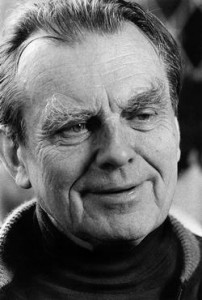
Happy 103rd birthday, Czesław Miłosz!
Monday, June 30th, 2014
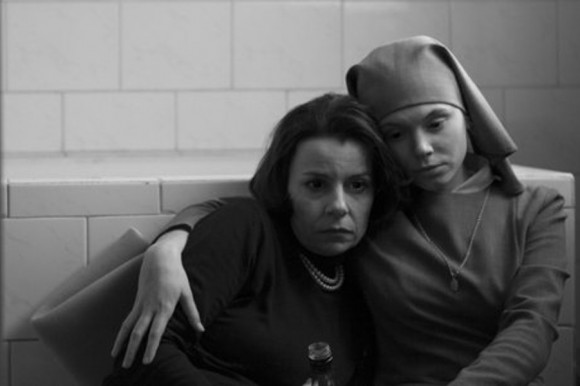
The novice Ida (Agata Trzebuchowska) comforts her aunt Wanda (Agata Kulesza).
Paweł Pawlikowski‘s Ida has bagged a zillion awards this year – but I hadn’t heard of the film until Marilyn Yalom, fresh from a trip to Poland, told me I must see it. It’s been called a grim “road movie” about two women – one an 18-year-old girl about to take her vows in a convent; the other her aunt, a judge and former state prosecutor called “Red Wanda,” who sent “enemies of the people” to their deaths during the show trials of the Stalin era. The two meet for the first time, and Wanda Gruz tells the convent-reared girl that she is in fact Jewish, born Ida Lubenstein, the daughter of her sister. It’s 1962, and the two take off into the drab Communist era towns to find out what became of Ida’s family during the war. The answer is not a happy one (spoiler alert): the German occupation inspired many murderous atrocities among the occupied; the Lebensteins were butchered by the people who were sheltering them, and their property seized. The baby Ida was dropped off at a convent doorstep.

Family reunion.
I won’t recap the many reviews, except to note a few Polish nuances that are likely to be missed by the Western audience. One viewer was surprised that the disillusioned commie Wanda’s taste for music extended to Mozart’s “Jupiter Symphony” – but that’s no surprise in Eastern Europe. It’s more interesting to me that jazz played such a big role in Communist Poland – there’s a lot of John Coltrane. American jazz was also big in occupied France, as a defiant symbol of resistance and freedom. Props to jazz-lovers everywhere.
More subtext: few in the West know how those who had resisted the Nazis, the Polish patriots, were harrassed and persecuted by the Communist government – hence Wanda’s social isolation, both Jewish and Communist. There are other distinctively Polish cues in the film – during a flashback to one of courtroom a man who protested the social state by whacking down with a saber the red tulips planted by social scouts. The saber had belonged to his grandfather, who had served with the out-of-favor Polish patriot and statesman of the interwar period, Józef Piłsudski. One Pole told me that every erstwhile Polish aristocrat has a plot of land, a title, and a sword under his bed. Well, here’s the sword.
 Some critics have taken issue with the film’s ending. So do I, but for entirely different reasons. It seemed to me a modern solution plopped onto an earlier era – one I happened to have lived through, so I have some firsthand memories. The idea of a virginal 18-year-old novice dropping her drawers (literally) to have a one-night-stand with a saxophonist in a band is as likely as her twerking her way to Silicon Valley and making a killing in a start-up. Many critics have also spoken about Ida’s return to the city need to “find herself,” live a little, daring to imagine another future, and experiencing a “fuller life” – all the usual clichés. They forget she has a funeral to go to. In any case, the sex scene hardly represents passionate abandon – it’s pretty joyless, tentative, and rote. Others have deplored Ida’s eventual rejection of romantic love – they are the true idealists, thinking that a traveling young jazz musician would have had an enduring fascination with the inexperienced teenager.
Others comment that both women’s are psychologically shaken by their experiences together, and that Ida begins to question her faith. I didn’t even see it touched, let alone bruised. Was I watching a different movie? Alright, alright – I’ll give you one suppressed giggle at the solemn and silent convent dinner, but otherwise it seems so much wishful thinking and projection on the part of Western viewers who don’t understand Ida’s choices. Wanda is a different case. Brittle and about to break, despite her apparent toughness, she jumps to her death.

Now we know.
Let me offer an alternative interpretation, perhaps just as fanciful: with the suicide of her aunt, the only relative she has ever met, she decides, for a day or two, to re-inhabit that lost, abandoned life – not just to accompany Wanda on her solitary path to death, to immerse herself in it, to revivify the life and to redeem it. She wears her aunt’s clothes, stays in her apartment, plays her music (very like the redemptive “substitutions” in Inkling Charles Williams‘s writings.) Wanda’s taunt to Ida, vis à vis sex, has been frequently cited in the write-ups about the film: “You should try. Otherwise what sort of sacrifice are these vows of yours?” Perhaps Ida took it to heart on a far deeper level than Wanda had intended. She experiences it, so that she can renounce it consciously, rather than blindly. (This, of course, reduces the saxophonist to a mere object or symbol, but there’s really not much way around that in any reading of the film.)
Oh yes, and one more thing Western viewers are likely to miss. When Wanda deals the photographs of her family like cards on a table – Director Pawlikowski includes one photo that would not have been a family member, someone who was almost totally unknown in Poland at the time because, as a Polish patriot, she was persecuted by the Polish government and her reputation suppressed. Irena Sendler, with her team of women in Żegota, the underground council to save Jews, saved 2,500 Jewish babies and children in the Warsaw Ghetto. Every Pole knows that. The women of Żegota said not one convent refused to shelter a child.
Psssttt!!! Check out the comment selection below. Pretty interesting stuff about the woman who may have been the prototype for Wanda.

Real writer
It’s the 100th anniversary of the assassination that triggered World War I. On this day in 1914, the 19-year-old Serbian Gavrilo Princip shot the Austrian Archduke Franz Ferdinand. The assassin was one of those nobodies who pops up occasionally in history, rather like John Wilkes Booth, but the Austrian writer Robert Musil has another take on the schoolboy, who was secretly a poet – as well as French leader Georges Clémenceau, who “obviously had a poet living inside him,” and Italian novelist/playwright Benito Mussolini. In this passage taken from his notebooks in late 1935 or early 1936:

Writer wannabe
“In a word, one must remind those irredeemably blind people who despise literature that even Nero set Rome on fire once, and this not just because he was mentally ill, as is maintained, but above all because he was a writer. Their respect for writing will increase if they notice that not only amateur writers, writing dilettantes, but also writers who for one reason or another never fully managed to devote themselves to writing, have set the world on fire.
“Compared to them, the real or fully developed writers are not dangerous in any way and, aside from spiritual theft, bourgeois bankruptcy, and offences against public decency, have never done anything serious at all. The source of restlessness in the kind of people who destroy worlds is transformed in these writers to a quietly burning and nourishing hearth-flame and they make a well-ordered export business out of the adventures of their fantasy…”
Read the rest at the blog on Musil, Attempts to Find Another Human Being, here. As I recall, Joseph Stalin was an aspiring writer, too, and Mao Tse-Tung was a poet of note. I suppose it could be flipped around to be an argument for killing all of us early… Some sort of fireworks exploding outside as I write. I find it rather chilling on a warm summer night.
 Jenny Davidson likes sentences. More than that. She says that “sentences are my obsession—I linger on them compulsively, it is the feeling of words in the mouth that got me hooked on literature in the first place as a very young child…” She wanted to write a book that conveyed some of the magic of that way of reading. And she has. The Columbia University Press blog has an interview with her about her new book, Reading Style: A Life in Sentences.
An excerpt:
Q: You’re a scholar of eighteenth-century English literature, a novelist, and a blogger; how did these three hats you wear inform your approach to writing Reading Style?
Jenny Davidson: From my point of view, those three hats—scholarship, fiction-writing, blogging—are part of a single fully integrated set of activities, and I wrote this book partly to show what that means for me as a reader and writer. The separation between scholarship and fiction-writing has always seemed to me largely artificial—I will write a novel because there’s a problem or topic that I’ve pursued as far as I can by scholarly means and want to think about further in a different medium, and the same thing goes in the other direction. Blogging is something I took up about ten years ago: it was largely for my own enjoyment, with some minor self-promotional aspect I suppose, but I found as I continued to do it that it became an excellent way to develop and refine an easy, fluent critical voice that I could then take back into the more formal kinds of criticism I also write.
***
Q: Chapter 2 is intriguingly titled “Lord Leighton, Liberace, and the Advantages of Bad Writing,” so what are some of these advantages?

Many hats.
JD: The names in the title are drawn not directly from life but from one of my favorite novels, Helen DeWitt’s The Last Samurai, which among other things is a brilliant and profound examination of the relationship between morality and prose style. The kinds of bad writing DeWitt’s protagonist attributes to the characters she dubs “Lord Leighton” and “Liberace” are not redeemable. But other kinds of bad writing are, or at least that’s what I want to argue. George Eliot is a good bad writer, and so is Lionel Shriver: in the case of each of these authors, there is a kind of muscular intellectual force that bludgeons you and impresses itself on you at one and the same time. The sentences are often slightly cringe-worthy, but it is in aid of a greater good. Harry Stephen Keeler is another writer I single out for praise—the supposed “badness” of his writing really strikes me as a kind of imaginative strangeness that amounts at times to genius. If we always restrict ourselves to books written in the best possible taste, we risk losing a whole continuum of aesthetic and moral effects.
She also has a blog called Light Reading. “For me, blogging has not been a form of personal revelation,” she said to Columbia News. “Light Reading mostly gives me a way to comment on what I’m reading, watching or otherwise thinking about in a mode that’s at once less formal and more flexible than a conventional book review or an academic article. The personal voice of the blogger is part of what draws us to a given blog, but I don’t find myself drawn—either as a reader or a writer—to very personal blogs.
George Bernard Shaw famously wrote, “Only fine arts and torture changes a man.”
Simone Weil focused on the “torture” part. Malheur is usually translated as “affliction” – best option, perhaps, for describing the conditions necessary so that, as she wrote, “the human creature may un-create itself.” “Unhappiness” is too subjective and mild; though “affliction” doesn’t quite convey the inevitability and doom of “malheur.” In his introduction to the piece, which was pulled together from her notebooks, George Panichas wrote about affliction: “Along with beauty, it is the only thing piercing and devastating enough to penetrate the soul.”
I sent this to an ailing friend, not knowing what he’ll make of it. I’m having a Job-like day today, so I need to reread it, too:
 In the realm of suffering, affliction is something apart, specific, and irreducible. It is quite a different thing from simple suffering. It takes possession of the soul and marks it through and through with its own particular mark, the mark of slavery. Slavery as practiced by ancient Rome is only an extreme form of affliction. The men of antiquity, who knew all about this question, used to say: “A man loses half his soul the day he becomes a slave.”
Affliction is inseparable from physical suffering and yet quite distinct. With suffering, all that is not bound up with physical pain or something analogous is artificial, imaginary, and can be eliminated by a suitable adjustment of the mind. Even in the case of the absence or death of someone we love, the irreducible part of the sorrow is akin to physical pain, a difficulty in breathing, a constriction of the heart, an unsatisfied need, hunger, or the almost biological disorder caused by the brutal liberation of some energy, hitherto directed by an attachment and now left without a guide. A sorrow that is not centered around an irreducible core of such a nature is mere romanticism or literature. Humiliation is also a violent condition of the whole corporal being, which longs to surge up under the outrage but is forced, by impotence or fear, to hold itself in check.
On the other hand pain that is only physical is a very unimportant matter and leaves no trace in the soul. Toothache is an example. An hour or two of violent pain caused by a decayed tooth is nothing once it is over.
It is another matter if the physical suffering is very prolonged or frequent, but in such a case we are dealing with something quite different from an attack of pain; it is often an affliction.
Affliction is an uprooting of life, a more or less attenuated equivalent of death, made irresistibly present to the soul by the attack or immediate apprehension of physical pain. If there is complete absence of physical pain there is no affliction for the soul, because our thoughts can turn to any object. Thought flies from affliction as promptly and irresistibly as an animal flies from death. Here below, physical pain, and that alone, has the power to chain down our thoughts; on condition that we count as physical pain certain phenomena that, though difficult to describe, are bodily and exactly equivalent to it. Fear of physical pain is a notable example.
When thought is obliged by an attack of physical pain, however slight, to recognize the presence of affliction, a state of mind is brought about, as acute as that of a condemned man who is forced to look for hours at the guillotine the that is going to cut off his head. Human beings can live for twenty or fifty years in this acute state. …
Read more here.
 Is nuclear holocaust inevitable? Can we back away from the cliff we have been anxiously gazing over for 70 years – or in many cases, simply trying to ignore? Some say there’s no turning back. The German philosopher Günther Anders noted, after his visit to Hiroshima and Nagasaki in 1958: “Now that humanity is is capable of destroying itself, nothing will ever cause it to lose this ‘negative all-powerfulness,’ not even a total denuclearization of the world’s arsenals. Now that apocalypse has been inscribed in our future as fate, the best we can do is to indefinitely postpone the final moment. We are living under a suspended sentence, as it were, a stay of execution – a reprieve.”
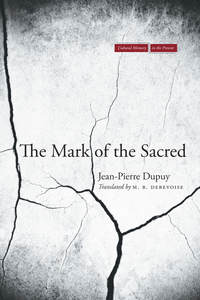
Not everyone is so pessimistic. California Governor Jerry Brown joined Stanford historian David Holloway, who studies atomic energy during the Cold War years; Stanford cryptologist Martin Hellman, known for his risk analysis studies on nuclear threats; environmentalist and historian Jon Christensen, and Stanford philosopher Jean-Pierre Dupuy, who writes about the nexus of ethics and technology, for a conversation on “The Nuclear Menace” this week. Jean-Pierre was the principal reason I accepted the invitation to the event in Stanford Libraries’ Bender Room. He credited the man he called his mentor, René Girard, for some of his insights, which were also drawn from his recent book, The Mark of the Sacred, from Stanford University Press.
It was a dynamite panel all round, and Jerry Brown’s presence was enormously cheering. Why a California governor on a panel discussing nuclear deterrence? Brown reminded the group that, decades ago during his first stint as governor, he had been nicknamed “Governor Moonbeam” for his tendency to roam outside “the very narrow range of permissible topics. … The end of humanity ought to be a permissible topic.”
Back to the “Mark of the Sacred”: Jean-Pierre described how, in our world, “rationality appears to have relegated all remnants of the religious mind to the past” and yet is still greatly influenced by it. “The problem is not to reconcile reason and faith. It is to recognize the marks of the sacred in the most outstanding and the most terrifying achievements of the rational mind.”
French author
Wait a minute. That’s where René Girard’s influence comes in. “The sacred” is a term that carries a lot of baggage, but it’s used here in a very precise Girardian way. “The sacred” is the way archaic societies bonded through rituals of sacrifice and violence. Jean-Pierre reminded us that the Latin root of sacred is sacer, which gives two faces to the sacred: a saint on one hand, the accursed on the other; the veneration on one, an abomination on the other. “One of the marks of the sacred is radical ambivalence. It is infinitely good, as it protects us from our own violence; it is infinitely evil, as it is intrinsically violent.” Elements of the archaic persist into our postmodern era for, as Hellman noted, we have powers that were once considered godlike. “Only God could destroy a city; we can do that now,” he said – but would anyone consider the human race godlike in its maturity? he asked. Crickets.
Our attitude towards nuclear weapons matches this ancient pattern: “Their only usefulness today is said to be the fact that they protect us from others using them against us. In Biblical terms: Satan casts out Satan, and he is the only one capable of casting out Satan, that is, himself,” said Jean-Pierre.
While our nuclear arsenals are said to protect us against nuclear war, their absence would arguably be an even greater deterrent – a modern paradox. Dupuy cited military strategist Bernard Brodie: “one of the foremost factors making deterrence really work and work well is the lurking fear that in some massive confrontation crisis it may fail. Under these circumstances one does not tempt fate.” Jean-Pierre considered the interplay of accident and fate in our nuclear future – Oedipus’s fate required an “accident” at the crossroads for fulfilment, said Jean-Pierre. We are now dealing with “blind mechanisms, which make human passions, moral categories, intentions and strategic planning obsolete,” he said. In today’s world, “it may be rational to pretend to be irrational.” For example, Putin seems to prefer a chaotic, dangerous Ukraine rather than a democratic one that tilts towards European integration. “Putin’s behavior is a powerful generator of unpredictability. Strategic or not, this card may trump all the others.”
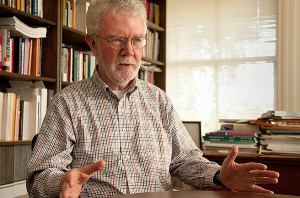
Cold War historian (Photo: L.A. Cicero)
According to Dupuy, a nuclear holocaust could occur even without hatreds or passions. He reminded us of the dozens of times we were on the brink of nuclear war during the Cold War. Anders anticipated a “paradise inhabited by murderers without malice and victims without hatred. … No war in history will have been more devoid of hatred than the war by tele-murder that is to come … this absence of hatred will be the most inhuman absence of hatred that has ever existed; absence of hatred and absence of scruples will henceforth be one and the same.” (Sounds like warfare by drones, doesn’t it?)
A nuclear holocaust can occur even if no one wills it, given the automatic human tendency of escalation to extremes, as military theorist Carl von Clausewitz noted, and as Girard elaborated in Battling to the End. The stakes that trigger such reactions can be ridiculously small – witness our entry into World War II, or the bickering between China and Japan over small islands in the Pacific. “All of this points to a new regime of violence in which human intentionality and human agency have become irrelevant.”

Savvy cryptologist
Dupuy noted,”Linking Auschwitz and Hiroshima, Hannah Arendt and Günther Anders probed the scandalous reality that immense harm may be caused by a complete absence of malignity; that a monstrous responsibility may go hand in hand with an utter absence of malice. Our moral categories, they discovered, are powerless to describe and judge evil when it exceeds the inconceivable.”
Philosopher David K. Lewis summarized the situation this way: “You don’t tangle with tigers – it’s that simple.” The “tigers” are our own violent tendencies. Luck, chance, fate, and the tiger “point to a world in which humanity itself has become irrelevant and miscalculation can carry the day.”
Another Girardian note during the question-and-answer period: Jean-Pierre suggested that not all nations, even belligerent ones, aim for the annihilation of the other – for example, Iran may not be nuking up to destroy Israel, but rather because, in mimetic fashion, nations imitate each other, and “to be taken seriously on the world scene, you have to be nuclear.” He recommended that we “sever the link between prestige and nuclear possession.”
Someone quoted Whole Earth Catalog’s Stewart Brand, who updated his comment from 40 years ago, “we are as gods, we might as well get good at it” to the more imperative “what I’m saying now is we are as gods and have to get good at it.” Jerry Brown offered what might be considered an “action point” for the afternoon: “Techno-optimism is a view that leaves out the virtue of humility. Optimism can be as lethal as pessimism,” he said, recalling the Tower of Babel. “Humility is in short supply among scientists and politicians and others as well.” Well, that’s something we can start working on today.

The guv’na with René Girard’s grandson, David Girard Brown of American University (Photo: Cynthia Hartley)
The Book Haven is proudly powered by
WordPress
Entries (RSS)
and Comments (RSS).
© Stanford University. 450 Serra Mall, Stanford, California 94305. (650) 723-2300. Terms of Use | Copyright Complaints
