Archive for July, 2015

Ukrainian poet Serhiy Zhadan at the end of Europe

Friday, July 31st, 2015

Share
Serhij Żadan

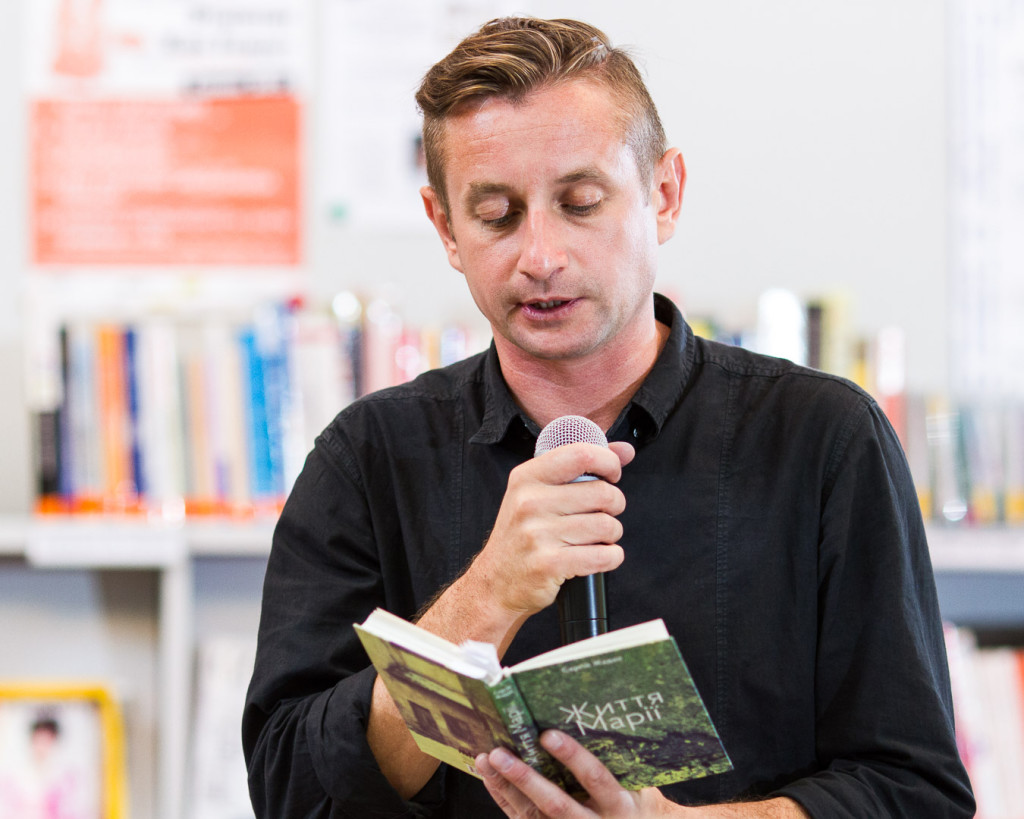
Reading from “Lives of Maria” in Wrocław, earlier this year. (Photo: Rafał Komorowski)

We wrote about Serhiy Zhadan, Ukrainian poet, novelist, essayist, and translator over a year ago, in a post titled, “They told him to kneel and kiss the Russian flag. Then he told them to…” That’s when the pro-Russian demonstrators broke his skull with bats in his native Kharkiv, the second largest city of Ukraine, a place that has the misfortune to be close to the Russian border.

“Americans need to understand, in Eastern Europe, writers still have a huge influence on society,” Vitaly Chernetsky, a professor of Slavic literature at the University of Kansas told the New Yorker in a story here. “It may sound like an old-fashioned ‘poet stands up to tyranny’ story, like something out of Les Miz—‘Can you hear the people sing?’—but it’s really kind of like that. … He’s a writer who is a rock star, like Byron in the early nineteenth century was a rock star.”

We were happy to see him appear last week in a New York Review of Books blogpost by Timothy Snyder, “Edge of Europe, End of Europe.” Tim said “What Zhadan actually seems to aspire to – and here his willingness to risk his life for Europe is a clue – is what [writer Mykola] Khvylovy called ‘psychological Europe’: the acceptance of conventions, the work to transcend them, and the absolute indispensability of freedom and dignity for the effort.” The discussion includes Czesław Miłosz as well:

Zhadan’s most recent work, a collection of poetry published earlier this year entitled Lives of Maria, is a book of Ukraine’s war and of Zhadan’s own survival: “you see, I lived through it, I have two hearts/do something with both of them.” Yet as the book proceeds the meditations are increasingly religious, the poems often taking the form of conversations with Maria herself. No one, in eastern Slavic culture or anywhere else, combines the writerly personas of tough guy and holy fool as does Zhadan. He raps hymns.

A happenstance Californian.

Kindred spirit?

At points in Lives of Maria, Zhadan sounds like Czesław Miłosz, the twentieth-century Polish poet, who also strove toward Europe through both the local and the universal: “I wanted to give everything a name.” Miłosz was the preeminent poet of a borderland, one to the north of Kharkiv, Lithuanian-Belarusian-Polish (and Jewish) rather than Ukrainian-Russian (and Jewish). His position, not so different from Zhadan’s perhaps, was that Europe can best be recognized on the margins, that uncertainty and risk are more substantial than commonplaces and certainty. And indeed, the last section of Lives of Maria is devoted to Zhadan’s translations of Miłosz. Zhadan begins with two of Miłosz’s poems, “A Song on the End of the World” and a “A Poor Christian Looks at the Ghetto,” that ask the most direct questions about what Europeans did during the twentieth century and what they might and should do instead. The second poem communicates the pain and difficulty of actually seeing and trying to learn from the Holocaust, which was, or at least once was, a central idea of the European project. The first transmits, almost breezily, certainly eerily, what a European catastrophe might feel like. It concludes: “No one believes that it has already begun/Only a wizened old man who might have been a prophet/But is not a prophet, because he has other things to do/Looks up as he binds his tomatoes and says/There will be no other end of the world. There will be no other end of the world.”

Where Miłosz wrote in Polish that the old man had other things to do, Zhadan writes in Ukrainian that there were already so many prophets. Perhaps so. Pro-European Ukrainians are taking a chance, not demanding a future. They watch the Greek crisis too, and their position is often more scathing than anything western critics of the EU could muster. The point then is not certainty but possibility. Zhadan might well have died for an idea of Europe; other Ukrainians already have. Yet the risks he has taken, both physical and literary, are not in the service of any particular politics. Many of his essays and poems are about the attempt to understand people with whom he disagrees. He is an outspoken critic of his own government. Like Miłosz, who described Europe as “familial,” or like Khvylovy, who called Europe “psychological,” Zhadan is pursuing experimentation and enlightenment, a sense of “Europe” that demands engagement with the unmasterable past rather than the production and consumption of historical myth. “Freedom,” writes Zhadan in Lives of Maria, “consists in voluntarily returning to the concentration camp.”

It rather makes me hanker for a translation. Anyone? Oh well, you can read all of Tim’s article here.
Salman Rushdie: “We are living in the darkest time I have ever known.”

Wednesday, July 29th, 2015
Share
©Zygmunt_Malinowski_

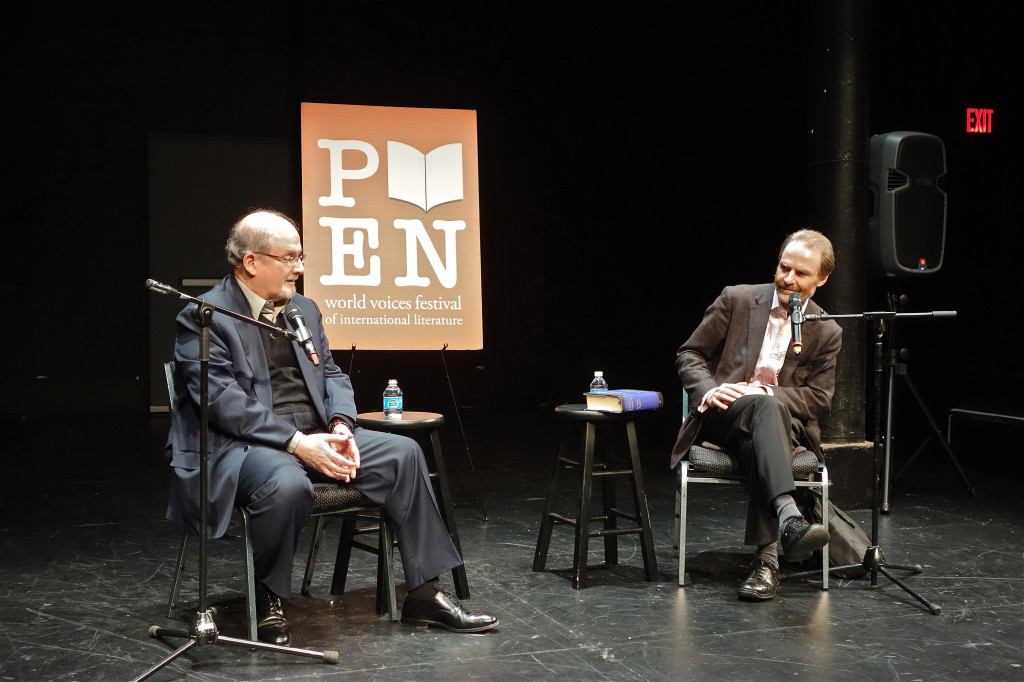
Would people defend him today? He thinks not. With Timothy Garton Ash last year. (Photo: Zygmunt Malinowski)

Charlie Hebdo has announced that they will publish no more cartoons featuring Mohammed, although every other religion and public figure will continue to be fair game. In other words, the terrorists have won. “We have drawn Mohammed to defend the principle that one can draw whatever they want… We’ve done our job,” said Laurent “Riss” Sourisseau, Charlie Hebdo’s editor-in-chief.

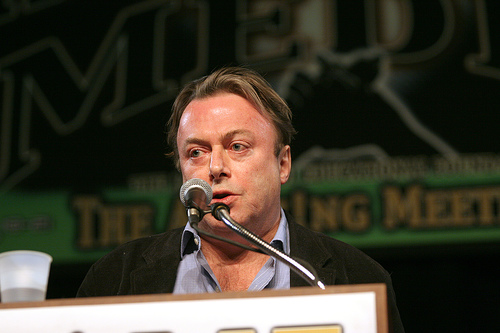
It’s hard to be nostalgic about a fatwa, but Sir Salman Rushdie‘s recent comments in The Telegraph remind us that his Valentine’s Day card from the Ayatollah Khomeini in 1989 were the good old days. Leading figures from around the world linked arms to express solidarity with him, and to protest any encroachment on freedom of speech. Susan Sontag, Norman Mailer, Joseph Brodsky, Christopher Hitchens, Seamus Heaneyand others stood for Rushdie. There was no backing down. And today?

Said Rushdie, “We are living in the darkest time I have ever known.” The author of the condemned Satanic Verses, told France’s L’Express. “I’ve since had the feeling that, if the attacks against Satanic Verses had taken place today, these people would not have defended me, and would have used the same arguments against me, accusing me of insulting an ethnic and cultural minority.”

Everblooming friendship

Thank you, Christopher.

In particular, Rushdie said he was dismayed by the protests that followed a decision by the American branch of the PEN writers’ association to award a prize for courage to Charlie Hebdo after a dozen of its staff were massacred in January. More than 200 writers, including Michael Ondaatje, Teju Cole, Peter Carey, and Junot Díaz, signed a letter objecting to PEN rewarding the satirical magazine for publishing “material that intensifies the anti-Islamic, anti-Maghreb, anti-Arab sentiments already prevalent in the Western world.”

“It seems we have learnt the wrong lessons,” Rushdie told L’Express. “Instead of realizing that we need to oppose these attacks on freedom of expression, we thought that we need to placate them with compromise and renunciation.” Cole explained to him that his case was different – 1989 protesters defended Rushdie against charges of blasphemy; Charlie Hebdo’s cartoons, he argued, were an expression of Islamophobia.

Rushdie thinks it’s a case of political correctness gone wild. “It’s exactly the same thing,” he said. “I’ve since had the feeling that, if the attacks against The Satanic Verses had taken place today, these people would not have defended me, and would have used the same arguments against me, accusing me of insulting an ethnic and cultural minority.” (To be clear, I find Charlie Hebdo cartoons tasteless and not very funny. That’s not the point.) 

Let’s remember Sontag, president of PEN, in that 1989 moment. Hitchens wrote: “Susan Sontag was absolutely superb. She stood up proudly where everyone could see her and denounced the hirelings of the Ayatollah. She nagged everybody on her mailing list and shamed them, if they needed to be shamed, into either signing or showing up. ‘A bit of civic fortitude,’ as she put it in that gravelly voice that she could summon so well, ‘is what is required here.’ Cowardice is horribly infectious, but in that abysmal week she showed that courage can be infectious, too. I loved her. This may sound sentimental, but when she got Rushdie on the phone—not an easy thing to do once he had vanished into the netherworld of ultraprotection—she chuckled: ‘Salman! It’s like being in love! I think of you night and day: all the time!’ Against the riot of hatred and cruelty and rage that had been conjured into existence by a verminous religious fanatic, this very manner of expression seemed an antidote: a humanist love plainly expressed against those whose love was only for death.”

sontag3

Thank you, Susan.

Sontag and Hitchens were famous people, of course, who lived in high-rise apartments and could go into hiding, as Rushdie did. But a lot of other people put their lives on the line. Hitoshi Igarashi, the Japanese translator of The Satanic Verses, was stabbed to death on the campus where he taught, the Italian translator Ettore Capriolo was knifed in his Milan apartment, and in Oslo, William Nygaard, the novel’s Norwegian publisher, was shot three times in the back and left for dead.

Others at risk included bookstore owners, bookstore managers, and the people who worked for them. So let me take a few moments to recall the heroism of one of them, Andy Ross, owner of Cody’s Books in Berkeley, which was bombed in the middle of the night two weeks after the fatwa was announced. On his own blog (he is now a literary agent) he wrote:

I spoke of the fire bombing that occurred at 2 AM. More troubling was that as we were cleaning up in the morning, an undetonated pipe bomb was found rolling around the floor  near the poetry section. Apparently it had been thrown through the window at the same time as the fire bomb. Had the pipe bomb exploded, it would have killed everyone in the store. The building was quickly evacuated. … As I walked outside, I was met with a phalanx of newsmen. Literally hundreds. Normally I was a shameless panderer for media publicity. At this point I had no desire to speak. And I knew reflexively that public pronouncements under the circumstances were probably imprudent. …

Codys2006

Cody’s in 2006. (Photo: Creative Commons/Pretzelpaws)

One-time heroism wasn’t enough. How were they to react to the attack? Would they continue selling the book? Would they put it at the front of the store, or hide it somewhere towards the back? Or would it, like 1950s pornography, be offered by request only, in a brown paper bag?

I stood and told the staff that we had a hard decision to make. We needed to decide whether to keep carrying Satanic Verses and risk our lives for what we believed in. Or to take a more cautious approach and compromise our values.  So we took a vote. The staff voted unanimously to keep carrying the book. Tears still come to my eyes when I think of this. It was the defining moment in my 35 years of bookselling. It was the moment when I realized that bookselling was a dangerous and subversive vocation. Because ideas are powerful weapons. It was also the moment that I realized in a very concrete way that what I had told Susan Sontag was truer and more prophetic  than anything I could have then imagined. I felt just a tad anxious about carrying that book. I worried about the consequences. I didn’t particularly feel comfortable about being a hero and putting other people’s lives in danger. I didn’t know at that moment whether this was an act of courage or foolhardiness.

But from the clarity of hindsight, I would have to say it was the proudest day of my life.

The story wasn’t over. Rushdie visits the Bay Area regularly (I wrote about his visit to Kepler’s here). And even while in official hiding, he insisted on calling on Cody’s several years later (Berkeley rents finally did what bombs could not, and the valiant bookstore closed its doors in 2008). Ross recalls Rushdie’s appearance at Cody’s:

We were told that we could not announce the visit until 15 minutes before he arrived.  It was a very emotional meeting. Many tears were shed, and we were touched by his decision to visit us. We showed him the book case that had been charred by the fire bomb. We also showed him the hole in the sheetrock above the information desk that had been created when the pipe bomb was detonated. One of the Cody’s staff, with characteristic irreverence, had written with a marker next to the damaged sheet rock: “Salman Rushdie Memorial Hole”. Salman shrugged his shoulders and said with his wonderful self-deprecating humor, “well, you know some people get statues – and others get holes.”

Read the whole thing here.

Writer + typewriter = a classic look for the 20th century

Sunday, July 26th, 2015
Share
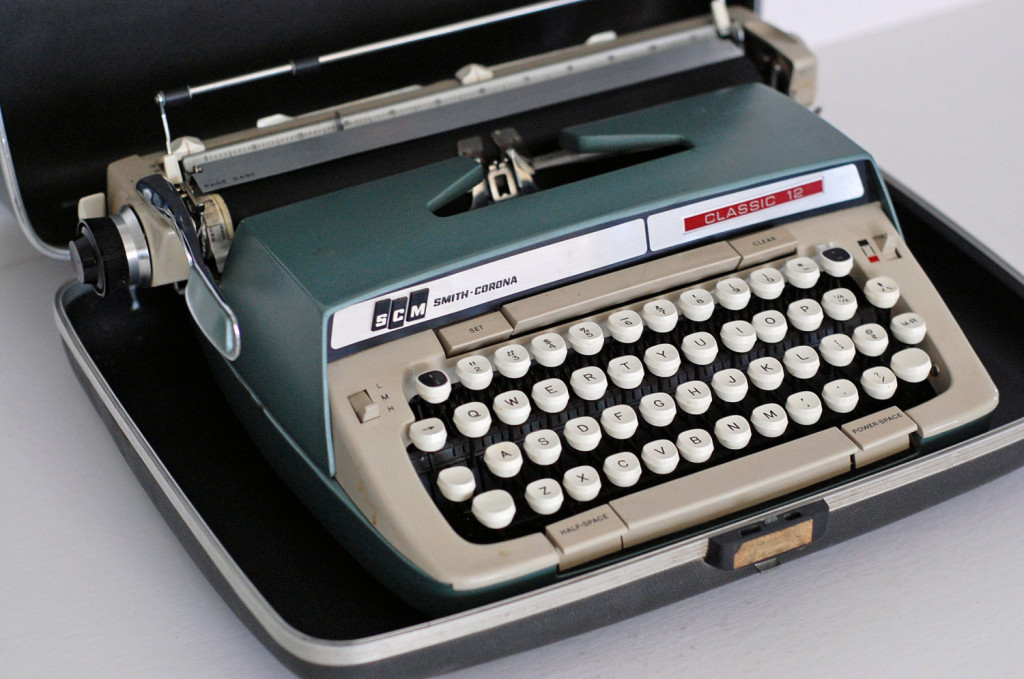
smith-corona

Very much like this one.

Somewhere in the back of my large garage, I have the Smith-Corona typewriter my parents gave me for Christmas in the 1970s. It was a close companion in Ann Arbor during my university years.

I have fantasies of life in a post-earthquake, post-Armageddon world without electricity or the worldwide web, where we have been reduced to gnawing on turnips pulled from the ground – but I will still be able to pump out copy on my old Smith Corona. I know, I know, every joint in the old machine has grown stiff and needs cleaning and oiling, and the typewriter ribbon has long since dried out – where would I get a new one? (You young ‘uns under forty don’t even know what I’m talking about, do you?)

48smithcorona

Dress not included.

I don’t indulge this fantasy often – as someone who would have great organizational difficulties writing without a searchable backlog of all my files at my fingertips, and since I nowadays have to write with a protective mitt on each hand, it’s hard to see how I would pound on manual typewriter without destroying both my wrists within the first few hours. It’s hard for me to get sentimental about the olden days.

However, it looks like one website I just found panders precisely to that nostalgia – Oz Typewriter here (it even won a Qwerty award – that’s a word that will mean nothing to Millennials, either). It’s home page even features a typewriter crime. On a page for writers and their typewriters, it has combox with comments like these: “Taylor Caldwell is working on a Remington – you can tell by the downturned carriage return lever. That’s a Hermes 9 that Marcuse is typing on. Amazing that Barthelme (with a wonderful ironic smile) is using such an old typewriter, with return lever on the right (LC Smith?). The margin stop on Schlesinger‘s machine looks like a Smith-Corona product to me. Huxley‘s typewriter is a Remington – you can tell from the folding tip of the return lever. My guess is a Streamliner.”

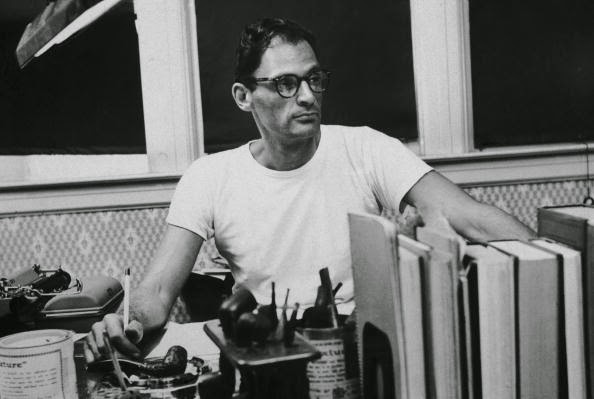
I have to say, these writers look terrific by their computers, Arthur Miller, Marguerite Duras, Salman Rushdie, and Stanford’s René Girard. We include Brendan Gill, too – the longtime New Yorker writer will be familiar to those who attended the now-defunct Stanford Publishing Course. There’s lots more on the website here – although Aldous Huxley looks a little confused and unhappy about the whole affair. Maybe his typewriter ribbon dried out.

Arthur Miller 1955

That’s Arthur Miller on a Royal in 1955.

Rushdie 001

A pre-fatwa Salman Rushdie on an … electric Corona? … in 1981.

Brendan Gill 1970

The New Yorker’s Brendan Gill on an Olivetti in 1970.

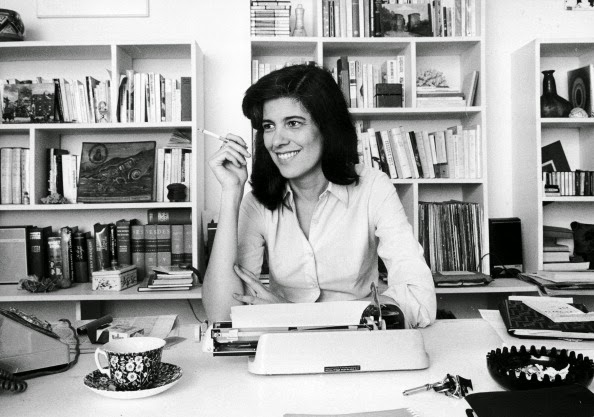
Susan Sontag 1972

Susan Sontag in 1972 – but can you identify that typewriter?

Rene Girard 1979

René Girard on an Olivetti DL, in Paris, 1979.

Alberto Moravia 1950

Alberto Moravia on a Remington, 1950.

Marguerite Duras 1955

Marguerite Duras, pounding it out on her Olivetti ICO MP1, in 1955.

Aldous Huxley 1946

Aldous Huxley hammering away on a … Royal? … in 1946.

Fiction versus philosophy: the word from John L’Heureux

Thursday, July 23rd, 2015
Share

lheureuxI owe the Stanford University Libraries five books by Saturday, and naturally one of them is AWOL. The other four are stacked up neatly by the door, ready for return. Where did the fifth go? Meanwhile, in my search I stumbled across Dikran Karagueuzian‘s Conversations with John L’Heureux, and opened it at random:
Q: You’re saying you didn’t like philosophy?

JL: The way a philosopher thinks is by its nature opposed to the way a fiction writer must think. I really believe that.

Q: Explain that, will you?

JL: Philosophy moves from the particular to the abstract on its way toward universal truths, whereas fiction is concerned with the practical, the concrete. Philosophy wants to investigate eternal questions such as whether or not we can know anything for certain and, if so, how? These are fascinating questions, but they don’t make for fiction, which wants to know who this particular man is and how the thinks and acts, and why.

Q: What about philosophical novelists?

JL: The more philosophical they are, the less engaging they’re likely to be, I think. There’s Gide, Joyce, and Mann, and you certainly have to regard them as philosophical novelists, but don’t you agree that each of them is more admired for his fiction than for the philosophical questions he raises? I’ve never known anybody who reads Joyce for his philosophy. But then there’s Sartre and Camus, whom you do read for their philosophy, but they make it worth your while. Camus is a wonderful novelist. The Stranger is a fascinating book and it’s certainly the fictional embodiment of an existential issue, but in general I think it’s true that the more philosophical the work, the less impressive it is as fiction.

kolakowski

Hide and seek.

Q: Okay. You’re saying that philosophy is concerned with the pursuit of truth with a capital T whereas fiction is concerned with a particular truth of everyday experience … which may reflect something larger, but in itself it’s not concerned with abstractions.

JL: Exactly. But the real danger is the habit of mind. The The habit of speculating philosophically is opposed by its nature to the fictional process of observing the way somebody curls his lip as he puts out his cigarette, a gesture that may turn out to be trace evidence, say, of an act of violence. The fiction writer must be an observer. He has to see. “One of those on whom nothing is lost.” James.

Back to the hunt.  The missing book? Leszek KołakowskiMetaphysical Horror. Tell me if you see it. It must be here somewhere…


Stanford Repertory Theater performs Noël Coward’s Hay Fever – but who was the real Judith Bliss?

Monday, July 20th, 2015
Share
hayfever3

The Bliss Family: David (Bruce Carlton), Judith (Courtney Walsh), Sorel (Kiki Bagger) and Simon (Austin Caldwell).

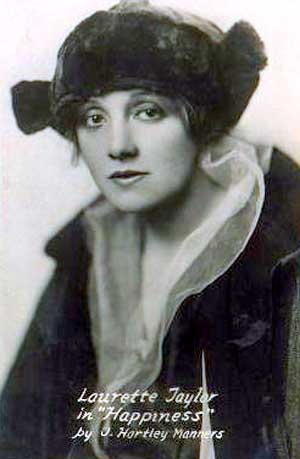
Playwright and songwriter Noël Coward spent a single weekend in the home of actress Laurette Taylor and her husband, the playwright J. Hartley Manners. The visit was such that he later, in three feverish days, wrote the play for which he is arguably best known, Hay Fever. Taylor made a big target: her larger-than-life personality was renowned, along with her theatrical moods and eccentricities. She was the sort of person who, we would say today, sucked all the oxygen out of the room. The play was a hit from the moment it opened in 1925. There were casualties, however. To put it mildly, Hay Fever strained the friendship.

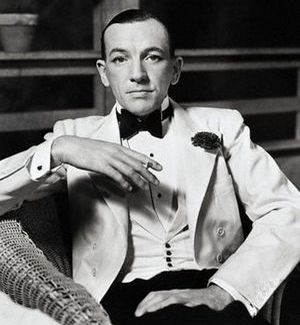
Coward

Ungrateful guest.

The Stanford Summer Repertory production, which opened last weekend, continues through August 9, with Courtney Walsh as Judith Bliss, Kiki Bagger as Sorel Bliss, Richard Carlton as David Bliss, Rush Rehm as Richard Greatham, Catherine Luedtke as Clara, Austen Caldwell as so-so novelist Simon Bliss, all under the direction of Lynne Soffer – tickets and info hereYou can’t really call a family dysfunctional when they’re so pleased with themselves, can you? The Bliss family likes itself, even if no one else does.

The play has been described as a cross between outright farce and comedy of manners. Stanford weighs in for the former, sometimes to its detriment. I could have used a slower pacing in the opening scenes, to hear the dialogue more clearly and get a feel for the characters before the comedy builds its own momentum. Sometimes the performers don’t seem to be actually listening to each other, or minding the cigarettes they light up and stub out every few minutes.

Judith Bliss is not just living in her past but the past, a different era of theater altogether. Perhaps a modern audience wouldn’t have understood the distinction, but it’s part of the fun of the play. The central character, matriarch Judith Bliss, is an actress who is past her heyday, hungering for a smashing comeback and longing for the return of melodrama with its clichéd gestures and formulaic plots. That era had given way with an excited crash to the brazen sexuality of the jazz baby. (Remember 1925 was the magic year of both Gentlemen Prefer Blondes and The Great Gatsby.)

Taylor

She really did make a comeback.

This production builds heat as it moves, trust me (and kudos to costume designer Connie Strayer). Two characters to watch in this production: Berkeley Rep veteran Deborah Fink excels as vamp flapper Myra Arundel. She’s sleek, smug, and self-contained as a cat, and doesn’t begin to unravel until the very last scenes. Another scene stealer: Kathleen Kelso as ingenue flapper Jackie Coryton. She’s making her Stanford Repertory Theater debut. The tall, willowy blonde sways uncertainly like a tall narrow tree in a high wind. The face under the cloche hat is constantly on the verge of crumpling into tears. She’s already unraveled, the moment she steps into the country house.

The original Judith Bliss, Laurette Taylor, was an actress from a previous era, more of the generation of Mary Pickford than Anita Loos or Clara Bow. Was Laurette Taylor the has-been that Noël Coward immortalized? Not quite. She finally did make her comeback in 1946, but not in the revival of a cheesy melodrama. She was the original Amanda Wingfield in an unforgettable performance of The Glass Menagerie. Tennessee Williams’s “sad, delicate drama of a struggling family in extremis was greeted with modified rapture by most of the critics as a new voice, a potential turning point for a tired commercial theatre,” according to Robert Gottlieb in The New Yorker (here):

But the true rapture was reserved for the play’s star, Laurette Taylor, reappearing after a difficult interlude of alcoholism, but still a revered name in the theatre. Her biggest success, decades earlier, had been in the comedy Peg O’ My Heart, which she performed for years both in New York and around the country, and in a movie adaptation. Now, as Amanda Wingfield, first in Chicago and then on Broadway, she emerged as an actress without peer, her performance referred to again and again as the greatest ever by an American actor. When I saw her, I knew it was the finest acting I had ever seen, and, more than sixty-five years later, I still feel that way. But why? What did she do that made her acting so unforgettable?

She simply didn’t act. Or so it appeared. She wasn’t an actress; she was a tired, silly, irritating, touching, fraught, aging woman with no self-awareness, no censor for her ceaseless flow of words, no sense of the effect she was having on her children—or the audience. It was as if you were listening in on the stream of her consciousness. Her self-pitying yet valiant voice, reflecting both the desperation of her situation and the faded remnants of her Southern-belle charm, was maddening, yet somehow endearing. You wanted to hug her, to swat her, to run from her—in other words, you reacted to her just the way her son, Tom, did.

 Actress Patricia Neal called it “the greatest performance I have ever seen in all my life.” Sometimes there really are happy endings. Even for drama queens.

hayfever

Dysfunctional family? Maybe not. Richard Carlton, Courtney Walsh, and Kiki Bagger in “Hay Fever.”

Boris Pasternak on Doctor Zhivago and “this terrible lack of time.”

Thursday, July 16th, 2015
Share
sharif

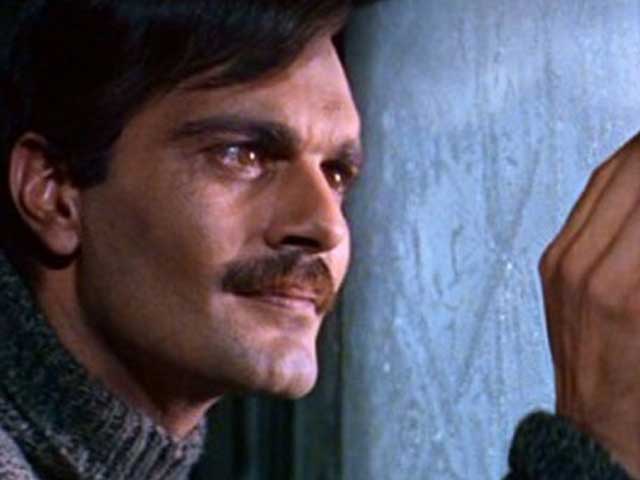
A pretty good Zhivago?

Omar Sharif, who died earlier this week, was a handsome man and an uneven actor. I was a girl when I first saw Doctor Zhivago, and it made an impression, although this is difficult to talk about in the years since because my Russian friends won’t stop laughing at me when I try. In any case, Lisa Lieberman over at 3quarksdaily put her finger on it:

“Omar Sharif plays a Russian and Doctor Zhivago was shot mostly in Spain by a British director, produced by an Italian. ‘Lara’s Theme,’ the schmaltzy leitmotif that evokes the Julie Christie character, can still be heard in elevators today. But the film has endured, in no small part due to the humanity of Omar Sharif’s performance.

“Let’s start with an early scene: it is 1912 and a group of workers are demonstrating in the streets of Moscow, led by the idealistic Pasha Antipov, a young social democrat. An equally young and idealistic Yuri Zhivago watches the scene from a balcony, and witnesses the violence as the workers are mowed down by Cossacks on horseback. Pasha is radicalized by the event and becomes a revolutionary, lashing out against the regime responsible for such brutality, but growing more ruthless as the story progresses. Yuri turns away, turns inward. Each new upheaval in Russia, each act of violence, reaffirms his determination to live, to love, and to create. Sharif registers pain in those soulful brown eyes. Unlike Pasha or the commander of the partisan unit that conscripts him later in the picture, his character never loses his humanity, never sacrifices his concern for individuals, their lives, their hopes, their needs in the name of ‘justice’ or some other abstract good.”

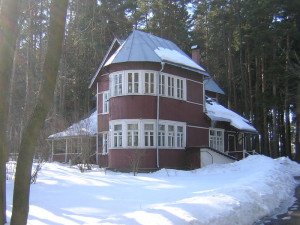
One could say the same for some of the other central characters of the Boris Pasternak‘s classic, but I wouldn’t have a chance to read the book until I went to university, and I didn’t visit Pasternak’s dacha outside Moscow in Peredelkino (the idyllic Varykino in the book is modeled on it) until many years after that. Sharif’s death did sent me back to the movie, but also back to Pasternak as well, and I was pleasantly surprised to see that, although he died in Peredelkino in 1960, the granddaughter of his friend, Olga Carlisle, managed to meet him a few months before his death, and managed to get a Paris Review piece, “The Art of Fiction No. 25” out about the experience. She describes her first visit to his home, with its “combined austerity and hospitality”:

peredelkino

The model for Varykino.

Pasternak’s house was on a gently curving country road which leads down the hill to a brook. On that sunny afternoon the hill was crowded with children on skis and sleds, bundled like teddy bears. Across the road from the house was a large fenced field—a communal field cultivated in summer; now it was a vast white expanse dominated by a little cemetery on a hill, like a bit of background out of a Chagall painting. The tombs were surrounded by wooden fences painted a bright blue, the crosses were planted at odd angles, and there were bright pink and red paper flowers half buried in the snow. It was a cheerful cemetery. [Pasternak would be buried in that cemetery within a few months. – ED.]

I paid the driver and with great trepidation pushed open the gate separating the garden from the road and walked up to the dark house. At the small veranda to one side there was a door with a withered, half-torn note in English pinned on it saying, “I am working now. I cannot receive anybody, please go away.” After a moment’s hesitation I chose to disregard it, mostly because it was so old-looking and also because of the little packages in my hands. I knocked, and almost immediately the door was opened—by Pasternak himself.

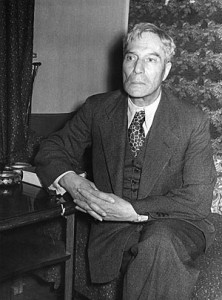
He was wearing an astrakhan hat. He was strikingly handsome; with his high cheek-bones and dark eyes and fur hat he looked like someone out of a Russian tale.

pasternak

Out of time.

The whole thing is worth a read, of course – it’s online here . The two had several Sunday afternoon meetings before she returned to Paris, and in that time he gave his opinions about a number of poets and authors, the play he was writing, poetry, music, and how old-fashioned Nietzsche seemed. And here’s what he said (well, some of it) about Doctor Zhivago: 

 “When I wrote Doctor Zhivago I had the feeling of an immense debt toward my contemporaries. It was an attempt to repay it. This feeling of debt was overpowering as I slowly progressed with the novel. After so many years of just writing lyric poetry or translating, it seemed to me that it was my duty to make a statement about our epoch—about those years, remote and yet looming so closely over us. Time was pressing. I wanted to record the past and to honor in Doctor Zhivago the beautiful and sensitive aspects of the Russia of those years. There will be no return of those days, or of those of our fathers and forefathers, but in the great blossoming of the future I foresee their values will revive. I have tried to describe them. I don’t know whether Doctor Zhivago is fully successful as a novel, but then with all its faults I feel it has more value than those early poems. It is richer, more humane than the works of my youth.”

International fame did not agree with him, at least not entirely: “… everyday life has grown very complicated for me. It must be so anywhere for a well-known writer, but I am unprepared for such a role. I don’t like a life deprived of secrecy and quiet. It seems to me that in my youth there was work, an integral part of life which illuminated everything else in it. Now it is something I have to fight for. All those demands by scholars, editors, readers cannot be ignored, but together with the translations they devour my time. . . . You must tell people abroad who are interested in me that this is my only serious problem—this terrible lack of time.”