Archive for August, 2017

Brodsky Among Us in English, and “the only form of moral insurance that a society has.”

Wednesday, August 30th, 2017
Share

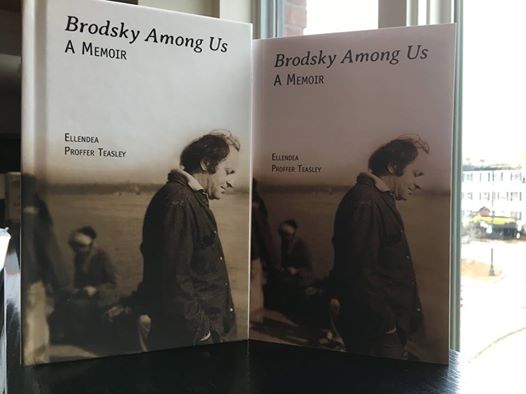
Marat Grinberg writes about Ellendea Proffer Teasley’Brodsky Among Us over at Commentary. The article was published in June, but it was easy to overlook during this eventful summer. Also easy to overlook: Brodsky Among Us, which I wrote about for The Nationis now in English, published by Academic Studies Press (on Amazon here).

“The publisher Ellendea Proffer Teasley’s memoir of the poet, which became a sensation when it was first published in Russian three years ago, provides a penetrating and at times deeply moving account of both the myth and the man behind the work,” writes Grinberg. “She renders the Brodsky she knew not just as a great poet and deeply imperfect human being, but also as a political thinker who was uncompromising and unforgiving in his beliefs.”

“Proffer writes of Brodsky’s ‘determination to live as if he were free in the eleven-time-zone prison that is the Soviet Union.’ She emphasizes that his opposition to the Soviet power was presented in starkly moral terms: ‘A man who does not think for himself,’ she writes, ‘a man who goes along with the group, is part of the evil structure himself.’”

The Commentary article, in a magazine founded by the American Jewish Committee in 1945, takes on the Nobel poet’s Jewishness, a subject he himself didn’t dwell on, to put it mildly. An excerpt:

Proffer and the poet in Petersburg.

Proffer implicitly links Brodsky’s Jewishness to this resistance to the “evil structure.” It is a primary subject of their first encounter, which she describes thus: “Joseph is voluble and vulnerable. He brings up his Jewish accent almost immediately; when he was a child, his mother took him to speech therapy to get rid of it, he says, but he refused to go back after one lesson.” The “Jewish accent” had to do with Brodsky’s inability to roll his “r”s, which, while by no means unique to Jews, was a mark of the Jew in the largely anti-Semitic Soviet environment. Brodsky bought into the prejudice and at the same time wore it with pride, making it his own.

Jewishness is an ongoing theme in Brodsky’s early poetry of the 1960s, in which he speaks of a Jewish cemetery on the outskirts of Leningrad and imagines his future “Jewish gravestone.” His “Isaac and Abraham” is a beautiful, tortured and complex midrash on the binding of Isaac. Brodsky transplants the biblical patriarchs onto the Soviet landscape, making the relationship between Abraham and Isaac symbolic of the rift between Russian-Jewish fathers and sons, who are burdened by the loss of Judaism as well as historical traumas both near and distant. The poem reveals Brodsky’s familiarity with Hebrew scripture as well as the kabbalah. In his later poetry, the explicit Jewishness all but disappears in accordance with his goal to become the greatest Russian poet of his era and instead becomes a powerful undercurrent.

The article makes a less persuasive case for Brodsky-as-conservative. He couldn’t be packaged that readily into any “isms.” Grinberg concludes: “A paradoxical thinker, Joseph Brodsky could combine an understanding that ‘man is a little bit corrupt, almost by definition’ with a wholehearted belief in American exceptionalism. Literature, and especially poetry, was for him both ‘the greatest… teacher of human subtlety’ and ‘the only form of moral insurance that a society has.’”
 .
Read the whole thing here.
.

First time in English: a powerful Russian voice from the Ukrainian conflict

Monday, August 28th, 2017
Share

A field in the Donbas. (Flickr)

Award-winning Ukrainian writer Vladimir Rafeenko, who writes in Russian, spent his whole life in the city of Donetsk, in the eastern Ukrainian mining region called the Donbas. Since the war between Russian-supported separatists and the Ukrainian state broke out in spring 2014, Rafeenko moved near Kiev.

When the characters in his novels refer to “Westerners,” it’s western Ukraine, facing Poland, Romania, and Hungary rather than Russia.

Ukrainian writer – in Russian.

It’s one of many terms that need unpacking in Семь Укропов (Sem’ Ukropov), in English “Seven Dillweeds,” taken from Rafeenko’s longer work, this year’s Долгота дней (Dolgota dnei, The Length of the Day). “Dillweed,” in the title, is Russian slang for a Ukrainian. Marci Shore, author of The Taste of Ashes: The Afterlife of Totalitarianism in Eastern Europe and Caviar and Ashes: A Warsaw Generation’s Life and Death in Marxism, 1918-1968, translated the piece in the current Eurozine, and explains some of the references for us in the introduction to this chilling short story about the conflict in Rafeenko’s native land, Donbas.

This story is the first time Rafeenko has appeared in English. An excerpt from the excerpt, about Pashka and his stepfather:

Matvei Ivanovich, having appeared out of the blackness of the coalminers’ night, took the boy under his protection, and succeeded in winning his heart.

Matvei Ivanovich had come there at a mature age; he’d come because of his ‘work transfer.’ And as he himself admitted, it wasn’t that he didn’t like Ukraine, it was more that he didn’t understand it. As he would say to the boy he was raising: ‘I don’t understand the Ukrainian language, son, and also all these complicated things with Stepan Bandera. I don’t like westerners, you understand? They’re barbaric somehow. Just barbaric people. And they only hang around with each other. Back at home there were a few of them working at our mine. And they only talked to their own and only in their own way. They even got beaten for that more than once. I don’t think there was any sense in that, though – just made them more spiteful. And so I figure: once you’ve got people like that, what can you do with them?’ …

Matvei Ivanovich tilted his head in a funny way, waved his hands, poured himself another shot of vodka, grabbed a half-salted pickle.

 спасибо, Marci.

спасибо, Marci.

When the shooting started in town, Matvei Ivanovich proceeded to study the situation. By then he’d already left his job, since he had a solid pension and at any rate the miners weren’t being paid any more. So he had time on his hands to learn about the state of the world. He walked around, talked to people. He would come back in the evening, tired, restless, but generally satisfied.

In the beginning of June, after he’d gotten his pension and the economy had sunk, Matvei Ivanovich was found in a city park, dead. He was lying in water with a sad smile and a deep gash on the right side of his neck. At the burial, Nina Ivanovna sobbed terribly. When they lowered the casket, she jumped into the pit. She tried to stab herself in the heart with a knife. But after a week she found work in the town centre as a janitor in a student dormitory, and in the new job she revived a little.

Pashka saw his stepfather every day in his dreams. There Matvei Ivanovich smiled and told stories, stories without endings and without beginnings, stories about coal, about Aleksandr Nevskii, about Belka and Strelka and the Battle of the Kalka. Truth be told, Pashka just caught the general tone, the details he could only make out hazily, as if through dirty glass. Eventually he signed up for the war against Right Sector, and thus for Gagarin and Gogol, and above all for Matvei Ivanovich, agronomist by his first diploma. They gave the boy a Kalashnikov and two magazine cartridges and sent him to fight with three dozen others like himself. It turned out, unfortunately, that in combat they were not alone – the enemy was there, too. And it quickly became clear that in a war, people kill each other. But truth be told, Pashka didn’t have time to make sense out of any of it.

Read the whole thing here.

“Myth does not reject any material”: Hilary Mantel on death and Diana, grief and mourning

Saturday, August 26th, 2017
Share

Not the kind of fairy tale you were thinking of.

Not normally my thing, but I saw a link for of the late Princess of Wales on the 20th anniversary of her death – and from The Guardian, no less – and so I clicked. It’s a long piece, but as I read, the writing was so good I began to weep with envy (figuratively speaking). I kept wondering: “Who is the remarkable author of this piece?”

Well, it’s Hilary Mantel. I’m embarrassed to say I’m the only person in the Western World who has not read Wolf Hall, but if this gives any indication – someone please send me a battered paperback, priority mail:

By her own account, Diana was not clever. Nor was she especially good, in the sense of having a dependable inclination to virtue; she was quixotically loving, not steadily charitable: mutable, not dependable: given to infatuation, prey to impulse. This is not a criticism. Myth does not reject any material. It only asks for a heart of wax. Then it works subtly to shape its subject, mould her to be fit for fate. When people described Diana as a “fairytale princess”, were they thinking of the cleaned-up versions? Fairytales are not about gauzy frocks and ego gratification. They are about child murder, cannibalism, starvation, deformity, desperate human creatures cast into the form of beasts, or chained by spells, or immured alive in thorns. The caged child is milk-fed, finger felt for plumpness by the witch, and if there is a happy-ever-after, it is usually written on someone’s skin.

Mantel shares my own thoughts about grief and mourning, which, in our own superficial culture, is certainly worth a rethink:

A deathbed, once, was a location dense with meaning, a room packed with the invisible presences of angels, devils, ancestors. But now, as many of us don’t believe in an afterlife, we envisage no final justice, no ultimate meaning, and have no support for our sense of loss when “positivity” falters. Perhaps we are baffled by the process of extinction. In recent years, death narratives have attained a popularity they have not held for centuries. Those with a terminal illness scope it out in blogs. This summer the last days of baby Charlie Gard riveted worldwide attention. But what is the point of all this introspection? Even before the funeral, survivors are supposed to flip back to normal. “Keeping busy” is the secret, Prince William has advised.

Brava, madam

Grief is exhausting, as we all know. The bereaved are muddled and tense, they need allowances made. But who knows you are mourning, if there is nothing but a long face to set you apart? No one wants to go back to the elaborate conventions of the Victorians, but they had the merit of tagging the bereaved, marking them out for tenderness. And if your secret was that you felt no sorrow, your clothes did the right thing on your behalf. Now funeral notices specify “colourful clothing”. The grief-stricken are described as “depressed”, as if sorrow were a pathology. We pour every effort into cheering ourselves up and releasing balloons. When someone dies, “he wouldn’t have wanted to see long faces”, we assure ourselves – but we cross our fingers as we say it. What if he did? What if the dead person hoped for us to rend our garments and wail?

When Diana died, a crack appeared in a vial of grief, and released a salt ocean. A nation took to the boats. Vast crowds gathered to pool their dismay and sense of shock. As Diana was a collective creation, she was also a collective possession. The mass-mourning offended the taste police. It was gaudy, it was kitsch – the rotting flowers in their shrouds, the padded hearts of crimson plastic, the teddy bears and dolls and broken-backed verses. But all these testified to the struggle for self-expression of individuals who were spiritually and imaginatively deprived, who released their own suppressed sorrow in grieving for a woman they did not know. The term “mass hysteria” was a facile denigration of a phenomenon that eluded the commentators and their framework of analysis. They did not see the active work the crowds were doing. Mourning is work. It is not simply being sad. It is naming your pain. It is witnessing the sorrow of others, drawing out the shape of loss. It is natural and necessary and there is no healing without it.

Read the whole thing here.

Postscript on August 28, from the poet Melissa GreenCynthia, I find most historical fiction what I call ‘Nike’ dressed up in Nikes – it isn’t real, it’s a costume drama with people speaking some sort of BBC British. But reading WOLF HALL (Yes, I too, came late to the party) I was quite astonished. I could see Cromwell standing in the garden with his cronies, and something about her language made me see utterly the sun on one cheek that shone differently on the cheek on another. The air sounded different, the footfalls, the wheeled carts, the snapping flags over Windsor, without even mentioning them. I believed I was there the way you do in the best movies–you blink when it’s all over and are stunned to find yourself in the 21st century. I was captivated as a reader, but as a writer, I kept flipping back and forth to find out how she did it, how the light looked utterly odd, the weight of their bodies on the paving stones sounded unusual. I couldn’t find out how she did it. And she did it better in the first book than in the second. I think she’s onto something here with Diana, and has written in a complex way about her. xo
Postscript on August 27:  On Facebook, Daniel Porter contributed  G.K. Chesterton‘s remarks on fairy tales to the post:  “Fairy tales, then, are not responsible for producing in children fear, or any of the shapes of fear; fairy tales do not give the child the idea of the evil or the ugly; that is in the child already, because it is in the world already. Fairy tales do not give the child his first idea of bogey. What fairy tales give the child is his first clear idea of the possible defeat of bogey. The baby has known the dragon intimately ever since he had an imagination. What the fairy tale provides for him is a St. George to kill the dragon. Exactly what the fairy tale does is this: it accustoms him for a series of clear pictures to the idea that these limitless terrors had a limit, that these shapeless enemies have enemies in the knights of God, that there is something in the universe more mystical than darkness, and stronger than strong fear.” – Tremendous Trifles (1909), XVII: “The Red Angel”

The unforgettable James Baldwin and “the terror within”

Thursday, August 24th, 2017
Share

With Shakespeare in ’69 (Photo: Allan Warren)

There’s a direct line between our moral and social crises and the collapse of the humanities. I wrote about that a little here and here, among many other places. Here’s one reason: literature is our chance to explore the world of  the “other,” to enter into some head other than our own. You can’t read The Brothers Karamazov without being able to understand multiple ways of living and thinking in the world, and some quite alien to one’s own p.o.v. That’s precisely what’s lacking in today’s public life, and that’s the understanding that should have been grounded in our educational system.

James Baldwin put it in his own insightful way: “You think your pain and your heartbreak are unprecedented in the history of the world, but then you read. It was Dostoevsky and Dickens who taught me that the things that tormented me most were the very things that connected me with all the people who were alive, or who ever had been alive. Only if we face these open wounds in ourselves can we understand them in other people.”

I discovered James Baldwin late – in fact, I discovered him when Stanford’s Another Look book club took on The Fire Next TimeChalk it up to all those advertising pages about the Library of America series. As I recall, Baldwin, in shirt-and-tie, sat behind a huge desk that looked like it was situated somewhere in the White House. I figured he was probably worthy, stuffy, respectable, and dull.

Boy was I wrong. He eats fire. But he probes his own inner landscape as eloquently and profoundly as he does his nation and his world. Maria Popova has a post this month on Baldwin, with two great excerpts from The Price of the Ticket: Collected Nonfiction, 1948-1985:

It has always been much easier (because it has always seemed much safer) to give a name to the evil without than to locate the terror within. And yet, the terror within is far truer and far more powerful than any of our labels: the labels change, the terror is constant. And this terror has something to do with that irreducible gap between the self one invents — the self one takes oneself as being, which is, however, and by definition, a provisional self — and the undiscoverable self which always has the power to blow the provisional self to bits.

***

It is perfectly possible — indeed, it is far from uncommon — to go to bed one night, or wake up one morning, or simply walk through a door one has known all one’s life, and discover, between inhaling and exhaling, that the self one has sewn together with such effort is all dirty rags, is unusable, is gone: and out of what raw material will one build a self again? The lives of men — and, therefore, of nations — to an extent literally unimaginable, depend on how vividly this question lives in the mind. It is a question which can paralyze the mind, of course; but if the question does not live in the mind, then one is simply condemned to eternal youth, which is a synonym for corruption.

Don’t forget the new film about Baldwin, I Am Not Your Negro. Trailer below:

The sea “like a wide blue road into the sky”: Willa Cather’s French journey

Tuesday, August 22nd, 2017
Share

Marcia de Sanctis over at Lit Hub, recounts being on the trail of a major American author in  “Retracing Willa Cather’s Steps in the South of France.” I’ve written about Marcia’s book, 100 Places in France Every Woman Should Go, here and here (and I wrote about her years ago interview with Joseph Brodsky here.) The new article, and the journey that inspired it, was born from that book:

Francophile (Photo: Ron Haviv)

A few years ago, while researching my book on France, I immersed myself in the country’s rich travel writing canon, and decided to retrace the voyages (or parts of them) of many of my literary idols. In Nîmes, I imagined Colette dancing in the Jardins de la Fontaine; I conjured the ghost of a bored Henry James by the Rhône River in Arles; and in Chamonix, I pictured 16 year-old Mary Godwin unwittingly gathering inspiration for Frankenstein while hoofing it across the Alps with her future husband, Percy Bysshe Shelley.  With her 1908 road trip classic A Motor Flight Through France always stuffed into my bag, Edith Wharton was my frequent guru and guide. But no one lit my path brighter than Willa Cather, who I have read and admired for as long as I can remember.

The collection of essays, Willa Cather in Europe: Her Own Story of the First Journey, is a series of dispatches she filed for the Nebraska State Journal in Lincoln to help pay for her voyage. It was 1902, and Cather was accompanied by her friend Isabelle McClung. The book contains, to my mind, some of the most evocative travel writing in the English language. The stories bear all the elements—personal reflection, descriptive detail, observational insight, and cultural depth—we strive for when writing about place, and in perfect proportion.

For awhile, Cather and a friend stayed in Saint-Clair, in a villa that was owned by a painter. She wrote that it was “good for one’s soul,” to “do nothing but stare at this great water that seems to trail its delft-blue mantle across the world.” But the place she loved best was Lavandou, writing: “No books have ever been written about Lavandou, no music or pictures ever came from here, but I know well enough that I shall yearn for it long after I have forgotten London and Paris,” she writes. “One cannot divine nor forecast the conditions that will make happiness; one only stumbles upon them by chance, in a lucky hour, at the world’s end somewhere, and holds fast to the days, as if to fortune and fame.”

And no wonder. Marcia writes, “The air was scented with dried lavender; the landscape was of pine, green fir and sea ‘reaching like a wide blue road into the sky.’”

Read the whole thing here. Meanwhile, photos by Marcia de Sanctis herself.)

John Milton, William Shakespeare on the Great American Eclipse: “disastrous twilight sheds on half the nations…”

Sunday, August 20th, 2017
Share

For those of you who don’t have funky little glasses, here’s what it will look like.

The Great American Eclipse is coming tomorrow, and the Book Haven finally succumbed to the craze.  We’ll be picking up our funky little glasses later today. But what did our greatest bards have to say on this occasion? Hint: nothing good. Both saw eclipses as dire omens, and Shakespeare, at least, spoke from direct experience. Our friends at the Folger Library in Washington told us so.

So here goes:

William Shakespeare

England experienced a total solar eclipse in 1598, and Shakespeare would have seen it, since the path of totality tracking arced from Cornwall in the southwest up to Aberdeen in Scotland. And he had a lot to say about it, according to the Folger Library:

1. An eclipse as an ill omen

“These late eclipses in the sun and moon
portend no good to us. Though the wisdom of
nature can reason it thus and thus, yet nature finds
itself scourged by the sequent effects.”
—Gloucester in King Lear (1.2.109)

2. The physical darkness of an eclipse as a metaphor for psychological darkness

“My wife, my wife! What wife? I have no wife.
O insupportable! O heavy hour!
Methinks it should be now a huge eclipse
Of sun and moon, and that th’ affrighted globe
Should yawn at alteration.”
—Othello in Othello (5.2.121)

3. An eclipse as that which mars beauty

“No more be grieved at that which thou hast done.
Roses have thorns, and silver fountains mud;
Clouds and eclipses stain both moon and sun,
And loathsome canker lives in sweetest bud.”
—Sonnet 35

John Milton:

John Milton may have missed his own personal total eclipse in his lifetime, but he had quite an imagination, and wrote about them. He may have been writing with a thought to Charlemagne’s son, Emperor Louis, who was so perplexed by the five minutes of total darkness (probably the eclipse of May 5, 840 A.D.), that he died shortly afterwards, some say of fright.

So what did Milton think? Context is all.

1.

The fall of Lucifer is compared to an eclipse in the opening of 1667’s Paradise Lost. For the eighteenth-century writer Edmund Burke, Milton’s description of the fallen angel who still retains traces of his heavenly glory was the most sublime descriptive passage in all of poetry.:

                                            He above the rest
In shape and gesture proudly eminent
Stood like a tower. His form had yet not lost
All her original brightness, nor appeared
Less than archangel ruined, and th’ excess
Of glory obscured: as when the sun new-risen
Looks through the horizontal misty air
Shorn of his beams, or from behind the moon
In dim eclipse disastrous twilight sheds
On half the nations, and with fear of change
Perplexes monarchs. Darkened so, yet shone
Above them all th’ archangel; but his face
Deep scars of thunder had intrenched, and care
Sat on his faded cheek, but under brows
Of dauntless courage, and considerate pride
Waiting revenge. Cruel his eye, but cast
Signs of remorse and passion to behold
The fellows of his crime , the followers rather
(Far other once beheld in bliss), condemned
Forever now to have their lot in pain.

2.

In “Samson Agonistes,” the poet likened his own experience of blindness to eclipse:

Within doors, or without, still as a fool,
In power of others, never in my own;
Scarce half I seem to live, dead more then half.
O dark, dark, dark, amid the blaze of noon, [ 80 ]
Irrecoverably dark, total Eclipse
Without all hope of day!

3.

In “Lycidas,” the death of the eponymous hero is due to the building of his ship during an eclipse:

The air was calm, and on the level brine
Sleek Panope with all her sisters play’d.
It was that fatal and perfidious bark,
Built in th’eclipse, and rigg’d with curses dark,
That sunk so low that sacred head of thine.

Take note! All you writers lay down your pens tomorrow! Who knows what evil will be wrought by what you write!