Archive for August, 2020

Summer, the Hum of Poetry, and the Wild Accidents That Gave Us Life…

Saturday, August 29th, 2020
Share

Life is an excess – call it the self-ecstasy of matter.” Caspar David Friedrich’s “The Summer”

Labor Day traditionally marks the end of summer, and we have little over one week to go. Let us celebrate the time we have, marred, as it has been, by coronavirus and California wildfires. Over at Entitled Opinions, with a podcast up at The Los Angeles Review of BooksRobert Pogue Harrison puts a deliriously joyful spin on the season. “Life is an excess – call it the self-ecstasy of matter,” he says.

He recorded this monologue at the solstice. Now his reflections summarize the season that is coming to a close.

Čapek: Seriously into summer.

The reason for the solstice, he reminded us, is that the earth does not spin upright, but tilts at more than 23 degrees, and that obliquity is responsible for life on our planet. An upright planet like Mercury would lack seasons, and be so cold at the poles that it couldn’t foster greenhouse gases, hence, liquid water would never form. Uranus, with a tilt of more than 82 degrees, would be blazing hot for six months and intolerably cold for the others.

But there’s more to life than that. Harrison said that the Czech author Karel Čapek, who cultivated his garden plot in Prague, understood intuitively what science now accepts: in the beginning, the earth “aggressively resisted life’s colonizing adventures.” Harrison described “the animosity and callousness of dead and sterile matter,” resulting in “the terrible fight life must have undergone inch by inch to take root in the soil of the earth.”

It took the tremendous self-affirming struggles of life itself to transform the earth, sea, and air into elements hospitable to life. Life itself first brought about the conditions that favor life on the planet today,” he continued. “This is the great paradox and great miracle of life: it’s life itself that actually transformed the earth into a planet favorable for life.”

He closes with the literature of summer – the luncheons and garden parties in Virginia Woolfs novels, the poetry of Alfred Lord Tennyson and Christina Rossetti, and the “humming, inarticulate music that one can hear in one’s head that is in some kind of syntony with a season.”

Listen to the podcast here.

The larkspur listens, “I hear, I hear”;
And the lily whispers, “I wait.”

– Alfred, Lord Tennyson

Conversations with René Girard in the LARB: “Girard at both his most typical and his most surprising.”

Thursday, August 27th, 2020
Share

Philosopher Down Under

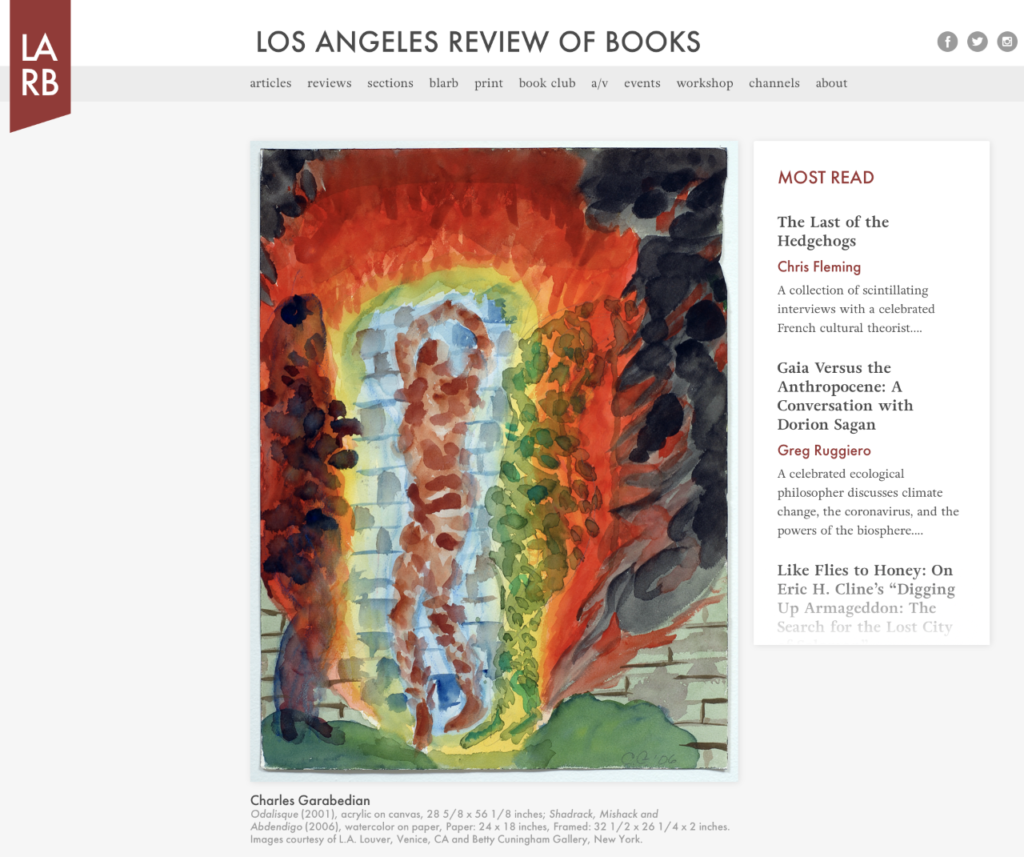
Chris Fleming has written a witty and lively review of my Conversations with René Girard: Prophet of Envy for the The Los Angeles Review of Books. (We’ve written about him here and here.) The Australian professor has written widely on issues of culture, philosophy, and literature, both in academic journals and in mainstream publications such as The Guardian, LitHub, The Chronicle Review, and The Sydney Review of Books. His debut on the West Coast is titled “The Last of the Hedgehogs” … well you see where that’s going:

IN 1953, Isaiah Berlin published his long essay “The Hedgehog and the Fox,” outlining his now-famous Oxbridge variant on there are two kinds of people in this world. He drew the title from an ambiguous fragment attributed to the ancient lyric poet Archilochus of Paros: “The fox knows many things, but the hedgehog one big thing.” Written with the aim of pointing out tensions between Tolstoy’s grand view of history and the artistic temperament that saw such a view as untenable, Berlin’s essay became an unlikely hit, although less for its argument about Russian literature than for its contention that two antithetical personae govern the world of ideas: hedgehogs, who view the world in terms of some all-embracing system, seeing all facts as fitting into a grand pattern; and foxes, those pluralists or particularists who refuse “big theory” for reasons either intellectual or temperamental.

Berlin’s typology is beautifully blunt: perhaps more a serious game than a scientific typology, it works wonderfully only when it does. With the French American literary and cultural theorist René Girard, it works very well. As Roberto Calasso suggested, Girard was almost the Platonic ideal of a hedgehog: he belongs to that lineage of 19th- and 20th-century thinkers whose vast synthetic ambition is now seen by many in the academy as not simply wrongheaded but almost impolite. Sweeping intellectual projects such as his come across today as naïve and even oppressive, animated by the most obnoxious nostalgias for the Enlightenment. Of course, the academics who offer such judgments are typically those whose own work is parasitical upon grand synthesizing theorists like Marx, Freud, and Nietzsche.

Like these older thinkers, although distinct from them in important ways, Girard was disinclined toward mere taxonomic labor, such as structuralist classification or the identification of linguistic “themes” and “figures,” but was interested rather in asking large questions about origins — the origin of religion, of language, of culture, of violence, of human psychic life. And although such explanatory ambition is hard to find in humanities academics these days, it is surprisingly common among contemporary scientists, who suffer far fewer anxieties — one might argue, insufficient anxieties — about their own capacities to address the big questions that interest them most. And so, physicists and biologists continue to write magnificently incoherent, best-selling books addressing large questions about human nature and culture on behalf of those of us who, some time ago, politely vacated the field. Whether this is because we in the humanities no longer find such all-encompassing theorizing intellectually tenable, or whether (less flatteringly) we have been conditioned by those institutional and funding frameworks that render such projects nonviable, a generation devoid of Freuds or Nietzsches or Marxes of its own might turn out to be something we will one day regret. (Unless, of course, we are now content to have Yuval Noah Harari carry the banner for us all.)

The upshot:

“Cynthia Haven’s fascinating new collection, Conversations with René Girard: Prophet of Envy, showcases Girard at both his most typical and his most surprising. Like many intellectuals, and not just hedgehogs, Girard returned repeatedly to the same themes throughout his career — what he called with self-mocking charm, in one exchange included here, his “monomania.” Of course, as one would hope, the reader will find in this book explications of the standard Girardian theses about imitative desire, scapegoating, and religion. And yet, throughout the volume, Girard also turns his attention to topics rarely if ever broached in his body of work: opera, eating disorders, Husserlian phenomenology, literary modernism. … Haven’s book is a welcome tonic for those of us for whom universalist theories are liable to provoke an outbreak of hives. As Adam Phillips once said about psychoanalysis: “like all essentialist theories,” it “makes a cult out of what could be just good company.” Regardless of how one evaluates Girard’s overarching intellectual project, there is little doubt that he was often excellent company indeed, as this collection amply attests.

Read the whole thing here. Many people did – it was picked up by 3quarksdaily, Books Inc. and Daily Nous, among others. A week after its publication it was still the best read piece at LARB. See the screenshot below for proof:

 

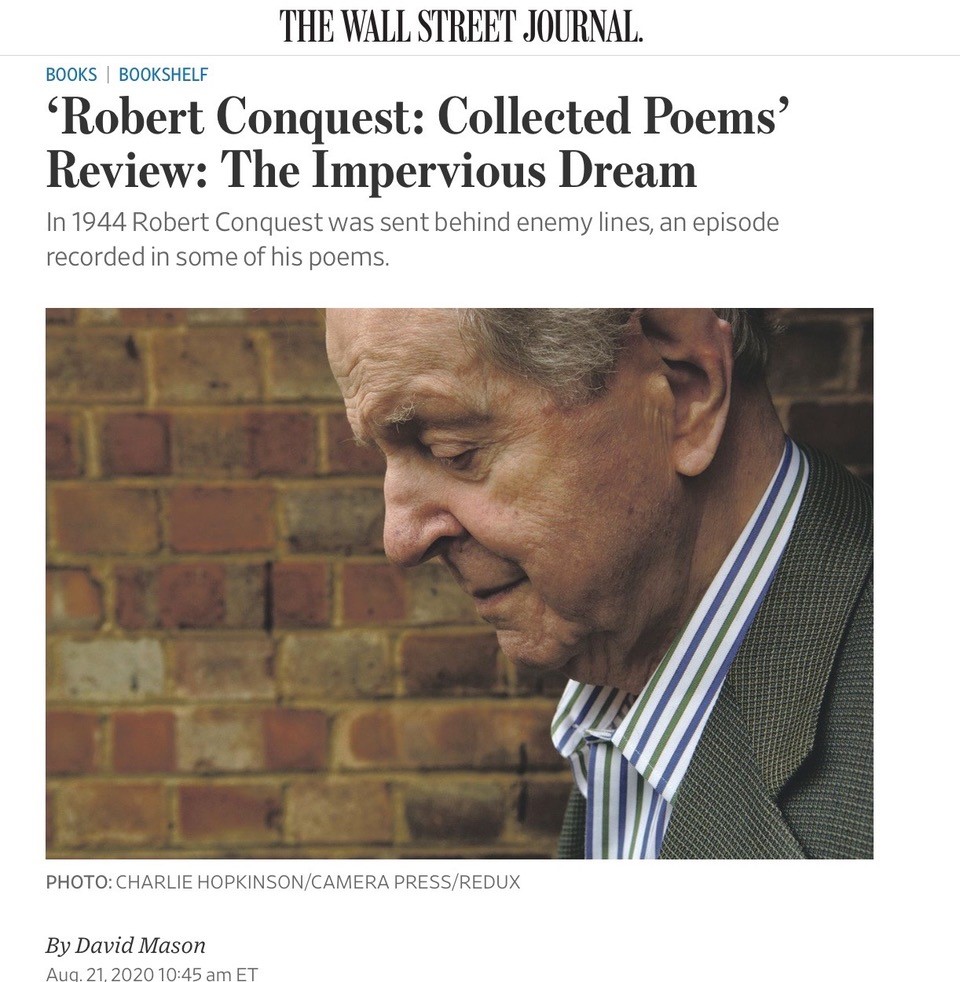
“He was so good at everything he did”: Robert Conquest and his poems of “elegant irreverence” in WSJ

Sunday, August 23rd, 2020
Share

A literary scholar – and a very good one.

Robert Conquest‘s Collected Poems is out at last, thanks to the assiduous efforts of his widow, the literary scholar Elizabeth Conquest. And also to Philip Hoy of Waywiser, who is my publisher as well. But thanks especially, in the last few days, to David Mason, who has written a review, “The Impervious Dream,” in the Wall Street Journal. We’ve written about Stanford’s Bob Conquest, who died in 2015 at 97, here and here and here. among other places. We’ve written about Liddie Conquest here and here and herePhil Hoy is here, and David Mason here and here and here.

An excerpt from the review:

He was so good at everything he did—soldier, diplomat, historian and poet—that I wouldn’t be surprised to learn he also left behind a few sonatas and paintings in oil. His histories of the Soviet Union’s failures and atrocities include The Great Terror (1968) and The Harvest of Sorrow (1986), meticulously researched and humane investigations of a criminal state, surely among the major historical achievements of the 20th century. His television documentary series, Red Empire (1990), distills this work and makes grimly compelling viewing.

But Conquest first came to readers’ attention as a poet of sophistication and grace, and as the editor of two New Lines anthologies (1956 and 1963) that introduced a group of English poets known as The Movement, among them Philip Larkin, Elizabeth Jennings, Kingsley Amis and Thom Gunn. Though his poetry was pushed aside by his work as a public intellectual, we now have the opportunity to see it whole for the varied, remarkable accomplishment it is, a poetry praising “the great impervious dream / On which the world’s foundations rest.”

Mason: a poet himself

In her editor’s note for this new “Collected Poems,” the poet’s widow, Elizabeth Conquest, gives us a glimpse of his character: “Kingsley Amis, complaining to Philip Larkin of getting old, wrote: ‘Bob just goes on and on, as if nothing has happened.’ And so he did, walking a mile at light infantry pace until his 89th year, dying at age 98 in the midst of editing his 34th book, while also writing a poem.” Readers tempted to dismiss Conquest as a dinosaur for his lyric formality, his Old World erudition and his occasionally patronizing love of women would be too hasty. This is a civil voice, a man who in his poem “Galatea” praises both “passion and reserve.” An early poem about the Velázquez painting known as “The Rokeby Venus” begins, “Life pours out images, the accidental / At once deleted when the purging mind / Detects their resonance as inessential: / Yet these may leave some fruitful trace behind.” Conquest positioned himself between the life lived and its ideal expression, yet never lost the realism that chastened ornament.

I am particularly moved by Conquest’s poems about World War II. Another early work, “For the Death of a Poet,” echoes elders such as Eliot and Auden, while touching a nerve of its own: “But how shall I answer? I am like you, / I have only a voice and the universal zeals / And severities continue to state loudly / That all is well. / Even the landscape has no help to offer./A man dies and the river flows softly on. / There is no sign of recognition from the calm/And marvellous sky.”

Read the whole thing here (warning: paywall).

Rachel Hadas: “Poets and novelists have been writing about life under COVID-19 for more than a century.”

Thursday, August 20th, 2020
Share

Rachel Hadas (Photo: Cynthia Haven)

There should be a word for it: a word for a passage or page of literature that anticipates, that seems to be written to address, a time that hasn’t happened yet. According to  of the New Yorker, “But good art is always prescient, because good artists are tuned into the currency and the momentum of their time.”

Poet Rachel Hadas gives a few examples over in The Conversation:

“Dipping a bit further back, into Henry James’ “The Spoils of Poynton” from 1897, I was struck by a sentence I hadn’t remembered, or had failed to notice, when I first read that novella decades ago: “She couldn’t leave her own house without peril of exposure.” James uses infection as a metaphor; but what happens to a metaphor when we’re living in a world where we literally can’t leave our houses without peril of exposure?

She continues:

In Anthony Powell’s novel “Temporary Kings,” set in the 1950s, the narrator muses about what it is that attracts people to reunions with old comrades-in-arms from the war. But the idea behind the question “How was your war?” extends beyond shared military experience: “When something momentous like a war has taken place, all existence turned upside down, personal life discarded, every relationship reorganized, there is a temptation, after all is over, to return to what remains … pick about among the bent and rusting composite parts, assess merits and defects.”

The pandemic is still taking place. It’s too early to “return to what remains.” But we can’t help wanting to think about exactly that. Literature helps us to look – as Hamlet said – before and after.

Read the whole thing here. It can be hard on deadline finding a photo that isn’t copyrighted. It was easy finding one this time over at Ablemuse. This photo was taken twenty years ago, when I met and interviewed the poet in NYC.

Lessons from the Iraq War: Scott Beauchamp on Antigone, Simone Weil, and “the unfathomable wickedness of murder.”

Saturday, August 15th, 2020
Share

Painting by Sebastien Norblin (1825), Ecole Nationale Supérieure des Beaux-Arts.

It’s a busy weekend for me, busier than is reasonable, but I wanted to take a moment to point out “The Problem of Force: Simone Weil’s Supernatural Justice,” a moving and provocative essay by Scott Beauchamp in The Point. It weaves together his experiences as a soldier in Baghdad, with Sophocles‘s Antigone, with the words of Simone Weil, who writes, “In all the crucial problems of human existence the only choice is between supernatural good on one hand and evil on the other.” 

It begins:

Every human death feels unnatural. Even the peaceful passing of elderly relatives who’ve lived rich lives and completed the full circuit of experiences we all feel entitled to—work, marriage, children, vacations, holidays—are attended by a grief so massive that it slips our processes of rational cognition. It hits us obliquely, and never chronologically. I’m walking through the produce aisle of the grocery store and unexpectedly, while lifting a bag of apples into my cart, I feel the shocking lightness of my grandfather’s body as I bathed him while he was dying of cancer. Anguish so vast that it reaches you in fragmented details outside of time. A sack of apples becomes a spirit medium. How can the loss of a person be natural?

Soldier turned writer Beauchamp

Every human death feels unnatural, but murder even more so. The first murdered corpse I saw was in Baghdad during my initial deployment as an infantryman in 2007. In the middle of an otherwise uneventful patrol through the heavy stench of narrow streets, a group of smiling children gestured for us to follow them. They laughed and danced their way to a road which opened up into a spacious dead-end street a little wealthier than the rest of the neighborhood. Patriarchs smoked nervously in doorways, aloof but expecting us. The children, still laughing and asking for chocolate, had clustered around a body slumped over on its knees at the edge of the curb. The man had been bound, gagged, tortured, and killed. His skin bloated and shifted colors in the sun. Flies filled the air, buzzing with the same strange energy as the children. In my memory, I can’t recall the man’s face, only his wounds.

It had been a political murder. This was at a time of sectarian violence, when Baghdad neighborhoods were being consolidated by a long-oppressed Shia majority and Sunnis, some former bigwigs under Saddam Hussein, were being run out of the city in often violent fashion. To the Shia, it was retribution for decades of a criminal dictatorship. What did it matter to them that Saddam was gone if the Sunnis still had the best houses, the best jobs, and all the money? The body we found had been mutilated and conspicuously placed as a warning: leave now or this will happen to you. The corpse that had nauseated me and shocked me into a life-altering sense of disgust had been created by someone’s idea of justice. That’s the double scandal of a person murdered in the name of justice, whether it happens in a Baghdad street or in the middle of the road in Minneapolis: the unfathomable wickedness of murder is justified in the grim vocabulary of order and stability. It’s enough to make you question the legitimacy of any manmade definition of justice.

How does Weil and Antigone come into it? Here:

Supernatural love, always.

For Weil, when agents of the state resort to violence, they are always morally wrong. On the other hand, the supernatural conception of justice also demands that we extend compassion to those who have recently been perpetrators of violence. After all, Polynices hadn’t been merely a passive victim. He’d fought and killed and if he’d been successful in battle very well might have pillaged Thebes and sold its citizens into slavery. Nevertheless, Antigone honors him with a burial. Why? Creon, confused himself, asked the same question. “I was born to join in love, not hate—that is my nature,” she responds.

What sort of eyes does it take to see your enemy as more than your enemy? What sort of heart does it take to love them? In a 1947 essay called “Void and Compensation,” Weil wrote, “I also am other than what I imagine myself to be. To know this is forgiveness.” The line reflects her conviction that transcendent love begins in forgiveness, including the forgiveness of one’s own previous failures to transcend one’s tribal “role.”

Read the whole thing here.

Henry James’s “The Aspern Papers”: a story for the era of doxxing, “outing,” and our right to be left alone – Zoom discussion on Monday, August 24.

Monday, August 10th, 2020
Share

James: “the canals assume to the eye the importance of a stage…”

It’s two weeks to our special Zoom discussion of Henry James‘s short 1888 classic, The Aspern Papers. The Another Look book club will be hosting the event, in partnership with Stanford’s Distinguished Careers Institute, on Monday, August 24, 3-4:30 p.m. (Register for the event here.) If you haven’t read the short novel, you should – you really should. Those of you who associate Henry James with sentences that go on relentlessly for pages will be pleasantly surprised by this tight, yet psychologically insightful work.

The Aspern Papers was inspired Percy Bysshe Shelley‘s correspondence with Claire Clairmont, the stepsister of his wife Mary Wollstonecraft Shelley, the author of Frankenstein. (Shelley’s novel was featured in a January 2017 Another Look event.) Clairmont cherished the letters until her death. Of course, James transposes that into fiction – but it’s a lively and insightful read, and those daunted by James’s three-page-long sentences needn’t be afraid. The plot keeps a good pace in this psychologically insightful work, while treating us to the wonder that is Venice.

Himself

The story: an elderly invalid who once was the beloved of a renowned American poet, Jeffrey Aspern, lives in seclusion with her spinster niece in a Venetian palazzo. The unnamed narrator goes through elaborate machinations to gain access to her private papers and literary relics from the long-ago romance.

The story has new relevance for us today. “What James delivered, in 1888, was not some dusty antiquarian fable but a warning call against the cult of celebrity that was already on the rise, and against the modern insistence that artists and writers can – or should – be prized out of their work like cockles from a shell, for public consumption,” critic Anthony Lane wrote in The New Yorker. In the era of doxxing and “outing,” the story explores our right to be left alone, and our right to have secrets. At the heart of the book is the rapacious desire of one man to reach through time to possess another.

Tobias Wolff and Robert Pogue Harrison will lead the discussion. Acclaimed author Robert Harrison, professor of French and Italian, writes regularly for The New York Review of Books and hosts the popular talk show, Entitled Opinions. Wolff, a Stanford professor emeritus of English, is the recipient of the National Medal of Arts.

Elena Danielson, director emerita of the Hoover Library & Archives, will offer a few remarks as the author of The Ethical Archivist. And yours truly will have a few words to say on the occasion, too, as the author of the biography, Evolution of Desire: A Life of René Girard.

Again, register here. We’d love to see you!